Van's Air Force

The definitive Van's Aircraft support community! Buying, building or flying an RV? Join our exclusive family of mentors and enthusiasts!

Rotax Myths

Another Rotax Myth: Not many small airplanes have a Rotax Engine.
Worldwide, more Rotax engines are installed in aircraft than all of the other manufactures COMBINED !
Is that still true when you only consider manned aircraft? I understand a portion of their production goes into drones that may have much more limited life expectancies...
 
Trying to get the thread back on track. Please forgive my ignorance as I haven't really followed these engines. If a Rotax wears out and needs an overhaul is it easy to find a shop to do it? Do A&P's do it in the field? Is Lockwood the only place that is capable? Is it more economical to just get a new engine? Has anyone here actually worn one out, had it overhauled and flown it several hundred more hours? How was the experience. How do the overhaul prices compare to the Lycoming / Continental? I'm genuinely interested in the overall cost of owning and flying one long term and in the aircraft resale value.

Thanks,

Joe
 
Trying to get the thread back on track. Please forgive my ignorance as I haven't really followed these engines. If a Rotax wears out and needs an overhaul is it easy to find a shop to do it? Do A&P's do it in the field? Is Lockwood the only place that is capable? Is it more economical to just get a new engine? Has anyone here actually worn one out, had it overhauled and flown it several hundred more hours? How was the experience. How do the overhaul prices compare to the Lycoming / Continental? I'm genuinely interested in the overall cost of owning and flying one long term and in the aircraft resale value.

Thanks,

Joe
I'll try to help out. First off describing wearing out is a little hard with Rotax engines. TBO is 2000 hours but many keep flying beyond that date. Yes they do "wear"out eventually but most timed out engines come out of commercial planes with a regulatory requirement to overhaul or replace. Rotax has a mechanic certification program and the typical airfield A&P would not be my suggestion. An overhaul really needs to be done by a certified Rotax overhaul or at least heavy maintenance tech. I maybe wrong but I beleive most timed out engines that are considered worn out are just replaced. Engine lead times are reasonable. Today listed base price for a new 912isSport is $32,100, there wil be add ons and shipping and taxes, but that gives you an idea. Check Rotax service website to find out more about service available and training. There are a number of shops capable of performing overhaul and heavy maintenance, Lockwood is not the only one nor are they the only dealer in the USA. Operating costs are generally considered lower due to fuel savings, type of fuel, and less oil used.
 
Trying to get the thread back on track. Please forgive my ignorance as I haven't really followed these engines. If a Rotax wears out and needs an overhaul is it easy to find a shop to do it? Do A&P's do it in the field? Is Lockwood the only place that is capable? Is it more economical to just get a new engine? Has anyone here actually worn one out, had it overhauled and flown it several hundred more hours? How was the experience. How do the overhaul prices compare to the Lycoming / Continental? I'm genuinely interested in the overall cost of owning and flying one long term and in the aircraft resale value.
Some of your questions are easy to answer, others are really case dependent and I'll attempt a few of them. First though, I want to point out that nobody is really making the argument that Rotax is cheaper. It might be, depending on what it would be replacing but the bigger idea is that Rotax offers a different and potentially better technical solution. Particularly in aircraft that are designed around it.

I see now that Doc stepped in with decent answers to most of your questions.

Cylinder, piston, and crank wear is usually minimal on 'timed out' Rotax motors. Engines inspected after TBO usually still have good compression and the power making portions have several hundred (thousand<s>?) hours of useful life. The other side of the coin is that an engine at that point will have had at least one gearbox service and need another. The gearbox is where the Rotax will show wear.

The gearbox is easily serviceable. This can be removed and sent in to service centers, which is not limited to Lockwood. There are 2 other distributors and the independent service center network is growing. A gearbox rebuild is not labor intensive but does require some special tools. It can be done in a couple hours. Cost will depend on corrosion and wear and it could be a little under $1,000 or a few thousand. Of course, there are always outliers.

Like Doc said, the engines and parts are widely available between the three distributors. You can order a new engine or parts and often have them in days. This can add considerable value in scenarios where a replacement or major engine work on a traditional engine can often mean several months of down time.
 
- AvWeb Safety Analysis of Rotax vs Lycoming :

Failure Rates at a Glance:

  • Statistical Averages: In historical safety studies spanning experimental and light sport aircraft, engine malfunction/failure rates for both engines hover similarly. Some long-term fleet studies have noted the Rotax 912 reporting about 1 failure or malfunction per 36 aircraft, very closely matching or slightly better than comparable legacy engines.
  • Core Reliability: Core component failures (e.g., thrown rods, broken crankshafts) are incredibly rare for both.
System Breakdown & Common Issues:

  • Rotax 912:
    • Strengths: Dual electronic ignition, liquid-cooled cylinder heads, and zero risk of shock cooling.
    • Failure Prone Areas: Issues are more frequently traced to its carburetor/induction system (e.g., dual carburetor balancing) and oil system maintenance.
    • Operational Quirks: You must "burp" the dry-sump oil system prior to the first flight of the day, and turning the propeller backward can damage the gearbox.
  • Lycoming O-320:
    • Strengths: Simpler, heavier-duty traditional architecture with fewer moving parts outside the block.
    • Failure Prone Areas: More susceptible to fuel mismanagement, magneto failures, and carburetor ice.
    • Operational Quirks: Requires careful management of cylinder head temperatures during rapid descents to avoid shock cooling.

Operational Differences:

  • Fuel & Range: The Rotax 912 is efficient (burning roughly 4 to 5 GPH) and can run on unleaded automotive fuel (mogas) as well as 100LL avgas. The Lycoming O-320 burns considerably more (typically 6 to 9 GPH depending on power setting) and historically relies almost exclusively on 100LL.
  • Maintenance: The Rotax has a higher overhaul frequency requirement and highly specific maintenance checks compared to the tractor-like simplicity of the Lycoming.
The Rotax 912 and Lycoming O-320 both have excellent, highly comparable mechanical reliability, but their failure profiles differ. While core engine component failures are rare for both, the Lycoming generally suffers from fewer induction/accessory issues, whereas the Rotax requires stricter adherence to maintenance for its specialized cooling and carburation systems.

1779998365443.pngAVweb
 
- AvWeb Safety Analysis of Rotax vs Lycoming :

Failure Rates at a Glance:

  • Statistical Averages: In historical safety studies spanning experimental and light sport aircraft, engine malfunction/failure rates for both engines hover similarly. Some long-term fleet studies have noted the Rotax 912 reporting about 1 failure or malfunction per 36 aircraft, very closely matching or slightly better than comparable legacy engines.
  • Core Reliability: Core component failures (e.g., thrown rods, broken crankshafts) are incredibly rare for both.
System Breakdown & Common Issues:

  • Rotax 912:
    • Strengths: Dual electronic ignition, liquid-cooled cylinder heads, and zero risk of shock cooling.
    • Failure Prone Areas: Issues are more frequently traced to its carburetor/induction system (e.g., dual carburetor balancing) and oil system maintenance.
    • Operational Quirks: You must "burp" the dry-sump oil system prior to the first flight of the day, and turning the propeller backward can damage the gearbox.
  • Lycoming O-320:
    • Strengths: Simpler, heavier-duty traditional architecture with fewer moving parts outside the block.
    • Failure Prone Areas: More susceptible to fuel mismanagement, magneto failures, and carburetor ice.
    • Operational Quirks: Requires careful management of cylinder head temperatures during rapid descents to avoid shock cooling.

Operational Differences:

  • Fuel & Range: The Rotax 912 is efficient (burning roughly 4 to 5 GPH) and can run on unleaded automotive fuel (mogas) as well as 100LL avgas. The Lycoming O-320 burns considerably more (typically 6 to 9 GPH depending on power setting) and historically relies almost exclusively on 100LL.
  • Maintenance: The Rotax has a higher overhaul frequency requirement and highly specific maintenance checks compared to the tractor-like simplicity of the Lycoming.
The Rotax 912 and Lycoming O-320 both have excellent, highly comparable mechanical reliability, but their failure profiles differ. While core engine component failures are rare for both, the Lycoming generally suffers from fewer induction/accessory issues, whereas the Rotax requires stricter adherence to maintenance for its specialized cooling and carburation systems.

View attachment 118944AVweb
Ok couple more myths to dispel. The information from this AVWeb post is dated and not current.

14. Failure Prone Areas: Issues are more frequently traced to its carburetor/induction system (e.g., dual carburetor balancing) and oil system maintenance. The carburetor issue has been previously discussed. Today the vast majority of new Rotax engines are fuel injected. Oil system maintenance consists of checking crankcase magnetic plug, changing oil and filter (less expensive as only 3 liters/quarts required) and done once a year or 100 hours which is a longer interval than Lycoming/Conti. Maybe cleaning the oil reservoir every 200 hours counts being failure prone.

15. Operational Quirks: You must "burp" the dry-sump oil system prior to the first flight of the day. Actually "burping" moves oil out of crankcase to oil reservoir so the oil level can be checked accurately. You burp to check oil level, no requirement to do it first flight of day other than perhaps it wise to check oil level before flying. I am aware of several operators that check oil level when engine is warm after last flight of day, top up if needed. Overfilling is frowned upon.

16. Turning the propeller backward can damage the gearbox. In reality turning the prop backwards can damage the sprag clutch on the starter and more importantly induce air into the hydraulic lifters which can result in all kinds of damage to the valve train and cylinder heads.

17. The Rotax has a higher overhaul frequency requirement and highly specific maintenance checks. Not sure where this comes from as service interval is generally 1 year or 100 hrs whichever comes first. TBO is 2000 hours on 912 and 916. 915 is shorter at 1200 hours. The 915 is almost an orphan now as the 916 has pretty much supplanted it. If specific means a vey well written line service manual with step by step instructions, I am not sure its a negative.
 
Ok couple more myths to dispel. The information from this AVWeb post is dated and not current.
It's not really even AvWeb content. It's an AI generated summary drawing from various sources. And as you pointed out, a little bit sloppy.

They try so hard though! A for effort, boomer! :ROFLMAO:
 
Ok couple more myths to dispel. The information from this AVWeb post is dated and not current.
Just out of curiosity, are you actually currently flying and maintaining a Rotax powered aircraft yourself? Dispelling aircraft engine myths seems like an odd way to approach flying, especially to guys like me who have owned and flown numerous aircraft since 1978, including building, maintaining and flying an RV-9A for 22-years now. I have been told many times by many pilots that the Lycoming O-320 and O-360 are virtually "bullet proof" engines. However, I have never assumed that to be fact, especially when my engine is tying to tell me something -- just something to ponder. And, checking the oil before flying each day is very important, especially when you only hold 3-quarts, and I would also check the belly to insure that 2-quarts aren't sticking to that before flying, as well. (y):cool:(y)
 
It's not really even AvWeb content. It's an AI generated summary drawing from various sources. And as you pointed out, a little bit sloppy.

They try so hard though! A for effort, boomer! :ROFLMAO:
So, are you saying that these AvWeb refenced AI points are untrue or just being disrespectful in your response? :cool:
 
Time to cool it down folks. The point of the thread was to answer legitimate questions and point people towards solid information. It has devolved into name calling and personal attacks so if there is a mod lurking shut it off. -JJR
Some of us lurkers appreciate the informative posts, thanks. Probably too off topic, sorry, but I'm not sure why people are so sensitive this week. This is cropping up in other threads as well.
 
Always a good idea to occasionally re-read the rules on civility here, chaps. https://www.vansairforce.net/threads/posting-rules.224578/ (it's literally in the first paragraph).
Deleted a few replies that were over the line, and I'm about to lock down a couple of accounts for a month if it continues....maybe four months. Hair trigger…

Tired of a few folks thinking VAF is like the rest of the internet (cousin, it is not). Feeling like making an example out of a handful of posters to recalibrate the tone. Push me on the matter if you feel so inclined. Polite and civil, or you’ll be somewhere else.

I’m your huckleberry,
dr (damn right)

Screenshot 2026-05-29 at 8.44.10 AM.png
 
Last edited:
Thank you, gentlemen,

A few more questions:

What little I had read and admittedly is likely outdated info, is that some of the more common issues had to do with:
electrical generation capacity and reliability.

Radiator leaks, (maybe not a Rotax issue but perhaps a kit supplier installation design issue)?
Have these been resolved?

Are these "non core engine" accessories or "systems" well supported?

My only experience tinkering or flying with Rotax engines was on a couple of 2 strokes installed on ultralights and that was over a decade ago and was very limited.

Thanks for trying to bring me up to speed,

Joe

p.s. I'd love to get a ride in a Sling or similarly equipped aircraft flying out of a 7 or 8000" elevation airport to get a real idea of how performance compares to my RV7 with IO 360 and constant speed prop. Would it be a true 4 passenger aircraft? I know apples to oranges, right?
 
What little I had read and admittedly is likely outdated info, is that some of the more common issues had to do with:
electrical generation capacity and reliability.

It's fair to say there has a been a rocky road on the electrics, but another kind of complicated answer. IMO, it has mostly been related to accessory items like voltage regulators or installations that pushed the limits of capacity. I think the days of the electrical system design at near-capacity will soon be behind us but not necessarily because of anything Rotax has done. Rather, the nature of aircraft designed around the 9 series engine is maturing.

The engine has offered a compact and lightweight power, and originally that meant somewhat minimalist aircraft were being designed specifically for the 9 series. As time went on and people wanted more avionics (etc) the electrical demand in the aircraft crept up. Rotax offers an accessory alternator for additional capacity but it has not been common. Post mosaic, the aircraft designing for the engine series are going to be bigger and/or more complex and increased and redundant generation will probably be more common. The RV-12 is a good example, where Van's has added an alternator to support IMC operations.

There was also a recent service bulletin related to failing stators as the result of a clogged oil passage. This was an assembly defect resulting from misapplication of thread lock and seemingly limited to a particular batch of recent engines. From what I could tell there were some real problems, but by and large the inspection process caused more heartburn than actual failures.

Radiator leaks, (maybe not a Rotax issue but perhaps a kit supplier installation design issue)?
Have these been resolved?

I'm not aware of a big radiator problem other than the RV-12 which is a Van's part. There has been two SBs to address this. I think the jury is still out on whether the most recent SB resolves things but it was a significant change that included a very different mounting system and a new radiator design.

My only experience tinkering or flying with Rotax engines was on a couple of 2 strokes installed on ultralights and that was over a decade ago and was very limited.

The 2 strokes are a whole different world. I have had enough training to know that I don't really want to touch one. From a MX standpoint, the 9 series engines are in their own world and there is no crossover in the technical training or documentation.

p.s. I'd love to get a ride in a Sling or similarly equipped aircraft flying out of a 7 or 8000" elevation airport to get a real idea of how performance compares to my RV7 with IO 360 and constant speed prop. Would it be a true 4 passenger aircraft? I know apples to oranges, right?

I'm not sure the TSI is a true 4 pax even at sea level. I have seen mixed commentary on this. 2 up, it would be interesting to see your comparison at altitude.
 
Thank you, gentlemen,

A few more questions:

What little I had read and admittedly is likely outdated info, is that some of the more common issues had to do with:
electrical generation capacity and reliability.

Radiator leaks, (maybe not a Rotax issue but perhaps a kit supplier installation design issue)?
Have these been resolved?

Are these "non core engine" accessories or "systems" well supported?

My only experience tinkering or flying with Rotax engines was on a couple of 2 strokes installed on ultralights and that was over a decade ago and was very limited.

Thanks for trying to bring me up to speed,

Joe

p.s. I'd love to get a ride in a Sling or similarly equipped aircraft flying out of a 7 or 8000" elevation airport to get a real idea of how performance compares to my RV7 with IO 360 and constant speed prop. Would it be a true 4 passenger aircraft? I know apples to oranges, right?
I will try...

A bit of history as you alluded to, Rotax engines "grew up" from small predominately 2 cycle engines used in snowmobiles and personal watercraft. The 912 was the first foray into 4 cycle aviation engine realm. It was 80 hp and had 2 generator stator coils on the rear of the engine. Being small, light, and relatively low hp it was installed in small light relatively unsophisticated aircraft with small electrical loads. As the horsepower grew to 100 with the introduction of 912 ULS, the engine was put into more complex aircraft and the low output of the generator set became problematic. There was a design change in the stators and structure with the introduction of the 912is and subsequent models with a commensurate increase in electrical output. Cooling was enhanced by changing oil routing to "splash" oil on and through the coils. The new design started to have generator B failures reported first in the gyrocopter world and Rotax responded by introducing a nozzle and pressurized oil galley to more effectively direct cooling oil onto the coils. This has worked reasonably well to improve the reliability and life of the Gen B coil. Just when the world thought the issue was taken care of, it was discovered that due to a factory assembly error, some oil nozzles were installed using the wrong medium that resulted in the oil nozzle being clogged or partially blocked, with a rash of new Gen B failures. This drove a fairly wide and well known recall to have the nozzle checked for patency and replaced if flow was restricted. The improved generator structure has been reliable for what it is, a relatively small 30 amp output generator. As the 9xx engines have continued to grow in HP, they are being used in larger and more complex aircraft. Demands for electrical capacity are now served by auxiliary alternators. An example is the new RV-12 that has a heated pitot tube which demands more electrical output capacity, thus an added alternator.

The radiator issues are a Van's issue as Nate mentioned.

My Sling experience consists of helping a new owner with an oil change. It was a very nice TSi with 2 seats. Performance reportedly is very nice. If memory serves, it had a constant speed prop as well.
 
I will try...

A bit of history as you alluded to, Rotax engines "grew up" from small predominately 2 cycle engines used in snowmobiles and personal watercraft. The 912 was the first foray into 4 cycle aviation engine realm. It was 80 hp and had 2 generator stator coils on the rear of the engine. Being small, light, and relatively low hp it was installed in small light relatively unsophisticated aircraft with small electrical loads. As the horsepower grew to 100 with the introduction of 912 ULS, the engine was put into more complex aircraft and the low output of the generator set became problematic. There was a design change in the stators and structure with the introduction of the 912is and subsequent models with a commensurate increase in electrical output. Cooling was enhanced by changing oil routing to "splash" oil on and through the coils. The new design started to have generator B failures reported first in the gyrocopter world and Rotax responded by introducing a nozzle and pressurized oil galley to more effectively direct cooling oil onto the coils. This has worked reasonably well to improve the reliability and life of the Gen B coil. Just when the world thought the issue was taken care of, it was discovered that due to a factory assembly error, some oil nozzles were installed using the wrong medium that resulted in the oil nozzle being clogged or partially blocked, with a rash of new Gen B failures. This drove a fairly wide and well known recall to have the nozzle checked for patency and replaced if flow was restricted. The improved generator structure has been reliable for what it is, a relatively small 30 amp output generator. As the 9xx engines have continued to grow in HP, they are being used in larger and more complex aircraft. Demands for electrical capacity are now served by auxiliary alternators. An example is the new RV-12 that has a heated pitot tube which demands more electrical output capacity, thus an added alternator.

The radiator issues are a Van's issue as Nate mentioned.

My Sling experience consists of helping a new owner with an oil change. It was a very nice TSi with 2 seats. Performance reportedly is very nice. If memory serves, it had a constant speed prop as well.
Have they resolved the Rotax specific cracked engine mount issues, or is this an on going (as required) inspection item?
 
Have they resolved the Rotax specific cracked engine mount issues, or is this an on going (as required) inspection item?
I think it's mixed results. The mount, and the upper standoff have both been issues. Again, these are Van's parts.

I have heard through the grapevine recently that a local school has 2 planes with cracked mounts. These would be pretty recent iterations. Probably something to still look at closely, but that's probably always true of engine mounts.
 
Have they resolved the Rotax specific cracked engine mount issues, or is this an on going (as required) inspection item?
I am not aware of a Rotax issued service bulletin, letter, instruction, or alert on 9xx engines with the Rotax supplied mount. RV-12's use a Van's supplied mount that has had issues.
 
Right -- thorough inspection of the engine mount is always good practice during a condition inspection. So far, Van's has had very good luck with their engine mounts on other models (i.e. RV 7, 8, 9, 10 and 14). So, might be caused from the higher Rotax vibrational frequency modes.
 
Right -- thorough inspection of the engine mount is always good practice during a condition inspection. So far, Van's has had very good luck with their engine mounts on other models (i.e. RV 7, 8, 9, 10 and 14). So, might be caused from the higher Rotax vibrational frequency modes.
Not having problems on the Rotax factory mount favors a design or manufacturing defect with the Van's part over the engine being the cause, but certainly could be related to vibration. Same suspicion with the coolant leaks.

I also wonder if the prop could make a difference. There is a Rotax spec for mass moment of inertia and both of the Sens' props fall within that range, so I think they are fine for the engine. As mentioned prior, there are rattles and a heavy clunk that everyone notices on startup and shutdown. Lighter props like the E-props reduce that significantly. It's reasonable to think that the lighter prop would be easier on everything, regardless of whether it's necessary for the engine itself.
 
Some Trivia…. 11 years ago, I asked over in the RotaxOwner Forum… Why is the 912 called 912?

Asking Hans Paierl, "the father of the 912" concerning this question, he laughed and said: back in 1989 Rotax were building engines with less than 1000cm3 and because our account department could not handle more than three numerics back then, he decided to choose the niner for Aircraft engines and the 12 for 1200cm3 cubic capacity of the first 80 HP Rotax 912.
 
Have they resolved the Rotax specific cracked engine mount issues, or is this an on going (as required) inspection item?
Not sure if you are aware or not but Just to clarify, the engine mount used on the 12 is a Vans part not Rotax.

EDIT: disregard, I see others have already made this clear.
 
Not sure if you are aware or not but Just to clarify, the engine mount used on the 12 is a Vans part not Rotax.

EDIT: disregard, I see others have already made this clear.
It does appear to be quite a "different animal" than Van's Dynafocal or Conical engine mount -- Conical not shown.

1780079240348.png 1780079509449.png
 
- AvWeb Safety Analysis of Rotax vs Lycoming :

Failure Rates at a Glance:

  • Statistical Averages: In historical safety studies spanning experimental and light sport aircraft, engine malfunction/failure rates for both engines hover similarly. Some long-term fleet studies have noted the Rotax 912 reporting about 1 failure or malfunction per 36 aircraft, very closely matching or slightly better than comparable legacy engines.
  • Core Reliability: Core component failures (e.g., thrown rods, broken crankshafts) are incredibly rare for both.
System Breakdown & Common Issues:

  • Rotax 912:
    • Strengths: Dual electronic ignition, liquid-cooled cylinder heads, and zero risk of shock cooling.
    • Failure Prone Areas: Issues are more frequently traced to its carburetor/induction system (e.g., dual carburetor balancing) and oil system maintenance.
    • Operational Quirks: You must "burp" the dry-sump oil system prior to the first flight of the day, and turning the propeller backward can damage the gearbox.
  • Lycoming O-320:
    • Strengths: Simpler, heavier-duty traditional architecture with fewer moving parts outside the block.
    • Failure Prone Areas: More susceptible to fuel mismanagement, magneto failures, and carburetor ice.
    • Operational Quirks: Requires careful management of cylinder head temperatures during rapid descents to avoid shock cooling.

Operational Differences:

  • Fuel & Range: The Rotax 912 is efficient (burning roughly 4 to 5 GPH) and can run on unleaded automotive fuel (mogas) as well as 100LL avgas. The Lycoming O-320 burns considerably more (typically 6 to 9 GPH depending on power setting) and historically relies almost exclusively on 100LL.
  • Maintenance: The Rotax has a higher overhaul frequency requirement and highly specific maintenance checks compared to the tractor-like simplicity of the Lycoming.
The Rotax 912 and Lycoming O-320 both have excellent, highly comparable mechanical reliability, but their failure profiles differ. While core engine component failures are rare for both, the Lycoming generally suffers from fewer induction/accessory issues, whereas the Rotax requires stricter adherence to maintenance for its specialized cooling and carburation systems.

View attachment 118944AVweb

Great write up but fuel needs to be on spacific fuel consumption comparisons need to be Brake Specific Fuel Consumption (BSFC).

Apples and Apples, one is 100HP engine and the other 160 HP nominally.

Rotax 100 HP is limited to (5 min max. At max continuous it is 6.8 HPH
At 5500 RPM max continuous it is not in ECON mode and claimed 98HP. Fuel burn will be 5.6 GPH

At 75% power, the Lycoming O-320 has a Specific Fuel Consumption (SFC) of approximately (0.48) to (0.52) pounds of fuel per brake horsepower per hour (lb/bhp/hr) when leaned.

You can run your Lycoming a. t 92 HP (57% power) and get very low fuel burn (while going slower), approximately 5.5 to 6.0 gallons per hour (gph). The Rotax will be slightly better, but not significantly.

There is nothing new or special under the sun the Rotax is doing. 4-Strole, Horz opposed, geared (not new).
Electronic fuel injection and electronic ignition is available on the Lycoming, more the electronic ignition than EFI. However do you need EFI in an engine you take off at full rich, lean in cruise which you are at most of the flight, then en-rich before landing. Yes it puts fuel management on the pilot I admit but so? That LANE A and LANE B kind of worries me.

Two things can be true, both are good engines, but one is for slower smaller light aircraft, and the other is for faster larger planes. If you want to do aerobatics or hydraulic CS prop... than the Lycoming is the choice. For LSA the Rotax is king. Lyc O-235 and Continental O-200's had their lunch ate, but both great engines. The O-200 is used in LSA's.

Our club just had the C-152's engine exchanged with a Sparrow Hawk 125 HP O-235, one SureFly Electronic ignition and STC'ed prop. It will give a RV-12iS a run for the money. Two members building time went on a putt-putt XC at 2300 RPM, leaned, got ridiculously low fuel burn of low to sub 5 GPH. In the Clubs C-182 with a O-470, for local training I have students fly 20"/2200 RPM. 9 to sub 8 GPH. Yes you can get lower fuel burn if you manage the engine. The Rotax 912iS does it for you, but PUSH the throttle up to RICH range, burn similar fuel to any other engine on a BSFC basis. The gearing helps fuel but the Rotax being GEARED and all the issues or potential issues with GEAR BOX is a Con and may cost more than a nominal higher fuel burn in a direct drive engine.
 
Last edited:
Hopefully an attempt to inform and dispel some common mis-information.
Rotax Myths
  1. Small boutique maker of engines. Actually BRP is a multi-national company with a 4-5 billion dollar market cap. BRP has produced over 7 million engines across their product lines for over 50 years. The aviation division has produced over 170,000 engines over the last 30 years. Who knows how many drone engines.
  2. Rotax doesn’t produce certified engines for certified aircraft. Rotax has produced certified engines for a number of airframes and continues to do so. Tecnam, Sling, Cubcrafters, and Van’s use certified engines in SLSA aircraft. There are several European plane manufacturers that use certified engines as well. The small c in the model name indicates a certified engine, e.g. 912isc Sport is the certified version of the 912is.
  3. Rotax engines are not reliable. Over the years of use, the track record for Rotax aviation engines has been found to be as good, if not better than other engines. The TBO for the 912 and 916 series is 2000 hours with many engines flying beyond that time period.
  4. Rotax is water cooled. In reality the 9xx series is a hybrid engine with the cylinder heads being water cooled and the cylinders being air cooled. As such, shock cooling is not a concern and CHT’s are much more consistent.
  5. If a Rotax looses all its coolant the engine quits. The engine is designed to handle such an event. With a power reduction the engine may safely be operated up 30 minutes with air cooling only. If the CHTs exceed the temp limit (temp and time) they need to have the hardness tested or the heads replaced. The engine doesn’t just overheat and seize up.
  6. There is no constant speed prop option. Though not common, all of the 9xx series engines can be equipped with an electric prop governor and variable pitch prop. External mounting pad is available for an additional alternator or vacuum pump. (Hydraulic CS prop setups are also available--Thanks to all that pointed this out)
  7. Don’t trust the electronics. Like legacy engines Rotax has redundant electrical systems. 2 generators, 2 regulators, 2 ECU units. Further, its has 2 ignition systems and dual fuel injectors per cylinder.
  8. No service is available. This is a valid complaint in many parts of the USA. Factory approved training is available but limited to a handful of locations. Frankly, the market for A&Ps to learn about Rotax has been stunted by the predominance of the engine in the EAB market. As more SLSA planes come into the market with Rotax engines, the market dynamic is anticipated to correct the shortage.
  9. I don’t trust an airplane with a gearbox or PSRU. Almost all helicopters have a transmission, otherwise known as a gearbox. Most turboprops with a PT6 engine have a gearbox. A320’s have a gearbox. Gearboxes are not inherently bad. Rotax gearboxes have a slipper clutch and a 30 degree ramp on the coupling from prop shaft to gearbox output shaft. This actually protects the engine during a prop strike and there are relatively simple tests to be done after a prop strike that does not require engine teardown.
  10. Parts are expensive. Compared to what? Not cheap, but comparable to other aircraft engine manufacturers. Most parts are available within weeks, not months or years.
  11. Rotax engines don’t use 100LL. Well they do, but the lead does shorten some service intervals. Decalin can be used but Rotax XPS oil has been developed to mitigate the lead effect without Decalin. Many owners try to use mogas but if not available, fly 100LL without problem.
1. You count a huge conglomerate, multi national company which makes EVERYTHING, dozens of companies, ROTAX just one they gobbled up. That is a good thing, giving them resources. In the end it is a boutique (not a negative) Austria engine maker for LSA (non certified but ASTM approved) engines. Cool. It is what it is.
2. No they are NOT certified nor do they have the traceability of a Lyc. They are approved by ASTM committee for LSA's, not certified nor are the planes they go in.
3. Not sure who says that but reliability is directly related to poor maintenance and operations abuse. I do find the Rotax is less tolerant of abuse (my gut opinion).
4. Yes water cooling is great, big radiator is not, heavy, draggy, subject to Van's SB's. However it is indeed water and oil cooled. Lyc is air and oil cooled.
5. Heard it will fly w/o coolant, get you on ground. I'd be concern if it did dump coolant. RV-12iS exhaust pipe runs ridiculously close to water line. A lot of stuff in there, exhaust, water lines, radiator, water tank, oil lines, oil cooler, dry sump oil tank, LANE A/B EFI / EI, coil packs... The exhaust in particular needs a lot of TLC per MM.
6. I personally say NO to electric props. Curtiss C-46 Commando twin-engine transport known for deadly (electric) propeller malfunctions during WW II.
7. Back up A/B Gens, battery s/b reliable, BUT two magnetos, carb/mechanical FI/mechanical fuel pump is fault resistant. P-Mags (self powered EI) are on a O-360.
8. Have not had to get a Rotax part so no comment, but will say Lycoming has parts from Lycoming and several STC sources, USA made.
9. Trust is their issue. You do have to watch RPM on ground, not back drive, 100LL fuel lead coats gears. Direct drive has it's charm. I say do as you like fly more.
10. Parts? Not sure but a Rotax with cylinder issues, may replace them. Not horrible but not cheap, and Lycoming comparable. Again Lyc pars have several sources.
11. Yep I know Rotax drivers who don't hunt down 93 Oct ethanol free we have in area, and/or don't use additive with 100LL Avgas. I looked at their plugs. Yep.

I would not say these are myths, as they all have some validity or are preferences and observations. Points are valid for discussion, but again, we are talking Apples and Oranges. There is no right and wrong. A high Rev small displacement geared engines vs bigger more powerful direct drive certified aircraft engines. I do say certified counts due to QC and traceability, but Rotax does a great job of making engines. However Rotax SB's... too much thread locker blocking oil passage, over heating coils, cotter pins, fuel pumps... Not throwing stones, Lyc has had spurious issues as well, but TWO THINGS ARE TRUE, they are both good engines with Pros and Cons and TOTALLY different missions. You can't compare. No myth.


 
Last edited:
Our club just had the C-152's engine exchanged with a Sparrow Hawk 125 HP O-235, one SureFly Electronic ignition and STC'ed prop. It will give a RV-12iS a run for the money. Two members building time went on a putt-putt XC at 2300 RPM, leaned, got ridiculously low fuel burn of low to sub 5 GPH.
That's a lot of time/money/STC spent to fly a 60 year old airframe very slowly yet still burning 1.5 gph more than an RV12iS with an E-Prop. Am I allowed to make this statement or is this a personal attack?
 
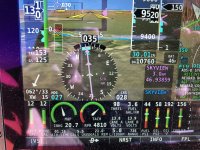
As to fuel burn, with my 912iS, engine, I get 150 kts true at the mid altitudes burning 3.5 gph. Buit then I am flying a Risen 912.
150KTS TAS? What airplane???? Risen 912 you say. Wow that is great. What is the tail number. Take a picture of your EFIS.
That is 42 NM per Gal or 48 MPG.... insane efficiency, better than a long EZ. (y) 😊
Rutan Long-EZ gold standard of efficiency typically achieves between 25 to 45 miles per gallon (mpg) with a Lyc O-235 or O-320.
 
Last edited:
I'll beat up the Rotax a little bit since we're here. I'm finding a minor disadvantage to my 912is this week as I make plans to fly the Hayward Air Rally. We're rookies in a tough field so it's just a father/daughter flying weekend with no expectation to really be competitive, but it's still fun to try. Anyway, with the FADEC controls along with general engine efficiency we aren't left with much to work the fuel burn. The thirsty engines with mixture control can make some fuel flow changes, but we have to take what we can get.

We won.

Consistency was key. Based a year or so worth of 912is FADEC data we identified the power setting that resulted in the most consistent TAS and fuel flow in the altitude range expected for the course. 5300 RPM for 110KTAS and 4.6 GPH between 3500-4500. We ran just under a cumulus deck for most of the course between 3600-4000. Our time estimate was decent, but what put us over the top was nailing our fuel estimate almost exactly. 11.3 was the estimate, we burned 11.29. Off by 1.28 ounces, less than a shot glass.

Incredible precision from this engine system.
 
2. No they are NOT certified nor do they have the traceability of a Lyc. They are approved by ASTM committee for LSA's, not certified nor are the planes they go in.
Again, this is false. As I posted earlier: There are type-certificated Rotax 912 engines used in aircraft with regular FAR 23 type certificates, like the Tecnam P2006T (normal category, twin engine) and Diamond DA20-A1 (utility category). Don't believe me? Then believe the FAA, it's Type Certificate Data Sheet (TCDS) number E00051EN.
 
Back
Top