Sorry, wasn't aware that anybody can't view all of threads there. Free to sign up. Anyway, I guess I can summarize some lessons learned here.
Converting acceleration to ips:
View attachment 112529
View attachment 112530
where acceleration is in Gs, velocity in ips and Frequency is cycles per minute (RPM).
If running prop at 1000 RPM and want to detect 0.07 ips or less, we're looking for 0.015 Gs. If using the ADXL335, that has a sensitivity of 300 mV/G, that's 4.5mV!
Doubling the RPM to 2,000 we're looking to get the vibration below 9 mV from the ADXL335.
As you can see we're working close to the 4.9mV/bit resolution of a 10-bit A/D converter @5V.
If feeding the ADXL335 signal to an Arduino Nano or Mega (has a 0 to 5V range and 4.9mV resolution) I'll probably first have to amplify the signal 100 to 200 times to get a reasonable resolution.
Trying to understand FFT (DFT):
See attached FFT tutorial.
I think the light bulb finally came on:
Sample two channels simultaneously:
1) trigger signal
and
2) accelerometer signal.
Then do FFT on both sample sets.
Note the frequency "bin" with the highest accelerometer peak (should also be RPM/60)
Read the phase from the trigger channel same bin.
Most stable phase results if sampling starts on trigger signal.
Summary of last posts:
"Seems the prop balancers out there brags about bringing it below 0.07 ips.
So what I already have (ADXL335 with 20x, 60x and 100x amplification) should be adequate. Still, it will be interesting to see what the ADXL313 can do. Output data rate sets bandwidth:
Output Data Rate (Hz) - Bandwidth (Hz) Rate
400 - 200
200 - 100
100 - 50
50 - 25
25 - 12.5
12.5 - 6.25
50Hz (3,000RPM) should be quite adequate for prop balancing.
Wanted to post an update one using the ADXL335 all-digital accelerometer because it may be a while before I get to continue testing.
I decided to try it out because I had already purchased it and because I should be able to get fairly accurate absolute acceleration values. (One LSB is 1/1024 Gs.)
Prop is already pretty well balanced by adding 1/4" carbide rods in heavy side of hub and painting the light blade black on backside, so this is mainly curiosity.
So the objective here is to measure absolute prop acceleration.
Some points I encountered:
Even though the ADXL335 is capable of 1,600 samples/second, the digital SPI or I2C interfaces limits how fast you can get the data into for example my Arduino Mega 2560.
The built-in bandwidths (low pass filter) fixed to 1/2 of sample rate may not be ideal.
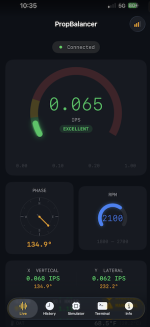
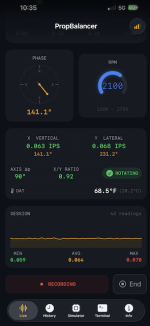
During actual ground runs I saw what I thought were much too high values. After some research I found out that one needs to divide the values gotten after doing FFT (DFT) by number-of-samples/2 to get correct (peak acceleration) values!
I still don't know if the ips vibration that, for example Dynavibe reports, is peak, peak-peak or RMS.
I tried different algorithms to determine prop vibration. I've given up on the 2-channel FFT amplitude and phase method. It may work with an electrical motor but not with impossibly noisy phase signal on a combustion engine and prop. Instead I've gone to the 4-run test-weight spreadsheet method to determine weight and angle.
My latest algorithm is to measure prop period (RPM) by trigger signals, and then take 32 samples (the ADXL335 set to 1600 samples/sec but reading the data at 1/32 prop rotation period intervals) through one full prop revolution. That can be repeated (for example 1, 2, 4, 8, 16, 32 or 64 times) and averaged to get rid of noise. The prop vibration amplitude should be found in the lowest frequency (non-DC) FFT "bin". The frequency of that bin of course is prop-RPM/ 60.
I decided on that algorithm after doing some simulations. Unless you can set the sample rate to a multiple of the prop RPM or frequency (not possible with the ADXL335), the adjacent FFT frequency or spectrum "bins" will get part of the amplitude, unless you can hit and maintain the exact RPM for that sample rate. In other words, at a fixed sample rate, as you vary RPM, looking at the FFT spectrum, you'll see one frequency peak and adjacent frequencies being zero and then grow. I was not able to calculate accurate values by pro-rating the adjacent bin amplitude values by RPM frequency ratio to bin frequencies (by how far the measured frequency is from bin frequencies).
Another method I need to look into is quadrature. If a signal frequency (RPM) is known, one can apparently multiply samples of that signal with exponential or trig functions and obtain amplitude of the sampled signal? Probably the same that's done in FFT/DFT but for a one-channel FFT? Question will be how stable is the rotational speed (frequency or RPM) of a prop through one or more sampled rotations?
Will be interesting to see results from actual flight data collection runs."
Maybe I was limited by the speed of the Arduino Mega and may be able to get better results using an ESP32 and the "Step 3: Extracting the 1× Vibration Vector" in the ESP32_Propeller_Balancer_Design.pdf in post #11 above.
Have fun and by all means posts your experience and results.
Finn
EDIT: Of course the above reveals my complete ignorance on how FFT or DFT is actually done. I simply included an Arduino FFT library in my code.