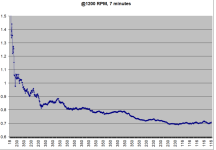


Here's some math explaining the "Influence Coefficient" mentioned in a previous post, which I haven't verified:
How does a prop balancer calculate an "influence coefficient" using an engine run with no weight and an engine run with a trial weight
How a Prop Balancer Calculates an Influence Coefficient
This is a classic single-plane balancing problem. The influence coefficient (also called the balancing sensitivity) answers: "How much does the vibration vector change per unit of trial weight, at a given angular position?" It's measured empirically because you can't easily model the system analytically (flexible mounts, complex geometry, etc.).
Run 1 — Baseline (no weight)
Measure the vibration at the target RPM. The result is a vector with both magnitude and phase:
Run 2 — Trial weight run
Attach a known trial weight W at a known angular position θ_W on the prop, then run again at the same RPM to get a new vibration amplitude and phase.
The influence coefficient IC is the change in vibration caused by the trial weight, divided by the trial weight vector:
This is complex-number division where:
The result IC is a complex number with units of (vibration)/(gram), e.g., (in/s)/gram, and encodes:
The magnitude tells you how many grams to add. The angle tells you where on the prop to place it, in the same angular reference frame as your tachometer trigger.
Step 1 — Convert to rectangular (complex) form:
Step 2 — Compute ΔV:
Step 3 — Compute IC:
Step 4 — Compute correction weight:
Performing the complex division gives you a magnitude (grams) and angle (clock position on the prop).
Phase measurement requires a reflective tape + optical pickup (or mag sensor) giving a once-per-rev pulse. The balancer measures the time delay between this trigger and the vibration peak, converting it to degrees. Without phase you only know how bad the imbalance is, not where to correct it.
This is a classic single-plane balancing problem. The influence coefficient (also called the balancing sensitivity) answers: "How much does the vibration vector change per unit of trial weight, at a given angular position?" It's measured empirically because you can't easily model the system analytically (flexible mounts, complex geometry, etc.).
The Two Runs
Run 1 — Baseline (no weight)
Measure the vibration at the target RPM. The result is a vector with both magnitude and phase:
- A₀ = vibration amplitude (e.g., in/s or mm/s)
- φ₀ = phase angle relative to the tachometer once-per-rev trigger pulse
Run 2 — Trial weight run
Attach a known trial weight W at a known angular position θ_W on the prop, then run again at the same RPM to get a new vibration amplitude and phase.
Calculating the Influence Coefficient
The influence coefficient IC is the change in vibration caused by the trial weight, divided by the trial weight vector:
Code:
IC = (V1 - V0) / (W at angle θ_W)This is complex-number division where:
- Numerator: the change in vibration caused by the trial weight (ΔV = V1 − V0)
- Denominator: the trial weight expressed as a vector (magnitude × angular position)
The result IC is a complex number with units of (vibration)/(gram), e.g., (in/s)/gram, and encodes:
- How sensitive the system is to added mass
- The phase lag between where you put weight and where the vibration effect appears
Using IC to Find the Correction Weight
Code:
W_correction = -(V0 / IC)The magnitude tells you how many grams to add. The angle tells you where on the prop to place it, in the same angular reference frame as your tachometer trigger.
Worked Example
| Quantity | Value |
| Baseline vibration V0 | 0.15 in/s @ 45° |
| Trial weight W | 10g @ 0° |
| Post-trial vibration V1 | 0.22 in/s @ 112° |
Step 1 — Convert to rectangular (complex) form:
Code:
V0 = 0.15·cos(45°) + j·0.15·sin(45°) = 0.106 + 0.106j
V1 = 0.22·cos(112°) + j·0.22·sin(112°) = -0.082 + 0.204j
W  = 10·cos(0°) + j·10·sin(0°) = 10 + 0j
Step 2 — Compute ΔV:
Code:
ΔV = (-0.082 + 0.204j) - (0.106 + 0.106j) = -0.188 + 0.098jStep 3 — Compute IC:
Code:
IC = (-0.188 + 0.098j) / (10 + 0j) = -0.0188 + 0.0098j
   = 0.0212 (in/s)/g @ 152°
Step 4 — Compute correction weight:
Code:
W_corr = -(0.106 + 0.106j) / (-0.0188 + 0.0098j)Why Phase Matters So Much
Phase measurement requires a reflective tape + optical pickup (or mag sensor) giving a once-per-rev pulse. The balancer measures the time delay between this trigger and the vibration peak, converting it to degrees. Without phase you only know how bad the imbalance is, not where to correct it.
Practical Notes
- The trial weight should cause a noticeable change — typically 20–50% change in amplitude or a clear phase shift. Too small and measurement noise dominates.
- RPM must be identical between runs — even small differences change vibration amplitude independently of balance.
- The IC is only valid at the RPM where it was measured, since structural dynamics are speed-dependent.
- Commercial balancers (Dynavibe, etc.) do all this math internally and just tell you grams and clock position.
Complex Number Division
To divide two complex numbers, you can't just divide real and imaginary parts separately (unlike addition). Instead you use a trick: multiply top and bottom by the complex conjugate of the denominator, which eliminates the imaginary part from the denominator and gives you a plain real number to divide by.
The conjugate of a complex number simply flips the sign of the imaginary part:
The useful property is that a number multiplied by its conjugate is always a real number:
(The cross terms cancel, and j² = -1 turns -b²j² into +b².)
To compute (a + bj) / (c + dj):
We need to divide V0 by IC to find the correction weight:
Identify a, b, c, d:
Step 1 — Compute the numerator terms:
Step 2 — Compute the denominator:
Step 3 — Divide:
Step 4 — The correction weight is the negative of this:
The balancer displays the result as grams at a clock position, which is polar form:
So the balancer would call for 7.07 grams at 72.6° on the prop.
If both numbers are already in polar form (magnitude @ angle), division is even simpler — divide the magnitudes and subtract the angles:
This is why engineers often stay in polar form for division and multiplication, and switch to rectangular form only for addition and subtraction.
To divide two complex numbers, you can't just divide real and imaginary parts separately (unlike addition). Instead you use a trick: multiply top and bottom by the complex conjugate of the denominator, which eliminates the imaginary part from the denominator and gives you a plain real number to divide by.
The Complex Conjugate
The conjugate of a complex number simply flips the sign of the imaginary part:
Code:
If z = a + bj
Then z* = a - bj
The useful property is that a number multiplied by its conjugate is always a real number:
Code:
(a + bj)(a - bj) = a² + b²(The cross terms cancel, and j² = -1 turns -b²j² into +b².)
The Division Procedure
To compute (a + bj) / (c + dj):
Code:
Step 1: Multiply numerator and denominator by the conjugate of the denominator (c - dj)

        (a + bj)   (a + bj)(c - dj)
        -------- = ----------------
        (c + dj)   (c + dj)(c - dj)

Step 2: Expand the numerator using FOIL

        (a + bj)(c - dj) = ac - adj + bcj - bdj²
                         = ac - adj + bcj + bd      (since j² = -1)
                         = (ac + bd) + (bc - ad)j

Step 3: Expand the denominator (always gives a real number)

        (c + dj)(c - dj) = c² + d²

Step 4: Separate into real and imaginary parts

        Result = (ac + bd)    +    (bc - ad) j
                 ---------         ---------
                  c² + d²           c² + d²
Worked Example — From the Prop Balancer Calculation
We need to divide V0 by IC to find the correction weight:
Code:
V0 =  0.106 + 0.106j
IC = -0.0188 + 0.0098j
Identify a, b, c, d:
Code:
a =  0.106   b =  0.106
c = -0.0188  d =  0.0098
Step 1 — Compute the numerator terms:
Code:
ac + bd = (0.106)(-0.0188) + (0.106)(0.0098)
        = -0.001993 + 0.001039
        = -0.000954

bc - ad = (0.106)(-0.0188) - (0.106)(0.0098)
        = -0.001993 - 0.001039
        = -0.003032
Step 2 — Compute the denominator:
Code:
c² + d² = (-0.0188)² + (0.0098)²
        = 0.000354 + 0.000096
        = 0.000450
Step 3 — Divide:
Code:
V0 / IC = (-0.000954 / 0.000450) + (-0.003032 / 0.000450)j
        = -2.12 - 6.74j
Step 4 — The correction weight is the negative of this:
Code:
W_corr = -(-2.12 - 6.74j) = 2.12 + 6.74jConverting the Result to Polar Form (Magnitude and Angle)
The balancer displays the result as grams at a clock position, which is polar form:
Code:
Magnitude = √(real² + imag²)
          = √(2.12² + 6.74²)
          = √(4.49 + 45.43)
          = √49.92
          = 7.07 grams

Angle     = atan2(imag, real)
          = atan2(6.74, 2.12)
          = 72.6°
So the balancer would call for 7.07 grams at 72.6° on the prop.
Doing it in Polar Form Directly
If both numbers are already in polar form (magnitude @ angle), division is even simpler — divide the magnitudes and subtract the angles:
Code:
If P = M_p @ φ_p   and   Q = M_q @ φ_q

Then P / Q = (M_p / M_q) @ (φ_p - φ_q)
This is why engineers often stay in polar form for division and multiplication, and switch to rectangular form only for addition and subtraction.

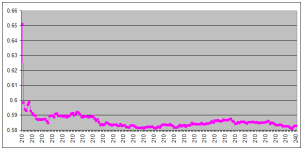

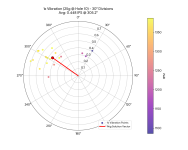
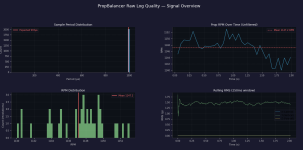
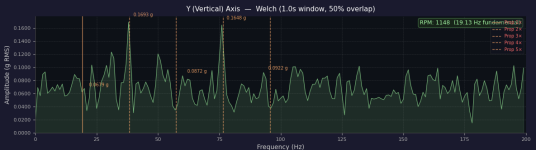
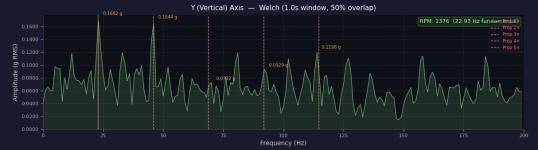
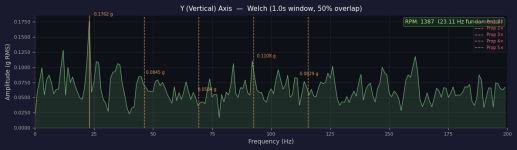
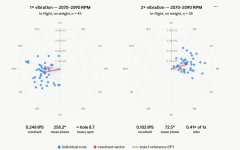
 some of it goofy)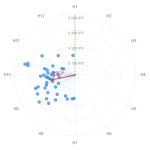


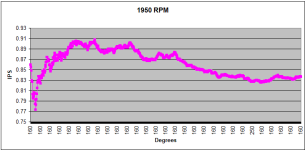
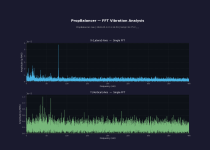


 If it has to do with airplanes, there is an interest somewhere in the Van sub-universe. If you are flying a twin and the engines aren’t at the same RPM, you are hearing the difference frequency reminding you to synchronize the RPMs.