Sadly, I lost a friend and his wife in an RV-6 with O-360. He followed the practice of not using the boost pump on take offs. While we were departing two ship formation from Petaluma after lunch he experienced a loss of power. Witnesses on the golf course said the engine was sputtering. I was number 2 executing a running rejoin when he attempted a turn back resulting in a stall spin.
just a week before that flight he pulled the mechanical fuel pump due to issues.
Charlie, I'm sorry for your loss.
Out of morbid curiosity, what did the NTSB/FAA find as the contributing factor(s) to the accident?
If it was the mechanical fuel pump, what was its failure mode and would have running the boost pump achieved anything?
...Onward...
The only reason to turn on the pump during switching tanks or during critical phases of flight (take off, landing) is to ensure continued fuel flow. It's not a bad practice considering that the fuel delivery to the engine is dependent upon a single, rapidly wiggling, mechanical device (suck-blow, repeat)...but...
I test the pump every time I start the airplane -- raise the fuel
pressure to +30psi, open the throttle 1/2" or so, move the mixture to Full Rich, observe fuel
flow on the EFIS, then turn the pump off and hit the starter. I don't use it the rest of the time.
I've played with some scenarios, and I think the only one that is problematic is the failure of the engine driven pump shortly after V1/Vr and before about 200ft AGL. For all other cases, enabling the boost pump if the engine-driven one fails is a non-event; the correct corrective action takes < 1 second to achieve.
Now, if the engine driven pump cracks open and spills its guts all over the inside of the cowling, turning the boost pump on won't do a thing...other than feed the incipient fire.
Not looking for a war - just a good understanding of the possible failure modes and mitigating actions before introducing additional actions that *could* be worse than the effect they're intended to prevent...





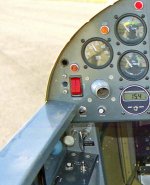
 Fuel pump switch just in front of the throttle and below the carb heat control knob in this picture. Handy arrangement if things should go quiet........