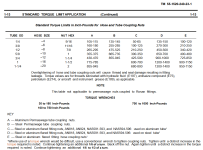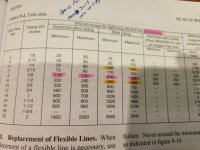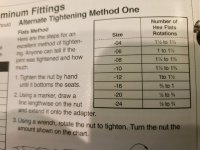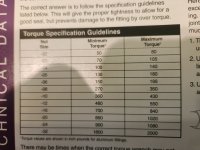


Ok I know this has been discussed before, but even after reading everything I can find on the forum, I don't know if I'm doing this right and I can't stop overthinking it. I'm trying to attach my Aircraft Specialty fuel hoses to my Andair fuel selector and the AN fuel fittings in the tunnel.
The Standard Aircraft Handbook and AC 43.13 both have ranges for aluminum fittings/tubes, and ranges for steel fittings/tubes. However, there's nothing out there that says what to do when mixing aluminum and steel. I've seen some people say to use the aluminum torque range and others have said to use the steel range. The steel torque range seems a bit excessive for the aluminum fittings though.
Aeroquip fittings seem to be the most similar to the ones on the Aircraft Specialty hoses but again Aeroquip is for aluminum, not steel. The torque ranges listed by them are a bit higher than the ranges found in the Standard Aircraft Handbook and AC 43.13.
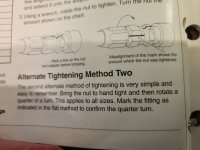
Also, the flats method doesn't work because these steel fittings maybe make it a half of a flat past hand tight before torque required to keep them turning skyrockets.
Someone please save me from myself and tell me how I should be tightening these fittings.
And a bonus question: While going down this rabbit hole I've seen some things that say I should be lubricating threads on steel fittings. I've opted to use stainless fittings for the hoses on the firewall (so the brake lines and the fuel lines) so since that's stainless steel on stainless steel, should I lubricate the threads to prevent galling? I know that the standard rule is to not lubricate flared fittings, but I'm wondering if the threads (not the flared faces) on stainless fittings are a special case.
Thanks
The Standard Aircraft Handbook and AC 43.13 both have ranges for aluminum fittings/tubes, and ranges for steel fittings/tubes. However, there's nothing out there that says what to do when mixing aluminum and steel. I've seen some people say to use the aluminum torque range and others have said to use the steel range. The steel torque range seems a bit excessive for the aluminum fittings though.
Aeroquip fittings seem to be the most similar to the ones on the Aircraft Specialty hoses but again Aeroquip is for aluminum, not steel. The torque ranges listed by them are a bit higher than the ranges found in the Standard Aircraft Handbook and AC 43.13.
Also, the flats method doesn't work because these steel fittings maybe make it a half of a flat past hand tight before torque required to keep them turning skyrockets.
Someone please save me from myself and tell me how I should be tightening these fittings.
And a bonus question: While going down this rabbit hole I've seen some things that say I should be lubricating threads on steel fittings. I've opted to use stainless fittings for the hoses on the firewall (so the brake lines and the fuel lines) so since that's stainless steel on stainless steel, should I lubricate the threads to prevent galling? I know that the standard rule is to not lubricate flared fittings, but I'm wondering if the threads (not the flared faces) on stainless fittings are a special case.
Thanks