

Van's Air Force

The definitive Van's Aircraft support community! Buying, building or flying an RV? Join our exclusive family of mentors and enthusiasts!

Torque for steel fuel fittings with aluminum AN fittings

tims88

Well Known Member
Ok I know this has been discussed before, but even after reading everything I can find on the forum, I don't know if I'm doing this right and I can't stop overthinking it. I'm trying to attach my Aircraft Specialty fuel hoses to my Andair fuel selector and the AN fuel fittings in the tunnel.

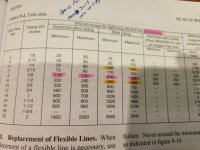
The Standard Aircraft Handbook and AC 43.13 both have ranges for aluminum fittings/tubes, and ranges for steel fittings/tubes. However, there's nothing out there that says what to do when mixing aluminum and steel. I've seen some people say to use the aluminum torque range and others have said to use the steel range. The steel torque range seems a bit excessive for the aluminum fittings though.

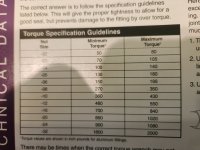
Aeroquip fittings seem to be the most similar to the ones on the Aircraft Specialty hoses but again Aeroquip is for aluminum, not steel. The torque ranges listed by them are a bit higher than the ranges found in the Standard Aircraft Handbook and AC 43.13.

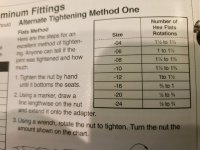
Also, the flats method doesn't work because these steel fittings maybe make it a half of a flat past hand tight before torque required to keep them turning skyrockets.

Someone please save me from myself and tell me how I should be tightening these fittings.

And a bonus question: While going down this rabbit hole I've seen some things that say I should be lubricating threads on steel fittings. I've opted to use stainless fittings for the hoses on the firewall (so the brake lines and the fuel lines) so since that's stainless steel on stainless steel, should I lubricate the threads to prevent galling? I know that the standard rule is to not lubricate flared fittings, but I'm wondering if the threads (not the flared faces) on stainless fittings are a special case.

Thanks
 
Ok I know this has been discussed before, but even after reading everything I can find on the forum, I don't know if I'm doing this right and I can't stop overthinking it. I'm trying to attach my Aircraft Specialty fuel hoses to my Andair fuel selector and the AN fuel fittings in the tunnel.

The Standard Aircraft Handbook and AC 43.13 both have ranges for aluminum fittings/tubes, and ranges for steel fittings/tubes. However, there's nothing out there that says what to do when mixing aluminum and steel. I've seen some people say to use the aluminum torque range and others have said to use the steel range. The steel torque range seems a bit excessive for the aluminum fittings though.

Aeroquip fittings seem to be the most similar to the ones on the Aircraft Specialty hoses but again Aeroquip is for aluminum, not steel. The torque ranges listed by them are a bit higher than the ranges found in the Standard Aircraft Handbook and AC 43.13.

Also, the flats method doesn't work because these steel fittings maybe make it a half of a flat past hand tight before torque required to keep them turning skyrockets.

Someone please save me from myself and tell me how I should be tightening these fittings.

And a bonus question: While going down this rabbit hole I've seen some things that say I should be lubricating threads on steel fittings. I've opted to use stainless fittings for the hoses on the firewall (so the brake lines and the fuel lines) so since that's stainless steel on stainless steel, should I lubricate the threads to prevent galling? I know that the standard rule is to not lubricate flared fittings, but I'm wondering if the threads (not the flared faces) on stainless fittings are a special case.

Thanks
Your best resource for that information is the folks at Aircraft Specialty.
 
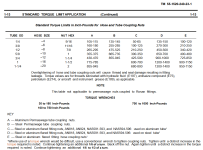
Dmattmul: TM 55-1520-240-23-1 is an intermediate maintenance manual for a CH-47D helo. Sections 1-13 and 1-14 are standard torque and hardware installation information and some substitution information.

You can download the full document here. It's 439 pages:
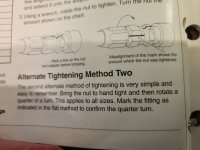
First chart---for our stainless hose ends, we use the 'steel spec' high limit----for those with actual torque wrenches. I personally use the flats method--
 

Attachments

  • 20230605_094125.jpg
    20230605_094125.jpg
    233.2 KB · Views: 109
  • 20230605_094215.jpg
    20230605_094215.jpg
    221.6 KB · Views: 95
  • 20230605_094233.jpg
    20230605_094233.jpg
    237 KB · Views: 79
  • 20230605_094342.jpg
    20230605_094342.jpg
    207.6 KB · Views: 106
Dmattmul: TM 55-1520-240-23-1 is an intermediate maintenance manual for a CH-47D helo. Sections 1-13 and 1-14 are standard torque and hardware installation information and some substitution information.

You can download the full document here. It's 439 pages:
Thanks, makes sense. Probably came from my dad who was one of the test pilots (Army) for the Chinook back in the 60's. He stayed flying into his late 80's.
 
I don't recall ever putting a torque wrench on an AN fitting. We'd assemble the fitting hand tight to ensure everything went together smoothly, then wrench tighten the B nut a further 1/4 turn. Any more than that and you risk damaging the flare and ruining the line.
 
Something to remember, is that there is a separate chart for torques when the fittings are used in oxygen service. They are not the same values.
 
First chart---for our stainless hose ends, we use the 'steel spec' high limit----for those with actual torque wrenches. I personally use the flats method--
So 300 in-lbs even when the fitting that the hose end is being attached to is aluminum? I can get a torque wrench where I need to, but I'm not sure I can get enough leverage with another wrench to hold fitting in place while I tighten it to 300.

I went to 130 in-lbs last night on one fitting and it barely made it about an 1/8 of a turn so I'm concerned about how much torque it will take to get it 1 to 1.5 flats past hand tight.

If that's what everyone is doing then I'll give it a try.
 
From a JIC fitting chart:

The table below gives the torque tightening values for JIC (AN) fittings in both stainless steel and aluminum. When a combination of aluminum and stainless steel fittings are being mated, always use aluminum fitting torque values.

Also, from Summit AN fitting torque guidance:

Look at note #2:
  • When using aluminum and steel fittings, use the torque for the aluminum fitting.
 
Last edited:
I went to 130 in-lbs last night on one fitting and it barely made it about an 1/8 of a turn so I'm concerned about how much torque it will take to get it 1 to 1.5 flats past hand tight.

If that's what everyone is doing then I'll give it a try.
1/8th of a turn is one flat.... the next 1/2 flat will take way more torque.
1/8th of a turn is not one flat!!! how could it be on a 6 sided nut/bolt..... idiot!
 
Last edited:
Tom,

I too cannot get more than 1/2 flats on your provided brake and fuel hoses. Are you lubricating threads or dry assembly? Should I up my game in the gym?

Thanks
 
Tom,

I too cannot get more than 1/2 flats on your provided brake and fuel hoses. Are you lubricating threads or dry assembly? Should I up my game in the gym?

Thanks
nothing on the threads. I take 2 stubby wrenches and squeeze. LOL, those of you that know me know that I havent been in a gym since Ford was president. Now, ful disclosure, I AM one that tends to overtighten fluidline fittings, yes even aluminum. But a good, real AN aluminum fitting wont be damaged from alittle overtightening. Its a matter of feel as well. There are just some places that are virtually impossible to get a torque wrench on the fittings. And no, I dont think there is a real spec for stainless hose ends on aluminum fittings. That why the flats method, and feel has always worked well for me. Test it by putting the fittings in a vise, tighten it, mark it, disassemble and then re tighen with a torque wrench and see what it is.
 
The torque specs for AN tube fittings and boss ports assume the threads have been lubricated by system fluid. All the mil-spec installation guides including the chart above in post 3 and also AC 43.13-1b specify this. Vaseline (petrolatum) is also acceptable and is what I normally use. When mixing steel and aluminum, use the aluminum torque values. Table 9-2 in AC 43.13-1B has the torque values. Table 1-41 in TO 00-25-223 also has torque values for softer aluminum tubing and says "For combinations of materials, use the lower torque value of the applicable materials." Figure 1-44 shows where to lubricate the fitting.
 
Last edited:
So 300 in-lbs even when the fitting that the hose end is being attached to is aluminum? I can get a torque wrench where I need to, but I'm not sure I can get enough leverage with another wrench to hold fitting in place while I tighten it to 300.

I went to 130 in-lbs last night on one fitting and it barely made it about an 1/8 of a turn so I'm concerned about how much torque it will take to get it 1 to 1.5 flats past hand tight.

If that's what everyone is doing then I'll give it a try.
Decided to take some well-made used once stainless braided hoses (5, yes, I'm OCD about getting the perfect length hose) and 2 newer digital torque wrenches and 1 beam style torque wrench and compare number of flats to measured torque and mockup some fitting on my workbench and vise. Normally I use the torque method (aluminum spec so 100-125 in lbs. using table 1-13 and would shoot for the upper range) If on occasion I could not get a torque wrench in place (w claw foot) I would use the german gut and tite method which I now believe the flat method would be better but wanted to try first. With an aluminum B nut, aluminum tubing and an aluminum bulkhead fitting the 125 in. lbs. is pretty close to the 1/4 turn method (1.5 flats) Trying my SS hoses with an aluminum bulkhead fitting 125 in lbs. was never going to get me the 1/4 turn. I tried lubricating (hydraulic fluid) and no lubrication. I went to 200 in lbs and got a little more but not the 1/4 turn. 200 in lbs. just seemed too tight and a spec I have never used. Is anyone really going to 300 in lbs. with stainless braided hose? 1/4 turn? Tim, did you get to 300 in lbs. or 1/4 turn? I like the count the flats method rather than just "feeling" the torque needed but 1/4 turn seems high with an aluminum bulkhead fitting.
 
Tim, did you get to 300 in lbs. or 1/4 turn? I like the count the flats method rather than just "feeling" the torque needed but 1/4 turn seems high with an aluminum bulkhead fitting.
I haven't tried going to 300 in lbs yet and I don't think I will. This is actually my second time trying to install these fuel hoses, and I did go all the way up to 260 in-lbs the first time...but then I continued to overthink it and got worried I may have damaged the aluminum fittings so I took them all out and that's why I'm here again. I think 260 may have just been where I stopped on my way to try to get into the steel range listed in AC 43.13. I also don't remember if I actually got 1 to 1.5 flats or not. What I do know is that I bent my tunnel ribs a little bit around some of the holes that the bulkhead fittings are in because there isn't much room to get good leverage with another wrench to secure the fitting while tightening. So there is no way I'll get to 300 in-lbs for fittings inside the center tunnel without doing even more damage to something.

My plan for now is to use the torque ranges listed in the Aeroquip and Summit charts. I'll start at the low end of the aluminum range (150 in-lbs for -6 fittings) and if they leak when I finally get a chance to test the lines, then I'll tighten them some more. I would just do the flats method, but I'm convinced I won't get even 1 full flat past hand tight in the space that I'm working in without damaging something on the plane.
 
For a -6 steel hose end and aluminum bulkhead fitting, the correct torque is 110-130 in-lb (lubricated) not 300 in-lb. The reason the torque values are higher for steel than aluminum is to get the flare to seal properly on the harder surface. If one surface is aluminum, then you don't need as much torque to get a good seal. I purchased the SS hoses from AS/TS Flightlines and they work great but for inside the cabin where all the fittings don't need to be fireproof, I wish the hoses had aluminum ends instead. It would save weight and be easier to get a good seal. BTW, I used Del seals on every fuel line in the cabin to minimize the chance of a leak.
 
Last edited:
Back
Top