

Van's Air Force

The definitive Van's Aircraft support community! Buying, building or flying an RV? Join our exclusive family of mentors and enthusiasts!

RV-15 Aileron Observations

MCA

Well Known Member
Advertiser
First, let me say this is a wonderful kit. I've thoroughly enjoyed it so far. I can only imagine that if they sold a version where the parts are prepped and primed, all we'd have to do is the fun part.

A couple of observations while building the ailerons. YMMV.

1. Cleco together both the left and right sides, including the pivot brackets to make sure you have it correct. It's not hard, but potentially very difficult to fix later. Double check that the countersinks are on the correct side.
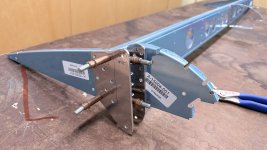
IMG_6789.jpeg

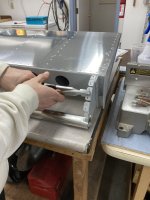
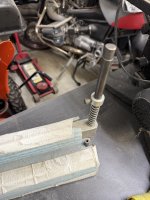
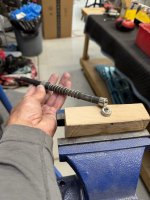
2. I made a small wooden block jig to dimple the leading edge skin with the DRDT-2. For 12 holes it works. (UPDATE: Scroll down and Troy suggests Instead of blocking up the die, you can just flip the skin and then blocking is not required. I haven't tried it but sounds like a great idea!)
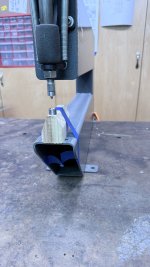
IMG_6882.jpeg

3. Check that the nutplate is for 10-32 size screw.
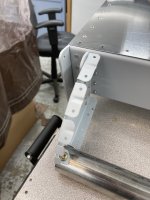
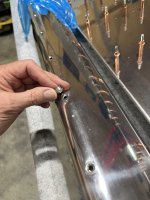
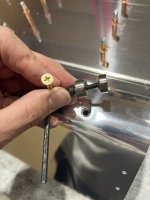
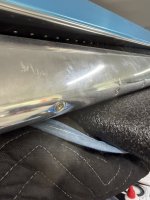
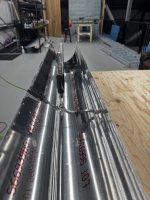
4. Once you have the front ribs built up, check that everything aligns properly and that the AN3 screw screws in properly - all the way. On one of the ailerons the hole in the rib (not the fatter bracket) did not line up exactly and therefore caused some binding on the nutplate. That caused the rivet securing the nutplate to snap. A huge issue if the front skin was riveted on. Fortunately the counterweight tube is on B/O so I do have access to fix it. The planned repair is to slightly enlarge the hole (in the thin rib material only, not on the bracket) and replace the broken rivet.
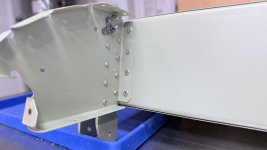
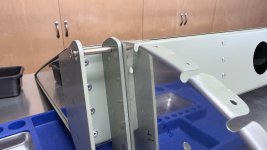
IMG_6906.jpeg

IMG_6908.jpeg

Curious if anyone else has run into this.
 
Last edited:
Item 1 above...I was confused by the inboard/outboard naming and the mirror image thing on the plans and I countersunk two of these parts on the wrong side.

I will have to buy two new ones some day when the ordering system makes that possible.

So, DEFINITELY clecko it all together first before you cut anything. That will be SOP going forward.
 
I observed it when I first reviewed the plans and made scribble notes all over them. I plan on marking each CS hole as the blue comes off.
 
Here’s a question for you Marc - have you bolted on the counterweight tubs yet? If not…check your nuts!!😉

While we (me and some helper-neighbors) were doing a fuel gauge calibration on the Rocket yesterday afternoon, Louise was over at the bench installing the eight #8 screws and nuts that hold the counterweight tubes on to the two ailerons. Seemed like it was taking an excessive amount of time. Yes, it was a super tight spot to work, yes, she was using a ratcheting right-angle screwdriver, and yes, you have to reach into the tube with a wrench to hold the nuts - but still…she mentioned that after a lot of time, the nuts weren't coming up tight. I realized this morning that those were the symptoms of trying to put an AN3 Nylon locknut onto a #8 screw - it will thread into the nylon with a friction fit, but the metal threads aren’t engaged - and it never comes up tight!

Sure enough, the little compartment in the tackle box is properly labelled for 8-32 nylon locknuts…but all eight nuts that were in there were AN3’s! So everyone check your nuts, make no assumptions, and if it takes a 3/8” wrench instead of an 11/32”, you’ve got the wrong nuts.
 
Here’s a question for you Marc - have you bolted on the counterweight tubs yet? If not…check your nuts!!😉

While we (me and some helper-neighbors) were doing a fuel gauge calibration on the Rocket yesterday afternoon, Louise was over at the bench installing the eight #8 screws and nuts that hold the counterweight tubes on to the two ailerons. Seemed like it was taking an excessive amount of time. Yes, it was a super tight spot to work, yes, she was using a ratcheting right-angle screwdriver, and yes, you have to reach into the tube with a wrench to hold the nuts - but still…she mentioned that after a lot of time, the nuts weren't coming up tight. I realized this morning that those were the symptoms of trying to put an AN3 Nylon locknut onto a #8 screw - it will thread into the nylon with a friction fit, but the metal threads aren’t engaged - and it never comes up tight!

Sure enough, the little compartment in the tackle box is properly labelled for 8-32 nylon locknuts…but all eight nuts that were in there were AN3’s! So everyone check your nuts, make no assumptions, and if it takes a 3/8” wrench instead of an 11/32”, you’ve got the wrong nuts.

Adding "Verify parts labeling accuracy of hardware boxes" to my inventory workflow sheet. Thanks for sharing Paul.
 
Here’s a question for you Marc - have you bolted on the counterweight tubs yet? If not…check your nuts!!😉

While we (me and some helper-neighbors) were doing a fuel gauge calibration on the Rocket yesterday afternoon, Louise was over at the bench installing the eight #8 screws and nuts that hold the counterweight tubes on to the two ailerons. Seemed like it was taking an excessive amount of time. Yes, it was a super tight spot to work, yes, she was using a ratcheting right-angle screwdriver, and yes, you have to reach into the tube with a wrench to hold the nuts - but still…she mentioned that after a lot of time, the nuts weren't coming up tight. I realized this morning that those were the symptoms of trying to put an AN3 Nylon locknut onto a #8 screw - it will thread into the nylon with a friction fit, but the metal threads aren’t engaged - and it never comes up tight!

Sure enough, the little compartment in the tackle box is properly labelled for 8-32 nylon locknuts…but all eight nuts that were in there were AN3’s! So everyone check your nuts, make no assumptions, and if it takes a 3/8” wrench instead of an 11/32”, you’ve got the wrong nuts.
Someone mentioned this in a different "thread" 😁 a while back but I can't find it right now; Van's actually sent me replacement smaller nuts in one of my backorder shipments. Doesn't look like it's made it onto the wiki yet, either.

I mentioned this elsewhere, but for me those washer head screws were too long and the nuts were threadbound. Support recommended a washer, but I bought some AN525-832R7 screws with another order from ACS and they work well.
 
Sure enough, the little compartment in the tackle box is properly labelled for 8-32 nylon locknuts…but all eight nuts that were in there were AN3’s! So everyone check your nuts, make no assumptions, and if it takes a 3/8” wrench instead of an 11/32”, you’ve got the wrong nuts.
Upon inventory of kit #116 received Friday, the bin labelled 8-32 locknuts did in fact have 8-32 locknuts, so thanks for making us check, and thanks giving Vans the feedback.
 
Here’s a question for you Marc - have you bolted on the counterweight tubs yet? If not…check your nuts!!😉

While we (me and some helper-neighbors) were doing a fuel gauge calibration on the Rocket yesterday afternoon, Louise was over at the bench installing the eight #8 screws and nuts that hold the counterweight tubes on to the two ailerons. Seemed like it was taking an excessive amount of time. Yes, it was a super tight spot to work, yes, she was using a ratcheting right-angle screwdriver, and yes, you have to reach into the tube with a wrench to hold the nuts - but still…she mentioned that after a lot of time, the nuts weren't coming up tight. I realized this morning that those were the symptoms of trying to put an AN3 Nylon locknut onto a #8 screw - it will thread into the nylon with a friction fit, but the metal threads aren’t engaged - and it never comes up tight!

Sure enough, the little compartment in the tackle box is properly labelled for 8-32 nylon locknuts…but all eight nuts that were in there were AN3’s! So everyone check your nuts, make no assumptions, and if it takes a 3/8” wrench instead of an 11/32”, you’ve got the wrong nuts.

As an additional note, make sure you check how tight those screws are. Every one of the AN525 screws specified bottomed on the threads before the screw was tight to the structure. I could easily turn the screw in its hole even when the nut appeared tight.

YMMV but I ended up adding a washer under each screw head to fix the issue. I opted not to put the washer under the nut due to the radius of the tube so the nut sits in the tube as the plans show.
 
It doesn't specifically say to in the KAI's but did anyone edge roll the "nose" skins of the ailerons? Seems like a spot where it might be a good idea, but I don't have any experience in this area so thought I'd ask...
 
A “Gotcha” on the ailerons….Page 34-10, attachment of the A-15008-1 stainless tubes. They are not end for end symmetrical. There is an inboard end and an outboard end. If attached flipped, the six leading edge holes won’t quite line up with the skin, but they are close enough that a person might put a lot of time and effort into trying to make it fit.

Another note is that the nose ribs require serious fluting into order to bring holes into alignment with skin. I needed two deep flutes on the top two tabs for alignment.
 

Attachments

  • IMG_5437.jpeg
    IMG_5437.jpeg
    1.4 MB · Views: 145
  • IMG_5436.jpeg
    IMG_5436.jpeg
    1.7 MB · Views: 145
It doesn't specifically say to in the KAI's but did anyone edge roll the "nose" skins of the ailerons? Seems like a spot where it might be a good idea, but I don't have any experience in this area so thought I'd ask...
It would be a logical thing to do especially since the skin forward of there is tensioned to open the aft edge. What does tech support say?
 
Thanks for the Wiki and all the posts. It helps a ton.

Just to let you all know, my 8-32 nuts are also AN-3's. (I will let Van's know but plan on keeping them as I have plenty from other builds and inventory)

Also, the corner nut plates for the ailerons 34-08 has the wrong nutplate (thanks wiki), it does show the MS21055-L3 on the picture of the parts box but the actual nutplates are for -8 screws.
Like others have said, please check this as it would be hard to fix later.
That one page had multiple errors, 1) ribs are labeled wrong, 2) nutplate is labeled wrong on drawing, 3) box has correct label but wrong nutplates inside (#8's vs -3's).
 
I am stepping through the section 34 aileron build and KAI in prep for wing arrival. Help me here -the aileron control is inboard. Views on 34-01 and 34-03 shown as Right Side views but the LE skin (1) A-15001-001 is listed as a left in the 34-02 table.

I am looking at the errata on the Wiki (THANKS!) and since this deviation is not listed . . . Is the skin the only right/left error? i.e is the whole column of left/right part quantity and part numbers swapped or are they all shuffled?

Should I just lay out the parts on the table, do what looks correct and build?
 
I am looking at the errata on the Wiki (THANKS!) and since this deviation is not listed . . . Is the skin the only right/left error? i.e is the whole column of left/right part quantity and part numbers swapped or are they all shuffled?

Should I just lay out the parts on the table, do what looks correct and build?

I have found the parts quantity and left/right to be confusing. I did not make a note or remember where, but I definitely feel like it switched convention at least once early on. I generally ignore the counts and left/right. I follow the part numbers and what looks right.

The habit of referencing the drawing for things like hole orientations and flange direction relative to other parts and inboard/outboard is really helpful when you get to the D cell nose ribs and it feels like juggling parts.
 
Aileron Leading Edge Counterbalance Dimpling. I borrowed this set of AVERY Screw Down Dimple Dies. Worked very well. I spread the leading edge slightly to avoid the outer circumference of the die adding an unwanted dent.
IMG_8101.jpegIMG_8097.jpeg
 
Just wanted to share how I was able to dimple the leading edge.
I have the C-channel dimpler and removed the rod, grabbed a scrap piece of wood, drilled a hole for the dimple and had help holding the skin.
It worked great.
IMG_0312.jpeg

IMG_0309.jpeg
IMG_0310.jpeg
 
Just wanted to share how I was able to dimple the leading edge.
I have the C-channel dimpler and removed the rod, grabbed a scrap piece of wood, drilled a hole for the dimple and had help holding the skin.
It worked great.
View attachment 116322

View attachment 116323
View attachment 116324
Hi Scott, I see you built a rv-12 and now rv-15. How would you compare the build complexity of the 2 kits so far? I am contemplating building a kitplane but my skills are limited. I know both planes are very different but ideally I want a Rotax high wing kitplane Lego style.
Thank you to you and all Van brothers&sisters for your feedback and recommendations !
PS: I am attending FAA OSH sheet metal basic course this year
 
Last edited:
Hi Scott, I see you built a rv-12 and now rv-15. How would you compare the build complexity of the 2 kits so far? I am contemplating building a kitplane but my skills are limited. I know both planes are very different but ideally I want a Rotax high wing kitplane Lego style.
Thank you to you and all Van brothers&sisters for your feedback and recommendations !
PS: I am attending FAA OSH sheet metal basic course this year
I also built a -12 and am building a -15.

The only major difference between the two is that you will need to learn to buck rivets for the -15. There are a lot of solid rivets in both kits, but on the -12 you can squeeze them all. It's not a difficult skill to pick up but it does mean that there will be times you need a helper. Shooting rivets also means it will be noisier, if that's a concern.

Otherwise the -15 is just a bigger project. More parts, parts are bigger, more pages in the KAI. The KAI for the -15 is broken down step by step which I don't think is better or worse, just different. Both are easy to follow.
 
I also built a -12 and am building a -15.

The only major difference between the two is that you will need to learn to buck rivets for the -15. There are a lot of solid rivets in both kits, but on the -12 you can squeeze them all. It's not a difficult skill to pick up but it does mean that there will be times you need a helper. Shooting rivets also means it will be noisier, if that's a concern.

Otherwise the -15 is just a bigger project. More parts, parts are bigger, more pages in the KAI. The KAI for the -15 is broken down step by step which I don't think is better or worse, just different. Both are easy to follow.
I am not afraid of rivets - pulled or solid. I am afraid of fabrication, fiber glass work and system integration but will get help where needed. It seems to me that the plane has to fit the mission first and foremost I’ve also put together a -12, and I’m currently working on a -15.

The main thing that sets them apart is that you’ll need to learn how to use buck rivets for the -15. Both kits have plenty of solid rivets, but on the -12, you can actually squeeze them all in. It’s not too tricky to learn, but it does mean you might need a hand sometimes. Also, shooting rivets will make it a bit noisier, if that’s something you’re worried about.

Besides that, the -15 is just a bigger project. It has more parts, and those parts are bigger, plus there are more pages in the KAI. The KAI for the -15 is broken down into clear steps, which I don’t think is better or worse—just different. Both are easy to follow.

I’m not scared of rivets, whether they’re pulled or solid. I’m more worried about fabricating processes, fiberglass work, and getting everything to work together, but I’ll ask for help when I need it. It seems to me that the plane needs to fit the mission first and be a blast to build. Thanks, Nate, for your advice!
 
It would be a logical thing to do especially since the skin forward of there is tensioned to open the aft edge. What does tech support say?
Tech Support will say that “rolling” or “breaking the edge” of sheet metal skins on lap joints and butt joints has been a common aviation sheet practice since WW2.
 
It doesn't specifically say to in the KAI's but did anyone edge roll the "nose" skins of the ailerons? Seems like a spot where it might be a good idea, but I don't have any experience in this area so thought I'd ask...
I rolled the top edge, yes.
 
I am not afraid of rivets - pulled or solid. I am afraid of fabrication, fiber glass work and system integration but will get help where needed. It seems to me that the plane has to fit the mission first and foremost I’ve also put together a -12, and I’m currently working on a -15.

The main thing that sets them apart is that you’ll need to learn how to use buck rivets for the -15. Both kits have plenty of solid rivets, but on the -12, you can actually squeeze them all in. It’s not too tricky to learn, but it does mean you might need a hand sometimes. Also, shooting rivets will make it a bit noisier, if that’s something you’re worried about.

Besides that, the -15 is just a bigger project. It has more parts, and those parts are bigger, plus there are more pages in the KAI. The KAI for the -15 is broken down into clear steps, which I don’t think is better or worse—just different. Both are easy to follow.

I’m not scared of rivets, whether they’re pulled or solid. I’m more worried about fabricating processes, fiberglass work, and getting everything to work together, but I’ll ask for help when I need it. It seems to me that the plane needs to fit the mission first and be a blast to build. Thanks, Nate, for your advice!
I have really enjoyed the -15 build and the the -12 was very similar. Deburring is always the boring part but things come together so quick.
I would not be too worried about the fabrication. There is not much fabrication. Hopefully the wiring will be like the -12 which is amazing. Things like the windows and cowling are not hard. I just tell people to be patient and work it until you’re happy. Nothing is hard, it just takes time. Time to research how to do things you don’t know and then to do the work.
The instructions have been good. Ever since the RV-10 (I think), they have been so easy to follow. I do wish they had a mirror image download for the “right” parts because it can be confusing.
The -10 was a long build for sure but is such a great plane. Still love that plane and it has taken us on too many fun adventures. I built the -12 and had it for a few years but it just was not getting flown enough so I sold it. But I really liked building that plane. So far the -15 is the same and knowing that we don’t need to do wheel pants makes it even better :).
I tried buying my -12 back but the owner loves it so I found another awesome one. My 16 year old is about to solo in it.
Van’s is a great company, and a great product.
The pop rivet planes are definitely a good balance of build to fly ratio.
-Scott
 
Back
Top