Van's Air Force

The definitive Van's Aircraft support community! Buying, building or flying an RV? Join our exclusive family of mentors and enthusiasts!

RV-15 #150046 (Wing Kit)

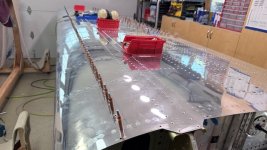
Marc, You will note that the fifth rivet back on the top of each nose rib has it's tail blocked by the stringer making it difficult to get a bucking bar in there. So, we removed the stringer clecos and slide the stringer out one end of the wing which gave us a clear shot at the rivet tail. Then we set the one rivet on each nose rib, slide the stringer back in place, clecoed it and pressed on.
Both ideas make total sense. Thank you!
 
Additionally, some Dowsil 737 silicone (Proseal would work too) was used on the middle rib to minimize the rib vibrating on the tube. I'm not sure why this metal to metal unsecured contact is OK.
This bothers me as well. I am thinking about riveting the tube to the middle rib.
 
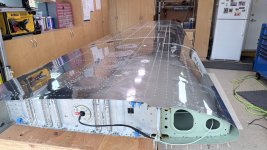
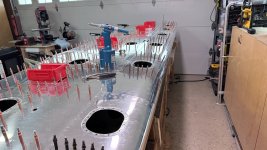
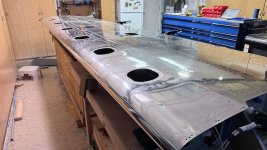
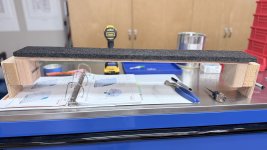
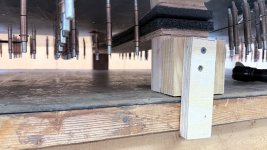
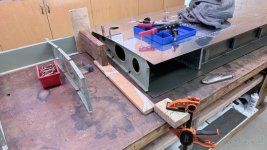
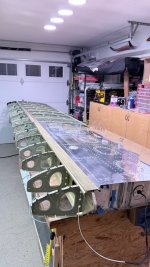
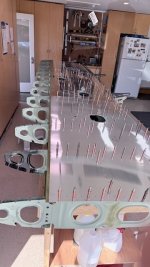
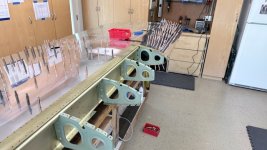
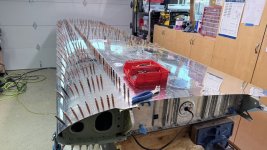
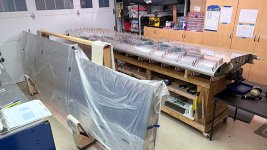
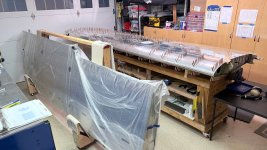
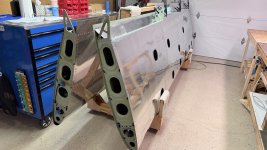
Here's a few pics of the stands used to hold the wing (and the ailerons and flaps). They were made out of spare wood from the shipping crates, and the foam used in the large crate. They should be made as wide as your table, and after early versions often slipped off the table, the side supports were added to keep the stands secure on the table.

1777403281662.jpeg

1777403297898.jpeg

They bend and conform to the wing.
 
Here's a few pics of the stands used to hold the wing (and the ailerons and flaps). They were made out of spare wood from the shipping crates, and the foam used in the large crate. They should be made as wide as your table, and after early versions often slipped off the table, the side supports were added to keep the stands secure on the table.

View attachment 116281

View attachment 116282

They bend and conform to the wing.


Nice! The foam will come in handy. How many supports are you putting under the wing?
 
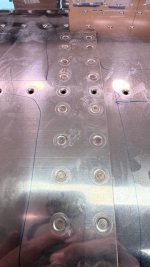
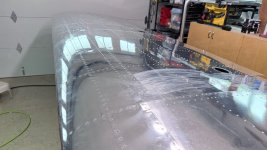
Was sick for a few days but finally managed to get the LEFT wing cleco'd and riveted. Recall that all the rivets forward of the main spar are solid flush rivets (426AD4-4). The process below is for that setup. (which is NON STANDARD)
1777782583008.jpeg

Thanks for the great input from others and the WIKI regarding solid rivets. I used a 3x gun, tungsten bucking bar, and pressure set to 40 PSI. It was no problem to buck the larger rivets and there's no need to use softer rivets.

However, with all the riveting completed, there's a pretty good cross section of quality of rivets as well as some unwanted dents in the sheet metal. I found it to be a tricky setup and many times your body, arms, etc. are not in ideal positions. An inspection mirror and light is a must.

I followed the sequence of events as laid out in the KAIs. If it called for a pulled rivet, then we pulled rivets. If it called to rivet the nose skin, we riveted the 426 rivets.

Here's the prep:
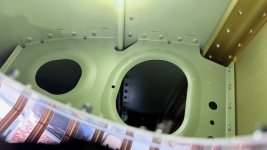
1. Do not install anything on or in the nose ribs until the riveting is done. That means plastic clips, pitot/AOA hose, snap bushings, landing light bracket and 1/4 rib, and wiring harness. You'll want as much room as possible in there. Most of this went in easily later on, but a ferw clips were tricky. Think through the sequence needed to re-install these parts, particularly around and behind the landing light bracket.
2. Remove the two stringers in the nose section, and only rivet those in after the other riveting is done. As mentioned above, it worked great to slide them out and they slid right back in later. (keep in mind the two short stringers are different, and only one works correctly per side)
3. Dimple the nose ribs, landing light bracket, 1/4 rib
4. Dimple the LE (nose) skins. Careful at the inboard and outboard edges as there are holes for fairings that don't get dimpled. I use a Sharpie to circle the holes that need a dimple.

The hardest part is the inboard set of rivets on the outboard double rivet edge sections. It's difficult to get to and inspect. A second SKILLED person would be very helpful.

You'll really have to decide if you want perfect rivets, or if you want to fly in a reasonable future time. Most turned out acceptable, a few were drilled out, and I decided to leave a few uglies in there. There's always a cost to drilling rivets, so it is a trade.

This would be super easy (SuperEasy™️) if Van's provided guidance that allowed flush pull rivets. Too late for me, but hopefully they can do that soon.
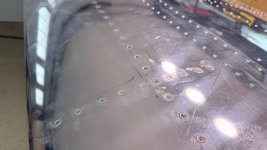
1777782862364.jpeg

Top skin:
1777782905869.jpeg

Bottom skin:
1777782941355.jpeg

1777782971570.jpeg

The AN5 bolt on the strut attach fitting was a super tight fit through the spar. You may want to check that prior to assembly.
1777783063506.jpeg

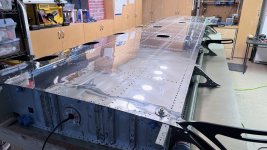
Next: secure wiring and install the fairing on the aft side of the wing.

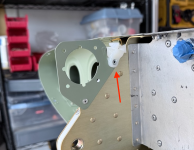
Additionally, the connector bracket was slightly modified to use a clip (I bought extra) which provies an elegant way to route the fuel sender wiring and ground wire to the main connector. Van's has not specified how they plan to incorporate the fuel sender wiring, but since the CiES senders use different wiring I am using the main connector for all electrical (fuel senders and puddle light power).

1777783806596.png
 
On to the tail
Almost! I was using micro/epoxy to fill the rivet holes in the flaps/ailerons but now tried Superfil for the wings. Superfil is working for me much better as it is easier to apply - you can do it with your fingers. Use a small syringe to place material, press in to the hole with your fingers, and then wipe off excess. Very easy to use. I expect a light touchup with a Scotchbrite pad.

1778248573588.jpeg
 
The right wing is moving along rapidly, much faster than the left wing now that I'm acquainted with the process.

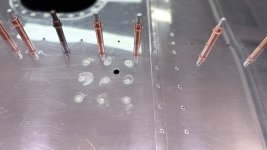
The area that gave me trouble before went fairly well. The aft spar section and aft ribs that require Cherry Max rivets only had two rivets that needed rework vs eight previously. I am convinced the key to successfully pulling these rivets is to have the rivet gun dead straight-on. Therefore I took some liberties with the aft ribs, and also ground down parts of the penumatic puller for more clearance with the top of the aft spar.

IMG_7453.jpeg

IMG_7454.jpeg

Note that the lower rib is bent down for installation.

It was helpful to use blocking so that ample pressure could be applied to the rivet squeezer to hold the flange flush to the main rear spar.

IMG_7455.jpeg

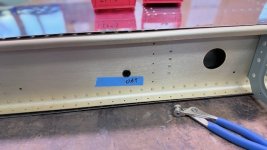
Finally, provisions for an OAT probe were installed. On the bottom of the cavity just outboard of the fuel tank I added a doubler and a 5/8" snap bushing in an existing hole in the main spar. The location was chosen because of the existing access panel, ability to get wiring through the main spar without drilling new holes, and the length of the OAT probe wire could be run to the wing root connector. Van's is planning to install the OAT probe in the fuselage belly, which I am not a fan of due to possible issue with engine heat and exhaust interference.

IMG_7457.jpeg

IMG_7459.jpeg

With the mixer boxes and other items prepped, this was about 10 hours of work from start to the image below.

IMG_7461.jpeg

Now ready for skins.
 
Last edited:
Looks great. Probably not on your radar at all, but did you think about what it would take to flush rivet the entire wing?
 
Hey Marc, you have probably already thought of this, but if you're putting the OAT probe on the bottom of the wing - and assuming you haven't already drilled the hole - you might consider putting it just inboard of the wing strut, so you're less likely to split your head open during a walkaround!

(Cessna puts their OAT probes and antennas on top of the wing center section... not something we're used to seeing on RVs!)
 
Hey Marc, you have probably already thought of this, but if you're putting the OAT probe on the bottom of the wing - and assuming you haven't already drilled the hole - you might consider putting it just inboard of the wing strut, so you're less likely to split your head open during a walkaround!

(Cessna puts their OAT probes and antennas on top of the wing center section... not something we're used to seeing on RVs!)
Hey Matt, thanks! That's exactly where it is located - inboard of the strut brace mount and under the wing. The poor picture above is of the doubler. I'll post some pics as soon as I flip the wing, later this week.
 
Looks great. Probably not on your radar at all, but did you think about what it would take to flush rivet the entire wing?
I don't believe the kit is designed for this. You could probably put flush rivets on the forward part of the main spar, but that would require countersinking the main spar, which I did not want to do.
 
I wonder why the instructions want every skin clekoed in place before putting in a rivet. I don't remember have to do that on the other RVs. You would think you could do the top and rivet, then flip it over and cleko and rivet the bottom?
 
The trick to saving clekos is in the stiffeners (I think). The ribs get clekos every other hole. The stiffeners only occasionally. The nose skins get a cleko in every hole.
1778546229327.jpeg

Rattle can primer is added at overlap points, per KAIs.
1778546263697.jpeg

First row of rivets installed.
1778546280156.jpeg

Solid rivets installed on LE skins, starting on the overlap section. While still difficult to reach some of these (recommend a helper), it went much easier the second time around.
1778546363537.jpeg

Steady progress.
1778546531846.jpeg
 

Attachments

  • 1778546378539.jpeg
    1778546378539.jpeg
    2.5 MB · Views: 8
The flush rivet leading edges still follow the same instructions as the standard kit, except the systems inside the LE are left out until later. The stringers are left out of the LE until after the top half is riveted. Below you can see the LE stringers being installed after the riveting is done:

1778818346535.jpeg

Inside of the LE after riveting:
1778818374867.jpeg

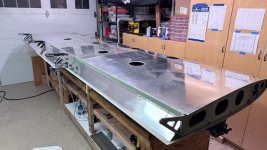
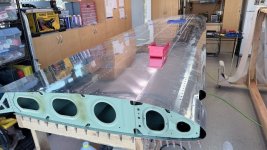
Completed top half, ready for flipping:
1778818402036.jpeg
 
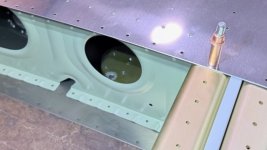
OAT probe.

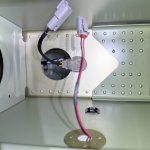
Van's is planning to install the OAT probe in the fuselage and I'd rather put it in the wing. It is just outboard of the fuel tank and inboard of the strut attach braces.

1779064284721.jpeg
R wing shown above, upside down.

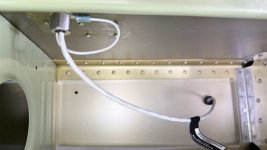
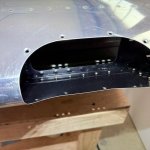
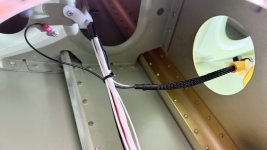
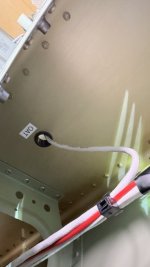
The wiring is routed through an existing 5/8" hole in the spar, where I added a snap bushing.
1779064321673.jpeg

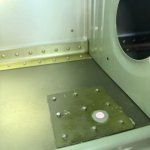
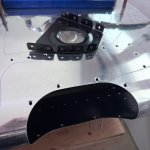
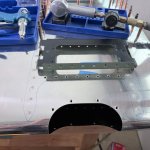
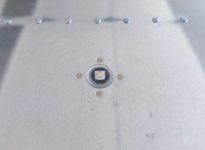
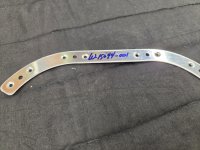
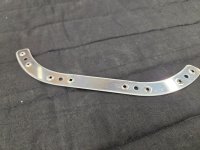
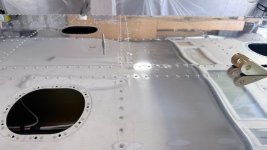
This is the doubler plate (I made it from scrap) that is on the bottom skin of the fuel tank assembly:
1779064369730.jpeg

And inside with OAT sensor installed (upside down):
1779064476792.jpeg

Doubler as seen on outside:
1779066408170.jpeg
 
Last edited:
Finishing the LE skin buildout (after using solid flush rivets). Recall that all the systems installation was deferred until after all the riveting was complete.

On the outboard edge of the wing, the sequence of assembly is important.
First the two wiring claps were installed.
1779064672748.jpeg

Then the smaller support rib was installed:
1779064695242.jpeg

Then the light bracket was installed:
1779064711809.jpeg

1779064718853.jpeg

Then the rest of the wiring brackets and wiring harness was installed. It's definitely tedious to do this now (rather than earlier) but necessary.
 
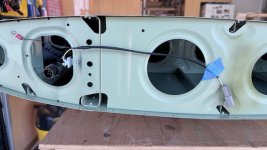
The wiring harness was stock, and slightly modified to add wiring for puddle lights (small LED lights for camping on their own battery), CiES fuel level sender, and OAT probe (on R wing).

There are two puddle lights on the bottom of the wing. One about 2/3 of the way out, and another in the (future) wingtip.
1779064966123.jpeg

1779064975289.jpeg

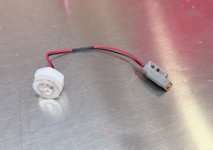
These are Deutsch DTM connectors:
1779065136360.jpeg

1779065146399.jpeg

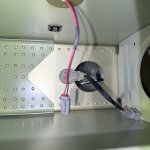
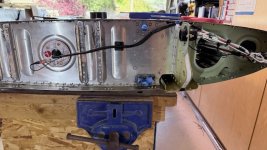
The wing is upside down here, but an existing hole in the spar was used to run wires from the harness and secure it with a ClickBond (CB4020V3N8, Cable Tie Mount, Right
Angle, .67" x .44" Nylon Saddle, 1/2" Length), and there is an access panel to install and connect the light after the wing is installed on the fuselage. The ClickBond is glued on so no holes have to be drilled in the spar.
1779065180959.jpeg

Or flipped:
1779065351718.jpeg

Power and ground come off the wiring harness. Power goes back the to main CPC connector at the wing root, and ground is sourced locally. I always use star washers in between the chassis and a flat washer to get a good ground through the primer.
1779065428354.jpeg

This is for the light in the wingtip:
1779065461446.jpeg

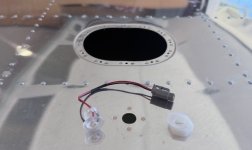
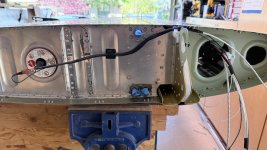
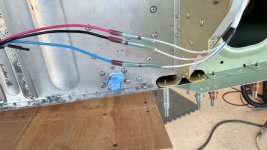
Here is the wiring at the wing root. It includes the standard wiring harness, plus the CiES fuel sender, OAT probe, and puddle light power.
1779065539312.jpeg

Environmental splices (Raychem Butt Splice D-436 Series) were used to extend the CiES fuel sender wiring to the connector:
1779065738990.jpeg

Pins for the CPC connector were crimped on (using special crimp tool from AMP) and added to the empty positions in the connector:
1779065592213.jpeg

The black cable clamp is a simple (and cheap) Home Depot clamp with the foam removed (it does not last) and cleaned with acetone. Use E6000 glue to adhere it.

Wing root connectors (AMP CPC Series 1):
Left Side: 206838-1
Right Side: 206036-1
 
Last edited:
OAT probe.

Van's is planning to install the OAT probe in the fuselage and I'd rather put it in the wing. It is just outboard of the fuel tank and inboard of the strut attach braces.

View attachment 117916
R wing shown above, upside down.

The wiring is routed through an existing 5/8" hole in the spar, where I added a snap bushing.
View attachment 117917

This is the doubler plate (I made it from scrap) that is on the bottom skin of the fuel tank assembly:
View attachment 117918

And inside with OAT sensor installed (upside down):
View attachment 117919

Doubler as seen on outside:
View attachment 117938
Is the OAT the standard Garmin probe for the G3X?
 
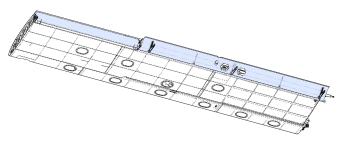
One additional comment on the wing kit and the flap cove skins.
1779079513546.png

I recommend two people to install the flap cove skin. It is onerous and delicate, needing a fine massage by two people who are being very careful. The trick is getting it over the flap tracks yet under the the wing skins.

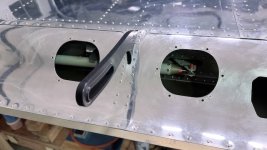
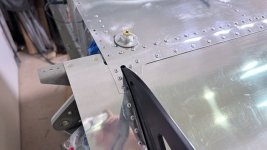
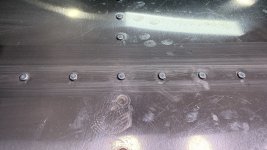
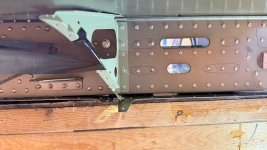
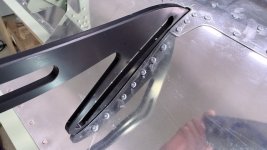
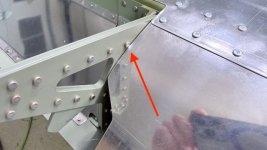
The middle flap track has a small recess that the cove skins tucks into. Please note that the outer flap tracks have no recess and the cove skin goes over them fairly readily. However, the middle one does have the recess and the skin it too tight to fit over the main part of the flap track without bending or warping. You have to slide it under, and the tabs from the main skin don't always tuck in nicely. Further, the rivets are very close to the flap tracks, so I had to use a close-clearance manual riveter. This is the area of concern:

1779079726304.jpeg

The outer flap tracks.
1779079782473.jpeg

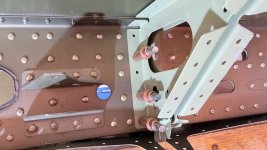
Finally, the outboard edge distance of the cove skin is tight with the rivets on the aileron bracket. It is not clear how the skin goes over or under some of the rivets. I think this is correct but not totally sure. Just slide it in.

1779079887156.jpeg

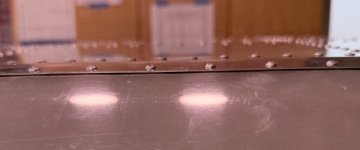
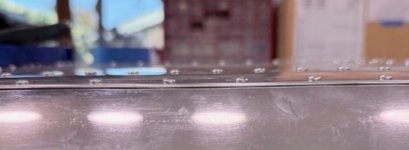
One other thing that is not in the KAIs. The instructions call for rolling the aft side of the lower skins, but do not say anything about the lower skin on the pre-built fuel tank. I recommend rolling that as well to match the other skins. It's actually not a big deal as it is in an obscure area, but if you want to be consistent...

This is aft tank skin not rolled:
1779080097402.jpeg

This is the adjoining skin, rolled:
1779080122668.jpeg
 
Last edited:
Marc, would it help if a couple of those rivets were set to min thickness/max width on the shop head?
There's really just that one rivet, and making it flatter could be a solution. I wonder what others have done here.
 
You could also make that rivet a double flush rivet.
Need to post location info to the wiki.

Boomer
 
You could also make that rivet a double flush rivet.
Need to post location info to the wiki.

Boomer
That would require doing that very early on in the build, long before you really knew what was going on there. Of course hindsight is 20/20. I guess someone else’s hindsight wouldn’t be the same thing. 🤪
 
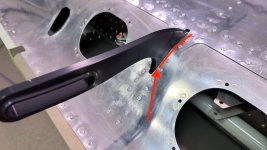
This is the Garmin pitot tube mast. Turns out it does not fit into the brackets provided with the kit. You'll see in the image below that the holes don't line up.

View attachment 114490

The mast does come with its own mounting bracket, which does fit. Since Van's isn't sharing what they're doing in the future for a pitot mast, I'll just install the Garmin mount. The other option is to install what came with the kit, and assume that Van's will provide an appropriate (and likely less expensive) pitot mast in the future. That's probably easiest, but of course not that path I'm taking. 🤷🏻

View attachment 114491
I am using the Garmin mast as well. With the holes in the Garmin plate being larger than the planned counter sunk rivet, I could make a washer to rivet or drill out the holes right through the skin and fasten it with hardware. What did you end up doing?
 
OAT probe.

Van's is planning to install the OAT probe in the fuselage and I'd rather put it in the wing. It is just outboard of the fuel tank and inboard of the strut attach braces.

View attachment 117916
R wing shown above, upside down.

The wiring is routed through an existing 5/8" hole in the spar, where I added a snap bushing.
View attachment 117917

This is the doubler plate (I made it from scrap) that is on the bottom skin of the fuel tank assembly:
View attachment 117918

And inside with OAT sensor installed (upside down):
View attachment 117919

Doubler as seen on outside:
View attachment 117938
Great Idea!
 
Last edited:
OAT probe.

Van's is planning to install the OAT probe in the fuselage and I'd rather put it in the wing.

Does anyone have any info on where on fuselage Van's is planning to install the OAT probe?
I would prefer not to end up with an extra hole somewhere in the fuse if the location is far enough away from the heat.
 
Does anyone have any info on where on fuselage Van's is planning to install the OAT probe?
I would prefer not to end up with an extra hole somewhere in the fuse if the location is far enough away from the heat.
They said on the underside of the fuselage out of the direct stream of the exhaust, but frankly, I don't think anywhere on the underside is OK.
 
I am using the Garmin mast as well. With the holes in the Garmin plate being larger than the planned counter sunk rivet, I could make a washer to rivet or drill out the holes right through the skin and fasten it with hardware. What did you end up doing?
I used a longer rivet so it would expand and fill the hole, but a washer would be good too.
 
Back
Top