

Van's Air Force

The definitive Van's Aircraft support community! Buying, building or flying an RV? Join our exclusive family of mentors and enthusiasts!

Questions about air cooling for engine cylinders

Sully73

Active Member
Patron
I am installing a Plenum system on my RV-8 to maximize the airflow through my engine cylinders. I have spent hours sealing the high pressure area (top of the cylinders) so cooling air is forced down through the cylinder fins.
The cabin heat supply air duct is currently on the back wall of the high pressure section above the cylinders. Question, Won't this steal cooling air from the high pressure section and lessen the amount of air being push through the cylinder fins? Is the a better place to mount the heater air intake duct? Or, should I install a valve on the current heater air duct so it can be closed on hot days? And, if I do this will it damage my heat exchange shroud by cutting off the air?
 
I think you will find that every airframe manufacturer uses a "dump" valve; where heated air not going to the cabin is dumped overboard. Yes, it is done this way to prevent overheating of the heat exchanger.
 
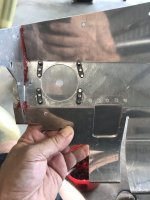
Yes, it takes some air away from cooling the engine. Pretty much every RV out there is configured like that. I guess you could design some sort of NACA inlet on the cowling that would supply air to the heat muff independent of the inlet air to the engine. However, this would possibly require experimentation of where and how to locate this inlet, and it may complicate how the cowling is removed. Another alternative is to install an orifice plate on the back baffle to limit the air that goes to the heat muff during the summer months. At the suggestion of another builder, I tried this approach, installing nut plates on the baffle to make this easier to take on and off without having to remove the plenum to get to the nuts. The photo shows a 1/2" hole in the orifice plate, which works just fine for me in southeast Texas. You may need a larger hole in Nebraska.
 

Attachments

  • IMG_5326.jpeg
    IMG_5326.jpeg
    1.3 MB · Views: 39
Yes, you're robbing high pressure air for cabin heat. But In my opinion, the upside of engineering and building a different way to get air into the heater muff is not worth the hassle it would take to get it from somewhere else.

The RV 14v baffles take ram air from the lower face of the baffle ramp in front of cylinder #1, but it also has a 5" hole in the aft baffle behind #3 that feeds the oil cooler, so imagine how much cooling air youre loosing through that gargantuan hole. Same with the air that's being diverted thru the oil cooler behind #4 on the parallel valve engines and whatever blast tubes you may have back there.

Pretty much the only option I can think of other than taking it off the baffle ramp like the RV14 (which is obviously robbing ram air before it even gets to the high pressure area inside the cowl) would be to install a NACA vent in the cowl and get ram air from outside. Then you would have to screw around with taking all that loose every time you wanted to get your cowl off. I have. buddy with a GlasStar and thats how it's done on that plane, for what it's worth.

Personally, I'd put it together per plan. After you get it flying if you think you have an issue, then cover the hole in the baffle with speed tape and see if you get a significant result. If you do it now, you're trying to solve for a problem before you know if it exists, and implementing a solution that you don't know will actually lead to a significant improvement.

Edit- I wouldn't leave that hole blocked with tape forever, because heat muffs are pretty lightweight. I think it probably needs that air going through to keep it from overheating whether you're piping it into the cabin or dumping it overboard.
 
Yes, it takes some air away from cooling the engine. Pretty much every RV out there is configured like that. I guess you could design some sort of NACA inlet on the cowling that would supply air to the heat muff independent of the inlet air to the engine. However, this would possibly require experimentation of where and how to locate this inlet, and it may complicate how the cowling is removed. Another alternative is to install an orifice plate on the back baffle to limit the air that goes to the heat muff during the summer months. At the suggestion of another builder, I tried this approach, installing nut plates on the baffle to make this easier to take on and off without having to remove the plenum to get to the nuts. The photo shows a 1/2" hole in the orifice plate, which works just fine for me in southeast Texas. You may need a larger hole in Nebraska.
Thanks for this information. Very helpfull
 
Yes, you're robbing high pressure air for cabin heat. But In my opinion, the upside of engineering and building a different way to get air into the heater muff is not worth the hassle it would take to get it from somewhere else.

The RV 14v baffles take ram air from the lower face of the baffle ramp in front of cylinder #1, but it also has a 5" hole in the aft baffle behind #3 that feeds the oil cooler, so imagine how much cooling air youre loosing through that gargantuan hole. Same with the air that's being diverted thru the oil cooler behind #4 on the parallel valve engines and whatever blast tubes you may have back there.

Pretty much the only option I can think of other than taking it off the baffle ramp like the RV14 (which is obviously robbing ram air before it even gets to the high pressure area inside the cowl) would be to install a NACA vent in the cowl and get ram air from outside. Then you would have to screw around with taking all that loose every time you wanted to get your cowl off. I have. buddy with a GlasStar and thats how it's done on that plane, for what it's worth.

Personally, I'd put it together per plan. After you get it flying if you think you have an issue, then cover the hole in the baffle with speed tape and see if you get a significant result. If you do it now, you're trying to solve for a problem before you know if it exists, and implementing a solution that you don't know will actually lead to a significant improvement.

Edit- I wouldn't leave that hole blocked with tape forever, because heat muffs are pretty lightweight. I think it probably needs that air going through to keep it from overheating whether you're piping it into the cabin or dumping it overboard.
Thank You, for this reply. Good Advice!
 
Yes, it takes some air away from cooling the engine. Pretty much every RV out there is configured like that. I guess you could design some sort of NACA inlet on the cowling that would supply air to the heat muff independent of the inlet air to the engine. However, this would possibly require experimentation of where and how to locate this inlet, and it may complicate how the cowling is removed. Another alternative is to install an orifice plate on the back baffle to limit the air that goes to the heat muff during the summer months. At the suggestion of another builder, I tried this approach, installing nut plates on the baffle to make this easier to take on and off without having to remove the plenum to get to the nuts. The photo shows a 1/2" hole in the orifice plate, which works just fine for me in southeast Texas. You may need a larger hole in Nebraska.
I reduced mine to a one-inch orifice for the one mounted on the rear baffle and even then, had to take the steel wool out of the heat muff. I've always been amazed how we try and fill every small seam in our baffle area and then have 3/4 in blast tubes, 2 in heat muff holes and a 4-5 in gigantic hole for our oil coolers. 😱 For my parallel valve 540 I close the flapper until my OT gets to 200 F and push all that air through the engine cylinders. Really helps with cooling for the first 3 or 4 mins of climb till I get to ~ 3,000 and find cooler air even in Florida. After that go LOP and reduce power to 65% and cruise climb to altitude. No cowl flaps or added cooling to increase drag, my pet peeve.

Here is a pic of a world class builder (now banned on this site, hopefully not much longer) of his NACA vents for heating. He had to go to carbon fiber as the thermoplastic ones warped, but I thought a unique solution and keeps more air to cool his engine and oil.

Screenshot 2026-06-01 101056.png
 
I am installing a Plenum system on my RV-8 to maximize the airflow through my engine cylinders. I have spent hours sealing the high pressure area (top of the cylinders) so cooling air is forced down through the cylinder fins.
The cabin heat supply air duct is currently on the back wall of the high pressure section above the cylinders. Question, Won't this steal cooling air from the high pressure section and lessen the amount of air being push through the cylinder fins? Is the a better place to mount the heater air intake duct? Or, should I install a valve on the current heater air duct so it can be closed on hot days? And, if I do this will it damage my heat exchange shroud by cutting off the air?
What engine are you putting in and does it have oil squirters ?
 
I have heated a -4, -7A, and HRII by picking up the hot exit air out of the oil cooler. Simple enough to point an open 2” SCAT tube at the back of the cooler.
I’m in Northern AZ where we get snow every winter and it does a great job, but It’s likely not warm enough for those in ultra cold northern climates.
It is simple, light, and makes use of free airflow.
 
Last edited:
The gigantic oil cooler hole generally isn't a pressure loss, as the cooler fins provide a significant flow restriction.

Just polishing the pins ....
 
The gigantic oil cooler hole generally isn't a pressure loss, as the cooler fins provide a significant flow restriction.

Just polishing the pins ....
That seems reasonable. I suppose the folks who stuff the heater muff full of steel wool are also creating a flow restriction. Do they see a noticeable drop in CHT's when they do that? I don't know the answer, but I think for the purpose of this conversation it probably doesn't matter.

At least for me, at some point, I have to dumb down the math or I'd never get anything done :)
 
Back
Top