

Van's Air Force

The definitive Van's Aircraft support community! Buying, building or flying an RV? Join our exclusive family of mentors and enthusiasts!

Pre built fuel tanks

TShort

Well Known Member
Friend
Curious what others are doing for the “QB” fuel tanks shipped with the kits.

The KAI say to flush with avgas (against my better judgement I did this on the L tank, and I think it was a waste of time and not worth the hassle/mess/risk. I filtered thru a coffee filter and basically got nothing. Won’t be doing it on the R tank). They then have you close the inspection panels and install the fuel sender, then leak / pressure test.

I watched the video from a few weeks ago where they talked about the commercial tank tester at the factory. So, in my mind, repeat leak testing is mainly to check our install of the cover plates and sender. I am not ready to close up the tank quite yet. I’ve done enough proseal work that I’m not super worried about closing the tank.

I just clecoed the main spar to the wing assembly. Once I rivet this, access to a lot of the tank is gone. Now I am scratching my head about doing a leak test before closing off the tank further.

What are others planning?
 
Curious what others are doing for the “QB” fuel tanks shipped with the kits.

The KAI say to flush with avgas (against my better judgement I did this on the L tank, and I think it was a waste of time and not worth the hassle/mess/risk. I filtered thru a coffee filter and basically got nothing. Won’t be doing it on the R tank). They then have you close the inspection panels and install the fuel sender, then leak / pressure test.

I watched the video from a few weeks ago where they talked about the commercial tank tester at the factory. So, in my mind, repeat leak testing is mainly to check our install of the cover plates and sender. I am not ready to close up the tank quite yet. I’ve done enough proseal work that I’m not super worried about closing the tank.

I just clecoed the main spar to the wing assembly. Once I rivet this, access to a lot of the tank is gone. Now I am scratching my head about doing a leak test before closing off the tank further.

What are others planning?

I’m not going to flush the tanks for reasons you state. I will do a leak check on the senders and access panels once the tank is closed. I haven’t decided when to close the tank but as you said, once it is part of the structure, access is restricted.
 
On the one side that I have attached I inspected closely for the things called out in the KAI. There were a few sealant nibs and some stray packing foam hiding in there. Also wiped it down well with a gas wetted rag. I'll probably do that again before sealing, which I won't do until I have the skin overlaps done so I can do all or most of the sealant work in one session (if my space allows).
 
Revisiting this to see if there is any more input from those building.

I decided to wait to seal the tanks - at least the left one, which is now part of my nearly finished wing. I sealed it a couple weeks ago, and leak tested it over the last few days.

I will start by saying I understand the intent of the balloon, and the procedure for testing as well as the implications of barometric pressure and temp on the balloon itself.

The issue is that on a tank which has been installed in the wing, you cannot spray soapy water (or leak detector) on all the seams / rivet lines. Some are not accessible.
I tested the sender and the cover plates which I installed. No leaks. I decided to leave the balloon inflated ... over 36+ hours, it has gradually deflated (probably 70%, not totally empty). Baro pressure has actually dropped, and temps in the shop are steady +/- 1 degree (I put a wireless temp sensor on the tank itself).

I'm not sure if I should ignore this balloon or not. My thinking is that such a slooooooow loss of pressure might not even be detectable with leak solution (assuming there is even a leak in the tank itself, vs just the cheap Amazon balloon).

I recall reading in other threads that some of you have not closed the tanks before building - what are you guys doing for testing? Just using the balloon, testing the stuff you sealed, and moving on?

I sealed the right tank this week and will test it before building the right wing just to eliminate this uncertainty...
 
Last edited:
balloon? They're, to some degree, porous and will deflate by themselves over time. Testing my RV-4 tanks I used an old altimeter which whilst also subject to P and T changes I was sure to be leak free...
 
You could inflate a second balloon, tie it off, and use it as a “control”.

Balloons are porous, as has been stated, and will deflate over time.
 
I am testing mine before getting it on the spar so I can spray it all. Trying to pinpoint a leak that is behind the spar does not sound like much fun. However, with the factory pressure testing, the factory work should not have leaks. You only really know you have no leaks until you fill it with fuel IMO.
 
A manometer works better. Hook a clear five to eight foot Tygon tubing up to the port and configure it into a big U shape that goes below than back up to the port level. When you fill the U part way up with water that will seal it. Then inflate it like you would with the balloon until the water levels are somewhat different, 6-18". This will test it for months. And it will go up and down with barometric pressure.
 
A manometer works better. Hook a clear five to eight foot Tygon tubing up to the port and configure it into a big U shape that goes below than back up to the port level. When you fill the U part way up with water that will seal it. Then inflate it like you would with the balloon until the water levels are somewhat different, 6-18". This will test it for months. And it will go up and down with barometric pressure.
Temp will also change it significantly.
 
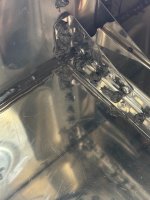
Did you guys remove the "tendrills" by hand by pulling or cutting them off one by one?
 

Attachments

  • tendrills.jpeg
    tendrills.jpeg
    476.2 KB · Views: 61
Back
Top