
Van's Air Force
You are using an out of date browser. It may not display this or other websites correctly.
You should upgrade or use an alternative browser.
You should upgrade or use an alternative browser.
IO-360-A1B6 vs -A1A
- Thread starter kbalch
- Start date


I don't know anything about the poweer settings, but I am considering a B6 for my plane as well. Hesitant due to the extra weight. Does the extra HP make up for that and then some? Why do you prefer the angle valve engine?I've been planning on the -A1B6 for my new -8, but have just located an -A1A. Identically configured, it's $20K cheaper. Is there any reason to be concerned with the power setting limitations of its non-counterweighted crank?

Power setting limitation is dependent on which propeller you use. I have the IO-360 A1A in my RV-7 with the Whirlwind 330 propeller and love the combination. No power setting limitations but a personal preference to stay above 2250. Also you are saving some pretty substantial weight on the front end with non-counterweighted crank. In all fairness however, if you get the counterweighted crank and Whirlwind 300 propeller would probably be about equal in weight. Don't think you can go wrong with either option.

kbalch
Well Known Member
I prefer the angle valve chiefly for its HP advantage over the parallel valve engine. Between the -A1B6 and the -A1A (both angle valve engines), the HP is identical.I don't know anything about the poweer settings, but I am considering a B6 for my plane as well. Hesitant due to the extra weight. Does the extra HP make up for that and then some? Why do you prefer the angle valve engine?
I've had both parallel and angle valve. I personally prefer the angel valve due to piston squirters however nothing is free because you pay with increase oil temperature (easy to mitigate), however the Angle valve cylinders are more expensive.I don't know anything about the poweer settings, but I am considering a B6 for my plane as well. Hesitant due to the extra weight. Does the extra HP make up for that and then some? Why do you prefer the angle valve engine?
kbalch
Well Known Member
I hadn't ever considered the Whirlwind prop, but some quick research really favors the 330 with the -A1A. That might very well be the plan!Power setting limitation is dependent on which propeller you use. I have the IO-360 A1A in my RV-7 with the Whirlwind 330 propeller and love the combination. No power setting limitations but a personal preference to stay above 2250. Also you are saving some pretty substantial weight on the front end with non-counterweighted crank. In all fairness however, if you get the counterweighted crank and Whirlwind 300 propeller would probably be about equal in weight. Don't think you can go wrong with either option.

The A1B6 is counter weighted, the A1A is not. The difference in weight, per the Lyco book, is ~8lbs.
While the A1A comes with "keep out" ranges, it doesn't have the same risk of "detuning" the c-weights when doing rapid moves with the throttle (e.g. formation flight).
Do verify that the engine you've found comes with piston squirters (most Angle Valves do, but there might be an odd build out there...) and roller lifters.
Save the 20K, and use it toward a Hartzell Composite prop.
While the A1A comes with "keep out" ranges, it doesn't have the same risk of "detuning" the c-weights when doing rapid moves with the throttle (e.g. formation flight).
Do verify that the engine you've found comes with piston squirters (most Angle Valves do, but there might be an odd build out there...) and roller lifters.
Save the 20K, and use it toward a Hartzell Composite prop.

RV8Squaz
Well Known Member
Hey Ken! It depends on the prop. My old Hartzell has an RPM restriction with the A1A of avoid continuous operation at 2000-2350 RPM. This is never a problem because I’m usually in the 2400-2600 range. Best to check the TCDS (Type Certificate Data Sheet) for your intended prop. The TCDS lists engine/prop combinations. If it’s not a certificated prop, a TCDS likely doesn’t exist. You’ll have to consult with Whirlwind to see if there are any RPM restrictions if you intend to use that prop.
RV8Squaz
Well Known Member
There is no power difference. The difference is that you could potentially use certain propellers without having an RPM restriction. The engines are the same except for the counterweighted crankshaft.I don't know anything about the poweer settings, but I am considering a B6 for my plane as well. Hesitant due to the extra weight. Does the extra HP make up for that and then some? Why do you prefer the angle valve engine?
kbalch
Well Known Member
Hey Jerry - Great to hear from you! Whirlwind says that there aren't any RPM restrictions with their prop. I'm very tempted to go with their 3-blade 330 model.Hey Ken! It depends on the prop. My old Hartzell has an RPM restriction with the A1A of avoid continuous operation at 2000-2350 RPM. This is never a problem because I’m usually in the 2400-2600 range. Best to check the TCDS (Type Certificate Data Sheet) for your intended prop. The TCDS lists engine/prop combinations. If it’s not a certificated prop, a TCDS likely doesn’t exist. You’ll have to consult with Whirlwind to see if there are any RPM restrictions if you intend to use that prop.
My bad. I am just learning about the engine letters and numbers, and I didn't know the A1A was not a parallel valve engine.There is no power difference. The difference is that you could potentially use certain propellers without having an RPM restriction. The engines are the same except for the counterweighted crankshaft.
RV8Squaz
Well Known Member
No worries. Lycoming has decoding chart somewhere that explains all of the prefixes and suffixes. It’s hard to find.My bad. I am just learning about the engine letters and numbers, and I didn't know the A1A was not a parallel valve engine.
Hey Ken,Hey Jerry - Great to hear from you! Whirlwind says that there aren't any RPM restrictions with their prop. I'm very tempted to go with their 3-blade 330 model.
Just another data point. I have the first Whirlwind 330-3 prototype that Whirlwind produced prior to open sells of the propeller and eventual sell to Hartzell. I've got about 600 hrs on the propeller now and had the 500 hr inspection completed prior to Jim selling the company. The propeller has amazing capability and one piece milled hub takes all the power pulses on the non counterweighted crank. No leaks in 600 hrs for what its worth. I think I did a write up 4 years ago that is somewhere on the site.

TParker
Well Known Member
I'd recommend doing some reading of Hartzell Manual 193, Volume 1 and Volume 2: Section 4 in Volume 2 for general info and then Volume 1 for specific engine/prop combinations.
To be clear(er): other than max RPM, there are no known operating restrictions but determination of specific restrictions, or lack thereof, requires more testing than Whirlwind has completed.Whirlwind says that there aren't any RPM restrictions with their prop.
kbalch
Well Known Member
Fair enough; much appreciated.I'd recommend doing some reading of Hartzell Manual 193, Volume 1 and Volume 2: Section 4 in Volume 2 for general info and then Volume 1 for specific engine/prop combinations.
To be clear(er): other than max RPM, there are no known operating restrictions but determination of specific restrictions, or lack thereof, requires more testing than Whirlwind has completed.
kbalch
Well Known Member
Cool; thanks! Sounds very good...Hey Ken,
Just another data point. I have the first Whirlwind 330-3 prototype that Whirlwind produced prior to open sells of the propeller and eventual sell to Hartzell. I've got about 600 hrs on the propeller now and had the 500 hr inspection completed prior to Jim selling the company. The propeller has amazing capability and one piece milled hub takes all the power pulses on the non counterweighted crank. No leaks in 600 hrs for what its worth. I think I did a write up 4 years ago that is somewhere on the site.
Hey Trevor,I'd recommend doing some reading of Hartzell Manual 193, Volume 1 and Volume 2: Section 4 in Volume 2 for general info and then Volume 1 for specific engine/prop combinations.
To be clear(er): other than max RPM, there are no known operating restrictions but determination of specific restrictions, or lack thereof, requires more testing than Whirlwind has completed.
So now that Hartzell owns Whirlwind, is Hartzell going to start running additional harmonic/vibration testing to the Whirlwind line? Would love to see data on the referenced general information within the Hartzell manual that specifies the frequency bands most detrimental to dangerous harmonics. Just food for thought and maybe Hector could help.
Lycoming sells a list of model numbers and the airplanes that used them. Probably not up to date but useful.No worries. Lycoming has decoding chart somewhere that explains all of the prefixes and suffixes. It’s hard to find.
TParker
Well Known Member
Remains to be seen, but don't count on it. This type of testing isn't free, and is part of why WhirlWind costs less. If we make a WhirlWind cost almost as much as a Hartzell, do you still want it?Hey Trevor,
So now that Hartzell owns Whirlwind, is Hartzell going to start running additional harmonic/vibration testing to the Whirlwind line?
It's pretty difficult to generalize this; the strict answer is any RPM band that drives stresses above the fatigue allowable. The whole thing (prop, engine, ignition) is a system, so each influences where the peak stress ranges are. And even then the amplitudes can differ and the capability of the particular prop can differ, so a particular RPM band can have acceptable stresses with one propeller/engine/ignition combo and unacceptable with another; there's no point in avoiding an RPM range where the stresses are fine with one combo just because they aren't fine with a different one. This illustrates it pretty well:Would love to see data on the referenced general information within the Hartzell manual that specifies the frequency bands most detrimental to dangerous harmonics.
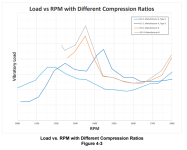
This is the same prop on four different engine configurations (really, three very different engines and one additional compression ratio on one of them) and one type of ignition system. The peaks are different both in amplitude and RPM band. With only data from one or two, I'd be hard pressed to accurately predict what the next one looks like. And this chart is just one measurement gage location on the prop, for one flight condition.
I can't speak for the A1A..... but I love my Angle valve A1B6 in my RV-8! I do seem to outrun my other RV buddies without much effort in accel and climb. Cruise is probably negligible.I don't know anything about the poweer settings, but I am considering a B6 for my plane as well. Hesitant due to the extra weight. Does the extra HP make up for that and then some? Why do you prefer the angle valve engine?
What I also really like about is it seems to run MUCH cooler on really hot days than my non-Angle valve guys I fly formation with. I never seem to have any CHT or Oil temp issues while some are asking to pull it back or level off so they can cool down a bit.
It is definitely more nose heavy than a regular O/IO-360. With a hartzell two blade metal prop - I was almost maxing out nose up trim if I was landing solo. With a pax in the back seat it was OK. I swapped out to a WW-300-3 Blade specifically to lighten the nose up some. It definitely is better (and smoother), but its still a bit nose heavy. Even with the metal prop it was managable, you just had to be aware of it. I wouldn't trade it for anything.
