

Van's Air Force

The definitive Van's Aircraft support community! Buying, building or flying an RV? Join our exclusive family of mentors and enthusiasts!

Fuel Tank Testing

rocketman1988

Been around for awhile...
Sponsor
I have the factory built tanks. After hearing that some have had leaks in the factor built tanks, I decided to test mine.

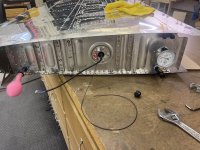
In order to eliminate any potential leaks, I used AN6 gauge fittings on the two AN6 tank fittings. On the first, I mounded the Schrader valve. The second, a 0-5 psi gauge was installed. the two AN4 fittings were capped with AN caps. The fuel sump was plugged with a brass NPT plug. All NPT threads were sealed using loctite 567.

The fuel caps were adjusted and the o-rings lubed with Krytox.

The tank was then pressurized to 0.8 psi. The plans say no more than 1 psi.

The tank leaked down in about 24 hours.

Pressurized the tank again. This time, I went over ever rivet and every seam with Camco gas leak detector fluid. No bubbles at all. The tank leaked down in 24 hours.

Next, I transferred the AN fittings to the right tank and performed the exact same process. Tank leaked down in 24 hours...basically the same rate as the left tank.

I have sprayed all of the AN fittings, the valve, and the gauge...no bubbles.

I am at a loss, and two days wasted.

Didn't have this much trouble with the -10 tanks...

The worst part was looking at the "inspected by" stickers, while the tanks leaked down.

So, has everyone tested their tanks? What are you seeing?
 
What are people doing for temporary gaskets for the access panels and fuel sender during the tank pressure tests?

I finished building the right tank. I want to pressure test it before I go any further but don't want to mess with pulling sealant off the access covers if I can avoid it.
 
What are people doing for temporary gaskets for the access panels and fuel sender during the tank pressure tests?

I finished building the right tank. I want to pressure test it before I go any further but don't want to mess with pulling sealant off the access covers if I can avoid it.
You will have to test it again after you do the panels, right?
 
What are people doing for temporary gaskets for the access panels and fuel sender during the tank pressure tests?

I finished building the right tank. I want to pressure test it before I go any further but don't want to mess with pulling sealant off the access covers if I can avoid it.
I only tested after final closure and sealing of the access panels.

Unfortunately this means if you find a leak (like I did), at least one panel is coming back off…
 
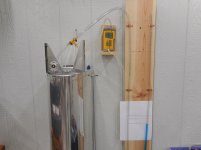
Hard to beat a balloon…I’ve seldom used a gage…but a Schrader valve and a balloon zip tied on a brass nipple works
That balloon is there to prevent over pressurizing the tank, though it may show a relatively large leak. I prefer a gauge or manometer...well, unless the gauge is leaking. :unsure:
 
Honestly, a pre welded integral tank would have been so much better.
THIS. But I get it, it's a 'homebuilt' after all, designed to be done on the cheap by builders like me who have never built an airplane before.

I'm a few weeks out from testing my tanks so I'll be watching this thread.
 
Why aren’t we using “fuel cells” like they do in the racing world? I think Extra Aircraft is using plastic (some form) for their fuel tanks. My 70 year old Bonanza has fuel bladders and the reliability and crash worthiness far exceeds the wet wing design. Maybe the new folks running vans will turn their attention to making improvements to their old designs instead pushing out another new product every several years. It was such a great design to begin with, seems like low hanging fruit to me.
 
Have you leak checked the schrader valve? Notorious leak points. Might also try soappy wayer from a sprayer. I have almost been dupped a couple times where the flow was great enough that the bubbles won’t be seen unless the area is floode with fluid. With a light coat, the air just pushes away the water without making a bubble. Losing 1 psi in 24 hours with that much tank volume is not a tiny leak.
 
Use an aircraft hydraulic Schreder valve…they are good for 3400+ psi and don’t leak.

The balloon is very practical, as you can inflate it pretty large and let sit for days…I zip tie them and then wrapped with a couple wraps of gap seal tape from sailplanes, but electrical tape works fine too.

The most likely place you find leaks are the aft corners and then fuel senders and access plates.

The easiest trick ‘I’ve found for finding leaks, is to fill the tank with a quart of isopropyl alcohol and rotate it around…if you have a leak, isopropyl is way finer than air and in short order, you will find your leak…ISO won’t hurt the Pro Seal and evaporates rapidly once you drain it.
 
That balloon is there to prevent over pressurizing the tank, though it may show a relatively large leak. I prefer a gauge or manometer...well, unless the gauge is leaking. :unsure:
The air volume in the tank is large enough that it doesn’t take much of a change in ambient temperature to show a very noticeable change in the balloon inflation.
That is why the instructions from Vans has never included, referencing the balloon as evidence of a leak. As others have mentioned, it is a pressurization indicator and to help prevent over pressurization. Using a leak indicator solution while the tank is pressurized is the only reliable method in my opinion.
 
I had a slow leak in the centre of the gas cap even though it was adjusted correctly and had duct tape over it. The air still managed to get out. I switched gas caps and it solved my problem.
 
The tanks are in an air conditioned shop so temp shouldn’t be much of a factor.

Can’t control the barometric pressure but it is highly unlikely that it changed enough to cause a 0.8 psi change.

Schrader valve has been changed to a new one.

I have been through almost two bottles of Camco Gas leak detector fluid which works much better than soap and water. Almost no way to miss bubbles.

I really do not want to fill the tanks with gas and the have them sit full of fumes in my shop for the remainder of the build. That will be a last resort.

I am considering using one of the crates and lining it with plastic sheet. Secure the pressurized tank in the crate and then fill the crate with water. Kind of like how they find a leak in a tire.

Very frustrating, but building the tank into the wing and then finding a leak would be worse.
 
Last edited:
I am considering using one of the crates and lining it with plastic sheet. Secure the pressurized tank in the crate and then fill the crate with water. Kind of like how they find a leak in a tire.
that was going to be my next suggestion. There is a reason shops sacrifice space for a big tank. just too easy to miss leaks with spray on solutions. obviously a major hassle, but sounds like you are out of options. should be able to buy a cheap kiddie pool.
 
that was going to be my next suggestion. There is a reason shops sacrifice space for a big tank. just too easy to miss leaks with spray on solutions. obviously a major hassle, but sounds like you are out of options. should be able to buy a cheap kiddie pool.
I hate to say this, but what about pressurizing the tank and them putting it in a blow up wading pool> hey Bob--you have a swimming pool? Hot Tub? :unsure:
 
That balloon is there to prevent over pressurizing the tank, though it may show a relatively large leak. I prefer a gauge or manometer...well, unless the gauge is leaking. :unsure:
The balloon could be a leak source. I didn't used one. Also, I needed to put packing tape over my gas caps to stop a very slow leak there. I used the manometer method and left it set up for a few days. It's a very sensitive test that worked for me. YMMV....;)
 
The balloon could be a leak source. I didn't used one. Also, I needed to put packing tape over my gas caps to stop a very slow leak there. I used the manometer method and left it set up for a few days. It's a very sensitive test that worked for me. YMMV....;)
Not using the balloon. All fittings are hard plumbed with a gauge.
 
Back
Top