

Van's Air Force

The definitive Van's Aircraft support community! Buying, building or flying an RV? Join our exclusive family of mentors and enthusiasts!

Door Seal Recommendation?

Dad's RV-10

Well Known Member
Sponsor
When my father fit the doors and cabin top, he did not incorporate a McMaster style door seal on the cabin lip. Without getting into extensive glass work, the cabin lip will not properly accept that style seal. At this stage, I'm not going to get into that.

He used some kind of foam seal on the door itself (per the plans?) but after 12+ years, it's falling off and needs to be replaced. It's a square gray foam seal. I have no idea what type or the source.

Looking for recommendations for a en effective, durable seal to be applied directly to the door.

Thanks.
Door Seal.jpg
 
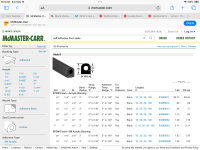
I did self adhesive door seals from McMaster. 12 years on the plane and still working. Cheap and easily replaced if needed.

I suggest you get some 3/8” tall as well as some 1/2” tall and see what works best for you.

You will need to fill in the gap associated with the door hinge and run the seal over it. I used some scrap rigged packing foal (like your wheels/brakes came in) and some black RTV to hold it in.

Carl
 

Attachments

  • door seal.jpeg
    door seal.jpeg
    140.3 KB · Views: 158
I did self adhesive door seals from McMaster. 12 years on the plane and still working. Cheap and easily replaced if needed.

I suggest you get some 3/8” tall as well as some 1/2” tall and see what works best for you.

You will need to fill in the gap associated with the door hinge and run the seal over it. I used some scrap rigged packing foal (like your wheels/brakes came in) and some black RTV to hold it in.

Carl
Carl,

Which style of seal did you use. To me looks like style D or possibly F?
 
Carl, neat idea. Might make my issue easier to solve.
The knife edge that people often use eppxy/flox to build up with, what do you put on that edge? Anything?
Thanks you,
Jtm4
No. The seal sticks to the outside flange on the door and seals against the inside surface of the cabin top door opening. The edge of the cabin door opening is sanded enough so it does not hit the door when closed (per the instructions).

Side note - on the new RV-10 build I may go with 3/8” tall, 3/8” wide seals instead of the 7/16” tall, 3/8” seals. Easy to experiment with each.

Carl
 
No. The seal sticks to the outside flange on the door and seals against the inside surface of the cabin top door opening. The edge of the cabin door opening is sanded enough so it does not hit the door when closed (per the instructions).

Side note - on the new RV-10 build I may go with 3/8” tall, 3/8” wide seals instead of the 7/16” tall, 3/8” seals. Easy to experiment with each.

Carl
Carl, It is me that texted.
Can you share a photo of where you put the double sided tape seal? I am having a tough time visualizing where to try this on mine. The logical lip is very short, maybe 1/4 inch.

LOL, it is the same picture, I am an idiot!
 
Last edited:
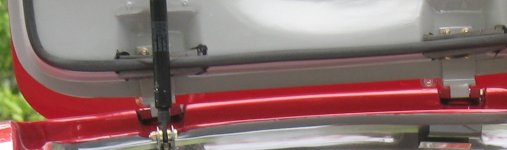
This will give you an idea of how I did it. Note that the door opening flange has been slightly widened and flattened to provide a sealing surface
 

Attachments

  • IMG_7731.jpeg
    IMG_7731.jpeg
    2.8 MB · Views: 125
  • Like
Reactions: RNB
This will give you an idea of how I did it. Note that the door opening flange has been slightly widened and flattened to provide a sealing surface
Manufacturer might have a different recommendation for orientation, but this seems to make sense.

 
Manufacturer might have a different recommendation for orientation, but this seems to make sense.

I'm inferring that you're implying Kyle has his struts inverted such that the rods are facing upward, however I have them the same orientation - because when the door is closed the rod is oriented downward, which is the position my doors spends the majority of their time in - thereby keeping the oil on the seals.
 
I'm inferring that you're implying Kyle has his struts inverted such that the rods are facing upward, however I have them the same orientation - because when the door is closed the rod is oriented downward, which is the position my doors spends the majority of their time in - thereby keeping the oil on the seals.
You missed the second reason why the piston needs to be oriented down, "provides dampening at the end of the stroke, hinges etc." of course as experimental builders free to point the piston any direction you feel comfortable with or if you don't want it to dampen at the end of the stroke.
 
Last edited:
You missed the second reason why the piston needs to be oriented down, "provides dampening at the end of the stroke, hinges etc." of course as experimental builders free to point the piston any direction you feel comfortable with or if you don't want it to dampen at the end of the stroke.
I’m not sure what you’re contending.

Thanks for reaffirming we have the freedom to build as we see fit, however I did not miss anything regarding dampening, or the installation instructions from pretty much every gas strut vendor that recommends having the piston rod orientated downward while at rest to maintain the oil seal retaining the gas, which is the main reason. The seal maintained in an oil bath does aid dampening.

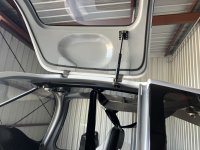
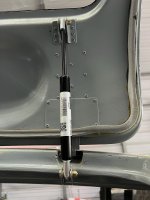
The installation shown in the photo shows the correct installation. Note that the piston rod faces upward when the door is open, and then rotates downward when the door is closed, which is the resting position. Anecdotally, this orientation is in kind with the rear hatch on my wife’s Ford Explorer.

If you’re implying that Kyle’s strut should be reversed, then I disagree as that would be counter to keeping the seals maintained.
 
I’m not sure what you’re contending.

Thanks for reaffirming we have the freedom to build as we see fit, however I did not miss anything regarding dampening, or the installation instructions from pretty much every gas strut vendor that recommends having the piston rod orientated downward while at rest to maintain the oil seal retaining the gas, which is the main reason. The seal maintained in an oil bath does aid dampening.

The installation shown in the photo shows the correct installation. Note that the piston rod faces upward when the door is open, and then rotates downward when the door is closed, which is the resting position. Anecdotally, this orientation is in kind with the rear hatch on my wife’s Ford Explorer.

If you’re implying that Kyle’s strut should be reversed, then I disagree as that would be counter to keeping the seals maintained.
Ron - there are some struts that provide significant extra dampening at the very end of the fully extended stroke. I have them, and once the door is a third open I can just let go, and it comes to a smooth and slow stop as it comes to fully open. But this only works with one specific orientation.
 
Ron - there are some struts that provide significant extra dampening at the very end of the fully extended stroke. I have them, and once the door is a third open I can just let go, and it comes to a smooth and slow stop as it comes to fully open. But this only works with one specific orientation.
+1

The dampening doesnt come from oil on the seal. About a 1/4 of the cyl volume is liquid oil. When the piston runs out of nitrogen to displace and hits this liquid oil, the action slows down, as the oil is foced through a small, metered hole, thus creating the dampening. The metered hole allows the gas to pass at a high rate , but not the liquid.
 
I have the VAN's supplied door seal available, I received with my finishing kit. I am doing the McMaster seal mode so I don't need the VAN's seal. If you are interested in it, PM me.
 
Back
Top