

Van's Air Force

The definitive Van's Aircraft support community! Buying, building or flying an RV? Join our exclusive family of mentors and enthusiasts!

Fast, On-Speed, Slow: A Common Language for Aircraft Control

The trouble I keep coming back to with this notion is that for the last 45 year and some six thousand hours in around 55 different aircraft, I’ve always approached the problem the same way and that is to learn the envelope of the machine and correlate the feelings, to data…in an RV-4, or a sailplane, or a TwinTurbine Commander, a Rocket, or a SuperCub the practice is the same. The feelings and sights and sounds all equate to input at a sensory level that we respond to with a margin for error…I’ve made a practice out of margin exceedence for educational purposes in every craft I’ve owned. I’m sure most of us have.

Simply put…stall/spin in the pattern isn’t from poor instrumentation, it’s from poor piloting…ie…failure to prioritize, plan, execute, cascading failures, with overload scenarios….whatever….good pilots don’t stall and spin, when correctly trained.

The training of “incipient spin recognition” is inadequate…it’s akin to telling someone a loaded gun is dangerous, but not letting them see the damage, feel the recoil and complete the equation.

The same group of guys who screw up and stall/spin in the pattern or anywhere else, accidentally, will continue to do so with another light or horn or buzzer. There is simple a contingent of people who are above learning. And I have pissed off people here in This forum with the assertion that todays kit building is not the same educational process as it was 30 years ago. flight training is the same to me…it’s all focused on the airline pathway, with little emphasis on sport flying.

So…as much as I appreciate the advancement of the developing technologies, I think we taught better student back in Cubs and Champs than we do now…I fly helicopters, sailplanes and power planes and they are all building blocks of the feelings and interpretations of data, which I began learning day 1 in an old Champ with a crusty old instructors, who had little tolerance for fear or ignorance and even less for poor execution.

My contention would be, that you are solving the wrong issue, if stall/spin is your reduction goal, Teach people the correct way to fly, which is far from the airline fashion extended patterns…stop with making all the adjustments in the pattern and get the airplane configured for landing BEFORE it’s in the pattern and it’s enlightening how much easier it all gets…

I advocate going beyond the burbles and stick shakes and wobbles…stall the plane….feel it….and the squawk boxes can all disappear and go quiet along with the airspeed indicator…because none of that data is relevant to the feelings of your sense correlating what the aircraft is telling you.

I’ve been taking guys flying forever, covering over the airspeed indicator and saying now what? And the answer is fly.__ you can see the angle of attack, you can feel it and feel the mush, and the burble and the stick…and it DOES NOT ‘MATTER one bit the speed on a gauge…it does it when it does and if you know it…then you respond, now in a fighter jet, coming to a pitching deck…I totally get the thesis and I’m sure there’s plenty more scenarios…

but in my airplane, regardless of weight…against ANY other aircraft and pilot, equipped with any electronic device…I can land on the same strip with not a worry in the world with my airspeed indicator completely covered…so Why on earth would I want one more thing in the cockpit to beep, flash, talk or do anything…let alone to develop it as a crutch to pretend-rely on…?

Not that I am eschewing advanced electronics in the cockpit….in the sailplane, it is impossible to select the best thermals and escape the highest sink without an audio variometer, which I absolutely see and know the value of….but in my 6…in the pattern with 10 gallons in the tanks…my wife next to me and 30 lbs of baggage, coming in to land? Nope…I don’t need an optimal approach for every landing, just a conservative one, 80 indicated in the 6, bled off to 70 over the fence works right up to gross weight…but you have to know your plane.

If my airspeed indicator crapped out tonight on my way home, it wouldn’t amount to a hill of beans for my landing. And that is my worry…those of you who fly thinking AoA indicators, lights, horns, beeps are going to make you safe….I disagree. And this works on my RV-6, Vagabond, old Waco, high performance sailplane….anything…

What will make you safe is realize that the requirement to know your airplane is an absolute. Those of you asking all these questions, to support your AoA theory such as…what about in a 4g turn…blah blah blah….guess what…4g stalls exactly like 1,2 or 3g…with the exception of the acceleration. the aircraft is still benign, as is the recovery…just the force of gravity adds a different feeling…learn those feelings and learn them well.

Ya wanna not stall and spin…??… Keep the ball centered, in fact in an RV….just keep your feet light and near centered and it’s pretty much dealt with.

To me, it’s ano’ther crutch, to allow those who take learning less seriously, to advance at a rate that exceeds their skill and understanding and it’s another mechanical thing that has a failure mode that just learning your machine and its aerodynamics and responses and feelings doesn’t require.

gadgets are neat and fun and I applaud those spending effort and time and money in the pursuit of their dreams, while being thankful that they are not my dreams. Above all…you HAVE to love experimental aviation in that all of us, get to choose what WE want for our own unique paths.

Respectfully…..me
 
This raises an obvious question, but maybe I have missed how you addressed it. Could it be that military fighters and airliners provide less seat of the pants feedback than the typical RV while approaching to land? That would explain why the military found such a large safety benefit in AOA, but it does not guarantee that the benefit would be as large for small planes. If you haven't addressed this issue seriously, doing so would give your arguments a lot more credibility (to me at least).
I would say that is definitely a "It Depends" answer. For instance in the Eagle, Despite its size and weight - it gives a surprising amount of aural and seat of the pants "feel". We teach students to fight using AOA numbers, but we also teach them to recognize where you are on the AOA range by feel - because you might be defensive and looking over your shoulder the entire time. Other fighters, I'm told, that have Fly by Wire controls are much more neutral as to feel. Whether that's true or not, I can't tell you as I've not flown a Hornet or other FBW fighter. So I don't think lack of seat of the pants feel was the reason the military went to AOA. I suspect its because Seat of the Pants feel can change based on weight, bank angle and such - i.e. it can lie to you.
 
The trouble I keep coming back to with this notion is that for the last 45 year and some six thousand hours in around 55 different aircraft, I’ve always approached the problem the same way and that is to learn the envelope of the machine and correlate the feelings, to data…in an RV-4, or a sailplane, or a TwinTurbine Commander, a Rocket, or a SuperCub the practice is the same. The feelings and sights and sounds all equate to input at a sensory level that we respond to with a margin for error…I’ve made a practice out of margin exceedence for educational purposes in every craft I’ve owned. I’m sure most of us have.

Simply put…stall/spin in the pattern isn’t from poor instrumentation, it’s from poor piloting…ie…failure to prioritize, plan, execute, cascading failures, with overload scenarios….whatever….good pilots don’t stall and spin, when correctly trained.

The training of “incipient spin recognition” is inadequate…it’s akin to telling someone a loaded gun is dangerous, but not letting them see the damage, feel the recoil and complete the equation.

The same group of guys who screw up and stall/spin in the pattern or anywhere else, accidentally, will continue to do so with another light or horn or buzzer. There is simple a contingent of people who are above learning. And I have pissed off people here in This forum with the assertion that todays kit building is not the same educational process as it was 30 years ago. flight training is the same to me…it’s all focused on the airline pathway, with little emphasis on sport flying.

So…as much as I appreciate the advancement of the developing technologies, I think we taught better student back in Cubs and Champs than we do now…I fly helicopters, sailplanes and power planes and they are all building blocks of the feelings and interpretations of data, which I began learning day 1 in an old Champ with a crusty old instructors, who had little tolerance for fear or ignorance and even less for poor execution.

My contention would be, that you are solving the wrong issue, if stall/spin is your reduction goal, Teach people the correct way to fly, which is far from the airline fashion extended patterns…stop with making all the adjustments in the pattern and get the airplane configured for landing BEFORE it’s in the pattern and it’s enlightening how much easier it all gets…

I advocate going beyond the burbles and stick shakes and wobbles…stall the plane….feel it….and the squawk boxes can all disappear and go quiet along with the airspeed indicator…because none of that data is relevant to the feelings of your sense correlating what the aircraft is telling you.

I’ve been taking guys flying forever, covering over the airspeed indicator and saying now what? And the answer is fly.__ you can see the angle of attack, you can feel it and feel the mush, and the burble and the stick…and it DOES NOT ‘MATTER one bit the speed on a gauge…it does it when it does and if you know it…then you respond, now in a fighter jet, coming to a pitching deck…I totally get the thesis and I’m sure there’s plenty more scenarios…

but in my airplane, regardless of weight…against ANY other aircraft and pilot, equipped with any electronic device…I can land on the same strip with not a worry in the world with my airspeed indicator completely covered…so Why on earth would I want one more thing in the cockpit to beep, flash, talk or do anything…let alone to develop it as a crutch to pretend-rely on…?

Not that I am eschewing advanced electronics in the cockpit….in the sailplane, it is impossible to select the best thermals and escape the highest sink without an audio variometer, which I absolutely see and know the value of….but in my 6…in the pattern with 10 gallons in the tanks…my wife next to me and 30 lbs of baggage, coming in to land? Nope…I don’t need an optimal approach for every landing, just a conservative one, 80 indicated in the 6, bled off to 70 over the fence works right up to gross weight…but you have to know your plane.

If my airspeed indicator crapped out tonight on my way home, it wouldn’t amount to a hill of beans for my landing. And that is my worry…those of you who fly thinking AoA indicators, lights, horns, beeps are going to make you safe….I disagree. And this works on my RV-6, Vagabond, old Waco, high performance sailplane….anything…

What will make you safe is realize that the requirement to know your airplane is an absolute. Those of you asking all these questions, to support your AoA theory such as…what about in a 4g turn…blah blah blah….guess what…4g stalls exactly like 1,2 or 3g…with the exception of the acceleration. the aircraft is still benign, as is the recovery…just the force of gravity adds a different feeling…learn those feelings and learn them well.

Ya wanna not stall and spin…??… Keep the ball centered, in fact in an RV….just keep your feet light and near centered and it’s pretty much dealt with.

To me, it’s ano’ther crutch, to allow those who take learning less seriously, to advance at a rate that exceeds their skill and understanding and it’s another mechanical thing that has a failure mode that just learning your machine and its aerodynamics and responses and feelings doesn’t require.

gadgets are neat and fun and I applaud those spending effort and time and money in the pursuit of their dreams, while being thankful that they are not my dreams. Above all…you HAVE to love experimental aviation in that all of us, get to choose what WE want for our own unique paths.

Respectfully…..me
I agree with you.... to a point. You are 100% correct that any pilot SHOULD know their airplane inside and out and be one with the feel in all ranges of its envelope. And that current instruction in that regard is lacking. However, the reality is there is a gulf between what "SHOULD" be and what "IS". Lots of people fly infrequently. Lots of people rent airplanes and not all of them are exactly alike. Some people fly airplanes that are prohibited by the POH from spinning.

I don't think anyone here - especially VAC - is advocating that these fancy AOA gauges REPLACE good airmanship. But even the best airmen make mistakes and these technologies, when used properly, supplement and enhance good airmanship. They go hand in hand. Its not a one or the other proposition. And I don't see an AOA system being anymore of a "crutch" than having an airspeed indicator is.

If you believe it IS a crutch - why not remove your Airspeed, VVI, RPM, and other indicators from your RV-6? I mean surely can can fly just fine with out them strictly by feel, right?
 
I would love to have an AOA system that functions as more than just a progressive stall warning (which unfortunately seems all I can do with the built-in Dynon AOA).
 
I agree with you.... to a point. You are 100% correct that any pilot SHOULD know their airplane inside and out and be one with the feel in all ranges of its envelope. And that current instruction in that regard is lacking. However, the reality is there is a gulf between what "SHOULD" be and what "IS". Lots of people fly infrequently. Lots of people rent airplanes and not all of them are exactly alike. Some people fly airplanes that are prohibited by the POH from spinning.

I don't think anyone here - especially VAC - is advocating that these fancy AOA gauges REPLACE good airmanship. But even the best airmen make mistakes and these technologies, when used properly, supplement and enhance good airmanship. They go hand in hand. Its not a one or the other proposition. And I don't see an AOA system being anymore of a "crutch" than having an airspeed indicator is.

If you believe it IS a crutch - why not remove your Airspeed, VVI, RPM, and other indicators from your RV-6? I mean surely can can fly just fine with out them strictly by feel, right?
Why not remove them..? I’ll get to that in a moment, but…I applaud your response and wholeheartedly agree. Further, I appreciate the sentiment of wanting to make things safer. Perhaps the only disagreement would be even the best airmen make mistakes. EVERYONE makes mistakes. the best airmen recognize them, self analyze them and attempt to correct them…but mistakes will always be a part of aviation.

I am not picking on VAC….I don’t know who that is. I love that he’s doing something cool in aviation.

Why not remove my airspeed? Or any other indicator? Because so far, I haven’t seen a more effective tool for accomplishing the task flying the aircraft in a better way.
For many years, I ran off launches with a hang glider on my shoulders and went flying with no airspeed, no nothing…just a bar to push or pull on. Were my sense keener than? Maybe…variometers added more sophistication and made me more efficient…did it make me better? No. Developing the feel of the wing and the air did though.

Given that everyone learns differently…and the the airspeed indicator has served well for the last hundred years, I’d say it’s proven…maybe not perfect, but conservative.

AoA strikes me as necessary for jet fighters. You probably can’t feel the difference of a thousand pounds while cruising down final at 180 knots, trying to bleed altitude and speed…I can’t even imagine…but for flying an RV or Rocket, or 185…or any GA aircraft into a 2,000 foot strip do we need to be On Speed or is a 5 mph tolerance acceptable?

I’ll be honest….we are losing more people from mid-airs and flight into terrain than stall spin…we should have peoples heads out of the cockpit more, not one more distraction.

I’ve demonstrated hundreds of times….in RV’s and Rockets….80mph…on downwind, trimmed for speed, power and prop set for a comfortable descent ( 13-15”mp)
Cover the airspeed, fly the plane to the ground…if high, reduce power, if low…add power…it just works. Fly the attitude, by setting up the attitude correctly. Familiarity is the solution.
The 6 P’s
Prior planning prevents piss poor performance.

Works every time and the AoA is stick pressure and sight picture OUT the canopy.

Again…great conversation, the thesis fits lots of places, but in my world of GA…it’s just another gadget to spend time learning, installing, calibrating, figuring out why it doesn’t do what it’s suppposed to….etc…do I see it as mainstream for those of us who love looping and rolling our RV’s…? I don’t. My head is outside the cockpit all the time, when this things is suppposed to be doing something.

To all of the many instrument types, who use their RV’s for cross country….this just might be the best thing since the bread slicer…I have no idea about that…
 
I’ll be honest….we are losing more people from mid-airs and flight into terrain than stall spin…we should have peoples heads out of the cockpit more, not one more distraction.
OK, so everyone is entitled to their own opinion - but not to their own facts. This isn’t even remotely close. LOC is the PRIMARY cause of fatal accidents in experimental aviation (about 30%), and most of those end up in a stall/spin. (Mid-airs are 2-3% of fatals) So you’re arguing from a misconception of where the risk lies.

I know of two fatals in the past ten years where current, active military fighter pilots flying their personal E-AB on their own time attempted turnbacks after an engine failure, stalled, spun, and died. If guys THAT current and THAT steeped in a safety-oriented flight operation can screw up, we can ALL screw up. The first step to lower risk flying is to admit that to ourselves….
 
I’ll be honest….we are losing more people from mid-airs and flight into terrain than stall spin…we should have peoples heads out of the cockpit more, not one more distraction.
I don't have the data but I'm sure it is out there. Seems I read about a lot of GA airframes stall spin/impossible turn fatals. We lost a great advocate of safety and training to one last year that should have been survivable.
 
Is your thesis then….that AoA device…during an engine failure on takeoff, from someone attempting to turn back , which have all trained tirelessly on not doing….as the basis for this technology….cuz…sorry…but you lose me entirely if you think one more distraction will help there. ???

In the sailplanes, we practice rope breaks incessantly…and it pays off…go pick a tree, fence, anywhere, and anything…but for Pete’s sake don’t turn back below 200 feet agl. Helicopters and power planes the same….yet it still happens. I don’t see AoA changing that. Training yes….but only good training.

Iv’e also seen a few extremely avoidable accidents…most were from a distracted pilot, trying to deal with his first mistake and the ensuing melee’.

Watched a guy take off with an engine that you could hear running terribly from a mile away…ya can’t cure stupid and never will.
 
The trouble I keep coming back to with this notion is that for the last 45 year and some six thousand hours in around 55 different aircraft, I’ve always approached the problem the same way and that is to learn the envelope of the machine and correlate the feelings, to data…in an RV-4, or a sailplane, or a TwinTurbine Commander, a Rocket, or a SuperCub the practice is the same. The feelings and sights and sounds all equate to input at a sensory level that we respond to with a margin for error…I’ve made a practice out of margin exceedence for educational purposes in every craft I’ve owned. I’m sure most of us have.

Simply put…stall/spin in the pattern isn’t from poor instrumentation, it’s from poor piloting…ie…failure to prioritize, plan, execute, cascading failures, with overload scenarios….whatever….good pilots don’t stall and spin, when correctly trained.

The training of “incipient spin recognition” is inadequate…it’s akin to telling someone a loaded gun is dangerous, but not letting them see the damage, feel the recoil and complete the equation.

The same group of guys who screw up and stall/spin in the pattern or anywhere else, accidentally, will continue to do so with another light or horn or buzzer. There is simple a contingent of people who are above learning. And I have pissed off people here in This forum with the assertion that todays kit building is not the same educational process as it was 30 years ago. flight training is the same to me…it’s all focused on the airline pathway, with little emphasis on sport flying.

So…as much as I appreciate the advancement of the developing technologies, I think we taught better student back in Cubs and Champs than we do now…I fly helicopters, sailplanes and power planes and they are all building blocks of the feelings and interpretations of data, which I began learning day 1 in an old Champ with a crusty old instructors, who had little tolerance for fear or ignorance and even less for poor execution.

My contention would be, that you are solving the wrong issue, if stall/spin is your reduction goal, Teach people the correct way to fly, which is far from the airline fashion extended patterns…stop with making all the adjustments in the pattern and get the airplane configured for landing BEFORE it’s in the pattern and it’s enlightening how much easier it all gets…

I advocate going beyond the burbles and stick shakes and wobbles…stall the plane….feel it….and the squawk boxes can all disappear and go quiet along with the airspeed indicator…because none of that data is relevant to the feelings of your sense correlating what the aircraft is telling you.

I’ve been taking guys flying forever, covering over the airspeed indicator and saying now what? And the answer is fly.__ you can see the angle of attack, you can feel it and feel the mush, and the burble and the stick…and it DOES NOT ‘MATTER one bit the speed on a gauge…it does it when it does and if you know it…then you respond, now in a fighter jet, coming to a pitching deck…I totally get the thesis and I’m sure there’s plenty more scenarios…

but in my airplane, regardless of weight…against ANY other aircraft and pilot, equipped with any electronic device…I can land on the same strip with not a worry in the world with my airspeed indicator completely covered…so Why on earth would I want one more thing in the cockpit to beep, flash, talk or do anything…let alone to develop it as a crutch to pretend-rely on…?

Not that I am eschewing advanced electronics in the cockpit….in the sailplane, it is impossible to select the best thermals and escape the highest sink without an audio variometer, which I absolutely see and know the value of….but in my 6…in the pattern with 10 gallons in the tanks…my wife next to me and 30 lbs of baggage, coming in to land? Nope…I don’t need an optimal approach for every landing, just a conservative one, 80 indicated in the 6, bled off to 70 over the fence works right up to gross weight…but you have to know your plane.

If my airspeed indicator crapped out tonight on my way home, it wouldn’t amount to a hill of beans for my landing. And that is my worry…those of you who fly thinking AoA indicators, lights, horns, beeps are going to make you safe….I disagree. And this works on my RV-6, Vagabond, old Waco, high performance sailplane….anything…

What will make you safe is realize that the requirement to know your airplane is an absolute. Those of you asking all these questions, to support your AoA theory such as…what about in a 4g turn…blah blah blah….guess what…4g stalls exactly like 1,2 or 3g…with the exception of the acceleration. the aircraft is still benign, as is the recovery…just the force of gravity adds a different feeling…learn those feelings and learn them well.

Ya wanna not stall and spin…??… Keep the ball centered, in fact in an RV….just keep your feet light and near centered and it’s pretty much dealt with.

To me, it’s ano’ther crutch, to allow those who take learning less seriously, to advance at a rate that exceeds their skill and understanding and it’s another mechanical thing that has a failure mode that just learning your machine and its aerodynamics and responses and feelings doesn’t require.

gadgets are neat and fun and I applaud those spending effort and time and money in the pursuit of their dreams, while being thankful that they are not my dreams. Above all…you HAVE to love experimental aviation in that all of us, get to choose what WE want for our own unique paths.

Respectfully…..me
Totally get it. About 12K hours (more than 100 airplanes), fighter weapons school instructor, experimental test pilot, 4 combat tours, airline pilot and about 3K hours instructing under Part 61...Also flunked a ride in F-4 RTU for departing the jet and taking over 20K feet to recover. I'm also not an aerobatic pilot; and I've never jumped off a cliff in a hang glider (amen, brother you are braver than me!) Fighting an airplane and flying aerobatics are different skills sets. If aerobatics was the right skill set for air superiority, the Italians would rule the world (check my last name) 🤣. LOC happens. It doesn't matter how well you are trained or what your background is. I know plenty of really good pilots that have walked home, been picked up from the sea or worse when they screwed up. Hence, I never start a discussion from a position of "been there, done that, got the t-shirt." We all have different backgrounds, but what matters are the facts. My point is, fatal mishap rates haven't changed. I'd be happy as a clam if we could teach aircraft handling to mitigate LOC, but it's not as simple as "we suck at that," because we don't. We have to ask "why do we still kill folks in 2026 for the same reason we did in 1963 (or 1943, for that matter)?" Here's an example of me departing my RV-4 without any aerodynamic cues at all:
 
Last edited:
but for Pete’s sake don’t turn back below 200 feet agl. Helicopters and power planes the same….yet it still happens. I don’t see AoA changing that. Training yes….but only good training.
So what if the engine quits at 300 AGL? 500 AGL? 800 AGL? Are you saying you would never turn back to the field??

If you DO turn back, then AOA is THE BEST TOOL to safely accomplish that maneuver. Because its a very dynamic maneuver. I went out and did a bunch in my RV-8 from 1000 down to 200 AGL..... and trying to fly best glide airspeed with constantly changing bank angles is almost impossible. I tried it "by feel", by airspeed and by AOA and AOA was the only one that consistently got me back to the runway with enough energy. The feel method was the worst - I always got too slow.

Ofc, there's no substitute for good training and lots of practice - but the AOA tool can significantly enhance both.
 
Absolutely great…GREAT example…of how not to do it. You have far more experience than I…and obviously are passionate about this and again, I applaud the sentiment. That demonstration done again 80ias would never occur. So training to stick to a conservative pattern speed and only bleed the speed over the fence, solves this problem. Having flown 4’s for the better part of 35 years, as well as 6, rocket etc…there is only one place I go, which is 800 feet, where a speed below 80 is required…we aren’t trying for 2 wires here…

VAC…I think if this could incorporate into an actual HUD type plate on the canopy…something you can see through…I have no idea how that works, but my wife’s Bentley does it…and it’s rather awesome.

And I agree with your assertion on aerobatics and all that…it’s still super cool you are doing something to make life better for an area that needs an update. While guys like me are gonna be a touch sell…time and video’s like that will help drag us old farts into new ways of thinking,
 
So what if the engine quits at 300 AGL? 500 AGL? 800 AGL? Are you saying you would never turn back to the field??

If you DO turn back, then AOA is THE BEST TOOL to safely accomplish that maneuver. Because its a very dynamic maneuver. I went out and did a bunch in my RV-8 from 1000 down to 200 AGL..... and trying to fly best glide airspeed with constantly changing bank angles is almost impossible. I tried it "by feel", by airspeed and by AOA and AOA was the only one that consistently got me back to the runway with enough energy. The feel method was the worst - I always got too slow.

Ofc, there's no substitute for good training and lots of practice - but the AOA tool can significantly enhance both.
Sadly…an engine failure on takeoff for me…ends in trees or wires…and with a constant speed prop, nothing is your friend except speed…so I’m a break ground and head for the tree trying to see 120 and some options for the fields ahead.

But to me this is no different than the Height/Velocity curve in the helicopter…there are just realities that a box isn’t going to cure. A discipline and training and understanding of the problem might allow you to stack the odds in your favor. Ie…trees are softer than power poles, fences are better than ditches. And the admission that this is a very critical phase of flight and demands your undivided attention.

And no….I won’t turn back. Nothing good behind me. Not at 60:1 in the big glider and not at 2:1 in the 500….and definitely not in the Waco or the 6. Pick a tree…fly the plane to the ground,
 
Absolutely great…GREAT example…of how not to do it. You have far more experience than I…and obviously are passionate about this and again, I applaud the sentiment. That demonstration done again 80ias would never occur. So training to stick to a conservative pattern speed and only bleed the speed over the fence, solves this problem. Having flown 4’s for the better part of 35 years, as well as 6, rocket etc…there is only one place I go, which is 800 feet, where a speed below 80 is required…we aren’t trying for 2 wires here…
I don't at all understand what you're trying to say here. Are you saying that you would fly the entire impossible turn at 80 kts regardless of the bank angle needed to get back to the runway/field? Or that you would never attempt the turn back in the first place?

Oh, nevermind. You answered it already. Don't take this the wrong way, but remind me never to fly with you as a pax.
 
Yup. Energy is power converted into some combination of altitude and airspeed. I can't refute your basic game plan, but if the engine fails on takeoff, it's just a physics problem at that point. How I fly the airplane is an energy management problem.--what do I want to do with the energy available? If I have a smart computer figuring out where I'll crash (continuously computed impact point), I'll factor that into my decision matrix. If I can fly a simple condition (say on speed AOA) to make that work out, even better:


Fly safe,

Vac
 
Last edited:
Sadly…an engine failure on takeoff for me…ends in trees or wires…and with a constant speed prop, nothing is your friend except speed…so I’m a break ground and head for the tree trying to see 120 and some options for the fields ahead.
What if your only options were houses or wires?
 
IFR charts predicated on speed.
I am a simple pilot. I will never do a fly by with a banked pull up.

I fly from point A to point B and do a bit of sight seeing.

I'm late to the party but it is a pretty huge misconception that the instrument rating is not needed if all you do is fly VFR. The IFR ticket, even if you never use it, adds a tremendous safety margin to day to day around the patch flying. The insurance companies know it (they've got "data") and instantly discount premiums for instrument rated pilots. The same deal is with the AoA - you don't need to understand it until one unlucky day when you stall at a "perfectly above stall" airspeed. You may be transferring that same "IFR is useless" logic to the AoA subject.
 
Please list N numbers.

Wow. Differing opinions not welcome.

The N-number comments are disturbing, and seems like I’ve met the playground bully. Have absolutely no intent of sharing such a thing…I’ll leave you to it and please accept my humble apology for interrupting an interesting thread.
 
Terrible options…don’t have those constraints yet…
You've never flown into a suburban airport?? Doesn't even have to be a big city. At my airport, I'm completely surrounded by dense houses and businesses. Powerlines on every road. Typically heavy traffic from 0600 to 2100 all day, every day.

You know what's NOT a terrible option in that case? Turning back to the airfield. Notice I said "airfield" and not runway. If I could make it even within the confines of the airfield fence, my options really open up. Airports are usually flat. There are ramps, taxiways, cross runways, open dirt or grass, etc.

You know what airports usually don't have??? Powerlines that criss cross the airfield, or trees in the middle, or rush hour traffic, or houses, or schools, etc. If I can make "a" runway - then that's bonus points. But My chances for survival go way up AND the risk of killing a family sitting down to dinner go way down even if I just crash into the grass on the edge of the field.

I think your mindset that there are "No good options behind me" needs some serious rethinking.
 
@Vac - hey brother, getting off of the contentious stuff for a bit..... I have a question for you. What "speed" is your ON SPEED AOA setting calibrated for? Like for instance my Garmin G3X is calibrated based on Stall speed. So for instance The
  1. Minimum Visible AOA (1.5 xVs)): The bottom green band on the AOA indicator, typically flown around 1.5 times the stall speed.
  2. Caution Alert AOA (1.1 x Vs): The start of the yellow chevron, corresponding to roughly 1.1 times the stall speed.
  3. Stall Warning AOA (1.0 x Vs)): The upper red chevron, corresponding to a power-off stall speed.
So what speed is the Green Donut telling me?? Is it best AOA for the best Approach speed? Is that Vx, Vy or something else.

My real question is in an engine out situation is: Which of the AOA indications do I fly? Does the 1.5x Vs = Best Glide? Because at least for me, best glide in my RV-8 flaps up (~ 80-85 KIAS) tends to be faster than my normal approach speed of 70-75KIAS full flaps. So how do I translate best glide to an AOA?
 
It's very easy to verify what airframes you have built. I can post what the FAA documents you built but prefer not to embarrass you on this platform. PLEASE CORRECT ME ! Longmire Ln.
It's very easy to verify what airframes you

have built. I can post what the FAA documents you built but prefer not to embarrass you on this platform. PLEASE CORRECT ME
You've never flown into a suburban airport?? Doesn't even have to be a big city. At my airport, I'm completely surrounded by dense houses and businesses. Powerlines on every road. Typically heavy traffic from 0600 to 2100 all day, every day.

You know what's NOT a terrible option in that case? Turning back to the airfield. Notice I said "airfield" and not runway. If I could make it even within the confines of the airfield fence, my options really open up. Airports are usually flat. There are ramps, taxiways, cross runways, open dirt or grass, etc.

You know what airports usually don't have??? Powerlines that criss cross the airfield, or trees in the middle, or rush hour traffic, or houses, or schools, etc. If I can make "a" runway - then that's bonus points. But My chances for survival go way up AND the risk of killing a family sitting down to dinner go way down even if I just crash into the grass on the edge of the field.

I think your mindset that there are "No good options behind me" needs some serious rethinking.
it’s fair to say I don’t stray much from home…as housing developments spread ever closer…it’s definitely good to re-evaluate.

Do you think the AoA devices de-saturate your thinking in an actual crisis? Maybe that’s the disconnect for me… when do you stop looking at airspeed and focus more on AoA?
 
That's just it..... AOA replaces Airspeed. Airspeed is irrelevant, only AOA is.
Yeah….i’m lost there…I’m used to taking off, climbing out, setting the rpm and map for either playing around or going somewhere…then trimming up and checking airspeed… and kinda using it as a cross check…how do you use AoA?
 
And to answer your question, I don’t think I really know exactly which speed is best glide…have pulled the power back and prop to coarse, but I think in an emergency the prop would cause a lot more drag than I expect….keeping around 75-80 and trying to fit somewhere survivable would be on my immediate list.
 
Let’s not get into the weeds with this discussion, and concentrate on the real reason for the post. An earlier quote was,

“Teach people the correct way to fly”.

Ok! Yes! We agree here! When does an airplane stall? Answer: critical angle of attack. Not airspeed, not feel, not sight, not anything else other than critical AOA.

Now, with experience, we know what the approach to critical AOA typically feels like, and sight pictures that are conducive to safe flight. However, AOA is the end all be all here. Exceed it and we stall. WHY would we continue to guess at AOA???? If we could measure AOA and display it, or hear it (or however else), why wouldn’t we use it? Why guess? We teach what AOA is, but most GA cockpits don’t have a way to see it. What we do have (in old airplanes, which I love), is an airspeed indicator with some color arcs on it. Students then correlate airspeed with stall instead of AOA. AOA is king. AOA trumps airspeed, feel, sight, etc. Exceed it and stall. So, let’s have an AOA indication. Just my opinion. Good discussion with a lot of strong opinions in this thread, but so far I think this is a healthy discussion.
 
Last edited:
I've been flying my homebrew audio AOA since last fall. Loving it. I can fly my landings more precisely with eyes outside looking for traffic and checking glideslope/touchdown position. I also find that I'm closer to stall than I thought during aerobatics (even though I've only unintentionally stalled a few times).

Regarding knowing what a stall feels like, a 4g stall feels different than a 1g stall. Forward CG feels different than aft CG. Solo weight speed is different than full gross speed. AOA automatically corrects for all of those differences.

Confession time, a while back was taking a large cousin for a flight. I'm big, they're big, need ballast in front baggage to keep forward of the aft CG limit. Right at full gross. But I absentmindedly flew my approach at the same speed as I use when solo. Didn't stall, but didn't have enough energy to flare. Hit hard. Damage was fortunately limited to wheel pants and gear fairings. AOA would have prevented that mistake.
 
I think it didn’t occur to me that you use AoA in lieu of airspeed entirely…I somehow kept thinking it was in addition to.

It seems like re writing the whole book with the FAA would be required, but maybe we all learned wrong….the Wright Brothers did…and they fixed it….so maybe there’s hope for me!
 
That's a very interesting document, making a lot of good points.

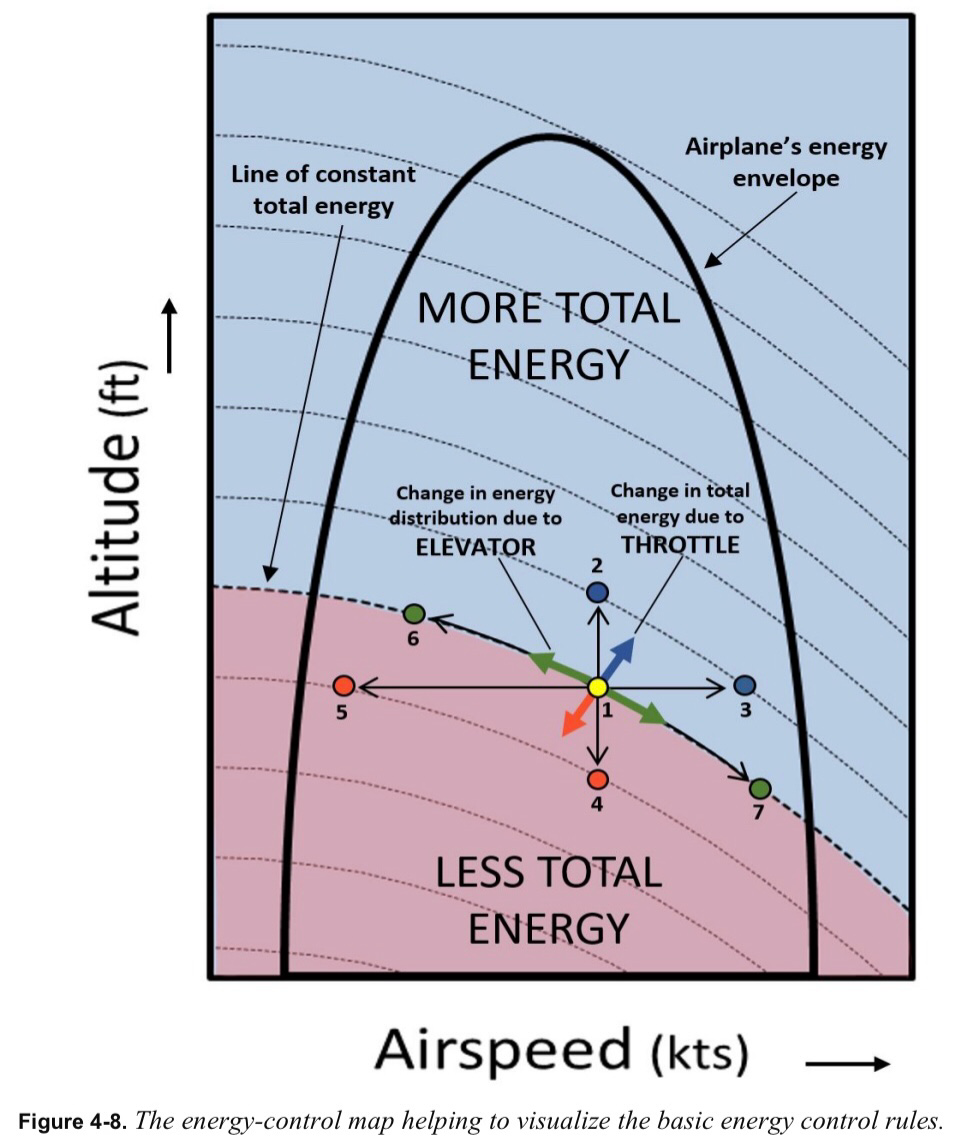
I think the description of the three aerodynamic states on p10 makes some assumptions about power availability that are only true in non-manoeuvring flight. In manoeuvring flight positive excess power can become unavailable in any of the three states, as shown in figure 4, which doesn't entirely match the description on p10.

Therefore, the slow/onspeed/fast aerodynamic state indicator is an essential part of your proposed operational method, but needs to be paired with an energy state indicator (a P_s gauge for example) to provide full information on which the pilot can make decisions (to know where the aircraft is on figure 4). This might be particularly relevant for general aviation aircraft with low thrust/weight ratios and correspondingly small power envelopes.

In general, I think your ideas are excellent, but I expect that standardisation of both instrumentation and instruction methods might be a fairly high barrier. I'd say that self-calibrating instrumentation systems are one of the keys to the approach.
 
I don't see what building vs not building has anything to do with anything. Experienced Builder != good pilot.

You are absolutely correct and I have apologized to that person and now this forum. (He is in the process of building something very unique and well thought out)

I do believe AOA might have kept me and my family from being another statistic and truly believe in the design, but everyone has a right to their thoughts here.
 
Last edited:
For many years, I ran off launches with a hang glider on my shoulders and went flying with no airspeed, no nothing…just a bar to push or pull on. Were my sense keener than? Maybe…variometers added more sophistication and made me more efficient…did it make me better? No. Developing the feel of the wing and the air did though.
Interesting here is that with hang gliders you were likely feeling the direction of arrival of the relative wind meaning you actually had a tactile feel of AOA. You had AOA indication as your primary data in these.

I think it didn’t occur to me that you use AoA in lieu of airspeed entirely…I somehow kept thinking it was in addition to.

It seems like re writing the whole book with the FAA would be required, but maybe we all learned wrong….the Wright Brothers did…and they fixed it….so maybe there’s hope for me!
Exactly!!!
 
Let’s not get into the weeds with this discussion, and concentrate on the real reason for the post. An earlier quote was,

“Teach people the correct way to fly”.

Ok! Yes! We agree here! When does an airplane stall? Answer: critical angle of attack. Not airspeed, not feel, not sight, not anything else other than critical AOA.

Now, with experience, we know what the approach to critical AOA typically feels like, and sight pictures that are conducive to safe flight. However, AOA is the end all be all here. Exceed it and we stall. WHY would we continue to guess at AOA???? If we could measure AOA and display it, or hear it (or however else), why wouldn’t we use it? Why guess? We teach what AOA is, but most GA cockpits don’t have a way to see it. What we do have (in old airplanes, which I love), is an airspeed indicator with some color arcs on it. Students then correlate airspeed with stall instead of AOA. AOA is king. AOA trumps airspeed, feel, sight, etc. Exceed it and stall. So, let’s have an AOA indication. Just my opinion. Good discussion with a lot of strong opinions in this thread, but so far I think this is a healthy discussion.

I once thought AOA was the be all end all and proper. And I think it is the right answer for most of us. But now I’m thinking AOA is actually an intermediate. Wing airflow is the be all end all. Airflow Performance Monitor measures this. For a healthy wing, it is essentially giving you a pressure diff AOA and would be used just like one. However, it also compensates for contaminated wing like an iced wing or damaged wing in which your critical angle likely is lower than your expected critical angle. APM would have saved the Challenger that crashed in Maine. https://data.ntsb.gov/carol-repgen/api/Aviation/ReportMain/GenerateNewestReport/202338/pdf

APM was featured on MentourNow. You can get an idea about it here though to be fair I was skeptical and had lots of questions after seeing the video. I contacted APM directly and they answered most my questions to satisfaction; overall great system for subsonic craft though also a more complicated system that really wouldn’t be necessary for we who avoid icing and are not all weather. Note were one to go APM, such readily would fit with everything Vac has been trying to teach and with indications both audio and visual in the manner Vac has advocated. From a pilot perspective, it is AOA.

Anyone interested in my questions and their answers, DM me and I’ll copy paste.


Last edited:
I think the description of the three aerodynamic states on p10 makes some assumptions about power availability that are only true in non-manoeuvring flight. In manoeuvring flight positive excess power can become unavailable in any of the three states, as shown in figure 4, which doesn't entirely match the description on p10.

Therefore, the slow/onspeed/fast aerodynamic state indicator is an essential part of your proposed operational method, but needs to be paired with an energy state indicator (a P_s gauge for example) to provide full information on which the pilot can make decisions (to know where the aircraft is on figure 4). This might be particularly relevant for general aviation aircraft with low thrust/weight ratios and correspondingly small power envelopes.

Thoughts regarding power carats. The F/A-18E/F and EA-18G had them. Earlier Hornets A-D did not. Yet we’d learn about “the poor man’s power carat” which we could use in these craft as well as in the T-45C. Such was entirely within the AOA system.

In the Hornet, we’d have three displays for AOA. There was the indexer which I likely saw and incorporated from peripheral vision yet never looked at or scanned, there was the digital number in the left side of the HUD, and with landing configuration, there was the ‘E-bracket’ left side of the velocity vector in the HUD. The Air Force would call this bracket ‘the staple,’ though while I believe it named for its shape, Vac elsewhere has commented he likes the name E as in Energy bracket. The T-45C in which I instructed similarly had indexers, digital value in HUD, and E-bracket in landing configuration. It also had an old school AOA gauge and I primarily used gauge and bracket. The T-45A in which I learned only had gauge and indexer.

Learning to land, we have three things. “Meatball,” LineUp, Angle of Attack. That’s it. And this is the way all published material is written. But after learning this, we’d learn from slightly more senior pilots in ready room or O’club conversation about “the poor man’s power carat.”

What was this mysterious carat? It was the E-bracket. You see, while we use pitch to control AOA and power to control path, you could still see path forecast in the AOA. That’s right, AOA is a lead indication of power requirement. If you saw the staple aka E-bracket drop meaning the velocity vector rapidly rose to above the bracket indicating a rapid slowing, you knew you needed to add a shot of power before you saw a VVI increase or path going lower. Similarly, if the bracket rose, you knew you needed a (lesser) power reduction (quickly to be counter-corrected).

What is a power carat? Well, power is energy over time. What is AOA? AOA is your kinetic energy relative to adequate kinetic energy for your craft. AOA predicts power needs.

Think about this, if you inadvertently go slow, and you’re not “stick thermalling,” that is you’re not inadvertently adding back stick, your trim is going to restore you to trimmed AOA and that means the nose is going to go down and your path down will steepen VVI down increase, except should you add power to change that VVI. It is still pitch for AOA, power for path, yet we now have this extra with AOA forecasting path.

This does get a little tricky for us in RVs unfortunately, as prop wash unlike zero vertical displacement jet engines changes our pitch moments hence we get AOA changes with power changes. Expect AOA to increase with power increases and decrease with power reductions. These can easily be compensated for via small trim changes with no need for longitudinal stick when looking at approach and landing power changes but will need stick influence to catch when talking missed approach, go around, rejected landings. This also means any AOA forecasts have to be before power corrections.

Better to ignore this concept entirely while learning AOA then revisit and see about adding it in after having fully gotten comfortable with AOA flying in the pattern.


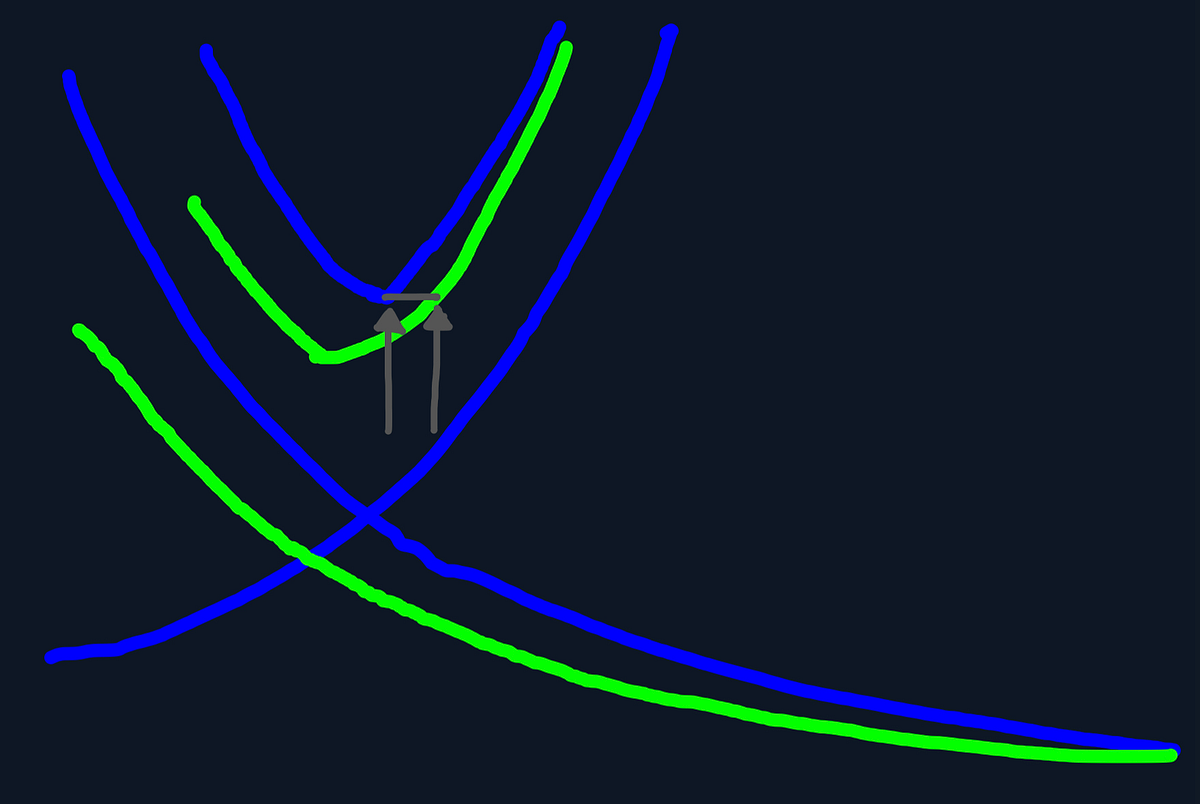
I’ve linked this before, I’ll link it again, https://medium.com/@jamesmcclaranallen/improve-your-landings-with-aoa-power-techniques-04601584fb3a

Also useful https://medium.com/@jamesmcclaranallen/back-side-of-the-power-curve-vs-drag-curve-8442d369d9c8
 
I once thought AOA was the be all end all and proper. And I think it is the right answer for most of us. But now I’m thinking AOA is actually an intermediate. Wing airflow is the be all end all. Airflow Performance Monitor measures this. For a healthy wing, it is essentially giving you a pressure diff AOA and would be used just like one. However, it also compensates for contaminated wing like an iced wing or damaged wing in which your critical angle likely is lower than your expected critical angle. APM would have saved the Challenger that crashed in Maine. https://data.ntsb.gov/carol-repgen/api/Aviation/ReportMain/GenerateNewestReport/202338/pdf

APM was featured on MentourLive. You can get an idea about it here though to be fair I was skeptical and had lots of questions after seeing the video. I contacted APM directly and they answered most my questions to satisfaction; overall great system for subsonic craft though also a more complicated system that really wouldn’t be necessary for we who avoid icing and are not all weather. Note were one to go APM, such readily would fit with everything Vac has been trying to teach and with indications both audio and visual in the manner Vac has advocated. From a pilot perspective, it is AOA.

Anyone interested in my questions and their answers, DM me and I’ll copy paste.


That’s a fair point. I guess I’m just foot stomping hard here because this topic is important. I think the airspeed vs AOA issue is misunderstood by a lot of pilots. Referencing airspeed to avoid stall is not the safest avenue. Many factors change the airspeed at which an airplane stalls. More than we can calculate in real time when normal ops become non normal.
 
@Vac -
  1. Minimum Visible AOA (1.5 xVs)): The bottom green band on the AOA indicator, typically flown around 1.5 times the stall speed.

My real question is in an engine out situation is: Which of the AOA indications do I fly? Does the 1.5x Vs = Best Glide? Because at least for me, best glide in my RV-8 flaps up (~ 80-85 KIAS) tends to be faster than my normal approach speed of 70-75KIAS full flaps. So how do I translate best glide to an AOA?
This gets tricky as you now have a bounding issue. Is pegged at the pegged value or beyond the pegged value? Are you trying to make it appear and disappear? Does such absorb more attention? Is it better to be just a touch slower as Langewiesche wrote so as to be able to push to stretch the glide thus giving you a stretch to target option not merely on and short of target? What about wind effects? The Glider Handbook does a much better job showing effects of optimum range glide in not still air. L/Dmax isn’t (L/Dmax is your best glide AOA in still air but the air is rarely still). You need to be faster into headwind as well as sinking air. At this, your displayed value is gone assuming 1.5 be the proper still air value. What about if you’re low and looking more to optimize the turn? Glider book teaches us optimum turn is minimum power required AOA which is maximum glide endurance AOA and at forty-five degrees AOB. Vac and Fly Onspeed organization wisely suggest using onspeed AOA in lieu of minimum power required AOA for a little extra stall margin. They also point out that if you’re sufficiently low as to be worrying about optimum turn, you don’t have time to adjust or worry about transitioning to optimum range after turn rather instead should stick with the lesser glide focusing to the landing. I too like to nerd out and get precise answers here while zero knots one g (though taking helicopter lessons, this expression is no longer valid), but definitely a case here for good enough and forget the precision. Either you’re high enough that you can set a glide that is good enough to reach a target, or you’re too low and should be looking for onspeed for better turn and more survivable energy into the least bad target you got.
 
Oh, nevermind. You answered it already. Don't take this the wrong way, but remind me never to fly with you as a pax.

While he seems stubborn, I think he is asking representative questions of a large portion of GA pilots. And he has actually shown ability to slowly accept and adapt. I think he is one you actually want to work with as in doing such you can model and work that whole larger pool.

I think it didn’t occur to me that you use AoA in lieu of airspeed entirely…I somehow kept thinking it was in addition to.

It seems like re writing the whole book with the FAA would be required, but maybe we all learned wrong….the Wright Brothers did…and they fixed it….so maybe there’s hope for me!
 
Something missing in these discussions is that we should be teaching constant AOA turns in slow flight and in steep turns. You shouldn’t be pulling back on the stick to compensate for loss of lift in turns, you should either be adding power to compensate or accepting larger VVIs while letting the nose drop a bit and knots to tick up a bit in turns. In terms of FAA rewrites to AOA, this is a big one. Others include making distinction between zoom and climb, dive and descent, noting zoom is analogous with instantaneous turn and climb is analogous with sustained turn.

If you have AOA indication and you’re pulling into that impossible turn, it isn’t that you’re pulling the turn for sake of speed, it is that you’re pulling to a different newly desired AOA for which you didn’t have time to trim. This is a distinctly different animal than pulling to hold a constant speed.
 
In the sailplanes, we practice rope breaks incessantly…and it pays off…go pick a tree, fence, anywhere, and anything…but for Pete’s sake don’t turn back below 200 feet agl. Helicopters and power planes the same….yet it still happens. I don’t see AoA changing that. Training yes….but only good training.

Have you noticed gliders now adding side strings? You can easily and cheaply get AOA. Both optimum turn and optimum still air glide straight as well as stall warning. Much better than speed for those rope breaks. Optimizes for load so you don’t have to. Though interesting thing with gliders, the speed for straight ahead best still air glide is remarkably close to the speed for 1.2 times max endurance glide with 1.2 being the value to compensate for a forty-five degree turn.

1783951450068.png
 
@justa6ereh @Notso

I didn’t find the whole conversation so I’m making a presumption regarding 120 kts, was this someone’s target for a ground effect acceleration to zoom climb? A ground effect acceleration to climb at 120? An accelerating climb to 120 and sustain 120? Generally I am presuming this is a left of bang consideration.

I do think there is value in 120 as it is better airflow and nicer to the engine for cooling. Could 120 help in a sense of avoiding an engine out scenario in the first place? Suppose a mechanic and a mechanical engineer would be better to address this. I’m neither.

As to 120 and energy, however, there is no difference PE vs KE in terms of TE. The best most rapid way we can add TE is Vy. There is value for a ground effect acceleration to zoom climb to beat a Vx climb (zooming to Vx as needed though need only need beat the obstacle not a Vx path, no reason to bleed toward Vx if you have obstacle beat yet such will beat a Vx path), and there is value to a ground effect acceleration to reach and climb at Vy, but any acceleration beyond Vy is counterproductive. Though ultimately these thoughts really add value for early liftoffs and late rejected landings as we shouldn’t typically be in such situations of need. If we’re not in situation of need, that gets us back to being able to do the 120 and be nice to the engine. Though we do need to account for some airfields not having straight ahead options and thus want Vy till adequate total energy and then 120.

This does leave right of bang discussion to which we’re on AOA and we’re going for onspeed as proxy for min power AOA for best turn.


Last edited:
What a timely post Vac! (Not an accident, I know….😉)

For those folks headed to Wisconsin in a week, there are going to be numerous opportunities to learn about AoA - Vac’s system, the Redbirds at the Pilot Proficiency Center (hey folks, it is AIR CONDITIONED!!!), and the EAA Safety Committee/AoA Working Group is going to have some fast, simplified training set up in Homebuilders Hangar so that those of you who don’t want to drag your butts all the way to the museum have no excuse for not giving it a try. If you’re in HBC, walk on over - Five minutes and you’ll know the basics of flying AoA. It is simple and frankly it is insanely easy. If you want to learn more find Vac, go to the PPC, drop in a forum… (I think mine on AoA is on Tuesday at 1130) …. And then go take a look at systems 0 bth integrated and standalone. All you guys buying Garmin? Its in there! Dynon and AFS? They’ve got it! GRT, MGL…..yup, and yup! And there are standalone systems for the steam gauge hold-outs as well - wander through the exhibit buildings and you’ll find them.

For those who say “we’ve been flying airspeed for generations, I am not going to change now!” Well….the needle has been moving now for a number of years - we’ve been taking surveys for a couple of years, and not only is the awareness of AoA flying increasing significantly every year, the installed base has been going up by leaps and bounds. Audible (tone) AoA is becoming a standard way of flying - and it is probably saving lives - although it is hard to gather data on “wow, I didnt; crash today…..”

AoA will keep you out of the stall weeds, and it will also help you land more precisely (ie, shorter), saving on brakes, potential runway excursions, and all those other bad things that happen when we approach way too fast. If you haven’t flow with it, you need to try it - and Airventure gives you a chance!

Paul
Like the electronic ignition arguments versus magneto, airspeed and AOA many people just don't like change and won't.
 
You've never flown into a suburban airport?? Doesn't even have to be a big city. At my airport, I'm completely surrounded by dense houses and businesses. Powerlines on every road. Typically heavy traffic from 0600 to 2100 all day, every day.

You know what's NOT a terrible option in that case? Turning back to the airfield. Notice I said "airfield" and not runway. If I could make it even within the confines of the airfield fence, my options really open up. Airports are usually flat. There are ramps, taxiways, cross runways, open dirt or grass, etc.

You know what airports usually don't have??? Powerlines that criss cross the airfield, or trees in the middle, or rush hour traffic, or houses, or schools, etc. If I can make "a" runway - then that's bonus points. But My chances for survival go way up AND the risk of killing a family sitting down to dinner go way down even if I just crash into the grass on the edge of the field.

I think your mindset that there are "No good options behind me" needs some serious rethinking.
The interesting thing about engine failures is that they seldom happen when conditions are perfect.
 
Back
Top