

Van's Air Force

The definitive Van's Aircraft support community! Buying, building or flying an RV? Join our exclusive family of mentors and enthusiasts!

RV-15 Flush Rivet Leading Edges

Thanks
I have looked at them and I am pretty sure the min. grip of .126" for the -3 size is too large for rivets used for attaching skins to the wing spar flanges (but I don't have a kit yet so have not confirmed that).

Doesn't matter though, because if you try and buy any it shows "No Stock" in your cart like it does for all of the other relevant sizes of Cherrymax.
Scott ; the Unimatic line from Howmet exceeds the specs of the LP4-3 and comes in a length -2 or -3 that likely would work. They are not "max" rivets.
Howmet part number SMLS100-B04-02 or -03. Again the issue appears to quantity required to buy, but 1000 divided amongst 4 builders might be doable. This line are flat 100 degree heads .125 nominal diameter aluminum with steel locking mandrel. Another option may be Avdel Avex 01604-00414 Multi-Grip Blind Rivet; 1/8 Inch (0.125 Inch), (0.155 - 0.312 Inch Grip) . Its a multi-grip flat head with specs (S=165 T=230) essentially identical to the LP4-3 (S=162 T=236) and stronger than the CS4. Plenty of those around for 9 cents each.
 
Scott, are you proposing flush rivets on the main spar? If so, wouldn't that require countersinking the spar itself (not something I'd want to do, even though that is SOP for other Vans aircraft). The spar seems too thick to dimple. Looking for your guidance...
Countersinking the spar has always been required on other past kits.
 
Countersinking the spar has always been required on other past kits.
Are you suggesting we countersink the -15 spar just because it is that way on the other kits? I have written Vans about this and they are not offering any guidance. I'd be hesitant to start drilling the spar without explicit guidance that it is ok to do so.

My *current* plan is to use solid rivets for the rivets forward of the main spar, and pull rivets per instructions on the spar and aft.
 
Are you suggesting we countersink the -15 spar just because it is that way on the other kits? I have written Vans about this and they are not offering any guidance. I'd be hesitant to start drilling the spar without explicit guidance that it is ok to do so.

My *current* plan is to use solid rivets for the rivets forward of the main spar, and pull rivets per instructions on the spar and aft.

Is there access to ribs in front of the fuel tank for solid rivets? I looked at this last night but didn't think so but I do not have my kit yet.
 
Vg's on my maule are well ahead of spar. Always dreamed how much faster it would be with cs rivets😜. Maybe?
 
Is there access to ribs in front of the fuel tank for solid rivets? I looked at this last night but didn't think so but I do not have my kit yet.
Yeah, it looks like there are access panels and the nose ribs have the flanges oriented to be accessible through those panels - all along the front from what I can see.
 
Are you suggesting we countersink the -15 spar just because it is that way on the other kits? I have written Vans about this and they are not offering any guidance. I'd be hesitant to start drilling the spar without explicit guidance that it is ok to do so.

My *current* plan is to use solid rivets for the rivets forward of the main spar, and pull rivets per instructions on the spar and aft.
I am suggest that all other RVs have the rivet holes on the flange of the spars countersunk. I fail to see how this 15 spar is built any differently, in terms of thickness of material, quality of material, etc. If countersinking, one is only countersinking the rivet holes on the flanges of the spars. I am struggling to understand how that would weaken the spar on the 15 when it has not done so on any of the other past RVs.

If you look at page 29-06 of the 15 plans there are 8 #40 holes that are called out to be countersunk on the spar. Granted that is only 8 holes but. . . !
 
Vg's on my maule are well ahead of spar. Always dreamed how much faster it would be with cs rivets😜. Maybe?
The relationship between leading edge, trailing edge and the spars is very different on different models of aircraft. Chord shape also greatly affects where VGs should go so you can’t compare two different airplanes. The short leading edge of the-15 wing might make the spar rivets work as VGs. As well if these rivets are behind where VGs should go than having them be flush serves no purpose other than near VNE.
 
Would someone that currently has a main wing spar confirm for me what the material thickness of the flange is?
Thx
 
Anyone any closer to finding a suitable flush pulled rivet for around tanks that are actually in stock?
 
Why pulled rivets around the tanks?
For those planning flush rivets, it looks to me like access for bucking the leading edge is present down the whole span of the wing?
 
Why pulled rivets around the tanks?
For those planning flush rivets, it looks to me like access for bucking the leading edge is present down the whole span of the wing?

Perhaps I should have said along the spar at the tanks. Post #47 above suggests pulled rivets are required.
 
Would the CR3212 cherrymax rivet work?
Cherry max rivets have a very tight tolerance for allowable hole diameter.

When a number 30 hole is dimple countersunk 100° degrees for a flush rivet, the hole enlarges beyond the max acceptable diameter for the cherry rivet.
 
I know there is a good solution....I just haven't found it yet.

From what I have seen so far, other than where already specified in the KAI (and I think with some good planning a lot of those can be avoided) the holes along the main spar flange directly ahead of the fuel tanks is the only locations that will require blind rivets for flush riveting the skins.
I am not sure why you are saying this. I have my left wing at the stage where I will be riveting the skins soon. There are access holes on the leading edge skins that allow access to all the ribs forward of the spar. I plan to buck flush solid rivets on the leading edge. I will post with pics when I get there.
 
I am not sure why you are saying this. I have my left wing at the stage where I will be riveting the skins soon. There are access holes on the leading edge skins that allow access to all the ribs forward of the spar. I plan to buck flush solid rivets on the leading edge. I will post with pics when I get there.

You are talking access to get to the ribs, I am pretty sure rebuilder2002 is saying access along the spar meaning the spar itself.
 
You are talking access to get to the ribs, I am pretty sure rebuilder2002 is saying access along the spar meaning the spar itself.
I understand that but there should also be access to the spar flange in front of the spar. I imagine then he is referring to the flange behind the spar. As for me, I do not intend to flush rivet the spar flange/skin rivets. That would require countersinking the spar flange as Marc had eluded to in his earlier posts above when he asked about countersinking the spar. I will be dimpling the forward ribs and skins up to but not including the spar attach rivets.
 
I understand that but there should also be access to the spar flange in front of the spar. I imagine then he is referring to the flange behind the spar. As for me, I do not intend to flush rivet the spar flange/skin rivets. That would require countersinking the spar flange as Marc had eluded to in his earlier posts above when he asked about countersinking the spar. I will be dimpling the forward ribs and skins up to but not including the spar attach rivets.
🤔 It seems if you “understand that”, then you should understand why I said what I did….

Just because you are planning to flush rivet only the nose ribs to the LE skins, doesn’t mean everyone else is.
 
🤔 It seems if you “understand that”, then you should understand why I said what I did….

Just because you are planning to flush rivet only the nose ribs to the LE skins, doesn’t mean everyone else is.
Sorry If my statement offended you. Not my intention.
Live Long and Prosper!
 
Cherry max rivets have a very tight tolerance for allowable hole diameter.

When a number 30 hole is dimple countersunk 100° degrees for a flush rivet, the hole enlarges beyond the max acceptable diameter for the cherry rivet.

It sounds like those of us who would like to flush rivet will have to get creative. I believe you have already suggested Cherry “N” rivets, AN426B and possibly the unaffordable CR3242 oversize CherryMax when necessary.

Since Van’s isn’t even shipping LP4-3’s to some builders, they are going to have to creative as well. https://vansairforce.net/threads/backordered-parts.240829/page-2#post-1915308
 
It sounds like those of us who would like to flush rivet will have to get creative. I believe you have already suggested Cherry “N” rivets, AN426B and possibly the unaffordable CR3242 oversize CherryMax when necessary.

Since Van’s isn’t even shipping LP4-3’s to some builders, they are going to have to creative as well. https://vansairforce.net/threads/backordered-parts.240829/page-2#post-1915308
I don’t think the oversized cherry rivets are inflated any more than the price of the standard ones right now. They all seem to be ridiculous prices, if you can find them.

I don’t know whether a hole diameter being a few thousands bigger than the max specified for a cherry max rivet would degrade the strength enough to matter, since we would be replacing a rather low strength rivet (by comparison) with them. And considering that they have been used in that manner in other high stress areas, such as on the RV-14 fuselage. I was just mentioning the fact so that people will keep in mind all of the different factors to consider, when deviating from the KAI.

I am still hopeful to find an acceptable alternative with a 120° flush head. This will have the benefit of requiring a shallower counter sink when used at hole locations along the spar flange (the only locations in the wing that will absolutely require blind rivets, as far as I can tell so far), and dimpling to 120° doesn’t enlarge the hole diameter as much. Along with them being much less expensive when compared to a cherry rivet.
 
Last edited:
Dare I ask why not consider annealing the 2117-T4 rivets and allowing them to reharden in situ? Provided anodized and not alodined rivets are used. Caveats: Oven with good temperature control, and tests to determine if it rehardens in 96 hours at 70F as specified in Mil spec. The Mil spec also has a wide temperature band for the annealing which is much larger than the specified allowable range in the oven, indicating some experimentation for exact temperature might be needed. I know some vintage VAFers have some experience.
Ref: MIL-H-6088G
 
Last edited:
Dare I ask why not consider annealing the 2117-T4 rivets and allowing them to reharden in situ? Provided anodized and not alodined rivets are used. Caveats: Oven with good temperature control, and tests to determine if it rehardens in 96 hours at 70F as specified in Mil spec. The Mil spec also has a wide temperature band for the annealing which is much larger than the specified allowable range in the oven, indicating some experimentation for exact temperature might be needed. I know some vintage VAFers have some experience.
Ref: MIL-H-6088G
Please be advised that the process you are suggesting is NOT annealing, which is a permanent softening, as opposed to solution heat treating, which is a temporary softening, with recovery of strength by work hardening (bucking) and/or time (~96 hrs), age hardening.

I have successfully used this process for more than 35 years and have had good results (more than 150 test coupons in overlap shear) as confirmation …

HFS
 
Please be advised that the process you are suggesting is NOT annealing, which is a permanent softening, as opposed to solution heat treating, which is a temporary softening, with recovery of strength by work hardening (bucking) and/or time (~96 hrs), age hardening.

I have successfully used this process for more than 35 years and have had good results (more than 150 test coupons in overlap shear) as confirmation …

HFS
I misspoke, thanks for adding that correction. The temperature range in the MIL spec is pretty wide, what temp should a guy use as a start for experimenting with the softening process?
 
There are many variations of solid rivets as well.
The AN426B4-X is made from 5056 alloy, so they are slightly softer than an AN426AD4 rivet but still have an lbf of about 295 which is only about 35lbf lower than an AD4!rivet.
The difference isn’t huge but it is very noticeable when squeezed with a hand squeezer.
Every little bit helps.
Where to order AN426B4 - 3,4,5, .?
 
Last edited:
I misspoke, thanks for adding that correction. The temperature range in the MIL spec is pretty wide, what temp should a guy use as a start for experimenting with the softening process?
I would direct you to look up Solution Heat Treatment for 2117 Aluminum alloy
Google, Bing or Foxfire for the definitive narrative on that subject …

HFS
 
In the seemingly never ending quest to source flush headed rivets that would be acceptable alternatives to an LP4-3, I have discovered how insane the whole Cherry rivet debacle has become.

Back story
For anyone wishing to flush rivet the wing at least as far aft as the main wing spar (lots of closely spaced rivets running full span on the wing, so likely the most beneficial), a suitable flush blind rivet will be needed because of zero access on the interior of the wing in the vicinity of the fuel tank.

While looking for alternatives to tha Cherrymax CR3242 series I have looked into other manufacturers that make an equivalent (they usually even have a similar part #).

I just got a quote from a supplier that has inventory of the Huck brand version in Part # HR3242-4-2.
Since each wing will require about 125 I requested a quote for 250 (seems like a reasonable quantity for good pricing🤔).

Quote came back at $55.50……. Each 😳

The search continues…..
How did that company determine a that price? Must be the same company that built the toilet seat for the govment,,,,
 
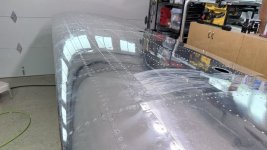
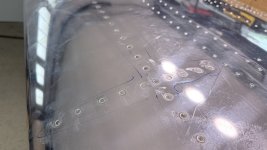
The left wing was flush riveted, and now working on the right wing. Details are in the main project thread. It would be nice to use flush pull rivets, but when I talked to Rian last week at Van's he had not yet found any he liked. Maybe in the future...

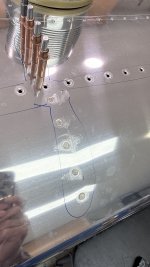
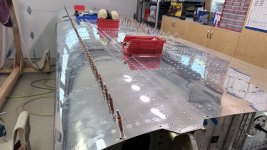
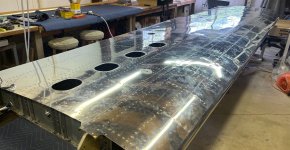
I used a 3x rivet gun set at 40 PSI with AD4-4 rivets and it worked fine. It doesn't appear that there's a need for soft rivets or any other derivations. A tungsten bucking bar is perfect for the tight spaces.

1778550067497.jpeg

1778550019130.jpeg

1778550036733.jpeg

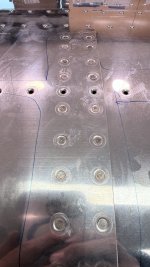
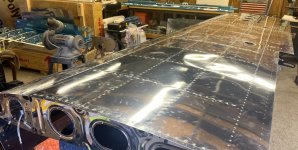
And the right wing, first rivets per KAIs.
1778550096306.jpeg
 
The left wing was flush riveted, and now working on the right wing. Details are in the main project thread. It would be nice to use flush pull rivets, but when I talked to Rian last week at Van's he had not yet found any he liked. Maybe in the future...

I used a 3x rivet gun set at 40 PSI with AD4-4 rivets and it worked fine. It doesn't appear that there's a need for soft rivets or any other derivations. A tungsten bucking bar is perfect for the tight spaces.

View attachment 117311

View attachment 117309

View attachment 117310

And the right wing, first rivets per KAIs.
View attachment 117312
Can you confirm all the rivets needed were -4 in length?
 
After two days of exploring a very deep rabbit hole, I may have found a flush blind rivet that would fit the bill for the leading edges.

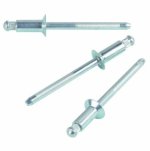
Avdel makes the BSCQ-04-03 which is a 1/8” diameter, aluminum body/steel mandrel, pulled rivet with a 120 degree countersunk head. It’s part of the Cherry Q family that uses a locking mandrel.

The steel mandrel plugs to form a weather tight seal and is zinc plated to avoid galvanic issues with the aluminum alloy body of the rivet.

The listed strength specs for the 1/8” size of the rivet are 350 lbf in shear and 325 lbf in tension, so about twice the listed shear strength of the LP4-3.

I did as much research as I could on the locking mandrel. Rans makes extensive use of the protruding head version of these Cherry Q’s on their S-19, S-20, and S-21 and I wasn’t able to find any examples of mandrel retention being an issue over time. They use the aluminum body/aluminum mandrel version for fastening skins and the stainless body/stainless mandrel version in the wing structure (mounting ribs to the spar, spar doublers, etc). The different material versions of the rivet all use the same means to lock the mandrel.

I plan to do a bit of testing when I get some in hand. They have a standard 1/8” grip range, like a CherryMax, but start at a -3 length. From the math by MCA on the first page of this thread, in a dimpled skin scenario these should exceed the minimum grip length by about 0.005”. I’ll dimple some skin coupons and check how well they pull. But compared to an LP4-3, these are obviously more sensitive to grip length.

Best of all, they are available and about $0.18 a piece.

I sent an email to Vans and got a response saying that the engineering department was going to have a look at them.
 

Attachments

  • IMG_0316.jpeg
    IMG_0316.jpeg
    12.6 KB · Views: 15
After two days of exploring a very deep rabbit hole, I may have found a flush blind rivet that would fit the bill for the leading edges.

Avdel makes the BSCQ-04-03 which is a 1/8” diameter, aluminum body/steel mandrel, pulled rivet with a 120 degree countersunk head. It’s part of the Cherry Q family that uses a locking mandrel.

The steel mandrel plugs to form a weather tight seal and is zinc plated to avoid galvanic issues with the aluminum alloy body of the rivet.

The listed strength specs for the 1/8” size of the rivet are 350 lbf in shear and 325 lbf in tension, so about twice the listed shear strength of the LP4-3.

I did as much research as I could on the locking mandrel. Rans makes extensive use of the protruding head version of these Cherry Q’s on their S-19, S-20, and S-21 and I wasn’t able to find any examples of mandrel retention being an issue over time. They use the aluminum body/aluminum mandrel version for fastening skins and the stainless body/stainless mandrel version in the wing structure (mounting ribs to the spar, spar doublers, etc). The different material versions of the rivet all use the same means to lock the mandrel.

I plan to do a bit of testing when I get some in hand. They have a standard 1/8” grip range, like a CherryMax, but start at a -3 length. From the math by MCA on the first page of this thread, in a dimpled skin scenario these should exceed the minimum grip length by about 0.005”. I’ll dimple some skin coupons and check how well they pull. But compared to an LP4-3, these are obviously more sensitive to grip length.

Best of all, they are available and about $0.18 a piece.

I sent an email to Vans and got a response saying that the engineering department was going to have a look at them.

Please do follow up after receiving Van's response. A 0.005”. min grip length is not much.
 
After two days of exploring a very deep rabbit hole, I may have found a flush blind rivet that would fit the bill for the leading edges.

Avdel makes the BSCQ-04-03 which is a 1/8” diameter, aluminum body/steel mandrel, pulled rivet with a 120 degree countersunk head. It’s part of the Cherry Q family that uses a locking mandrel.

The steel mandrel plugs to form a weather tight seal and is zinc plated to avoid galvanic issues with the aluminum alloy body of the rivet.

The listed strength specs for the 1/8” size of the rivet are 350 lbf in shear and 325 lbf in tension, so about twice the listed shear strength of the LP4-3.

I did as much research as I could on the locking mandrel. Rans makes extensive use of the protruding head version of these Cherry Q’s on their S-19, S-20, and S-21 and I wasn’t able to find any examples of mandrel retention being an issue over time. They use the aluminum body/aluminum mandrel version for fastening skins and the stainless body/stainless mandrel version in the wing structure (mounting ribs to the spar, spar doublers, etc). The different material versions of the rivet all use the same means to lock the mandrel.

I plan to do a bit of testing when I get some in hand. They have a standard 1/8” grip range, like a CherryMax, but start at a -3 length. From the math by MCA on the first page of this thread, in a dimpled skin scenario these should exceed the minimum grip length by about 0.005”. I’ll dimple some skin coupons and check how well they pull. But compared to an LP4-3, these are obviously more sensitive to grip length.

Best of all, they are available and about $0.18 a piece.

I sent an email to Vans and got a response saying that the engineering department was going to have a look at them.
Chris, I used a similar Avex rivet on my BD4 when I converted to metal skins. The results were good with no problems.

I recently ordered the rivets you found at $0.18 and plan to use them as soon as I finish my tanks. I have the 120 degree dimple.

Deene
 
After two days of exploring a very deep rabbit hole, I may have found a flush blind rivet that would fit the bill for the leading edges.

Avdel makes the BSCQ-04-03 which is a 1/8” diameter, aluminum body/steel mandrel, pulled rivet with a 120 degree countersunk head. It’s part of the Cherry Q family that uses a locking mandrel.

The steel mandrel plugs to form a weather tight seal and is zinc plated to avoid galvanic issues with the aluminum alloy body of the rivet.

The listed strength specs for the 1/8” size of the rivet are 350 lbf in shear and 325 lbf in tension, so about twice the listed shear strength of the LP4-3.

I did as much research as I could on the locking mandrel. Rans makes extensive use of the protruding head version of these Cherry Q’s on their S-19, S-20, and S-21 and I wasn’t able to find any examples of mandrel retention being an issue over time. They use the aluminum body/aluminum mandrel version for fastening skins and the stainless body/stainless mandrel version in the wing structure (mounting ribs to the spar, spar doublers, etc). The different material versions of the rivet all use the same means to lock the mandrel.

I plan to do a bit of testing when I get some in hand. They have a standard 1/8” grip range, like a CherryMax, but start at a -3 length. From the math by MCA on the first page of this thread, in a dimpled skin scenario these should exceed the minimum grip length by about 0.005”. I’ll dimple some skin coupons and check how well they pull. But compared to an LP4-3, these are obviously more sensitive to grip length.

Best of all, they are available and about $0.18 a piece.

I sent an email to Vans and got a response saying that the engineering department was going to have a look at them.

Chris did Van's ever get back to you?
 
Back
Top