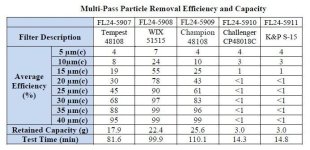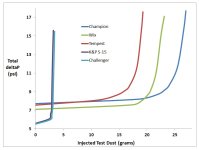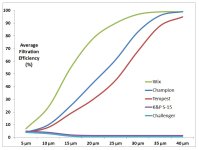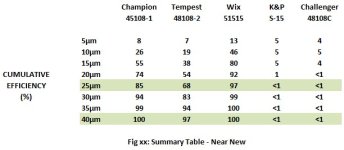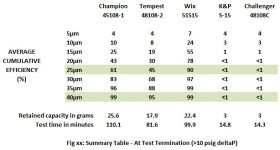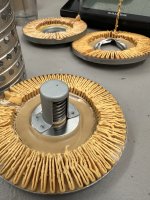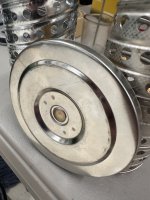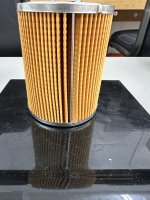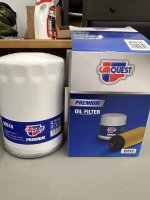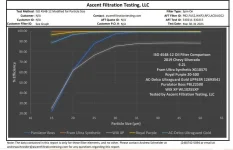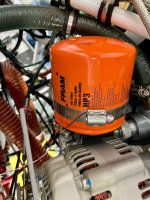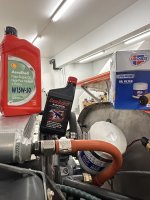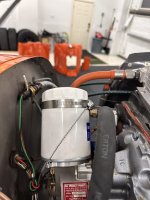



Respectfully, I believe you're overthinking this.How important is the size of the internal oil filter bypass valve for our purposes? I decided to take apart one of the STP S8AXL (premium guard XL) oil filters that I was planning to use on my Lyc. IO-360 (98.7% @ 15 microns). The bypass valve was tiny compared to the Champion Aerospace 48108-1.
The diameters of the valves were about 9mm vs 18mm. This means the Champion valve’s surface area is 4x higher. I used a trigger pull gauge to see how much pressure it took to begin opening them and it was about 4 lbs for the STP vs 9 lbs for the Champion. I was using a 9mm bullet sitting on top of the valves to depress them with said trigger pull gauge. The STP is specified to open at 15 PSI, which I think is about the same as the champion. With a positive displacement oil pump, I guess the size of the valve shouldn’t matter if the math for the spring and valve area still works out to 15 psi? (I’ve read that journal bearing oil passages are much more restrictive than any filter media or bypass valve ever would be.)
I tried using some online calculators and it seems like even the smaller valve of the STP would still allow 10 gpm of oil flow if the filter media was completely clogged. I think that’s about peak flow from the Lycoming oil pump at 2700 rpm.
I’m not sure what to make of all this though. If the filter media became completely clogged with contamination I’d prefer to have full flow through the bypass valve available.
The STP did have about 15% more media area than the Champion (280 vs 240 sq in).
View attachment 98474
View attachment 98473
Flow is proportional the sq rt of the available delta P across the valve; something we don't know. If the system pressure was created by something other that a PD pump (something with a pump curve like a centrifugal pump) then these calcs and related component design becomes more important and involved.
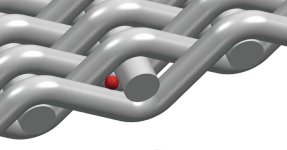
The PD pump is gonna flow a relatively constant rate though pump slippage (not significant) will increase. The oil pump is directly coupled to the engine so there's no component to worry about over-amping. The filter will never completely clog so the overall (inverse) filter component flow coefficient (Cv) is the inverse of the sum of the two Cv's; element and bypass though I'm sure the bypass is designed for full flow.
While I can't prove it, I'm sure the bypass valve exists to protect the filter element integrity i.e. not blow it out and send DOD through the oil system vs ensuring oil flow to the system in case of a complete blockage in the element . So, why all the BS ramblings? There's nothing to worry about. Let's assume each OEM knows the collapse pressure of their elements and designed the rest accordingly, probably with a ton of margin.
My worthless $0.02 for the day.
Last edited: