

Van's Air Force

The definitive Van's Aircraft support community! Buying, building or flying an RV? Join our exclusive family of mentors and enthusiasts!

What you should know about the moisture in your engine that causes corrosion on your tappets and cam lobes

scsmith

Well Known Member
Sponsor
Advertiser
I think people should have a better understanding of where the moisture comes from that causes the corrosion when a Lycoming is left sitting for prolonged periods.

It is NOT the ambient moisture in the environment. It does not matter if the plane is sitting in the Pacific Northwest, Or the Deep South, or the middle of the Mojave Desert.

The moisture is in the crankcase at engine shut down. It gets there from combustion gas blow-by. It is in the form of saturated steam (vapor). As soon as the engine starts to cool off, all that saturated vapor starts to condense. It forms condensation droplets on lots of things. The tappets seem to be the most prone to corrosion, partly because of the type of steel, and partly because the wiping action of the cam leaves very little oil film protection. Water droplets condensing on the tappets starts corrosion pretty quickly, but running the engine every few weeks keeps them polished smooth. Letting the engine sit a few months lets the corrosion get a toe-hold and start forming pits in the surface.

The only way to prevent this entire process is to purge the moisture out of the crankcase after shut-down with dry air.

There are threads on this forum describing very inexpensive engine dryers -- less than $50. It is not necessary to have a continuous purge flow. If you purge out the moisture and replace it with dry air, that's all you need to do. I hook up my dryer, turn the timer to one hour, and walk away.
 
I think people should have a better understanding of where the moisture comes from that causes the corrosion when a Lycoming is left sitting for prolonged periods.

It is NOT the ambient moisture in the environment. It does not matter if the plane is sitting in the Pacific Northwest, Or the Deep South, or the middle of the Mojave Desert.

The moisture is in the crankcase at engine shut down. It gets there from combustion gas blow-by. It is in the form of saturated steam (vapor). As soon as the engine starts to cool off, all that saturated vapor starts to condense. It forms condensation droplets on lots of things. The tappets seem to be the most prone to corrosion, partly because of the type of steel, and partly because the wiping action of the cam leaves very little oil film protection. Water droplets condensing on the tappets starts corrosion pretty quickly, but running the engine every few weeks keeps them polished smooth. Letting the engine sit a few months lets the corrosion get a toe-hold and start forming pits in the surface.

The only way to prevent this entire process is to purge the moisture out of the crankcase after shut-down with dry air.

There are threads on this forum describing very inexpensive engine dryers -- less than $50. It is not necessary to have a continuous purge flow. If you purge out the moisture and replace it with dry air, that's all you need to do. I hook up my dryer, turn the timer to one hour, and walk away.
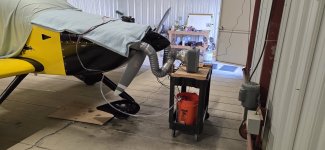
Would you post your dryer set up and timer?
 
You didn't ask me but maybe this will help others.
My dryer runs 30 min every day plus after a flight.
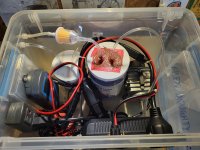
Simple clear gallon plastic container. Local Jimmy John's gave me a couple.
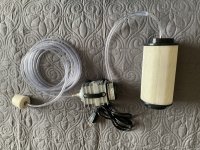
Amazon aquarium air pump. Big one. Moves a lot of air.
Amazon hygrometer installed in the lid
Amazon food strainer
Amazon dessicant beads. Two each gallon size to allow for exchange.
Fittings and aluminum tube out the bottom and top.
Friend printed an oil filler with NPT threads for another aluminum tube fitting.
10' clear tubing.
Fuel filter to catch any airborne silica.
Timer.
I used a block of wood to support the container so the fitting would clear. It lives in a Home Depot Homer bucket.
The strainer sits on the bottom and keeps beads from blocking the line. Air flows in the bottom and out the top.
When the meter goes above 10%, I change the beads and take the others home to dry. Since it's open loop, there's no smell drying and Sweetie doesn't mind me using the oven. 250 for 3 hours.
The whole rig is on a rolling tool cart along with the heater/fan, charger, sump heat power and dryer. Four circuits controlled by a Switcheon. The heater has a fan mode for post flight.
20260209_133541.jpg
 
Would you post your dryer set up and timer?
Here’s mine. I’ve posted it here before. Simple aquarium pump. Intake air is drawn through an air filter (from a snowmobile in this case—the open end needs to be sealed of course) to reduce silicon (dust) contamination. Polyethylene tubing. A rubber “crutch tip-like” table leg protector (1 1/4”?) fits over the dipstick opening. Double ended brass barbed fittings with threaded center sections connect the PE tubing to the filter and “crutch tip”. I use a simple lamp timer—30’ on then 30’ off. Repeat the on-off cycle x6, for a total of 3 hours “on”, starting ASAP after shutdown so the engine and oil are still hot. The off periods allow for equilibrium to be re-established, eg residual moisture in the oil to evaporate into the headspace. Six cycles may be overkill, but there’s little downside.

Most components came from Amazon. The fifty $ estimate is probably about right for what it cost in materials. Inflation has probably added a few $ to costs today.

I’m not sure if Steve is correct that geographic location, and thus humidity, doesn’t matter. Certainly combustion moisture is a large contributor and that is what my system targets, but relative humidity may also contribute in some situations. I live in the Tucson area, so for most of the year that’s not an issue for me. Only time will tell as to how effective this is at inhibiting corrosion. 🤞

IMG_7964.jpeg
 
When the meter goes above 10%, I change the beads and take the others home to dry.
Right or wrong, I wait quite a bit longer between bead changes. From what I have gathered, corrosion isn't going to start in a meaningful way until 40%+ humidity. I'm still building, but have a dryer hooked up full time since the engine has been setting on the plane for a year. I dry my beads once I hit about 30-35% humidity. I use a closed loop system, so typically don't have to change beads for 4-5 months (Seattle). Once I'm flying, I plan on using a little portable pump like this for a few minutes after shutdown to purge the vapor, then will throw on the closed loop dehydrator if I'm going to be gone for a while.
 
What part of the engine is this being attached to? The oil cap?
Yes. A friend printed one with 1/4 NPT female threads.
Right or wrong, I wait quite a bit longer between bead changes. From what I have gathered, corrosion isn't going to start in a meaningful way until 40%+ humidity. I'm still building, but have a dryer hooked up full time since the engine has been setting on the plane for a year. I dry my beads once I hit about 30-35% humidity. I use a closed loop system, so typically don't have to change beads for 4-5 months (Seattle). Once I'm flying, I plan on using a little portable pump like this for a few minutes after shutdown to purge the vapor, then will throw on the closed loop dehydrator if I'm going to be gone for a while.
Mine might never get that high! Colorado.
I go at least a month before it moves above 10%. 😁
 
Mine is a closed loop system that senses the humidity coming out of the engine and shuts it off at 30%. Comes on again at 35%. I don't bother with it in summer time as I fly regularly, but use it all winter as I am lucky to fly at all. When I do plug it in after a flight, it runs for about 20 minutes (I've never actually timed it). It's amazing how much condensation builds up inside the return line until it dries out, comes out around 80%. Once its dried it comes on rarely. All the parts were bought on amazon.

Alex
 

Attachments

  • 20250908_205220.jpg
    20250908_205220.jpg
    1.7 MB · Views: 142
Still on my list is to finish up a dehydrator design that combines both open and closed loop functions automatically - connected like a closed loop system, but has a servo controlled valve to allow the first X minutes of vapor to be purged into open air (so the nasty stuff doesn't go through the desiccant) before closing that off and creating a closed loop system. Total overkill, but I had fun designing the valve (made a 3D printed circular valve that could be controlled by a small RC servo motor - my main difficulty right now is I need to get a slightly better seal. If I can't get it, I'll try a solenoid valve). I also wanted to figure out how to code an Arduino, so learned that and made the system automatically run the valve based on time, then turn on/off the pump motor based on engine humidity levels.

I'm still building and don't need the dual function right now, so I put it on the back burner. One of these days I'll get back to it and redesign the valve. That's the only part that is not ideal. Otherwise the system works great. I know it's a bit on the rube goldberg side of things, but fun to design and I learned some new skills in doing it.
 
I think people should have a better understanding of where the moisture comes from that causes the corrosion when a Lycoming is left sitting for prolonged periods.

It is NOT the ambient moisture in the environment. It does not matter if the plane is sitting in the Pacific Northwest, Or the Deep South, or the middle of the Mojave Desert.

The moisture is in the crankcase at engine shut down. It gets there from combustion gas blow-by. It is in the form of saturated steam (vapor). As soon as the engine starts to cool off, all that saturated vapor starts to condense. It forms condensation droplets on lots of things. The tappets seem to be the most prone to corrosion, partly because of the type of steel, and partly because the wiping action of the cam leaves very little oil film protection. Water droplets condensing on the tappets starts corrosion pretty quickly, but running the engine every few weeks keeps them polished smooth. Letting the engine sit a few months lets the corrosion get a toe-hold and start forming pits in the surface.

The only way to prevent this entire process is to purge the moisture out of the crankcase after shut-down with dry air.

There are threads on this forum describing very inexpensive engine dryers -- less than $50. It is not necessary to have a continuous purge flow. If you purge out the moisture and replace it with dry air, that's all you need to do. I hook up my dryer, turn the timer to one hour, and walk away.
All likely true. In my case, however, I see no downside to leaving the whole engine on a dehydrator 24/7/365. If a little is good, more must be better.
 
The only way to prevent this entire process is to purge the moisture out of the crankcase after shut-down with dry air.
I would agree but I’m not so sure the Lycoming case design allows for an effective way of removing moisture from where it matters the most, at the top of the case where the cam sits. The most effective way to deal with this problem is to buy a Continental engine or fly more frequently. There’s a guy named Lew Gage who is the E-Series Bonanza guru and he’s done some pretty extensive work on the subject of removing moisture from the case after flight. His position is that most of the Continental engines don’t even allow for an effective path within the engine to evacuate the moisture. It’s about where you introduce the dry air, the path within the engine it follows, and where that air is removed again.
 
I find that the aquarium pumps don't really do that well. I use a $40 airbrush diaphragm compressor. You can find them on Ebay for cheap. The output from that goes through a gallon jug of silica gel desiccant. That goes through a air tool filter (so we don't pump silica dust into the engine) and then to a hose that has a rubber stopper on it sized to fit into the dip stick tube. It's all powered through a standard jacuzzi timer. I set the whole system up on a small moving dolly so it can be moved around easily.

The problem with closed-loop systems is that all that moisture from the crankcase gets cycled back through your silica gel and gets it saturated faster. With an open-loop system, where you purge the air out of the crankcase through the breather with dry air, the silica gel never gets more than just ambient moisture. After 10 years, my jug of silica gel is still blue. I have never had to dry it out. I see absolutely no benefit to a closed-loop system.
 
After 10 years, my jug of silica gel is still blue. I have never had to dry it out. I see absolutely no benefit to a closed-loop system.
In my neck of the woods, pumping ambient air through the desiccant in an open loop setup will saturate the desiccant in short order, depending on the time of year. I tried it for a couple of months before switching to closed loop because I got tired of drying the desiccant.
 
Such a dryer system seems like a lot of effort with minimal return.

I have not yet seen a drop of condensed “saturated steam” come out with my oil changes.
 
Such a dryer system seems like a lot of effort with minimal return.

I have not yet seen a drop of condensed “saturated steam” come out with my oil changes.
If the dessicant is soaking up the moisture that would normally be in your engine, its worth the effort !
 
Last edited:
The problem with closed-loop systems is that all that moisture from the crankcase gets cycled back through your silica gel and gets it saturated faster. With an open-loop system, where you purge the air out of the crankcase through the breather with dry air, the silica gel never gets more than just ambient moisture. After 10 years, my jug of silica gel is still blue. I have never had to dry it out. I see absolutely no benefit to a closed-loop system.
I'm using a drybot (too expensive, but my lifter/cam problem before the overhaul made it look cheap), and also see no reason for closed loop. CO is dry and it can regenerate the dessicant through heating automatically.

When I put it on after a flight, steam comes out my exhaust through the ASA crankcase vacuum fitting. I don't see any reason to recirculate that through dessicant instead of just providing dry air to the crankcase. The ambient air is a lot dryer than what's in the crankcase. Open loop works.
 
I run a shop vac on my dipstick tube for a couple of minutes, then put my dehydrator on.
Putting suction on an engine containing combustible vapors such as gasoline vapors and drawing it through a device with electrical sparks such as a shop vac motor seems very dangerous to me.
 
I pull the dipstick to allow the steam to escape then hook up a Blackmax engine dehydrator. This works for me in Houston, don't have to recharge desiccant. I also have a Tanis preheat, which I also keep on all year around, to keep the engine above dew point at all times. Might be overkill along with Camguard and oil changes every 4 months, but I consider all of it very cheap vs an engine overhaul.
 
Next time you shut down after flying, pull the dipstick and watch all the steam that comes from the crankcase.
No.
I get doing something for long term inactivity and storage. I'd find pickling easier.
This after every flight stuff? Nah.

You show me a scientific study that proves the financial impact of doing one or the other.
 
I’ve run a dehumidifier on our 182 pretty much continuously since 2013. It gets flown regularly as well. I started with a closed loop system and switched to a Drybot about 3 years ago. I also run a Drybot on my RV-14.

I’ve always said I’m not sure if it helps but it can’t hurt.

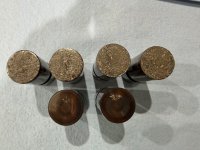
This winter, we removed and replaced 6 lifters out of the 182’s engine. I’m sure is a combination of corrosion and the fact that the lifters are made out of semi compressed chewing gum wrappers. They have 1300 hours since new with Aeroshell W100 and Camguard.

Here is a picture.

IMG_4603.jpeg
 
Such a dryer system seems like a lot of effort with minimal return.

I have not yet seen a drop of condensed “saturated steam” come out with my oil changes.
I see lots of steam come out after shut down when I pull the dipstick to put the drybot on. Moreover, when I used flight school planes with a cowl heater in the winter, I would get liquid water condensed on the dipstick afterwards, 100% of the time — and those planes are flown more often than anyone's RV.
 
I see lots of steam come out after shut down when I pull the dipstick to put the drybot on. Moreover, when I used flight school planes with a cowl heater in the winter, I would get liquid water condensed on the dipstick afterwards, 100% of the time — and those planes are flown more often than anyone's RV.

To be clear:
I am not challenging your observation.
I am not challenging your thinking these things are important.

I am saying that for me, absent evidence of financial impact in real terms, I am not going to do this fancy dryer stuff. I don't think a bit of steam is relevant, especially financially.

Most people find that colonoscopies are a good part of preventative medicine. Catch stuff early, head things off. I don't, mostly because of reading a physician written book that looked at the data. In order to save one life, something like 4 or 6 people get injured from these exams and the economic impact of all the tests being performed coupled with the injuries and deaths they cause are not worth it relative to the one life saved or prolonged.
 
indeed, open loop is just sucking in damp air, instead of recirculating/ drying.
we might be defining “open loop” vs "closed loop" differently. I see open loop as the aquarium pump taking in ambient air, pumping it through the desiccant, and then that dry air through the engine. Continuously positive pressure, low volume. I measure the humidity of the air pumped into the engine at 5% - 8%, cook the beads when the humidity of the pumped desiccated air gets to 20% (I rotate 7.5 lbs of desiccant at a time). I usually have to do that 2-4 times per year - takes a couple minutes to change out. Other than less bead cooking, I see zero advantage to “closed loop”. As to volume…I think it only has to be positive pressure, even a small amount of dry air flow through the engine is all that’s necessary If it's continuous) and an aquarium pump is all that’s needed to accomplish that. I periodically reassure myself of positive airflow by briefly attaching a condom to the oil separator output tube and see if it inflates.

There is no direct evidence that these things will do anything to extend TBO or stop corrosion, but inductively I reason that IF water is necessary for corrosion in in airplane engine THEN limiting water in the engine environment will limit the corrosion process". These dehydrators are cheap to make and take about 60 seconds to hook up after a flight. Changing the beads takes a couple of minutes. Can't hurt, might help.

1780234434162.jpeg
 
It is NOT the ambient moisture in the environment. It does not matter if the plane is sitting in the Pacific Northwest, Or the Deep South, or the middle of the Mojave Desert.

the ambient air may have some effect. I noticed a brand new steel driver bit had light surface rust after just a couple of days laying on top of toolbox near the airplane. mid atlantic spring with wide daily temp swings and some rainy days
 
we might be defining “open loop” vs "closed loop" differently. I see open loop as the aquarium pump taking in ambient air, pumping it through the desiccant, and then that dry air through the engine. Continuously positive pressure, low volume. I measure the humidity of the air pumped into the engine at 5% - 8%, cook the beads when the humidity of the pumped desiccated air gets to 20% (I rotate 7.5 lbs of desiccant at a time). I usually have to do that 2-4 times per year - takes a couple minutes to change out. Other than less bead cooking, I see zero advantage to “closed loop”. As to volume…I think it only has to be positive pressure, even a small amount of dry air flow through the engine is all that’s necessary If it's continuous) and an aquarium pump is all that’s needed to accomplish that. I periodically reassure myself of positive airflow by briefly attaching a condom to the oil separator output tube and see if it inflates.

There is no direct evidence that these things will do anything to extend TBO or stop corrosion, but inductively I reason that IF water is necessary for corrosion in in airplane engine THEN limiting water in the engine environment will limit the corrosion process". These dehydrators are cheap to make and take about 60 seconds to hook up after a flight. Changing the beads takes a couple of minutes. Can't hurt, might help.

View attachment 119197
If the humidity in my hangar is 80% and I run an open loop, im constantly drying from 80 %
With closed loop, im only drying the air in the circuit. I have tried both and the results are closed loop = less desiccant changes.
 
I’ve run a dehumidifier on our 182 pretty much continuously since 2013. It gets flown regularly as well. I started with a closed loop system and switched to a Drybot about 3 years ago. I also run a Drybot on my RV-14.

I’ve always said I’m not sure if it helps but it can’t hurt.

This winter, we removed and replaced 6 lifters out of the 182’s engine. I’m sure is a combination of corrosion and the fact that the lifters are made out of semi compressed chewing gum wrappers. They have 1300 hours since new with Aeroshell W100 and Camguard.

Here is a picture.

View attachment 119186
That would seem to be pretty solid anecdotal evidence that this problem is not as simple as portrayed here or easily solved, especially with simply purging air after flight.
 
the ambient air may have some effect. I noticed a brand new steel driver bit had light surface rust after just a couple of days laying on top of toolbox near the airplane. mid atlantic spring with wide daily temp swings and some rainy days
+1

This is a fairly involved process involving corrosion in general as well as unique properties of oil that can protect metal parts for a limited time, but then drip off, reducing protection.
 
If the humidity in my hangar is 80% and I run an open loop, im constantly drying from 80 %
With closed loop, im only drying the air in the circuit. I have tried both and the results are closed loop = less desiccant changes.
true but recirculating air deposits chemicals from the crank case back in the desiccant and then to the home kitchen during baking. i choose the lesser of two evilss and bake more often 😃
 
The problem with closed-loop systems is that all that moisture from the crankcase gets cycled back through your silica gel and gets it saturated faster. With an open-loop system, where you purge the air out of the crankcase through the breather with dry air, the silica gel never gets more than just ambient moisture. After 10 years, my jug of silica gel is still blue. I have never had to dry it out. I see absolutely no benefit to a closed-loop system.
In that case, if the ambient air is already that low in humidity, would you get almost the same benefit by just pumping ambient air through the engine, saving the overhead of dessicant beads?
 
After 10 years, my jug of silica gel is still blue. I have never had to dry it out. I see absolutely no benefit to a closed-loop system
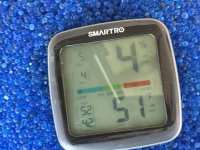
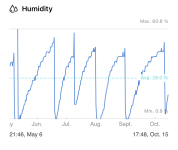
wow. i have to recycle beads every couple of months to a few weeks depending on the season. the dehydrator chamber is data logged in case the beads color is misleading. interesting that at above 50% saturation the process slows down significantly 1780241991753.png
 
To be clear:
I am not challenging your observation.
I am not challenging your thinking these things are important.

I am saying that for me, absent evidence of financial impact in real terms, I am not going to do this fancy dryer stuff. I don't think a bit of steam is relevant, especially financially.
It's hard for me to have certainty about any of it, but my calculation is that the benefits of purging crankcase moisture likely outweigh any drawbacks (cost/hassle).

When my last engine was pulled apart, the pitting on my lifters was substantial, and the wear on the cam lobes was extreme. I think the engine was down at least 25hp as a result of it. Is the pitting a result of corrosion? The plane was flown ~50h a year (which seems light to me, but is probably typical). I think there were periods of extended use and extended downtime. There were other reasons to believe the lifters and cam started out in less-than-new shape. I can't prove anything, but corrosion seems likely enough to be a contributor.
 
I use a $40 airbrush diaphragm compressor. The output from that goes through a gallon jug of silica gel desiccant. That goes through a air tool filter (so we don't pump silica dust into the engine) and then to a hose that has a rubber stopper on it sized to fit into the dip stick tube. It's all powered through a standard jacuzzi timer. I set the whole system up on a small moving dolly so it can be moved around easily.
Steve, any chance of a photo of your set up?
 
This is one of those things that everybody has an opinion on, and unfortunately, there isn't enough empirical data to arrive at a definitive one size fits all definitive answer and likely won't ever be.

Here's a few things that we can likely all agree on:

1. Due to their design, Lycomings are inherently prone to lifter & cam pitting if they sit with high humidity in the crane case long enough for the protective oil film to be overcome.
2. Lycoming seems to think that time frame is 1 month, based on their recommendation to pickle the engine if it sits for more than a month without at least one hour at operational temperatures to boil the moisture out of the oil.
3. There is a magic humidity number that is bad, and generally speaking, thats probably around 40%

Based on all that, I built a closed loop system and ran it continuously on my engine from the time it was unbagged and hung on the airplane until I put the breather tube on it. My breather tube is terminated right above the exhaust, so at that point it was impractical to continue that practice due to clearance with the exhaust. First flight was about a month later.

During the time I was pumping dry air, I could easily keep the internal humidity around 20% with just an aquarium pump and maybe a pound or so of beads which needed to be changed out or dried in the toaster oven every couple of weeks.

I typically fly more than the 1 hour per month Lycoming recommendation, but my plane has now been in the paint shop for about 2 months and the humidity is what it is. I'll admit I've thought about it, but it isn't keeping me up at night.

If for some reason I wasn't going to fly for 6 months of so, I'd likely dust off my dehydrator and go that route, but other than that, I'm not going to take any heroic measures.

My opinion, and worth what you paid for it.
 
After operation, venting the engine down to ambient air temps and KEEPING IT THERE or below, will eliminate any internal condensation.
 
If the humidity in my hangar is 80% and I run an open loop, im constantly drying from 80 %
With closed loop, im only drying the air in the circuit. I have tried both and the results are closed loop = less desiccant changes.
In an environment with that much humidity, you are probably right. A hybrid system would seem to make the most sense -- purge open loop for 20 minutes, then switch to closed loop and run continuously. That way, the crankcase water gets purged out and not loaded into your desiccant. Then, the recirculating dry air in closed-loop mode will minimize loading the desiccant with ambient moisture.
 
the ambient air may have some effect. I noticed a brand new steel driver bit had light surface rust after just a couple of days laying on top of toolbox near the airplane. mid atlantic spring with wide daily temp swings and some rainy days
Once the crankcase is purged with dry air, the diffusion process of mixing in ambient air through the (small) breather pipe to get that ambient air into the crankcase would be very very slow. I seem to remember someone (BillL?) posting data showing the very slow rise in humidity inside the crankcase after an open-loop purge.

And remember, the engine internals are coated with an oil film -- your screwdriver bit was not.

So - yeah, I'd concede that ambient air can have some effect, but that is small compared to the profound effect of a crankcase full of hot saturated steam being cooled to ambient temps.

It would be interesting to study whether simply removing the dip stick and venting the crankcase is sufficient. The breather pipe connection on the accessory case is higher than the dip stick port, and then turns down, forming a trap. I think this would just trap a bubble of hot moist air in the top half of the crankcase.
 
the dip stick and venting the crankcase is sufficient.
Or maybe something simple like using shop air from a compressor to purge it by blowing down the dipstick tube. Though I'm not sure how dry that is, and it probably varies with the climate of the place your hangar is located. I recall having to remove moisture from the bottom of air compressors.
 
It’s instructive to consider the absolute humidity, the amount of water per volume of air in the engine.
10-13% of the blow by gas is water. If you shut down the engine at a temperature of 180F the air in the crankcase is saturated and contains at least 0.3 ounces of water per cubic foot of air.
If you purge it with 70F 70% RH air it will reach .01 ounces/cubic foot reducing the amount of water by a factor of 30.

If you go to the trouble of taking it to 70F 30%RH it will only reduce it to .005 ounces/cubic foot, only another factor of two.
 
Last edited:
If the humidity in my hangar is 80% and I run an open loop, im constantly drying from 80 %
With closed loop, im only drying the air in the circuit. I have tried both and the results are closed loop = less desiccant changes.
I agree, closed loop = fewer dessicant changes...the only advantage to closed loop that I can think of. I noted that a few years ago when I had the thing set up for closed loop. I abandoned that segment of the circuit and went open loop so as to avoid having to get on the ground under the plane after every flight in order to slip the return line on the breather/oil separator. Now all I need to do after a flight is open the oil door, remove the dipstick, and screw the output line with silica filter into the dipstick tube.

As to the desiccant...I have 15 lbs of the stuff for about the last 6 years. My desiccant chamber holds 7.5 lbs. When the humidity in the output part of the chamber gets to 20%, it's pretty colorless and I know it's time to change it out. I empty the used desiccant into a couple of jugs and pour the other (fresh) 7.5 lbs into the desiccant chamber. Takes a couple of minutes to do that change. I take the used stuff home set it in the garage until my wife gets tired of it being there, at which point she'll bring it in and bake it in the convection oven at 200° for a couple of hours. I have to do that desiccant change maybe 2-4 times per year. It's really simple and very effective.
 
After a flight I pull the dipstick and use an air mattress pump blowing ambient air in the dipstick tube for a few minutes to purge the crankcase air. I then hookup the drier to the dipstick tube which runs 24/7 open loop. Considering that the engine is about the most expensive part of the plane, I am in the "it can't hurt" camp. I hope that between the drier, Camguard and flying 100 hrs per year that it will survive to TBO and beyond without needing any major surgery.
 
So - yeah, I'd concede that ambient air can have some effect, but that is small compared to the profound effect of a crankcase full of hot saturated steam being cooled to ambient temps.

It would be interesting to study whether simply removing the dip stick and venting the crankcase is sufficient. The breather pipe connection on the accessory case is higher than the dip stick port, and then turns down, forming a trap. I think this would just trap a bubble of hot moist air in the top half of the crankcase.
Yes, there is a huge amount of water vapor at shut down. However, all the metal parts are fully coated in oil at that time, so impervious to corrosion from any condensation or water vapor. It takes a week or two for the film to drip off and expose the bare metal. By that time, all that vapor has long since condensed and then evaporated and equalized with the ambient (osmosis) or is sitting at the bottom of the pan. I am firmly in the camp that the real destruction occurs 2+ weeks after shut down when that oil film is no longer there to protect parts. As shown in the tool example above, that i am sure we have all seen, you do not need water in liquid form to create corrosion. The lifters are unlike other parts, due to the high pressure, and can snowball from microscopic pits into full on spalling.

The cam gaurd guy posted a lab test many years ago. It was a std corrosion test and it showed std engine oil coated parts would become vulnerable around 14 days and with his additive, it was around 25. Pretty sure it was an industry standard test, not something he did in his garage.

Most trainer planes go to tbo and they have WAY more shut down events than the rest of us. On the flipside, they never sit for more than a few days. This seems to imply that moisture at shut down is not the root cause. Otherwise they should be seeing a whole bunch more of the problem then those of us flying every week or two. My limited experience is that spalling is more common on planes that sit idle for months.
 
Last edited:
Once the crankcase is purged with dry air, the diffusion process of mixing in ambient air through the (small) breather pipe to get that ambient air into the crankcase would be very very slow.
the problem with that theory is that slowly raising humidity inside the engine means that it’s also slow to leave and there will more opportunities for the humid air (once it does find its way in) to condense. a few hot humid days followed by a cold night is going to mess things up. but i’m not a meteorologist so may be i’m wrong 😑
 
An aslcamguard video says there is 0.1-2 oz water in the crankcase oil.

Do these fancy dryer systems remove water from oil and at what rate?
 
An aslcamguard video says there is 0.1-2 oz water in the crankcase oil.

Do these fancy dryer systems remove water from oil and at what rate?
I've never had my oil analysis detect any water. If there is actually water in the oil, I assume it would eventually move to the bottom of the oil pan, right?
 
Do these fancy dryer systems remove water from oil and at what rate?


No, they won't remove water that has already condensed and accumulated in the oil pan. Water is more dense than motor oil so it sinks to the bottom and is unavailable for evaporation. However, that water is also unavailable to the corrosion process, at least relative to the upper engine components. Running the engine for a period of time will boil that water off, however this discussion is more about ventilating the crankcase/oil sump with dry air right after shutdown to displace the moisture-laden air that accumulates when an internal combustion engine stops internally combusting. IOW, minimizing the amount of water that can accumulate.

Most of the oil-analysis labs will recommend getting the oil sample after running the engine. I think that means that the presence or absence of water reported in the analysis is non-indicative.
 
No, they won't remove water that has already condensed and accumulated in the oil pan. Water is more dense than motor oil so it sinks to the bottom and is unavailable for evaporation. However, that water is also unavailable to the corrosion process, at least relative to the upper engine components. Running the engine for a period of time will boil that water off, however this discussion is more about ventilating the crankcase/oil sump with dry air right after shutdown to displace the moisture-laden air that accumulates when an internal combustion engine stops internally combusting. IOW, minimizing the amount of water that can accumulate.

Most of the oil-analysis labs will recommend getting the oil sample after running the engine. I think that means that the presence or absence of water reported in the analysis is non-indicative.
Fully agree, most of the water ends up at the bottom of the pan. The problem here is a bit different and can lead to corossion in certain cases. If you do a bunch of short engine runs where a lot of this water collects in the pan over time and the oil doesn't got warm enough for enough time to evaporate it out, problems occur. It does not need to boil, but the warmer it gets, the faster it evaporates out, hence the lyc oil temp recommendations. All that water at the bottom gets mixed in with the oil via the pump. It is like a blender and creates a mixture of oil and tiny water droplets. This oil / water mix then sits on the metal parts after shut down for weeks. This will allow a tiny water droplet to be held against a metal surface with no ability to evaporate (water trapped between metal and oil film), creating agressive corrosion in that spot and there are tons of those tiny droplets.

The other problem is that this water mixes with combustion byproducts and forms acids. Have seen this many times in cars that only get driven to the grocery store. Accumulations of white gunk that collects in the rocker covers.

Very relevant to this discussion, as purging all that moisture after shut down will prevent the whole cycle. However, if every engine run gets warm enough, long enough to evaporate off all the water, you get the same result and why the majority of engines do not get lifter spalling even though they don't use dehydrators.
 
Last edited:
Back
Top