


Van's Air Force

The definitive Van's Aircraft support community! Buying, building or flying an RV? Join our exclusive family of mentors and enthusiasts!

What CHT's and EGT's is normal Range

design4p

Active Member
Hi,

I'm in the process of test flying and my CHT's are in the region of 155 degrees Celsius (310 degrees Fahrenheit) and my EGT's in the region of 680 degrees Celsius (1200 degrees Fahrenheit).

I have the standard RV14A setup Lycoming 390 engine with all Garmin avionics, G3X, Garmin Sensors etc.

It would be good to know the expected range of temperatures as these appear quite low.

Regards John
 
Sorry

Not enough data to say, but generally those numbers are great. You owners manual from lycoming has your CHT params. EGT, used to troubleshoot and in leaning, so really no wrong # ..... depends on many factors. Enjoy your 14.
 
The CHTs are fine for cruise. Lower airspeed tells the tale in climb, resulting in higher CHT and oil temperature.

There is no "correct" EGT number. EGT on a non-turbo Lycoming is a reference, not a warning. It indicates mixture via the relationship between peak EGT and the EGT indicated under the given conditions. Best power is found about 65C (150F) on the rich side of peak EGT. Lycoming recommended economy cruise is peak EGT, a setting which offers fuel savings with limited or no airspeed loss. For maximum economy without regard for the airspeed loss, you may go as far as you wish on the lean side of peak, as long as it remains smooth.

Your cruise CHT is so low I'd recommend you try leaning to peak EGT at full throttle above 9500 ft.
 
SNIP

Your cruise CHT is so low I'd recommend you try leaning to peak EGT at full throttle above 9500 ft.

+1. Your EGTs suggest you are flying around at full rich. Not good for your wallet or your engine (plug fouling, stuck exhaust valve, etc.).

If you CHTs remain that low at leaner mixtures it suggests you have excess cooling - so excess engine cooling air drag.

Mike Busch has a video discussing the “Sweet Spot” for CHTs, above 350 but below 400 (Lycoming engines). He explains why cooler CHTs is not always better.

https://www.eaa.org/Videos/Webinars/Engines-and-Firewall-Forward/6178810783001

Carl
 
+1. Your EGTs suggest you are flying around at full rich. Not good for your wallet or your engine (plug fouling, stuck exhaust valve, etc.).

If you CHTs remain that low at leaner mixtures it suggests you have excess cooling - so excess engine cooling air drag.

Mike Busch has a video discussing the “Sweet Spot” for CHTs, above 350 but below 400 (Lycoming engines). He explains why cooler CHTs is not always better.

https://www.eaa.org/Videos/Webinars/Engines-and-Firewall-Forward/6178810783001

Carl

Also on YouTube here if you don't have a membership. Although I am betting you do. :) I highly recommend a membership if you don't.
 
+1. Your EGTs suggest you are flying around at full rich. Not good for your wallet or your engine (plug fouling, stuck exhaust valve, etc.).

Not correct as far as I understand. Absolute values mean almost nothing for EGT. They are highly dependent upon probe placement, for example. It could just be that the OP’s probes are a ways down the exhaust. As Dan mentions above, they are important really only in relative terms to where a particular cylinder’s EGT peaks.
 
Interesting video with Mike Busch, thanks.
My RV 14 is at 70 hrs and in cruise depending on OAT is often around 300 CHT so quite low relative to Mikes’ 350 to 400.
What have others done to increase CHT’s?
 
Interesting video with Mike Busch, thanks.
My RV 14 is at 70 hrs and in cruise depending on OAT is often around 300 CHT so quite low relative to Mikes’ 350 to 400.
What have others done to increase CHT’s?

What kind of ignition do you have? Put an EI on there that advances the timing and it will jump up for sure!
 
Oil Temp

Most of the aviation oil companies have stated oil temp need to be at least 180º for an hour to boil off moisture in the oil. Many thinking low oil temps are beneficial, when 180º is a floor.
 
+1. Your EGTs suggest you are flying around at full rich. Not good for your wallet or your engine (plug fouling, stuck exhaust valve, etc.).

If you CHTs remain that low at leaner mixtures it suggests you have excess cooling - so excess engine cooling air drag.

Mike Busch has a video discussing the “Sweet Spot” for CHTs, above 350 but below 400 (Lycoming engines). He explains why cooler CHTs is not always better.

https://www.eaa.org/Videos/Webinars/Engines-and-Firewall-Forward/6178810783001

Carl

Mikes logic is that sticking valves are caused by lead deposits on the valve stem. This flies completely in the face of the standard remediation method for sticking valves, which is too remove deposits from the valve guide. If Mike were correct about deposits on the stem reducing the clearance, cleaning out the valve guides would not resolve the sticking valve problem and would instead require that the valve stem be cleaned of deposit build up. Given that the standard fix, which seems to work universally, is to remove deposits from the guides without touching the valve stem, It seems extremely unlikely that he is correct in his hypothesis. He covers a lot of correct science about lead deposits, but I believe he misplaces it in identifying the root cause of sticking valves, which a long history has been shown to be due to build up in the guides.

Lycoming further supports this logic, as they recommend cleaning out the guides, NOT cleaning off the valve stem, if the stem to guide clearance is reduced below specs. If this were an ineffective approach to the problem and instead required valve stem cleaning, I am confident that we would have figured it out by now.

Larry
 
Last edited:
The CHTs are fine for cruise. Lower airspeed tells the tale in climb, resulting in higher CHT and oil temperature.

There is no "correct" EGT number. EGT on a non-turbo Lycoming is a reference, not a warning. It indicates mixture via the relationship between peak EGT and the EGT indicated under the given conditions. Best power is found about 65C (150F) on the rich side of peak EGT. Lycoming recommended economy cruise is peak EGT, a setting which offers fuel savings with limited or no airspeed loss. For maximum economy without regard for the airspeed loss, you may go as far as you wish on the lean side of peak, as long as it remains smooth.

Your cruise CHT is so low I'd recommend you try leaning to peak EGT at full throttle above 9500 ft.


Dan. is the 65C (150F) conversion correct?

Produced by AI
150°F rich of peak (often used for best power mixtures in Lycoming engines) corresponds to 83.3°C rich of peak

When converting the temperature delta directly, a 150F difference is equivalent to a 83.3C difference.

This means whether you are using a Fahrenheit or Celsius engine monitor, you are adjusting the fuel/air mixture so your exhaust gas temperature (EGT) is 83.3C hotter than peak EGT.


How it is calculated
To convert an interval (or change) of temperature from Fahrenheit to Celsius, you multiply the Fahrenheit value by 5/9

(Note: If you are looking for an absolute temperature,

150∘F
converts to exactly

65.56∘C
, but when referring to "degrees Rich or Lean of peak," you must use the temperature interval conversion).


Also, what value is 50F LOP in celsius ? AI says it's 28C not !0 C ?
 
Last edited:
Produced by AI

Why on earth are you using AI to slop-out a unit conversion which you then need to ask everyone else to verify?

You can type "150 degF in degC" right into Google and it'll tell you what the numbers are.

- mark
 
Also, AI said "you are adjusting the fuel/air mixture so your exhaust gas temperature (EGT) is 83.3C hotter than peak EGT." I'm thinking its pretty much impossible to run even 1 degree HOTTER than Peak EGT, let alone 83.3 degrees hotter than peak. :)
 
Interesting video with Mike Busch, thanks.
My RV 14 is at 70 hrs and in cruise depending on OAT is often around 300 CHT so quite low relative to Mikes’ 350 to 400.
What have others done to increase CHT’s?
Following this topic.

On my 8, I've never seen CHT over 350. Sounds like I'm giving up some cooling drag. They are within 10 degrees of each other, though.
 
Best power is found about 65C (150F) on the rich side of peak EGT.
Can I clarify something here: we're interested in the conversion factor (slope) of 1.8 and not in the offset of 32?

i.e. a difference of 65°C is 117°F, while 65°C is ~149°F. We're using a relative starting point, not an absolute one, if that makes sense.

So is the reference number you're using 65°C (=117 °F) or is it 150 °F (=83°C)?


EDIT: I've been running around near peak EGT at altitude (9500-17500) and am wondering if ROP will give me a couple more kts.
 
Also, AI said "you are adjusting the fuel/air mixture so your exhaust gas temperature (EGT) is 83.3C hotter than peak EGT." I'm thinking its pretty much impossible to run even 1 degree HOTTER than Peak EGT, let alone 83.3 degrees hotter than peak. :)
Sure, that seems logical but AI can't really be wrong, can it?;) I sure hope people read this stuff to debunk this foolish myth that AI is changing the world. It has its place, but sure hope people are smart enough to realize it is riddled with flaws. It just copies others content and tries to apply it to your question, often incoprrectly.
 
Why on earth are you using AI to slop-out a unit conversion which you then need to ask everyone else to verify?

You can type "150 degF in degC" right into Google and it'll tell you what the numbers are.

- mark
Think you may have missed my point, or I described it really bad, I dont use Fahrenheit so was seeing if the direct conversion works, I know you can convert Fahrenheit to Celsius directly, just wondered if it worked the same with going LOP or ROP, celsius has a starting point 0 degrees and is simple to visualise.

So I take it 50 F LOP is 10 C ? ( this is a question )

These forums are great for discussion and asking questions, if someone is shot down for asking a question it changes the dynamics.
 
So is the reference number you're using 65°C (=117 °F) or is it 150 °F (=83°C)?

EDIT: I've been running around near peak EGT at altitude (9500-17500) and am wondering if ROP will give me a couple more kts.

Good catch. Actually anywhere in that range nets the same result.

Yes, more power means more speed, but "a couple" is about it.
 
Guys- I think that there are a couple of things that might be getting missed in some of these replies.

1. He said that he's test flying, so presumably this is a new engine. If thats the case, I think he should be flying it slobbering rich and at 65-75% power until the temps stabilize.
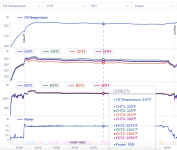
2. what's the oil temp? unlike an IO360, even right out of the box, the CHT's and EGT's on an IO390 will be pretty low, but the oil temp will likely be elevated until the piston rings find their happy place. One that happens, then he can start playing around with lean numbers.

The OP's numbers don't seem out of line for a new IO390 to me. Here's a screen shot of the cruise data from one of my early flights. My engine had less than 10 hours on it at this point. There aren't enough data fields to show everything at once, but the OAT was 68f and the fuel flow was 14gphScreenshot 2026-05-27 at 10.33.24 AM.png
 
Can I clarify something here: we're interested in the conversion factor (slope) of 1.8 and not in the offset of 32?

i.e. a difference of 65°C is 117°F, while 65°C is ~149°F. We're using a relative starting point, not an absolute one, if that makes sense.

So is the reference number you're using 65°C (=117 °F) or is it 150 °F (=83°C)?


EDIT: I've been running around near peak EGT at altitude (9500-17500) and am wondering if ROP will give me a couple more kts.
This is what I was trying to ask. ( but got shot down)

So when Leaning is 65c 117 f or is it the direct conversion of 65c =149 °F. ?
and when LOP is 50f 10 c or is 50f 28c ?

I know what the direct conversion is, just wondered if it worked for leaning, based on the above ? ( using the lean assist on G3X )

Thanks.
 
This is what I was trying to ask. ( but got shot down)

So when Leaning is 65c 117 f or is it the direct conversion of 65c =149 °F. ?
and when LOP is 50f 10 c or is 50f 28c ?

I know what the direct conversion is, just wondered if it worked for leaning, based on the above ? ( using the lean assist on G3X )

Thanks.
I think what we are asking is what is the original reference point. I believe it is -150°F (ROP). My engine monitor is set to F, and that seems common in the US when we talk about EGT and CHT.

65°C was probably obtained in a quick conversion from 150°F to C. The real number is probably -83°C. As Dan points out, it probably doesn't matter if you're 117°F or 150°F ROP because it's a fairly flat curve in that range.
 
No, only the change in degrees, so only the 1.8*C to F or F/1.8 to C, so no don't convert to absolute temps (don't use a conversion calculator) when looking at a delta temperature.
 
No, only the change in degrees, so only the 1.8*C to F or F/1.8 to C, so no don't convert to absolute temps (don't use a conversion calculator) when looking at a delta temperature.
Thankyou

so to confirm

what is 150f ROP in Celsius ?

and

what is 50f LOP in Celsius (delta)
 
Why on earth are you using AI to slop-out a unit conversion which you then need to ask everyone else to verify?

You can type "150 degF in degC" right into Google and it'll tell you what the numbers are.

- mark
Maybe you should have used AI ? :LOL:
 
Back
Top
