

Van's Air Force

The definitive Van's Aircraft support community! Buying, building or flying an RV? Join our exclusive family of mentors and enthusiasts!

Washing Out an Oil Cooler

DanH

Legacy Member
Benefactor
Advertiser
Mentor
Maybe I'm the last guy to get the memo, but here's the story...

Noticed oil temperatures were creeping up with increasing Hobbs time. No sign of additional blowby, so why?

Then one day I was scrubbing bugs off the leading edges, and thought, gee, when is the last time I had the inlet duct off the cooler? Sure enough, lots of visible bug parts and assorted dirt. I suspected there was a lot more garbage buried down in the fins.

Grabbed a bottle of evaporator coil cleaner, the stuff used to clean up the indoor unit in a heat pump. Dragged the airplane to a hose, shot the fins full cleaner, let it work a few minutes, then backflushed the core with a strong stream of water. Rinsed long and well, as there is some acid component to the cleaner.

Bingo. Oil temperatures are back to where they were 10 years ago.
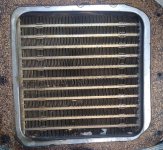
Oil Cooler Dirt 1000w.jpg
 
You might also consider sending it to a place like Pacific Oil Cooler for an internal power flush as well.
 
You might also consider sending it to a place like Pacific Oil Cooler for an internal power flush as well.

I did think about that Walt. Recently had the sump off for the inlet flange mod, and it was clean...no sludge or buildup of any kind. It's possible the lowest cross channel in the cooler is blocked (top inlet and exit), but the sump evidence says no, and the temps went back to original after washing out the fins.

Thought experiment...Imagine taping off a 6x6 area on the front of the airframe, and not washing it or removing the bugs for, oh, 1250 hours. What would it look like?
 
My oil temps have been similar, a slow increase over the last year or two; nothing alarming, but I’d rather have ‘em back where they were a few years ago. When my cylinders were off for a top OH awhile back I did a mineral spirits flush on the cooler and reinstalled; didn’t help much. I’m thinking after OSH I’ll send it to Pacific for a real flush/cleaning. Approaching 2200 hrs on this cooler, it’s probably kinda crusty in there.
 
My oil cooler was working fine with no leaks and temps were great in flight, but since it was many decades old and I was restoring the T-41a I thought I might as well do that too. When I got it back from that aviation oil cooler company in DFW where they washed it inside under pressure for days, it looked brand new. We installed it and about a month later we went for the first flight. It was a smooth flight and all temps were great. We were going to continue to my house but my IA suggested we land again at the airport where I was restoring it to look over everything and tighten anything that might have needed it. We landed uneventfully and after a quick taxi to my hangar when we got out there was oil all over the bottom cowling and on the ground. After removing the cowling we started the engine up and the oil cooler was leaking in various areas.

I made the mistake of taking mine to get washed inside by a company who did big aviation oil coolers for the DFW airliners, maybe they used too much pressure? They gave me my money back and the manager told me it happens a lot to them with these small GA filters which aren't built to the airliner's specs, but I still had to buy a new oil cooler which cost me a lot more.
 
I think the "washing OUT" part of the title might be what's throwing everyone off topic then. When I wash my plane's cowling inlets I don't wash the cowling out, I just wash the cowling.
 
It makes really good sense that your oil temp came down. When A/C guys clean the condenser coils on a unit they see a pretty significant change in the pressures. I don’t know what that difference is bc I’m not an A/C guy, but I’ve had them tell me that. Maybe some A/C guy can chime in.
 
My oil cooler was working fine with no leaks and temps were great in flight, but since it was many decades old and I was restoring the T-41a I thought I might as well do that too. When I got it back from that aviation oil cooler company in DFW where they washed it inside under pressure for days, it looked brand new. We installed it and about a month later we went for the first flight. It was a smooth flight and all temps were great. We were going to continue to my house but my IA suggested we land again at the airport where I was restoring it to look over everything and tighten anything that might have needed it. We landed uneventfully and after a quick taxi to my hangar when we got out there was oil all over the bottom cowling and on the ground. After removing the cowling we started the engine up and the oil cooler was leaking in various areas.

I made the mistake of taking mine to get washed inside by a company who did big aviation oil coolers for the DFW airliners, maybe they used too much pressure? They gave me my money back and the manager told me it happens a lot to them with these small GA filters which aren't built to the airliner's specs, but I still had to buy a new oil cooler which cost me a lot more.
That’s why I recommended Pacific Oil Coolers, they build, service and sell oil coolers for GA.
 
It makes really good sense that your oil temp came down. When A/C guys clean the condenser coils on a unit they see a pretty significant change in the pressures. I don’t know what that difference is bc I’m not an A/C guy, but I’ve had them tell me that. Maybe some A/C guy can chime in.
Effects are two fold. The fouling from dirt, dust, etc. allows less air flow through the fin pack. Less flow = less mass flow. That part of the heat xfer is driven by the properties of the air, specific heat. This is the measure of the fluid’s ability to carry heat, BTU’s/lbm.

Second part is the external film coefficient. This number is a measure of how well the conducted heat (through the heat exchanger‘s parent material) gets passed the the cooling air.(for lack of better Sunday AM words). Fouling tends to insulate the affected area as well as affect the boundary layer flow; both being bad.

Any fouling of this surface diminishes both of the above so the related effects are compounded. Keep it clean and free of corrosion or tarnish, though some margin for both is typical in sizing such applications.

On another note, I’d be wary of any service for internal cleaning. Verify any cleaning substances they use. HEx walls are very thin by design to promote efficiency. Any substance that reacts with the HEx materials can damage/weaken it.
 
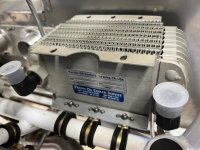
I sent an oil cooler to Pacific and they cleaned it inside and out. Not a speck of crud anywhere I could see. They also put a nice label on it. Looks brand new.IMG_0244.jpg
 
Apparently they do. See step #21 in their 25 step process:


"21. Unit is bead blasted and Iridite treated, then pressure tested for a third
Proof pressure testing, probably 1.5X max rated (not operating) press test i.a.w. ASME or similar means a lot.

This is definitely one of those "do not try this at home" items.
 
Apparently they do. See step #21 in their 25 step process:

The steps include cleaning the air side. It's something we can do ourselves, and typically neglect. I certainly did.
 
If I could add to the conversation. Dan mentioned Evaporator cleaner.
Evap cleaner solution is typically PH neutral. Will do no harm.
I caution against Condenser coil cleaner as it is typically alkaline based and is corrosive and will do damage.
They are designed to be flushed very well. If you have the cooler out of the plane and can rinse well then they are also a great brightener.
 
If I could add to the conversation. Dan mentioned Evaporator cleaner.
Evap cleaner solution is typically PH neutral. Will do no harm.
I caution against Condenser coil cleaner as it is typically alkaline based and is corrosive and will do damage.
They are designed to be flushed very well. If you have the cooler out of the plane and can rinse well then they are also a great brightener.
I would like to hear which of these cleaners might be PH neutral.
 
Probably the wrong one ;)

Seriously, pretty sure it was an evap cleaner. That said, note a big difference in the application. It's difficult to run a lot of rinse water through the coils of your indoor unit, so Ph neutral is important for sure. The remote mounted cooler on my -8 is easily rinsed with a garden hose running wide open, so a bit less concern about acid. It's why Mark (an AC industry professional, BTW) mentioned "if you have the cooler out of the airplane and can rinse well..".
 
We use Nu-Calgon mostly products.
This is a no rinse evap cleaner near neutral PH.

Our industry has had such a big problem with coil leaks that the correct cleaner (PH neutral) have become such a big deal.

The ones we use on outdoor coils (that can be thoroughly rinsed) are Alkaline and foam and brighten.
 
Back
Top