
Fuel running out the wing is a good indicator!I wonder what made them look to make sure the spar was OK.......)


Fuel running out the wing is a good indicator!I wonder what made them look to make sure the spar was OK.......

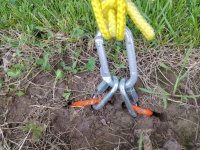
My tiedown carabiners are rated for 24 kilonewtons (almost 6,000 pounds) and weigh 32 grams each. Probably stronger than "just strong enough" .The Big Screw kits with straps have open hooks. No way Jose. That's just stupid. Like Bob said, use closed carabiners, or tie a knot in a rope.
View attachment 89443
I think technique has a bigger part than how strong in many cases. We had an F1 microburst blow through our airport 2-3 years ago. Maybe 50 planes on the ramp, but only two got damaged. A maule had only tied down the wings and not the tail. It was found upside down in a heap. The action of the movement with no tail security was enough to rip one of the 5/8” 12 braid ropes off one of the wings. The other was a long ez and it had its tie down rings ripped out of the wings. It was thrown against a fence 10’ away.I looked all over but I couldn't find that video. It would make interesting viewing, although I'd factor in that it was clearly not an unbiased experiment. I find it odd that they would break where the spikes go through, as the weak point seems to be where the arms pivot about the center, which is why they are intended to be installed vertically.
This gives rise to a question- how strong do tie downs need to be? I'm no engineer, but I understand the concept of "just strong enough" and wonder how that would apply in this case. Any stronger than "just strong enough" is just extra weight to be carried around. So, how strong is "just strong enough?"
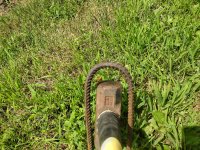

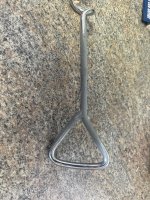

Good points. I may make me a set with the U-bolt in there to replace my current setup which is the 2 crossed-tubes and spikes which work well outside of T-storm country but otherwise probably need an upgrade.Except for the hook - that can get expensive, when it opens up. Assuming the hole doesn't rip out first.
Dave

Here's one I saw just yesterday, a variation on the one described in #31 and Simple and inexpensive.
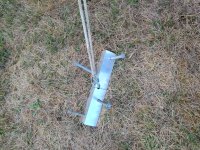
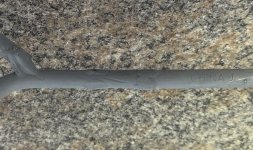
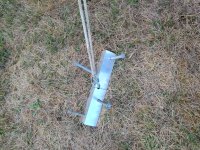
That's a fantasy tiedown. Not enough spikes, and as pictured, 12" nails stuck halfway in the ground are useless. And it's the vertical-pull type. If pulled at an angle, as it seems in the photo, two of the stakes are being pulled tangent to their axis, and the other two are not at 90 to the pull.
View attachment 96514
A Chinese dog tie, "fixed" by welding, complete with slag holes and grind marks? Tell us you're not serious. You just didn't want your Pekinese to get away, right?


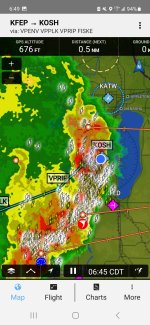
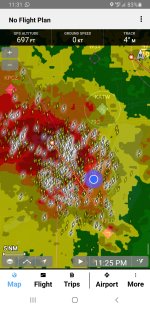
Oshkosh had a front come thorough last week with 90 MPH gusts on the field. THAT would be a problem for any of our tie-down systems. But more and better ropes, anchors and gust locks are always helpful The first thing to do is make sure the tail is tied down well. If the airplane starts to weathervane, the rest of your tie-downs won't do much good. I think this year I'm taking two tie downs for the -10's tail. gonna stake one apiece slightly behind and to the side of the airplane to better secure the tail against sideloads/weathervaning.Reminding folks of this thread. We’re getting close to that time of year! Please be responsible with your tie down choices!
I used the Big Screw system at OSH ‘23, backed up with the ultimate gust lock from AntiSplat, backed up further with the flight control locks on the ailerons and elevator (those red clamp style ones from AS). No issues with the windy storm that came through that year (45+ gusts).

When at parking at OSH, I tend to have TWO tiedowns on each wing, at different angles, and two on the tail. Airplanes are made to FLY, as we all know! Can one be TOO safe? One predicable thing about OSH weather is that it will be unpredictable!!Oshkosh had a front come thorough last week with 90 MPH gusts on the field. THAT would be a problem for any of our tie-down systems. But more and better ropes, anchors and gust locks are always helpful The first thing to do is make sure the tail is tied down well. If the airplane starts to weathervane, the rest of your tie-downs won't do much good. I think this year I'm taking two tie downs for the -10's tail. gonna stake one apiece slightly behind and to the side of the airplane to better secure the tail against sideloads/weathervaning.

I believe the best way to reduce the possibility of damage is to tie-down facing WEST! For whatever reason, most airplanes are parked facing East, but most gust fronts come from the West. Even with good control locks, a strong gust from the rear has a better chance of causing tail damage than if the plane is facing the wind. Ask me how I know. BTW - the parking guys allow you to park facing any direction, as long as you stay “in your box.”When at parking at OSH, I tend to have TWO tiedowns on each wing, at different angles, and two on the tail. Airplanes are made to FLY, as we all know! Can one be TOO safe? One predicable thing about OSH weather is that it will be unpredictable!!
Having volunteered at OSH since 1987, all but that little break we had for some virus something, I can vouch for gust fronts coming from ALL points of the compass. Seems like the strongest come from the North, but it depends, of course, on where the storm is that it is coming from. Do storms usually come from the West? Yes; but a storm originating in the West now sitting North of the field can generate gusts going SOUTH. I have many memories of sitting in my tent with the North wall bulging in!I believe the best way to reduce the possibility of damage is to tie-down facing WEST! For whatever reason, most airplanes are parked facing East, but most gust fronts come from the West. Even with good control locks, a strong gust from the rear has a better chance of causing tail damage than if the plane is facing the wind. Ask me how I know. BTW - the parking guys allow you to park facing any direction, as long as you stay “in your box.”

I have a set of EAA tiedowns that I made years ago, using 18" titanium rods as Ironflight did. Had just as much fun threading the ti. I've never put them to a severe test and I won't weigh with a "mine's best" opinion. But I have had an experience that some may find interesting.That Big Screw looks interesting - will have to take a look at them at OSH!
We have always had great success (at Oshkosh) with the EAA Homebuilder tiedowns, which uses a surface plate and three stakes driven through it at angles. It works really well in the Oshkosh soil - have never been able to use it in the rocky soils/dirt/rock out west. The lesson being that different regions have different requirements - what works at SnF might not work in Oshkosh…and vice versa.
I’m modifying one of our sets of EAA Tiedowns with Titanium stakes right now. Why? Because I got a good ear on three 3’ lengths of 1/4” titanium on E-Bay, that’s why. Cut them into manageable lengths of course. Took me DAYS to cut threads on the end of each one for nuts. They’ll be trick, and won’t bend like my steel takes that have been pretty abused over the years.
My annual reminder on spiral dog-stakes. Absolutely do NOT use them to tie down next to me if you bought them from any big box, pet, or sporting goods store - the triangle at the top will pull right out. But…. Years ago, a fellow sold sets of them made from Titanium, and they are heck-for-stout … and don’t weigh much. There are still a number of them in use, one set that we carry in our RV-3. So before you go medieval on someone for using what looks like a dog stake, you might complement them on having one of the few sets of titanium ones, and if they accept the compliment and tell you how great they are, you’re good…and if they give you a funny look, then you know they bought steel ones at Walmart. Move your plane somewhere else…..
Chuck, that's an effective and simple approach! I like it, and if it can be made lighter, I'd like it more.I put together a simple set of tie downs.
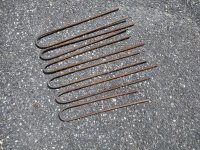
20' stick of 3/8" rebar from the local masons supply yard. Had them cut it into 6 pieces 40" long each. $6.50
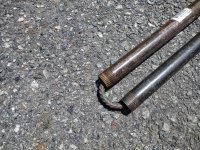
Bent them into U shapes using a pair of 5' long 3/4" steel pipe. I primed them to avoid the oxidized steel from getting on everything.
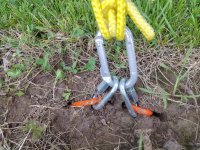
Pounded 2 in each tie down at a 45 degree angle.
Joined them with chain quick links, to avoid stressing my carabineers.
View attachment 92841View attachment 92843
View attachment 92844
Getting them out, there is plenty of surface area to tug on. Any long lever can be slipped under the U, to lever the them out of the ground.
No welding, and only needs a heavy hammer to install.
So simple even I could make and use them.
Chuck

Within the 4 corners of Homebuilt Parking we have areas that park facing all 4 cardinal directions, it's just the way things are laid out. Where I park I'm facing south, so I hope I don't get one of Michael's strong north gust fronts!I believe The North 40 all park facing West or East, depending on how one gets tailed in. Vintage and South 40 are all facing North. No choice as that is how the parking lines are laid out. Homebuilt is different.
The Big Deal is (and we say this EVERY year) TIE YOUR AIRPLANE DOWN!! (Sir, you need to tie your airplane down. Yeah, I know. I'm just going to registration. Good. That can wait. Please tie your airplane down now.) Sigh...........

I commented to a marshall at HBP that I wanted to park & tie down "into the wind".Within the 4 corners of Homebuilt Parking we have areas that park facing all 4 cardinal directions, it's just the way things are laid out. Where I park I'm facing south, so I hope I don't get one of Michael's strong north gust fronts!
And MED is correct- wherever you end up parked, if you want to spin it around and face the opposite direction, have at it. Just be sure that you are aligned with the rest of your row so you're not blocking the taxi rows, and fer Pete's sake, TIE THE THING DOWN!!!

......and that will all go in the tow-behind AirTrailer you have also designed and patented, right?I think the answer is clear - we need to travel with a post hole digger, a few sacks of cement, a cement mixer, some rebarb, a few gallons of water, and then make our own tie-down points wherever we go - patent-pending idea! ®, ™, ©, ℠


That’s been our internal running joke forever. If someone is really unhappy with their parking arrangements… there’s always Fond du Lac!I commented to a marshall at HBP that I wanted to park & tie down "into the wind".
He said, "fine then go to Fon du Lac"

Thanks for posting those . Weight is a big concern in my airplane RV6a with 160 HP as I can barely carry a small passenger with out being at gross weight with half fuel. I don't usually go to shows like this because I can't carry anything. But it's nice to see the company state they are the lightest on the market. As for some people weight is a very big issue in a very smallJeff,
I think the Point (pun intended, lol) of Dan’s comment about the Claw would be in conjunction with your Point (there it is again, lol) about proper installation.
I was also at the SunNFun tornado. Although my plane was not destroyed it was damaged. I was using the Claw tie-downs. I had them installed directly under the wing tie-down rings under the wing. In that sandy soil they came right out. In reality, I am not sure any tie-downs could really withstand a tornado. However, if anyone is going to use the Claw tie-downs it will be important to have the rope extend directly down from the tie-down ring on the wing. This ensures the pulling force is 90 deg from the angled stakes in the ground.
After the SunNFun tornado I stopped using the claw. One of the difficulties with using it with our low wings involves swinging a hammer directly underneath the wing in order to get that 90 deg angle. The risk of hitting the wing as one swings the hammer did not sit well with me. I think with high wing airplanes they are fine. I switched to the StormForce tie-downs and have not regretted the move.
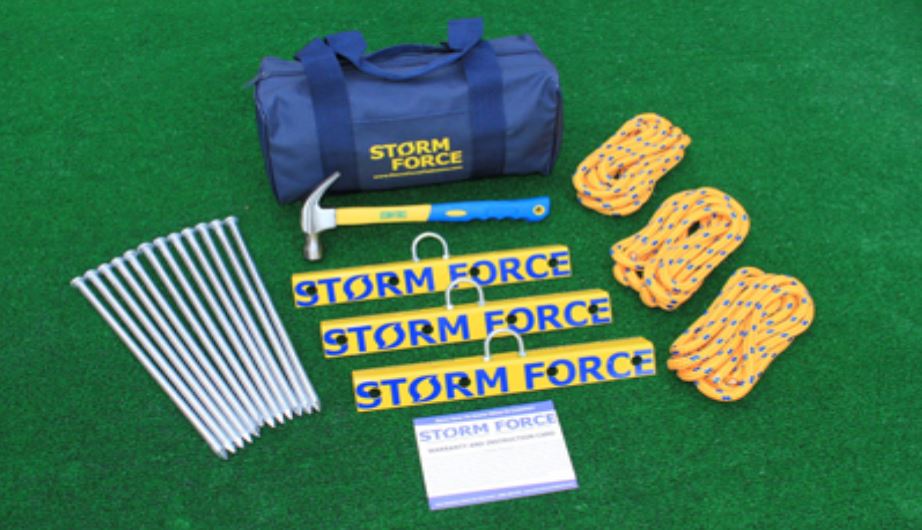
Aircraft Tie Down - Strongest Tie Down on the Market
Stormforce Aircraft Tie Down is Lightweight & Strong. Ideal for securing & tying down Aircraft , RV’s, Awnings & Satellite Dishesstormforcetiedowns.com
I know I'm responding to an old post, but the thing that bothers me about the claw is that if you follow the installation instructions, the claw is directly below the hard points on the aircraft. Compared to normal tie-downs which are set out a few feet away from the airplane, the claw doesn't offer the same resistance to the airplane wanting to shift around in winds. While the claw may have very good vertical pull numbers, the airplane flying away isn't your first concern in wind. The aircraft weathervaning is, and I think the claw is sub-optimal in preventing that.One of the difficulties with using it with our low wings involves swinging a hammer directly underneath the wing in order to get that 90 deg angle. The risk of hitting the wing as one swings the hammer did not sit well with me. I think with high wing airplanes they are fine. I switched to the StormForce tie-downs and have not regretted the move.

DH,As we move toward another Oshkosh, dare I mention a pet peeve? Yeah, dare I will....
At OSH, tiedowns protect the other airplanes. We park close together, and post-thunderstorm, long-timers have seen more than one upside down on another. If you park next to my airplane with some kind of crappy tiedown rig, expect to be chastised, finger pointed, tarred and feathered, and generally despised.
Seriously folks, we all have $50,000 to $350,000 invested, and often 1000's of hours of labor. You're welcome to be cavalier with your own stuff, but have some respect for your fellows. Invest in some serious tiedowns. Serious doesn't include the Claw (seen too many broken) and d@## sure doesn't include dog ties.
Let's talk. My veterans are solid aluminum stakes, 3/4" D and about 20" long, with 6" x 6" steel spades near the top and a welded rope ring. I've been using them almost 30 years. Don't recall where I got them, but the bare stake was probably military in origin. When driven so the spades are below the surface and rigged to pull perpendicular, they are very solid, even in sandy soil like Lakeland. The downside is they can be a lot of work to hammer into the ground, and I've camped a few places I couldn't get them into the ground due to rock content.
I recently purchased a set of Big Screw tiedowns, which are driven much like the aluminum stakes, so they pull perpendicular. The driver is a Dewalt DCF891B impact wrench with a six-point socket. It's the mid size impact; the large one (DCF900) weighs nearly twice as much. Here the overall package weighs about the same as the stakes with spades and the required large hammer. Pirep for the combo is good so far. I've driven them into the hard packed clay soil of the driveway in front of my shop, and a few weeks ago into the dirt at Trigger Gap AR, a place with a very high rock content. For sure it's less labor than a hammer, and very fast. I have no reservations about how well them will hold at OSH, but I'll reserve judgement about Lakeland until I can drive them there and get a feel for pull resistance in sandy stuff.