
Fuel running out the wing is a good indicator!I wonder what made them look to make sure the spar was OK.......)


Fuel running out the wing is a good indicator!I wonder what made them look to make sure the spar was OK.......

My tiedown carabiners are rated for 24 kilonewtons (almost 6,000 pounds) and weigh 32 grams each. Probably stronger than "just strong enough" .The Big Screw kits with straps have open hooks. No way Jose. That's just stupid. Like Bob said, use closed carabiners, or tie a knot in a rope.
View attachment 89443
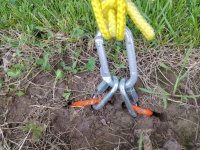
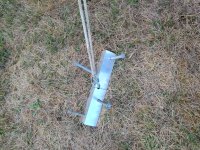
I think technique has a bigger part than how strong in many cases. We had an F1 microburst blow through our airport 2-3 years ago. Maybe 50 planes on the ramp, but only two got damaged. A maule had only tied down the wings and not the tail. It was found upside down in a heap. The action of the movement with no tail security was enough to rip one of the 5/8” 12 braid ropes off one of the wings. The other was a long ez and it had its tie down rings ripped out of the wings. It was thrown against a fence 10’ away.I looked all over but I couldn't find that video. It would make interesting viewing, although I'd factor in that it was clearly not an unbiased experiment. I find it odd that they would break where the spikes go through, as the weak point seems to be where the arms pivot about the center, which is why they are intended to be installed vertically.
This gives rise to a question- how strong do tie downs need to be? I'm no engineer, but I understand the concept of "just strong enough" and wonder how that would apply in this case. Any stronger than "just strong enough" is just extra weight to be carried around. So, how strong is "just strong enough?"
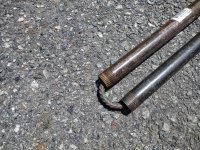
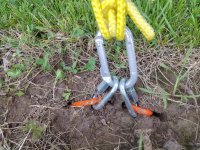
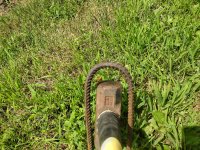

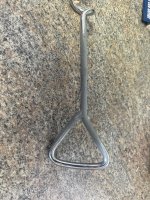

Good points. I may make me a set with the U-bolt in there to replace my current setup which is the 2 crossed-tubes and spikes which work well outside of T-storm country but otherwise probably need an upgrade.Except for the hook - that can get expensive, when it opens up. Assuming the hole doesn't rip out first.
Dave

Here's one I saw just yesterday, a variation on the one described in #31 and Simple and inexpensive.
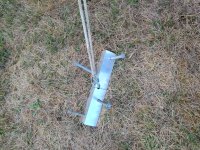
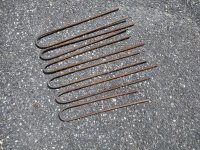
That's a fantasy tiedown. Not enough spikes, and as pictured, 12" nails stuck halfway in the ground are useless. And it's the vertical-pull type. If pulled at an angle, as it seems in the photo, two of the stakes are being pulled tangent to their axis, and the other two are not at 90 to the pull.
View attachment 96514
A Chinese dog tie, "fixed" by welding, complete with slag holes and grind marks? Tell us you're not serious. You just didn't want your Pekinese to get away, right?


Oshkosh had a front come thorough last week with 90 MPH gusts on the field. THAT would be a problem for any of our tie-down systems. But more and better ropes, anchors and gust locks are always helpful The first thing to do is make sure the tail is tied down well. If the airplane starts to weathervane, the rest of your tie-downs won't do much good. I think this year I'm taking two tie downs for the -10's tail. gonna stake one apiece slightly behind and to the side of the airplane to better secure the tail against sideloads/weathervaning.Bumping this thread. We’re getting close to that time of year! Please be responsible with your tie down choices!
I used the Big Screw system at OSH ‘23, backed up with the ultimate gust lock from AntiSplat, backed up further with the flight control locks on the ailerons and elevator (those red clamp style ones from AS). No issues with the windy storm that came through that year (45+ gusts).

When at parking at OSH, I tend to have TWO tiedowns on each wing, at different angles, and two on the tail. Airplanes are made to FLY, as we all know! Can one be TOO safe? One predicable thing about OSH weather is that it will be unpredictable!!Oshkosh had a front come thorough last week with 90 MPH gusts on the field. THAT would be a problem for any of our tie-down systems. But more and better ropes, anchors and gust locks are always helpful The first thing to do is make sure the tail is tied down well. If the airplane starts to weathervane, the rest of your tie-downs won't do much good. I think this year I'm taking two tie downs for the -10's tail. gonna stake one apiece slightly behind and to the side of the airplane to better secure the tail against sideloads/weathervaning.

I believe the best way to reduce the possibility of damage is to tie-down facing WEST! For whatever reason, most airplanes are parked facing East, but most gust fronts come from the West. Even with good control locks, a strong gust from the rear has a better chance of causing tail damage than if the plane is facing the wind. Ask me how I know. BTW - the parking guys allow you to park facing any direction, as long as you stay “in your box.”When at parking at OSH, I tend to have TWO tiedowns on each wing, at different angles, and two on the tail. Airplanes are made to FLY, as we all know! Can one be TOO safe? One predicable thing about OSH weather is that it will be unpredictable!!