

Van's Air Force

The definitive Van's Aircraft support community! Buying, building or flying an RV? Join our exclusive family of mentors and enthusiasts!

Sticky valve on a Thunderbolt IO390

Over the last 6 months I've been trying to learn and understand as much as possible about how sticky valves form and what one can do to mediate the issue. I've watched many U-tube videos and Mike Busch seems to have a very good Morning Sickness 101 presentations. I'm convinced based on several members that I should be able to get a "tell" before I would have a major problem (One good reason to let my EFIS fully boot and start recording data before engine start) and that is watching to see if all cylinder EGT's increase at the same rate and time. What I can't seem to find are pictures showing what one's valve seat and guide look like when valves are sticking. Mikes videos talk about the importance of a borescope but there are no pictures what it looks like. I did find one picture that looks like the stem is slightly varnished at best and no different than what my stems and guide look like on all 4 cylinders of mine! Checking from the top I get and makes sense to show lack of turning or the dreaded green streaks. Does anyone have pics of their stems and guides that had a sticking valve? Mike seems to feel borescope and not the wobble test is a better test, but I have no idea what I'm looking at.
 
Last edited:
@dmattmul, pity you're asking now, since I performed a "free the poor valve" action last week on yet another 390. Usual symptoms observed by the builder/pilot.

Removed the springs on valve of cylinder #2, and one could move the valve freely. But not completely, when pushing it towards the combustion chamber. Pulled it displayed no lateral play. Over the years I've done quite a few of those remedials, and don't use the wobble clock anymore, but move the valve laterally which is enough to feel the play. Or not.
Anyway, in this case we then had to hammer the valve into the cylinder. Pulling its tail thru the lower spark plug hole showed barely any trace of deposit, so a light scuff of scotch brite was enough. I've seen plenty of valves with lead deposits on their stem (and another reason I try to avoid any leaded fuel, Mogas being my favorite.
I then used my Vevor borescope to look into the guide, and the last inch or so clearly displayed brownish, becoming black, coke deposits. Used the adjustable reamer to clean it off, fished the valve and inserted it back into the guide, and the play was now satisfactory.
Subject aircraft has now flown a few hours with no remark.

PS
There are plenty of popcorn threads here as well as on other sites, regarding one's favorite oil, and does it promotes sticky valves, etc.
There is one brand of oil, angel number minus one digit, which I won't touch with a 10 foot stick, and guess what... all the "free the poor valve" jobs I performed to date have been on aircraft using this oil.
Hey, but what about the use of snake oil or MMO?
 
I'm curious why MMO is added to the fuel vs the oil.
MMO helps to keep lead in a aerosol state at lower temps when mixed with fuel. In theory, fewer lead deposits, which tend to happen at low combustion gas temps, where the lead can move to a solid state. This was its original design goal and why the military used it in WWII. It can also be added to the oil and in theory, helps break down carbon deposits. I believe that in the first case, MMO does what it claims. Unsure on the second.
 
Angel number?

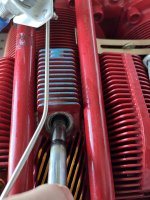
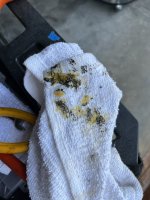
Anyway, one photo of the valve stem and one of the crap wiped off the reamer. It did not take a lot of “stuff” to stick the valve.

Using MMO in fuel for last 300 hours with no hints of EGT drops.
IMG_1696.jpegIMG_1699.jpeg
 
Angel number?

Anyway, one photo of the valve stem and one of the crap wiped off the reamer. It did not take a lot of “stuff” to stick the valve.

Using MMO in fuel for last 300 hours with no hints of EGT drops.
View attachment 89856View attachment 89857
This pic has fairly more than my #2 stem had but right around the same location. My engine sickness lasted only a few seconds, less than 10 seconds and I reamed the guide on the next flight so it was not a heavy build up. I have started using MMO, but have no idea if that is going to help.
 
Mikes logic here is that lead is found with carbon in the build up, therefore it must be coming from the fuel. Unfounded supposition IMHO. Your oil has disspersnts that hold debris in suspension. Much of that debris is lead particles, along with carbon. Therefore the oili is filled with lead particles and is then pumped into the rocker box and coats the valve stems and guides. When oil gets too hot, it oxidizes and becomes a hard substance called Coke, with the lead particles that were held in suspension now encapsulated in the Coke. This is an equally reasonable theory for the presence of lead in the guide build up, but Mike chooses to ignore it and go with a different theory. That's his perogotive, but doesn't mean everyone should accept it at face value. If mike were correct that it is lead that is the problem, how does he explain the presence of carbon in the build up?

Unfortunately no one really knows why it is such a problem with Lyc compared to all other engines. At least my theory has a variable that is unique to Lyc engines. Not sure we will ever know the true reason. Clearly lyc thinks it is too much heat, which is why they now use exotic filled valves to keep the valve stem heat down.

Larry

Sam Heron - c.1923

Lycoming still uses sodium filled exhaust valves since they don't have a better way to cool them -- and they don't use exotic valve rotators like Conti's to keep the seat wear even.

...maybe the sticking problem is from too much oil making it down the push rods and on to the stems...
 
…Mike seems to feel borescope and not the wobble test is a better test, but I have no idea what I'm looking at.

A thorough boroscope set reviewed by Savvy did not identify my stuck valve. Neither did the Feva 2.1 Exhaust Valve Condition Screening Report.

My symptoms were both lower than normal EGT at low rpm and low compression test numbers on cylinder 4. My first attempt to resolve was exhaust valve lapping per Savvy. During lapping, I could tell the valve seemed tight so I did the valve wobble test which confirmed it was too tight. Reamed the valve and it’s twice checked fine over the last 300 hours. All the other exhaust valves have checked normal with the valve wobble test.

My experience with a stuck valve is limited to one so YMMV.
 
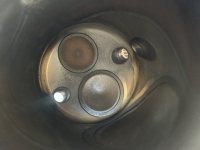
After spending over an hour trying to get the "money" shot of exhaust valve guide (Location of 90% + of stuck valves) of my angle valve 390 I gave up. I'm using the Borescope Mike Busch recommends although a little leery of getting it stuck under the valve after watching a Dave Pasquali video but no joy. I can't seem to get the lighting correct when at the right angle and when I get the lighting correct get only a small portion of the guide. A friend borrowed my borescope for his 540 and exhaust guides are very clear to see? It's a parallel valve engine, is that easier to capture the pic? If the borescope is the ticket seems Mike would have examples what this should look at with an imminent stuck valve.
 
Sam Heron - c.1923

Lycoming still uses sodium filled exhaust valves since they don't have a better way to cool them -- and they don't use exotic valve rotators like Conti's to keep the seat wear even.

...maybe the sticking problem is from too much oil making it down the push rods and on to the stems...
Pretty sure that is not the case. Do some research on lycoming lifters/plungers. Every lifter used in auto engines since the flathead ford has used bypass channels in the lifter to send oil up the pushrod to cool the exhaust valves. Lycoming lifters do not have these and why there is so little oil flow to the rocker box. They rely upon a very low volume bleed passed plunger clearances. If there was more oil flow, there would be more cooling of the exhaust valve. Oil is very effective at pulling heat off metal parts, just ask the guys with piston squirters about oil cooler sizing.

The stems must always have oil on the or else you would wear away the guide in a few hours.
 
After spending over an hour trying to get the "money" shot of exhaust valve guide (Location of 90% + of stuck valves) of my angle valve 390 I gave up. I'm using the Borescope Mike Busch recommends although a little leery of getting it stuck under the valve after watching a Dave Pasquali video but no joy. I can't seem to get the lighting correct when at the right angle and when I get the lighting correct get only a small portion of the guide. A friend borrowed my borescope for his 540 and exhaust guides are very clear to see? It's a parallel valve engine, is that easier to capture the pic? If the borescope is the ticket seems Mike would have examples what this should look at with an imminent stuck valve.
The clearance between the exhaust stem and guide is in the neighborhood of .002 - 004”. If not familiar with thousands, that is like 2 sheets of paper. That means a carbon build up of only .001-.002” will make the valve stick. I can’t fathom how you would see a build up in the inside of the valve guide while there is a valve stem in it. And even if you could, you are not going to be able to tell the difference between an .0005” and a .002” build up with something other than a microscope. All of the carbon coked onto the valve stem is meaningless, as it is outside of the area where it rides inside of the guide. You will almost universally find the stem to be clean and shiny in the area that rides in the guide.

If you want to know, just pop the spring off and wiggle the valve around. Should take 15 - 20 minutes once you have done it once.
 
Last edited:
The clearance between the exhaust stem and guide is in the neighborhood of .002 - 004”. If not familiar with thousands, that is like 2 sheets of paper. That means a carbon build up of only .001-.002” will make the valve stick. I can’t fathom how you would see a build up in the inside of the valve guide while there is a valve stem in it. And even if you could, you are not going to be able to tell the difference between an .0005” and a .002” build up with something other than a microscope.

If you want to know, just pop the spring off and wiggle the valve around. Should take 15 minutes.
Then why does Mike Busch request this picture? (See #5) Not playing devil's advocate just trying to understand how to be preemptive seeing sticky valves before they stick.

A sheet of paper is ~ 0.004" so less than one sheet of paper. :unsure: But agree the clearance is slim to none. A little coat of varnish would pretty well lock it up.
Screenshot 2025-06-10 103944.jpg
 
Last edited:
Then why does Mike Busch request this picture? (See #5) Not playing devil's advocate just trying to understand how to be preemptive seeing sticky valves before they stick.

A sheet of paper is ~ 0.004" so less than one sheet of paper. :unsure: But agree the clearance is slim to none. A little coat of varnish would pretty well lock it up.

View attachment 89870
I don’t understand most of what mike says. A lot of it seems scatter gunned and without great forethought. I think he just makes up new stuff to look smart. I will restate my belief that you cannot see a sticky valve scenario. Best to read less mike busch and more lycoming service instructions. They tell you how to catch this before the valves stick. Spoiler alert: it doesn’t include a borescope.
i do agree that getting the scope up in there to see the full sealing areas of the valve and seat are important, as is seeing the stem.

I have made a few wobble test tools and will make you one for a reasonable fee. It makes the test very easy, as you don’t need to remove the spring. Once the rocker is off, it is 5 minutes.
 
Last edited:
Sheesh. Why all the Secret Squirrel nonsense?
Apologies for having picked up your brain with this rather difficult to solve riddle... thing is I don't like discussing, or even worse, accusing, or promoting, a certain brand of whatever. Very close to politics or religion me thinks.
Since the cat is out of the bag, yes, multigrade as in Phillips 66 XC 20W50.

Checked my borescope right now, unfortunately no picture taken during that latest "free the poor valve" action.

@lr172 , curious, do you think you can realistically measure the wobble without taking the springs out?
 
Apologies for having picked up your brain with this rather difficult to solve riddle... thing is I don't like discussing, or even worse, accusing, or promoting, a certain brand of whatever. Very close to politics or religion me thinks.
Since the cat is out of the bag, yes, multigrade as in Phillips 66 XC 20W50.

Checked my borescope right now, unfortunately no picture taken during that latest "free the poor valve" action.

@lr172 , curious, do you think you can realistically measure the wobble without taking the springs out?
Yes

The tool that I made is a copy of the lycoming tool. It is a plate that bolts on using the rocker cover threaded holes. As you tighten the bolts, the plate compresses the valve spring (You tighten until the plate is snug against the heads machined surface) and you pop out the keepers. You then attach the stem extender and wobble it back and forth parallel to the dial indicator that mounts in the tool. The service instructions show pics of the tool and explain how to use it. Very quick to do the test correctly. The benefit of doing it this way is you get a precise wobble number that can be compared to the table and will identify both tight (build up) or loose (worn) guides.

I hvae used the tool to perform the test and it works fine. Takes about 20 minutes per and that includes comprerssing the plunger and removing the rocker. Without the tool, you must remove the spring first, but that only adds a few minutes once your accustom with the process. This way you can tell by quick feel whether or not it is tight once you have felt one with a proper clearance. Less precise than the dial indicator, so hard to tell the difference between clear and marginal build up. But you will easilly know if it is close to too tight or already too tight.

All of this will likely take way less time than trying to see something in there with a borescope.
 
Last edited:
I don’t understand most of what mike says. A lot of it seems scatter gunned and without great forethought. I think he just makes up new stuff to look smart. I will restate my belief that you cannot see a sticky valve scenario. Best to read less mike busch and more lycoming service instructions. They tell you how to catch this before the valves stick. Spoiler alert: it doesn’t include a borescope.
i do agree that getting the scope up in there to see the full sealing areas of the valve and seat are important, as is seeing the stem.

I have made a few wobble test tools and will make you one for a reasonable fee. It makes the test very easy, as you don’t need to remove the spring. Once the rocker is off, it is 5 minutes.
Hi Larry,
I will be interested in a tool that checks the valve and does not require removal of the spring. I also agree that it would be very challenging if not impossible to look at the stem with a borescope and identify issues, I have tried and not a chance for me.
 
thanks @lr172, I have such a tool myself, but never used it for the wobble check, since removing the springs is no big deal... the keepers can have their own mind though ;)
 
Hi Larry,
I will be interested in a tool that checks the valve and does not require removal of the spring. I also agree that it would be very challenging if not impossible to look at the stem with a borescope and identify issues, I have tried and not a chance for me.
Maybe i will post something and see who is interested. Don’t make a lot of $ doing this kind of stuff , mostly helping other builders, and suspect my post would get deleted, as i am not an advertiser on this site. Probably better to send me DMs.
 
Over the last 6 months I've been trying to learn and understand as much as possible about how sticky valves form and what one can do to mediate the issue. I've watched many U-tube videos and Mike Busch seems to have a very good Morning Sickness 101 presentations. I'm convinced based on several members that I should be able to get a "tell" before I would have a major problem (One good reason to let my EFIS fully boot and start recording data before engine start) and that is watching to see if all cylinder EGT's increase at the same rate and time. What I can't seem to find are pictures showing what one's valve seat and guide look like when valves are sticking. Mikes videos talk about the importance of a borescope but there are no pictures what it looks like. I did find one picture that looks like the stem is slightly varnished at best and no different than what my stems and guide look like on all 4 cylinders of mine! Checking from the top I get and makes sense to show lack of turning or the dreaded green streaks. Does anyone have pics of their stems and guides that had a sticking valve? Mike seems to feel borescope and not the wobble test is a better test, but I have no idea what I'm looking at.
there is not concrete answer to the ? about sticking valves. its kind of like your blood pressure, until you test it you don't know. same with the valves sticking and destroying your engine. GET THE WOBBLE TEST DONE EVERY 300 HOURS. now you know what is going on. ream the bad ones if you have a bad one. change what ever you want to try to help and get it tested again in another 300 hrs.
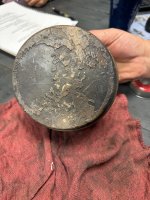
left photo= bad right photo = good
now go out and do the right thing!
 

Attachments

  • IMG_2448.jpeg
    IMG_2448.jpeg
    3.6 MB · Views: 35
  • IMG_5696.jpeg
    IMG_5696.jpeg
    2 MB · Views: 35
oh, one other thing, to get a wobble test done, find your local Robinson helicopter mechanic and schedule a test. they do them all the time because there is a service bulletin on the Robinson lycoming engines. smart ehh. look at all the pics you want, but don't think that will help SYA. Turbo OUT.
 
Back
Top