

Van's Air Force

The definitive Van's Aircraft support community! Buying, building or flying an RV? Join our exclusive family of mentors and enthusiasts!

Plane Power Alternator Failure - Redux...Redux...

bjdecker

Well Known Member
Ambassador
...since we haven't talked about alternators in a few hours... :)

I received the following unit from our comrade Brian Beatty (@bdbeatty) today. This alternator failed enroute to OshKosh a couple of years ago, after only a few hundred hours. Initial analysis by Hartzell/Plane Power was insufficient - stopping at the first thing that they saw and then denying his warranty claim because he had previously removed the rear cover to have a look.

...Boo Hartzell, Boo...

Findings:

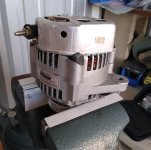
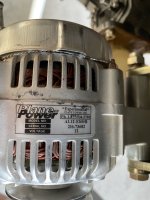
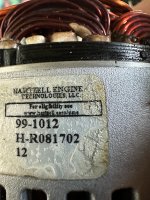
So, let the autopsy begin; Plane Power AL12EI60, s/n H-R081202, no external damage noted. A black dust/power is visible in all of the vent holes.

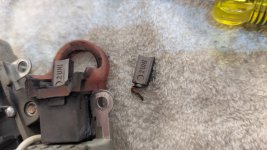
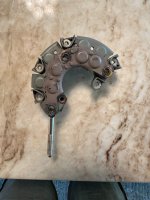
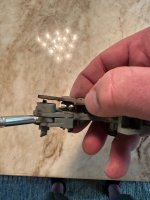
I removed the rear cover and observed that the rectifier was blown apart and literally hanging by a (brass) thread. Scorching, burn marks, and discoloration of the top diode carrier plate.
IMG_7495.jpg
IMG_7496.jpg

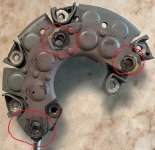
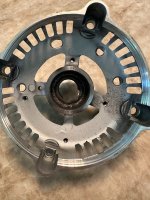
The top plate, which holds the 4 "negative" diodes showed evidence of overtemperature and all 4 diodes were failed, some open, some shorted. The bottom plate, which holds the "positive" diodes, was in better shape, but only 2 of the 4 diodes tested "Ok". Clearly a failed rectifier -- but why?

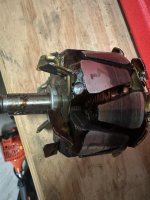
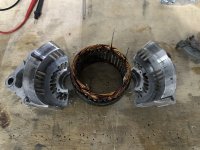
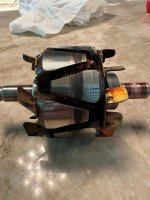
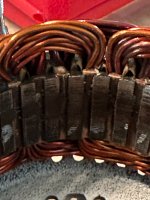
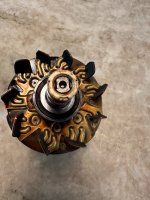
Splitting the case and removing the rotor revealed more ugliness - this alternator was clearly on its way to a total meltdown. The varnish on the magnet wire in the stator and on the fans of the rotor was discolored. The rotor showed signs of dragging the lam-stack of the stator. For reference, the O.D. of the rotor is 76.4mm, and the I.D. of the lam-stack in the stator is ~77.1mm.
IMG_7499.jpgIMG_7505.jpg

Both bearings rotated easily, and demonstrated no appreciable radial or axial movement of the inner races. The rear bearing was covered in black dust/powder and the outer race surface showed evidence of wear/movement.

The rotor was clearly wobbling, and dragging on the inside of the stator. Wear marks are evident and more prevalent on the aft portions of the prawls. This indicates that the rear bearing is moving radially in its retention cavity (SRE).

The rotor assembly, bearing and all, dropped out when I flipped the SRE assembly over. The cavity provided almost zero interference retention with the bearing.
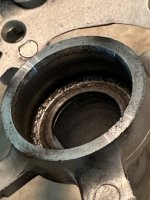
IMG_7504.jpg

Failure Root Cause:

The SRE bearing had "spun" in its housing over time for unknown reasons. On the incident flight, enough material had worn away to allow the rotor to oscillate (wobble) radially, and interfere with the stator. This interference produced a tremendous amount of heat (friction), which began to 1.) melt the varnish of the stator windings magnet wire, 2.) overheat the rectifier, diodes, causing them to fail. Once a plurality of diodes failed, the alternator was no longer producing DC voltage and the overvoltage/crowbar circuit tripped which shut down the field current. A blast tube was installed to direct air at the regulator heatsink, no failures observed in the regulator.

Commentary:

We assume a great deal of risk when we fly, and we rely on our suppliers to do "the right thing" with the products that we use. This SRE bearing/cavity issue has been around "for awhile now" (@DanH, @BillL for details/dates) but I don't recall seeing an SB or similar from anyone at Van's or Hartzell regarding it or any communication regarding next steps ( the minimum thing, the right thing would be to replace/rework the SRE, bearing and rotor.)

If this wasn't experimental aviation, and the FAA/NTSB "knew" about this failure mode, and/or there was an accident caused by this failure mode, I suspect the fleet would have been grounded by now.

This failure mode concerns me (...scares the he77 out of me, actually...). I think I may replace that SRE bearing with a larger (taller) one -- there's room in the SRE cavity (~13mm) for it.

-Brian-
 

Attachments

  • IMG_7497.jpg
    IMG_7497.jpg
    1.7 MB · Views: 79
  • IMG_7503.jpg
    IMG_7503.jpg
    1.3 MB · Views: 78
  • IMG_7507.jpg
    IMG_7507.jpg
    1.8 MB · Views: 87
Hi Brian,
Do you think the bearing's fore-and-aft movement wears the housing, making it loose? I suspect that is what you mean when you say a taller bearing. Great job on the write-up and the pictures!
 
Hi Brian,
Do you think the bearing's fore-and-aft movement wears the housing, making it loose? I suspect that is what you mean when you say a taller bearing. Great job on the write-up and the pictures!
Paul,

I don't believe it's fore/aft (axial) movement as the rotor is captured by the front (D.E.) flywheel, bearing, and spacer.

I believe the failure begins with heat causing the cavity to expand in diameter slightly, that coupled with the rotor spinning at >8000RPM (vs the design of ~5000RPM), and things begin to vibrate and move radially; think "run-out" or wobble. Over time, the cavity material frets, wears and allows for more movement, which causes more wear, which causes more movement...

The bearing in use by Plane Power is 32mm x 15mm x 9mm. The cavity is ~13mm deep, so a little more bearing and contact area might help. Also, the rotor in the Plane Power is balanced but nowhere near the tolerances that the B&C rotor appears to be. And B&C uses a larger bearing as well....

Brian
 
When asked recently, a senior Plane Power tech guy said they had "fixed" the SRE bearing problem back around 2020. He did not say how.

With a PLANE POWER every annual should include removing the PLANE POWER alternator for a bearing check. Simply clamp the pulley in a vice with the slip ring end pointed up. Now try to rock the alternator case back and forth. Any freeplay you can feel is cause to replace or repair the alternator.

Alternator Rear Bearing Test.jpg
 
Last edited:
If this wasn't experimental aviation, and the FAA/NTSB "knew" about this failure mode, and/or there was an accident caused by this failure mode, I suspect the fleet would have been grounded by now.

This failure mode concerns me (...scares the he77 out of me, actually...). I think I may replace that SRE bearing with a larger (taller) one -- there's room in the SRE cavity (~13mm) for it.

-Brian-
First, i am pretty sure that they sell this same alternator to the certified crowd, so definitely feel free to tell the faa what you found. That will likely get some play.

Second, it would appear there is too much imbalance and this puts radial strain on the sre bearing. The bearing can handle that load but the aluminum case holding the bearing cannot without fretting; just too soft for that much load. Instead of a deeper bearing, suggest you bore the opening and press in a bronze sleeve, machined to the correct ID. Even a plastic sleeve. I have seen that used in bosch alternators on the sre bearings.

I studied bearing stuff when making my mag hole based pickups for ei. Application was similar to alternator design - rotating shaft held in with two bearings and driven by a gear or pulley outside of the case. What i learned - both bearings are pressed on to the rotating element. One bearing is pressed into the case and the other must be a slip fit. The fundamental problem with this arrangement is that in some cases the bearing with the slip fit will have the whole bearing spinning and not just the inner race. This is more prevalent when the slip fit is not on the drive end. Clearly if this happens in an aluminum shell, the aluminum is going to wear away. The recommendation from the bearing engineer was to put a moderate axial compression on the slip fit bearings to prevent this. I used wave washers to apply that force. Doesn’t have to be much. Don’t remember the range anymore, but it was only a few ounces of pressure; 6-8 rings a bell but could have been in the teens. This helps the outer shell of the bearing to create enough friction with the case to stop the bearing from rotating. If the wear on the case bore is smooth and round, it is coming from this wear. If it is washboard, it is from the bearing slamming around.

Larry
 
Last edited:
…One bearing is pressed into the case and the other must be a slip fit. …

Larry
And the reason for this arrangement is so that differential expansion between the rotor and the case can be accommodated by allowing the slip fit bearing freedom to move axially.

Skylor
 
We assume a great deal of risk when we fly, and we rely on our suppliers to do "the right thing" with the products that we use. This SRE bearing/cavity issue has been around "for awhile now" (@DanH, @BillL for details/dates) but I don't recall seeing an SB or similar from anyone at Van's or Hartzell regarding it or any communication regarding next steps ( the minimum thing, the right thing would be to replace/rework the SRE, bearing and rotor.)
Yes, this is more than concerning. Thankfully we have at least 3 alternatives to PP/Hartzell now. Some are advertisers on this forum, but for some reason I can't find the list to the advertisers to confirm. Many thanks Brian (@bjdecker) for this analysis - really interesting!
 
When asked recently, a senior Plane Power tech guy said they had "fixed" the SRE bearing problem back around 2020. He did not say how.

Every annual should include removing the alternator for a bearing check. Simply clamp the pulley in a vice with the slip ring end pointed up. Now try to rock the alternator case back and forth. Any freeplay you can feel is cause to replace or repair the alternator.

View attachment 89651
Normally I agree with DanH and concur that if you have a Plane Power alternator then removing it every year and checking bearing play is probably not a bad idea. But I have a B&C alternator and I am NOT removing it every annual since has been error free since new for 5 years now.
 
Normally I agree with DanH and concur that if you have a Plane Power alternator then removing it every year and checking bearing play is probably not a bad idea. But I have a B&C alternator and I am NOT removing it every annual since has been error free since new for 5 years now.
I would at least check run-out/wobble in-situ on the pulley. If I remove the prop, that alternator belt is getting swapped anyway.
 
One variable not addressed here is rotor balance. It should be added to 1. bearing-to-case clearance when cold and hot, 2. Bearing seal/grease friction torque on the outer race, and whether it has a wave washer behind the outer race. In this case it appears the out-of-balance of the rotor has aggravated the bearing-to-case hot clearance.

Brian, one thing that is important is the serial number of the PP alternator, this way people can (possibly) see when it was made. Thanks for the continuing saga of failing alternators. Thanks again for your time investment on this topic.

Last item on my soapbox. Reliability tracking: you have noted that we get no reports or bulletins from vendors or any other organization. There is no reporting mechanism to collect field failures and report them in any form. We would need, as a minimum, 1. what component failed, 2. Hours on that component, description of the failure, and 3. Serial number if it's an assembled component. This report would always be available publicly. A paid subscription to VAF could cover the costs and make this available to the subscribers. A new VANS AIRCRAFT owner/pilot organization with paid subscription could also find this and represent the community with vendors. Nothing makes vendors better than daylight on the issues with good data. This could be done by EAA, VAF, or a new entity. We need it for the entire amateur built community so the group with the most clout is EAA. Stepping off the box now.
 
Brian one question: Can a Megger be used on the rotor windings and stator windings? Would that be the hidden failure mode that could cause noise (external whining) even if the AC content were in tolerance?
 
The question is, could excessive external heat in the FWF compartment start the process of this apparent self destruction?
In other words, was the heat initially generated due to improper assembly or design of the alternator or excessive external heat from exhaust etc?
Also, why are we spinning these things at 8000RPMs
I believe the failure begins with heat causing the cavity to expand in diameter slightly, that coupled with the rotor spinning at >8000RPM (vs the design of ~5000RPM),
A slightly larger pulley will reduce the rpms to its design limit and a cooling hose will help keep the heat in check.
My PP Alternator has been working flawlessly for hundreds of hours with no apparent sign of failure and so are
thousands of PP alternators in the field.
I do have a new PP spare on the shelve and a backup Monkworkz installed.
The later was more of an impulse purchase so I would have something to tinker with.
 
The question is, could excessive external heat in the FWF compartment start the process of this apparent self destruction?
In other words, was the heat initially generated due to improper assembly or design of the alternator or excessive external heat from exhaust etc?
Also, why are we spinning these things at 8000RPMs
There are far too many of us running ND or B&C alternators with no early life failures for this to be an environmental issue. Certainly heat could be causing the issues with the PP models, but that would be from a poor design that is not accounting for that heat, as all of the other alternators handle it just fine. My ND has 1400 hours on it and I don't even have a blast tube. It sees the same or worse conditions as the PP documented above that died in less than 200 hours.
 
One variable not addressed here is rotor balance. It should be added to 1. bearing-to-case clearance when cold and hot, 2. Bearing seal/grease friction torque on the outer race, and whether it has a wave washer behind the outer race. In this case it appears the out-of-balance of the rotor has aggravated the bearing-to-case hot clearance.

Brian, one thing that is important is the serial number of the PP alternator, this way people can (possibly) see when it was made. Thanks for the continuing saga of failing alternators. Thanks again for your time investment on this topic.

Last item on my soapbox. Reliability tracking: you have noted that we get no reports or bulletins from vendors or any other organization. There is no reporting mechanism to collect field failures and report them in any form. We would need, as a minimum, 1. what component failed, 2. Hours on that component, description of the failure, and 3. Serial number if it's an assembled component. This report would always be available publicly. A paid subscription to VAF could cover the costs and make this available to the subscribers. A new VANS AIRCRAFT owner/pilot organization with paid subscription could also find this and represent the community with vendors. Nothing makes vendors better than daylight on the issues with good data. This could be done by EAA, VAF, or a new entity. We need it for the entire amateur built community so the group with the most clout is EAA. Stepping off the box now.

I agree - and I thought I did mention rotor balance. The ND, clones/Plane Power all show some degree of "balancing" work; 3/16" or so holes drilled into the prawls (you can see them in the rotor picture.

IMG_7508.jpg

Now, is that sufficient balancing at ~8500 RPM??? Unknown, I'm not a mech-e, so I don't know -- but I do recall having my car tires/wheels balanced, and then having to go back again and again until they turned the velocity up on the machine and found a place to add some weights...

I forgot to mention -- there was a wave washer in the cavity.

The Serial Number on this unit was H-R081702. The unit that @JDA_BTR had was H-R081719. My original unit, which had a different failure signature (broken stator lead) was H-Q050303.
 
The question is, could excessive external heat in the FWF compartment start the process of this apparent self destruction?
In other words, was the heat initially generated due to improper assembly or design of the alternator or excessive external heat from exhaust etc?
Also, why are we spinning these things at 8000RPMs

A slightly larger pulley will reduce the rpms to its design limit and a cooling hose will help keep the heat in check.
My PP Alternator has been working flawlessly for hundreds of hours with no apparent sign of failure and so are
thousands of PP alternators in the field.
I do have a new PP spare on the shelve and a backup Monkworkz installed.
The later was more of an impulse purchase so I would have something to tinker with.

This is a bit of a chicken-vs-egg problem. Ambient air temp, radiant heat (infrared) from exhaust, current flow in the wires, etc. all contribute to the heat load. Throw in an out of balance rotor (at 8500 rpm) and suddenly metallurgy matters.

I don't think it's a design problem per se; there are billions of these things in the wild with a very very small failure rate. However, when you move a design from automobile world to aircraft world, some parameters are likely to be different and possibly exceeded.

We're spinning these at ~8500RPM because Lycoming made the flywheel pulley 9.75" (was 7.25" on older, smaller, lyc's), vs a car's which is typically 6" or so.

HET/Plane Power suggests (and has for a while now) putting in a 1" blast tube aimed at the back side of the alternator -- with no further detail.

Clearly YMMV here. Empirically, the B&C alternator is better more reliable than the PP unit, not because of any design or material differences tho. It appears to this observer, that the micro-balancing of the B&C rotor eliminates one contributor to the overall failure pareto. The other is moving to a simpler regulator architecture and cooler location.
 
There are far too many of us running ND or B&C alternators with no early life failures for this to be an environmental issue. Certainly heat could be causing the issues with the PP models, but that would be from a poor design that is not accounting for that heat, as all of the other alternators handle it just fine. My ND has 1400 hours on it and I don't even have a blast tube. It sees the same or worse conditions as the PP documented above that died in less than 200 hours.

Remember - the design point of these things was *never* for aircraft...

I don't know what the aluminum alloy is. The brackets appear to be sand-cast and machined; but who knows what subsequent yields-at-temperature are. Maybe 150F is just fine, and then things go "pear-shaped" at 275F.
 
Brian - just want to add my thanks to you for doing all this alternator work!! You are now the official “alternator guru” in my book…. The fact that all of these things are automotive based helps me to better understand the stock ND’s I have been using for years.
 
Brian one question: Can a Megger be used on the rotor windings and stator windings? Would that be the hidden failure mode that could cause noise (external whining) even if the AC content were in tolerance?

Seems like overkill -- I didn't think the windings in the rotor or stator were pushing 100's -> 1000's of volts. Certainly using one could expose marginal insulation and latent failures in the stator and rotor.

Crap windings in the stator are going cause the shape of the ripple's edge to change; so the "whine" will sound more like a "buzz" or a "growl". Failed windings in the rotor are just going to reduce the overall voltage. There are going to be magnetic field/flux changes, but I don't know how that would transition domains and manifest as anything "audible".
 
Brian - just want to add my thanks to you for doing all this alternator work!! You are now the official “alternator guru” in my book…. The fact that all of these things are automotive based helps me to better understand the stock ND’s I have been using for years.

Hardly -- I'm standing on the shoulders of giants (@DanH, @hgerhardt, @BillL, and others...) and reporting the view...

:)
 
Remember - the design point of these things was *never* for aircraft...

I don't know what the aluminum alloy is. The brackets appear to be sand-cast and machined; but who knows what subsequent yields-at-temperature are. Maybe 150F is just fine, and then things go "pear-shaped" at 275F.
do you have a bore gauge? would be intere4sting to see how round the worn bore is.
 
We're spinning these at ~8500RPM because Lycoming made the flywheel pulley 9.75" (was 7.25" on older, smaller, lyc's), vs a car's which is typically 6" or so.
A larger pulley on the alternator will turn it slower than a smaller one. Is there enough room to install an even larger diameter alternator pulley to reduce the rpm?
 
A larger pulley on the alternator will turn it slower than a smaller one. Is there enough room to install an even larger diameter alternator pulley to reduce the rpm?
Generally speaking, a much larger pulley will wear a hole in your cowling - there is very little room there. You can go up some, but check your clearances before going too far. Someone posted a link to a larger pulley available on the internet, and because it was cheap, I ordered one - I think it’s four inches. It showed up last week, and I think it is machined from depleted uranium….heavier than all get-out…no way it’s going on the nose of anything I’m flying! Oh well - sometimes you make a buying mistake, but it was a small amount, and something to laugh at….
 
Now, is that sufficient balancing at ~8500 RPM???
The ISO standard for balancing is ISO 1940-1. It provides guidance for a variety of machinery types with 11 balance quality grades, from G4000 (large marine diesel crankshafts) down to G0.4 (gyroscopes). The G6.3 balance quality grade is probably the one of most interest to us, being or such things as aircraft gas turbines, machine tools and turbochargers. The numerical part of the balance quality grade is the unbalance expressed in millimeters per second related to the angular velocity of the service speed (rpm). Thus G6.3 allows 6.3 mm/sec at the rated speed. So if a rotor was balanced to G6.3 at 4000 rpm it would not meet that standard at 8000 rpm.

It is not possible to tell from the balancing hole in the picture of the armature whether this was a static balance hole or a dynamic balance hole. To be of any use in our application, the balancing must be a dynamic balance.

The worn bearing housing at the case end opposite the pulley end could be caused by a dynamic unbalance of the armature, too large an initial clearance for the bearing, vertical/horizontal vibration from the piston engine, or torsional vibration transmitted from the crankshaft pulley to the alternator pulley (no, rubber v-belts do not dampen all of this).
 
Last edited:
The ISO standard for balancing is ISO 1940-1. It provides guidance for a variety of machinery types with 11 balance quality grades, from G4000 (large marine diesel crankshafts) down to G1 (gyroscopes). The G6.3 balance quality grade is probably the one of most interest to us, being or such things as aircraft gas turbines, machine tools and turbochargers. The numerical part of the balance quality grade is the unbalance expressed in millimeters per second related to the angular velocity of the service speed (rpm). Thus G6.3 allows 6.3 mm/sec at the rated speed. So if a rotor was balanced to G6.3 at 4000 rpm it would not meet that standard at 8000 rpm.

It is not possible to tell from the balancing hole in the picture of the armature whether this was a static balance hole or a dynamic balance hole. To be of any use in our application, the balancing must be a dynamic balance.

The worn bearing housing at the case end opposite the pulley end could be caused by a dynamic unbalance of the armature, too large an initial clearance for the bearing, vertical/horizontal vibration from the piston engine, or torsional vibration transmitted from the crankshaft pulley to the alternator pulley (no, rubber v-belts do not dampen all of this).
Thanks for this.

Any thoughts on SCHENCK equipment for performing this work? I was planning on calling them to find a shop that has one of their 552 KBTUs and are willing to do the work.
 
My responsibility was specifying the balance quality grade and rpm on design drawings, so I've not had to specify a balancing machine, but Schenck seems to be a reputable manufacturer, so yes, give them a call. You can ask if G6.3 is appropriate for aircraft alternators or if a better balance quality grade (G2.5) is more appropriate. Also ask about single plane versus double plane balancing.
 
My thing I repeat like a Parrot:
Balance Your Prop (vibrations wears everything out)
Reduce heat - Provide cooling Air and Heat Shields from radiant heat off exhaust pipes.
Remove, Inspect, Repair - Every condition inspection, brushes and as DanH said bearing Play.


To bjdecker, OP. Not saying you did anything wrong with your installation or maintenance. Thank you for posting this teardown. I have seen alternator failures, but this was nasty. Glad you are OK. PP not accepting warranty, I 2nd your comment.......Boo Hartzell, Boo...
 
Last edited:
I agree - and I thought I did mention rotor balance. The ND, clones/Plane Power all show some degree of "balancing" work; 3/16" or so holes drilled into the prawls (you can see them in the rotor picture.

View attachment 89689

Now, is that sufficient balancing at ~8500 RPM??? Unknown, I'm not a mech-e, so I don't know -- but I do recall having my car tires/wheels balanced, and then having to go back again and again until they turned the velocity up on the machine and found a place to add some weights...

I forgot to mention -- there was a wave washer in the cavity.

The Serial Number on this unit was H-R081702. The unit that @JDA_BTR had was H-R081719. My original unit, which had a different failure signature (broken stator lead) was H-Q050303.
As a mechanical engineer, I can tell you that the amplitude of vibration is exponentially proportional to the harmonics of the structure and varies throughout the expected frequency (RPM) band. Every structure is unique and has unique harmonic frequencies. These frequencies can sometimes be predicted if the structure is well-defined. This is not likely in our planes due to the wide variation in structures.

Any change in the geometry and/or mass of a structure changes its harmonic frequencies. Harmonic frequencies are those at which the structure will translate (move/vibrate) the most. Every structure has multiple harmonic frequencies (RPMs) that are separated by octaves, just like a piano or guitar or any other musical instrument. The frequencies are typically derived based on controlled vibration tests in what we in the industry refer to as "frequency sweeps". We hook up accelerometers at specific points throughout the structure that have the highest chance of detecting high amplitude translation during vibratory sweeps. Then we review the accelerometer data to determine at which frequencies (RPMs) the structure is subject to the dreaded harmonic frequency at each octave. The we "tune" the structure and/or vibration profile to ensure the structure is never subject to any of its harmonic frequencies in the expected service envelope.

In the case of these alternators - if they were designed and tested to operate below specific RPMs, and we run them at frequencies (RPMs) outside the design profile, then we are not able to predict the vibratory amplitude and effects of that vibration in our specific application(s).
 
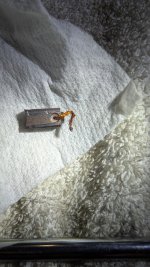
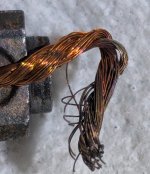
Tacking onto this thread...My Plane Power alternator had a different failure mode this past January. The braided wire on one of the brushes that connects the brush to the regulator assembly failed at the point it entered the potting behind the spring that pushes the brush against the slip ring. It showed signs of melting at the broken wires. This is with 520 tach hrs. the brush itself had a lot of material left on it. The bearings and play were acceptable.
I asked the Hartzell/PP rep at the NW aviation conference if they would be interested in the parts. The contact he gave me never responded to two emails.

I replaced the regulator/rectifier/brush assembly and spent the cash "saved" from not replacing the entire unit to also install a monkworkz unit in a backup configuration. Happy with that decision. Monkworkz was great to work with. If and when the PP unit fails again it will be replaced with a B&C.


PXL_20250120_230207682.jpgPXL_20250120_230220624.jpg
 
Tacking onto this thread...My Plane Power alternator had a different failure mode this past January. The braided wire on one of the brushes that connects the brush to the regulator assembly failed at the point it entered the potting behind the spring that pushes the brush against the slip ring. It showed signs of melting at the broken wires. This is with 520 tach hrs. the brush itself had a lot of material left on it. The bearings and play were acceptable.
I asked the Hartzell/PP rep at the NW aviation conference if they would be interested in the parts. The contact he gave me never responded to two emails.

I replaced the regulator/rectifier/brush assembly and spent the cash "saved" from not replacing the entire unit to also install a monkworkz unit in a backup configuration. Happy with that decision. Monkworkz was great to work with. If and when the PP unit fails again it will be replaced with a B&C.


View attachment 89795View attachment 89796

Do you recall which brush this was? The "stock" one, or the one that they (HET/Unipoint) rework to attach the white wire (Field + supply)?
 
Do you recall which brush this was? The "stock" one, or the one that they (HET/Unipoint) rework to attach the white wire (Field + supply)?
Brian, I looked through my pics. see attached. The white wire is there. And as others have said in the past, the replacement unit available from ACS that I sourced from ACS and installed also had it.
 

Attachments

  • PXL_20250120_224946922.jpg
    PXL_20250120_224946922.jpg
    1,019 KB · Views: 61
It should be noted that the date codes indicate alternator(s) built prior to the "improvements". The failures should not today's products have these weaknesses.
H-Qxxx is 2016, H-R. . . is 2017, and H-S . . is 2018. The improvements were in 2019 . . . and/or beyond. This should help others "understand" their existing alternators.
 
Paul,

I don't believe it's fore/aft (axial) movement as the rotor is captured by the front (D.E.) flywheel, bearing, and spacer.

I believe the failure begins with heat causing the cavity to expand in diameter slightly, that coupled with the rotor spinning at >8000RPM (vs the design of ~5000RPM), and things begin to vibrate and move radially; think "run-out" or wobble. Over time, the cavity material frets, wears and allows for more movement, which causes more wear, which causes more movement...

The bearing in use by Plane Power is 32mm x 15mm x 9mm. The cavity is ~13mm deep, so a little more bearing and contact area might help. Also, the rotor in the Plane Power is balanced but nowhere near the tolerances that the B&C rotor appears to be. And B&C uses a larger bearing as well....

Brian
Curious, what is the source of the design RPM of 5000? In a study of alternators I did a few years back showed that many were rated for much higher RPMs.
 
…and I think it is machined from depleted uranium….heavier than all get-out…

Mine was from Summit (house brand) and while certainly way heavier than required, it did not seem offensively so. That said, it immediately went in my lathe and I faced a great deal of material off the thing, followed by a series of .5 inch holes courtesy of my drill press.
 
Curious, what is the source of the design RPM of 5000? In a study of alternators I did a few years back showed that many were rated for much higher RPMs.
I don’t know what pp does, but most auto alternator installations use a 3:1 pulley ratio. Most auto engines are red lined around 6000 rpm, so alternators need to be able to handle 18,000 rpm. That said, those engines spend the bulk of there life at 700 or 2500 rpm / 7500 alt rpm. So the designers don’t need to deal with much usage at 18,000. It needs to not blow apart there, but they don’t really need to worry so much about what kind of wear it will create.

An auto alternator needs to gracefully handle 2000 - 10,000 rpm, continuously, and survive this for 3000 hours to be considered a reasonable quality part. Many ND, not clones, will easily do 4-5,000 hours in an auto installation.
 
Last edited:
It should be noted that the date codes indicate alternator(s) built prior to the "improvements". The failures should not today's products have these weaknesses.
H-Qxxx is 2016, H-R. . . is 2017, and H-S . . is 2018. The improvements were in 2019 . . . and/or beyond. This should help others "understand" their existing alternators.
Is mine a pre or post "improvement" alternator?


37FFE0C9-5291-462D-82EA-72BEDEF658ED_1_105_c.jpeg
 
For bearing housings.
Rule of thumb expansion rates,
steel 1 thou per inch per 100 deg C
Aluminium 2 thou per inch per 100 deg C
That was the rates we used 50 years ago designing bearing arrangements when I was a wet behind the ears fresh out of engineering college and a very very junior engineer.
These figures were the figures my mentor Ruben John Smith, one of the best engineers I have ever worked with gave to me if we did not have the expansion rate of the housing material. He was 6’ 4” and spent his war years as a navigator on Sea Catalina searching for downed pilots and Japanese subs. He had a few interesting escapades.

Rob
 
Is mine a pre or post "improvement" alternator?


View attachment 89817

It's an older unit - so It may not have any of the "improvements" that Hartzell has (claimed to have) made.

1. Stator Retention -- HET claims to have improved upon the retention mechanism of the stator in the DE bracket. The ND stock unit holds the stator in place with 2 flanged studs. The HET/PP unit is a 100mm O.D. Lam-stack stator but I can't figure out how it's held in place beyond the flanged-studs...maybe glue? I've heated it to 400°F, frozen it, hit it with a hammer, spoken harsh words, etc., still hasn't come apart. Going to split it apart with a cut-off tool this morning...will report back.

2. SRE bearing -- Older units appear to have a 32x9x15mm bearing with expansion compensation (i.e. outer race of bearing has two machined channels with elatomeric/plastic compound pressed in). Newer units ones use a plain bearing (6002). ND base (101211-2130/3030) uses a 32x11x15mm bearing; custom size "W"ide 6002 series.

3. Rotor balance -- No claims here, but the rotor shows evidence of at least static balancing. There are a couple of videos on YouTube that show various machines balancing rotors at speeds far less than what we operate (max 9327RPM) . E.g.
-- stop video at 0:00:13. Again, I'm not a mech-E, but it seems to me the rotors should be dynamically balanced, at least 2 planes, at the intended speed of operation.
 
Curious, what is the source of the design RPM of 5000? In a study of alternators I did a few years back showed that many were rated for much higher RPMs.
So, that was a DRP on my part - apologies.

Noteworthy, the automotive test tools (D&V electronics, ALT-198) show a maximum of 6000 RPM. For complete accuracy, we would need to find the spec that Stellantis (nee Chrysler) and Toyota wrote in 1960.

The bearings in the HET/PP (NTN) are spec'd to 20,000 RPM.
 
Here's the stator freed from the DE bracket.

IMG_7521.jpg

I had to use the cut-off tool. As I mentioned earlier, even the careful application of profanity along with a hammer couldn't do the job...

I'm pretty confident that the issue (?!) of the stator slipping & moving within the DE bracket has been resolved with the use of flanged studs, and whatever adhesive they applied to the outside of the lam-stack.
 
...since we haven't talked about alternators in a few hours... :)

I received the following unit from our comrade Brian Beatty (@bdbeatty) today. This alternator failed enroute to OshKosh a couple of years ago, after only a few hundred hours. Initial analysis by Hartzell/Plane Power was insufficient - stopping at the first thing that they saw and then denying his warranty claim because he had previously removed the rear cover to have a look.

...Boo Hartzell, Boo...

Findings:

So, let the autopsy begin; Plane Power AL12EI60, s/n H-R081202, no external damage noted. A black dust/power is visible in all of the vent holes.

I removed the rear cover and observed that the rectifier was blown apart and literally hanging by a (brass) thread. Scorching, burn marks, and discoloration of the top diode carrier plate.

View attachment 89628
View attachment 89631

The top plate, which holds the 4 "negative" diodes showed evidence of overtemperature and all 4 diodes were failed, some open, some shorted. The bottom plate, which holds the "positive" diodes, was in better shape, but only 2 of the 4 diodes tested "Ok". Clearly a failed rectifier -- but why?

Splitting the case and removing the rotor revealed more ugliness - this alternator was clearly on its way to a total meltdown. The varnish on the magnet wire in the stator and on the fans of the rotor was discolored. The rotor showed signs of dragging the lam-stack of the stator. For reference, the O.D. of the rotor is 76.4mm, and the I.D. of the lam-stack in the stator is ~77.1mm.

View attachment 89634View attachment 89632

Both bearings rotated easily, and demonstrated no appreciable radial or axial movement of the inner races. The rear bearing was covered in black dust/powder and the outer race surface showed evidence of wear/movement.

The rotor was clearly wobbling, and dragging on the inside of the stator. Wear marks are evident and more prevalent on the aft portions of the prawls. This indicates that the rear bearing is moving radially in its retention cavity (SRE).

The rotor assembly, bearing and all, dropped out when I flipped the SRE assembly over. The cavity provided almost zero interference retention with the bearing.

View attachment 89636

Failure Root Cause:

The SRE bearing had "spun" in its housing over time for unknown reasons. On the incident flight, enough material had worn away to allow the rotor to oscillate (wobble) radially, and interfere with the stator. This interference produced a tremendous amount of heat (friction), which began to 1.) melt the varnish of the stator windings magnet wire, 2.) overheat the rectifier, diodes, causing them to fail. Once a plurality of diodes failed, the alternator was no longer producing DC voltage and the overvoltage/crowbar circuit tripped which shut down the field current. A blast tube was installed to direct air at the regulator heatsink, no failures observed in the regulator.

Commentary:

We assume a great deal of risk when we fly, and we rely on our suppliers to do "the right thing" with the products that we use. This SRE bearing/cavity issue has been around "for awhile now" (@DanH, @BillL for details/dates) but I don't recall seeing an SB or similar from anyone at Van's or Hartzell regarding it or any communication regarding next steps ( the minimum thing, the right thing would be to replace/rework the SRE, bearing and rotor.)

If this wasn't experimental aviation, and the FAA/NTSB "knew" about this failure mode, and/or there was an accident caused by this failure mode, I suspect the fleet would have been grounded by now.

This failure mode concerns me (...scares the he77 out of me, actually...). I think I may replace that SRE bearing with a larger (taller) one -- there's room in the SRE cavity (~13mm) for it.

-Brian-
What does the actual warranty denial letter from Hartzell say?
 
What does the actual warranty denial letter from Hartzell say?
"At receipt unit rectifier assembly is damaged. Various washers and single rectifier to stator connection screw missing. Appears customer has been inside unit. Unable to determine if led to failure."

Because he added a blast tube retention of his own design to the rear housing, and then, subsequent to the failure, he removed the rear cover to ascertain the extent and nature of the failure, they denied his claim.

Reach out to him for further details. PM if you need his contact information for RMA/Record details.
 
"At receipt unit rectifier assembly is damaged. Various washers and single rectifier to stator connection screw missing. Appears customer has been inside unit. Unable to determine if led to failure."

Because he added a blast tube retention of his own design to the rear housing, and then, subsequent to the failure, he removed the rear cover to ascertain the extent and nature of the failure, they denied his claim.
AHA! And now all of the puzzle pieces are here. Remember a few days ago I posted this warning about the stator-to-rectifier screw preload loosening due to the plastic extruding under the screw head? In this case here, it strongly appears to me that NONE of the rear cover/stator-to-rectifier screws were properly torqued (all too loose). We know the owner of this alternator had the cover off to install the cooling shroud, and likely didn't tighten any of the screws sufficiently.

The loose screws caused high resistance in the rectifier brass ferrules (those make up the rectifier ground circuit), which of course caused lots of heat, with eventually all 3 screws becoming, in effect, plasma cutters. Notice the vaporized ferrules (circled in red below, you can make out some partial ferrule material left). Those 3 ferrules arcing away created LOTS of heat, which also cooked the (-) diodes. Notice all the (+) diodes are fine.

1749596108651.jpeg

Furthermore, all that heat conducted through the screws, which are threaded into the SRE casting, surrounding the bearing, causing the bearing bore to expand WAY more than 'normal', causing the bearing to flop around to the extent to where the rotor contacted the stator.

The takeaway? The shroud installer failed to torque the screws sufficiently, which led to the destruction of this alternator. The fact that it's a PlanePower had pretty much nothing to do with the failure. This from Hartzell is also telling: "Various washers and single rectifier to stator connection screw missing. Appears customer has been inside unit." I ain't speculating on that in public...

Ironically, the shroud installer's quest to help cool the alternator caused HUGE amounts of added heat.
 
. . . . Again, I'm not a mech-E, but it seems to me the rotors should be dynamically balanced, at least 2 planes, at the intended speed of operation.

Balance is always two planes for best result, but the rpm is not the rated or max. Turbocharger wheels are balanced on the same type machine and it would be impossible to spin them anywhere near operating speeds due to the power required. I dont know what the machines are but i have had and see many turbocharger wheels and they worked fine in operation. The compressor is balanced with two planes separately from the turbine wheel with integral shaft.

Wheels with tires are a different matter relative to the RPM. It is common that internal belt separations and other weird expansion shapes of the tire take place at speed. My professor in engineering worked for a famous tire company and while working on a problem had 100 tires x-rayed. Not a single tire had the belt aligned in the fused tire. Funny, said I, I never found one that was close to being balanced and recommended customers use another brand. Not so with metal parts.
 
Back
Top