

Van's Air Force

The definitive Van's Aircraft support community! Buying, building or flying an RV? Join our exclusive family of mentors and enthusiasts!

Placed Timing Mark on back of prop.

gasman

Well Known Member
Friend
I wanted to find a safe way to check the timing of my electronic ignition without being so close to the prop, and without the need for another person.

I made a bracket that would mount in the left inlet and allow an adjustable pointer to be mounted 3" from the back of the prop. I then set the timing that I wanted using the marks on the flywheel and a 32 oz yogurt container mounted to the nose cone with blue masking tape..... It had my cell phone mounted to it with blue masking tape also. With my Clinometer app, I had accuracy to within a 10th of a degree.

I then transferred the timing mark to the back of the prop and adjusted the pointer to alignment viewed from the pilots seat. I set the timing light in position close to the pointer secured to the top of the motor.

Waited till sunset, jumped in and fired it up..... perfect timing, with and without the vacuum line connected. So how accurate is it..... at that distance from the flywheel, 1/4 inch is one degree of movement.
 
Last edited:
I wanted to find a safe way to check the timing of my electronic ignition without being so close to the prop, and without the need for another person.

I made a bracket that would mount in the left inlet and allow an adjustable pointer to be mounted 3" from the back of the prop. I then set the timing that I wanted using the marks on the flywheel and a 32 oz yogurt container mounted to the nose cone with blue masking tape..... It had my cell phone mounted to it with blue masking tape also. With my Clinometer app, I had accuracy to within a 10th of a degree.

I then transferred the timing mark to the back of the prop and adjusted the pointer to alignment viewed from the pilots seat. I set the timing light in position close to the pointer secured to the top of the motor.

Waited till sunset, jumped in and fired it up..... perfect timing, with and without the vacuum line connected. So how accurate is it..... at that distance from the flywheel, 1/4 inch is one degree of movement.

Warren,

Got any pics? I?ve never really enjoyed doing this task, especially alone. Scares the **** out me.
 
Timing

If you run without the cowl you can use the case split line and the timing marks on the back of the flywheel. Not sure what you are timing at but can adjust from the 25 degree mark on back of flywheel.
 
Warren,

Got any pics? I?ve never really enjoyed doing this task, especially alone. Scares the **** out me.

If you clocked your prop at 10 & 4 then bring #1 up to comp. and then set your timing marks as you normally do with the case split and your timing mark as a rough reference ( best to use a piston stop https://www.aircraftspruce.com/catalog/topages/timing_ind1.php) to find TDC and use your cell phone as I noted in the OP.

Your prop should now be between 10 and 11:00 as you sit in the airplane. I used blue masking tape with a 1/16" line cut from white electric tape. I placed the tape on the back of the prop perpendicular to the prop, about 6" from the spinner, mine is fixed pitch. Bend up a piece of wire as a pointer and find a way to temporarily set it on the inlet. Sit in the plane and adjust the pointer to line up with the white mark. Keep the pointer at least 3" away from the prop. Now just make braces so the pointer will stay still when you run the motor.

Pictures are in post # 8.......
 
Last edited:
If you run without the cowl you can use the case split line and the timing marks on the back of the flywheel. Not sure what you are timing at but can adjust from the 25 degree mark on back of flywheel.

Electronic ignitions for the most part are set to TDC and the computer sets the timing. It needs to be confirmed with a timing light and the motor running at about 700 RPM. Usually this will take two people and one of them will be very close to a spinning prop standing on a box leaning over the motor with a timing light in one hand looking down the center of the case and trying to see a timing mark on the back of the flywheel.

The baffle behind the flywheel will also need to be removed to do this. And for any kind of accuracy, you will need to make a pointer that lines up with the case split and comes very close to the flywheel.
 
Electronic ignitions for the most part are set to TDC and the computer sets the timing. It needs to be confirmed with a timing light and the motor running at about 700 RPM. Usually this will take two people and one of them will be very close to a spinning prop standing on a box leaning over the motor with a timing light in one hand looking down the center of the case and trying to see a timing mark on the back of the flywheel.

The baffle behind the flywheel will also need to be removed to do this. And for any kind of accuracy, you will need to make a pointer that lines up with the case split and comes very close to the flywheel.

I made a pointer from -6 3003 tube (ends pinched in a vice and appropriately bent) and use a vice grip to hold it to the baffle attach support. You can get the pointer about 1/8" away from flywheel. Use the standard timing marks at the starter to set the engine at TDC then use a sharpie to draw a long, fat line on the flywheel at that pointer. I also like to put arrows left and right of the line in case the timing is off I will still see something to know how far off. You then don't need to get very close in order to see things while the engine is spinning or worry about trying to get your head over the case split line.

To keep the engine smoother, I set the EI for a fixed 25* timing and use the 25 degree mark instead of tdc for setting up the pointer and sharpie mark.

Larry
 
Last edited:
PICTURES.....

I updated the pictures into the thread and removed the old picture links.

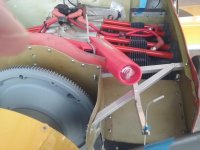
This is the bracket mounted with wing nuts...
20200411_190053.jpg
You can see the adjustable pointer with white tape on it. The timing light is secured in place close to the marks.

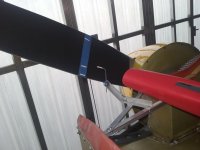
This next image you can see the tape on the prop with the timing marks I wanted to confirm .....
20200411_185910.jpg

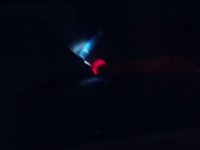
This last image was taken from the pilots seat with the canopy closed. The red glow is the timing light.
You can see the blue tape and the black prop with the strobe light reflection at 700 RPM.
20200411_202813.jpg20200411_202818.jpg
 
What works for me.
Tape a 12" drill bit along the top crank case split, extended thru a hole in the forward baffle so it was within 1/8" of flywheel. Made timing mark very prominent by using white & black vinyl tape on the appropriate spot on the flywheel. Used a STABLE platform to stand on over the engine. Use a 'dumb' timing light (plain version without dwell adjustment). Cautiously time engine...
https://www.youtube.com/watch?v=5U8f8lAQe6I
 
Last edited:
Timing marks

Way back when I was a helo mechanic we used reflective tape when tracking blades. Was highly visible even in bright daylight. This may work in this application.

Don Broussard
RV9 Rebuild in Progress
57 Pacer
 
With a tip of the hat to my friend Warren...

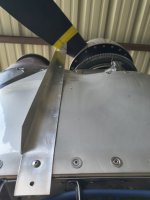
Simple pointer reference made with a length of aluminum sheet, with two bends, attached via the plenum lid screws. Position the prop so the desired timing mark is referenced to the split line, then make a mark on the tape to match the mark on the pointer. I have a tip-over canopy, so I just sit in the cockpit, hold the canopy open a bit with one hand and point a timing light with the other. Works great.

I've misaligned the marks in the photos so they are obvious.

IMG_20250422_154038323_HDR 600w.jpg
IMG_20250422_153715377_HDR 800w.jpg
 
Dan and Warren, I like that method of off setting the 25 deg timing mark to the prop making it easy to do with one person safely. The problem I've had is with the timing light. I got a light with the clip on sensor for #1 cyl plug wire. BUT can't get it to trigger from the high tension lead. I had to lengthen the signal wire for the sensor, it works fine on my two cylinder lawnmower but not on my Plansm II. Any experience with timing lights that work well and those that dont..?
 
Dan and Warren, I like that method of off setting the 25 deg timing mark to the prop making it easy to do with one person safely. The problem I've had is with the timing light. I got a light with the clip on sensor for #1 cyl plug wire. BUT can't get it to trigger from the high tension lead. I had to lengthen the signal wire for the sensor, it works fine on my two cylinder lawnmower but not on my Plansm II. Any experience with timing lights that work well and those that dont..?

Hi Dennis.
Try using a independent battery source for the timing light. Some timing lights won't work if you connect them to the aircraft battery while running the engine. Especially CDI ignitions.
 
Last edited:
Any experience with timing lights that work well and those that dont..?
Actron CP7527 Inductive Timing Light works on my Plasma 2+ using the aircraft battery. Can be found for around 50 bucks.

It's tough to see in bright light though.


Regards,
Rob
RV-7A
 
Hi Dennis.
Try using a independent battery source for the timing light. Some timing lights won't work if you connect them to the aircraft battery while running the engine. Especially CDI ignitions.
My efforts have always been out front of the "rotating propeller" and tried your idea of an independent battery yesterday. I still had no results in getting the light to trigger. my thoughts were maybe the wasted spark design or possibly the extra length in sensing wire I had to add to get out front of the prop. 20250505_150849.jpg
 
or possibly the extra length in sensing wire I had to add to get out front of the prop.
This would be my guess. that is an inductive pickup and may be sensitive. Wasted spark just fire two plugs at once. The energy on each plug wire is similar to others.
 
Dennis,
The high voltage delivery of a CDI and an inductive coil are quite different. Perhaps the simple electronics in that particular brand of timing light is rejecting, or failing to sense, the CDI delivery.

Or, a quick experiment...place the inductive pickup on the plug wire for the paired cylinder.
 
Dan and Warren, I like that method of off setting the 25 deg timing mark to the prop making it easy to do with one person safely. The problem I've had is with the timing light. I got a light with the clip on sensor for #1 cyl plug wire. BUT can't get it to trigger from the high tension lead. I had to lengthen the signal wire for the sensor, it works fine on my two cylinder lawnmower but not on my Plansm II. Any experience with timing lights that work well and those that dont..?
Page 36 from the manual...
tl.jpg
 
I miss the good old days when you could just turn the distributor on an idling motor to get the best rpm. I guess a spinning prop could make it a whole different ball game but still......
danny
 
Dennis,
The high voltage delivery of a CDI and an inductive coil are quite different. Perhaps the simple electronics in that particular brand of timing light is rejecting, or failing to sense, the CDI delivery.

Or, a quick experiment...place the inductive pickup on the plug wire for the paired cylinder.
Yeah, tried that on the #3 cyl just to see if it would trigger. Believe this light is just not compatible with the multi spark of the LS. On my Exmark it seems to fire OK even with the long sensing wires I added. Going to give some extra thought to the offset pointer method and reading frm the pilots seat, when I find a light that works on the CDI multi spark LS. Thanks for all the comments.
 
Yeah, tried that on the #3 cyl just to see if it would trigger. Believe this light is just not compatible with the multi spark of the LS. On my Exmark it seems to fire OK even with the long sensing wires I added. Going to give some extra thought to the offset pointer method and reading frm the pilots seat, when I find a light that works on the CDI multi spark LS. Thanks for all the comments.
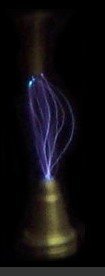
This is what one spark event looks like on a multi-spark CDI ignition. High voltage, low current. Confuses most inductive timing lights.
 

Attachments

  • Multi spark ignition.jpg
    Multi spark ignition.jpg
    4 KB · Views: 11
That's probably a series of individual arc formations recorded with a long shutter time.
That is correct. On a multi spark CDI ignition, one firing event has many arcs. That is one spark event on my distributor machine. That is why a CDI multi spark ignition works well LOP. More individual arcs to ignite the lean mixture per spark event.
 
How many discharges per firing event, and what duration? I've never looked at an MSD output.
 
How many discharges per firing event, and what duration? I've never looked at an MSD output.
MSD says
"MULTIPLE SPARKS ... The MC-4 produces full power multiple sparks for each firing of a plug. The number of multiple sparks that occur decreases as rpm increases, however the spark series always lasts for 20° of crankshaft rotation. Above 3,300 rpm there is simply not enough time to fire the spark plug more than once, so there is only one full power spark"
I use two of these units on my IO-390. That is a picture I took of one spark event on my SUN Distributor machine.
 
I dug around and came up with an old, cheap timing light. So I gutted it and attached the internal board (with strobe tube) out by the timing pointer, then extended the trigger circuit back to the cockpit with some scrap wire and an old push-to-talk switch. Works great. I can now close and latch the canopy, hold the stick aft with my right hand, and trigger the strobe while operating the throttle. Trashy (yeah, that's duct tape), but it works great.

IMG_20250507_203010802_HDR~2[1].jpg

MSD says....

I looked up the MSD literature for the MC-4. Just a quick read, but it certainly appears to be an interesting choice for the 4-cyl engines.

I may call MSD with a question about their statement. 20 degrees at 3300 RPM is roughly 1 ms. A single CDI discharge has a typical duration of 0.1 to 0.3 ms, so I'm curious about how they are stretching it out. Got any idea?
 
I dug around and came up with an old, cheap timing light. So I gutted it and attached the internal board (with strobe tube) out by the timing pointer, then extended the trigger circuit back to the cockpit with some scrap wire and an old push-to-talk switch. Works great. I can now close and latch the canopy, hold the stick aft with my right hand, and trigger the strobe while operating the throttle. Trashy (yeah, that's duct tape), but it works great.

View attachment 87182


I looked up the MSD literature for the MC-4. Just a quick read, but it certainly appears to be an interesting choice for the 4-cyl engines.

I may call MSD with a question about their statement. 20 degrees at 3300 RPM is roughly 1 ms. A single CDI discharge has a typical duration of 0.1 to 0.3 ms, so I'm curious about how they are stretching it out. Got any idea?
I use a 0.250 inch magnet on a 1.000 inch diameter rotor spinning passed two hall effect sensors as a trigger. The hall effect sensors have a built in amplifier output for computer timing. The programing box has an (RISC) reduced instruction set computer chip for high speed processing. The programing box has a lot of cool features and three different timing curves available with a flip of a switch.
 
Back
Top