

Van's Air Force

The definitive Van's Aircraft support community! Buying, building or flying an RV? Join our exclusive family of mentors and enthusiasts!

P-Mag Timing Offset for Angle Valve Engines

Status
Not open for further replies.

DanH

Legacy Member
Benefactor
Advertiser
Mentor
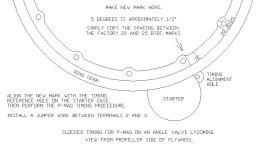
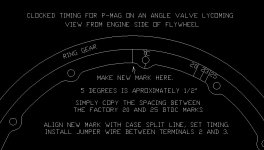
We're still seeing angle valve engines (particularly the 390) with P-mags timed incorrectly. Very often, it's because the user was confused about how to clock the installation when preparing to do the timing set procedure (i.e. blow in the tube). Perhaps illustrations will help. See below.

Background: the angle valve engines require significantly less advance than the parallel valve engines, a function of their port design. Lycoming specifies 20 BTDC base timing for the 390. User testing says the maximum practical advance is 30 BTDC, and that's useful only for slow burning, very lean mixtures. For typical peak EGT or slightly lean of peak cruise, there is little practical performance difference between 25 BTDC and 30 BTDC. However, less advance almost always nets lower temperatures, with lower mechanical stress.

A P-mag's base timing, with no jumper installed between terminals 2 and 3, is 30.8 BTDC, and it can advance to 39.2....way too much. Installing the jumper dials base timing back to 26.6 BTDC, with a max of 35....still too much. Clocking the installation, as described in the P-mag manual, allows further reduction. If clocked 5 degrees (with jumper installed), the timing becomes 21.6 base and 30 max. If clocked 7 degrees with jumper, the timing is base 19.6, with a maximum of 28. The following illustrations are drawn with 5 degree clocking, mostly to stay within the recommendations in the P-mag installation manual. However, I strongly recommend 7. Just make the new timing mark 2 additional degrees to the left.

When creating a clocked timing mark, use the factory timing marks for a handy dimension reference, or count ring gear teeth. Assuming a typical 149 tooth ring gear, 5 degrees is approximately 2 teeth (2.06), and 7 degrees is just a fuzz less than 3 teeth (2.9).
Clocked Timing Engine Side.jpg

Clocked Timing Propeller Side.jpg
 
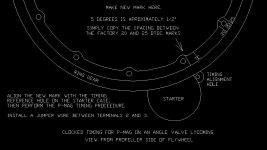
We're still seeing angle valve engines (particularly the 390) with P-mags timed incorrectly. Very often, it's because the user was confused about how to clock the installation when preparing to do the timing set procedure (i.e. blow in the tube). Perhaps illustrations will help. See below.

Background: the angle valve engines require significantly less advance than the parallel valve engines, a function of their port design. Lycoming specifies 20 BTDC base timing for the 390. User testing says the maximum practical advance is 30 BTDC, and that's useful only for slow burning, very lean mixtures. For typical peak EGT or slightly lean of peak cruise, there is little practical performance difference between 25 BTDC and 30 BTDC. However, less advance almost always nets lower temperatures, with lower mechanical stress.

A P-mag's base timing, with no jumper installed between terminals 2 and 3, is 30.8 BTDC, and it can advance to 39.2....way too much. Installing the jumper dials base timing back to 26.6 BTDC, with a max of 35....still too much. Clocking the installation, as described in the P-mag manual, allows further reduction. If clocked 5 degrees (with jumper installed), the timing becomes 21.6 base and 30 max. If clocked 7 degrees with jumper, the timing is base 19.6, with a maximum of 28. The following illustrations are drawn with 5 degree clocking, mostly to stay within the recommendations in the P-mag installation manual. However, I strongly recommend 7. Just make the new timing mark 2 additional degrees to the left.

When creating a clocked timing mark, use the factory timing marks for a handy dimension reference, or count ring gear teeth. Assuming a typical 149 tooth ring gear, 5 degrees is approximately 2 teeth (2.06), and 7 degrees is just a fuzz less than 3 teeth (2.9).

View attachment 90436

View attachment 90437
This is nice to have. I have saved these as photos, but it would be nice to be able to print them. Would it be possible to get them as black lines on a white background, to save black ink? I don’t know how to “reverse” the image. 🙄
 
What Dan posted also applies to higher HP parallel valve engines.

I use either the software from Emagair or (currently) the Engine Bridge Wifi module to set the timing internally on the P-Mags. Unfortunately, Emagair no longer provides the software to set the internal timing and advance. Maybe Hartzell will change that, but I won't hold my breath.
 
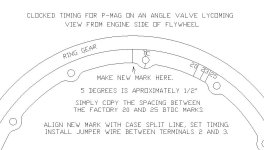
We're still seeing angle valve engines (particularly the 390) with P-mags timed incorrectly. Very often, it's because the user was confused about how to clock the installation when preparing to do the timing set procedure (i.e. blow in the tube). Perhaps illustrations will help. See below.

Background: the angle valve engines require significantly less advance than the parallel valve engines, a function of their port design. Lycoming specifies 20 BTDC base timing for the 390. User testing says the maximum practical advance is 30 BTDC, and that's useful only for slow burning, very lean mixtures. For typical peak EGT or slightly lean of peak cruise, there is little practical performance difference between 25 BTDC and 30 BTDC. However, less advance almost always nets lower temperatures, with lower mechanical stress.

A P-mag's base timing, with no jumper installed between terminals 2 and 3, is 30.8 BTDC, and it can advance to 39.2....way too much. Installing the jumper dials base timing back to 26.6 BTDC, with a max of 35....still too much. Clocking the installation, as described in the P-mag manual, allows further reduction. If clocked 5 degrees (with jumper installed), the timing becomes 21.6 base and 30 max. If clocked 7 degrees with jumper, the timing is base 19.6, with a maximum of 28. The following illustrations are drawn with 5 degree clocking, mostly to stay within the recommendations in the P-mag installation manual. However, I strongly recommend 7. Just make the new timing mark 2 additional degrees to the left.

When creating a clocked timing mark, use the factory timing marks for a handy dimension reference, or count ring gear teeth. Assuming a typical 149 tooth ring gear, 5 degrees is approximately 2 teeth (2.06), and 7 degrees is just a fuzz less than 3 teeth (2.9).
View attachment 90436

View attachment 90437
I strongly agree with your post but you fail to specifically mention that it is 5 degrees after TDC. Your illustrations do show this.
 
For us simpletons... 360/149 = 2.4 deg/tooth
don't forget about the 122 toothed (teethed? tooths?) simpletons... (You know there's somebody out there with a pumped up IO-320 with 10:1's...)

360/122 = 2.9°/tooth.
 
With all the data we have today showing that 20 BTDC ignition timing is desirable on angle-valvers, why did Mooney in collaboration with Lycoming specify 25 deg on the IO-360-A3B6D on the 1980 M20J? Maybe there's a few more ponies to be had at 25 deg at the expense of more heat, which was needed for marketing?
 
With all the data we have today showing that 20 BTDC ignition timing is desirable on angle-valvers, why did Mooney in collaboration with Lycoming specify 25 deg on the IO-360-A3B6D on the 1980 M20J? Maybe there's a few more ponies to be had at 25 deg at the expense of more heat, which was needed for marketing?
I would trust any timing recommendation from someone with a dyno, as that is the best way to determine optimal timing. My speculation on your question is that while 20* may be optimal for heavy loads, 65-75% power at peak, which was what they recommended for economy cruise, did better at 25* and upped the cruise speed numbers which was a major selling point. They just accepted the lower detonation margin and higher heat at high power to get those numbers. Probably no cht instruments, so no one knew about the heat.
 
With all the data we have today showing that 20 BTDC ignition timing is desirable on angle-valvers, why did Mooney in collaboration with Lycoming specify 25 deg on the IO-360-A3B6D on the 1980 M20J? Maybe there's a few more ponies to be had at 25 deg at the expense of more heat, which was needed for marketing?
See attached Lycoming SI 1325A, which recommends 20° timing for many angle valve engines. There must be something special about the dual mag (two mags in one) setup that doesn't recommend the timing to be set less advanced.
 

Attachments

Last edited:
Well the -360 has a 25 degree offset for timing, and the -390 (or angle valve 360) has a 20 degree offset. The PMAG is setup so that the offset is based on timing at TDC on a -360. Because it can be setup without a computer or interface it defaults to 25 degrees.

With the software, one can put it at TDC and then simply set the timing with the computer. I personally use the EngineBridge now, but used the PC program initially. The PC programs were a little buggy, with one version needed to set all the options, and a second to read it properly. The EngineBridge is excellent and easy. Like everything it costs more now than it did four years ago. But it works well.
 
Graphic illustrations should help angle valve users correctly position the crank for the P-mag timing procedure.

Everyone is welcome to distribute the drawings as desired. If someone wants to make them a sticky here, that's fine too.

Let's close this thread and start a new one for other discussion.
 
Status
Not open for further replies.
Back
Top