
Those can be moved to the rear spinner bulkhead to make them available for magnets.I see.
I think in my plane I have some of those holes filled with bolts for balancing.

Van's Air Force
You are using an out of date browser. It may not display this or other websites correctly.
You should upgrade or use an alternative browser.
You should upgrade or use an alternative browser.
Open Source EI for Lycoming??
- Thread starter petehowell
- Start date

The fuel pump is in the rear.Where is the fuel pump located on that engine? Up front like H2AD, or in the rear like most Lycomings?

I really like where this is going and hope to take advantage of it on my 6A. Probably when I'm done building the 12.
I am reluctant to make up work for others. However, as this effort blooms I think it's nearly time to setup an independent organization and website to keep track of the project. Something like Onspeed.org maybe? There's going to be a lot of pieces in motion. Keeping track of the using many threads here might become a wee bit unwieldy. Besides, there's already a cool logo.
If done right we could make it into a full time job for Pete.
I am reluctant to make up work for others. However, as this effort blooms I think it's nearly time to setup an independent organization and website to keep track of the project. Something like Onspeed.org maybe? There's going to be a lot of pieces in motion. Keeping track of the using many threads here might become a wee bit unwieldy. Besides, there's already a cool logo.
If done right we could make it into a full time job for Pete.

For sure there will be a website with the software and how-to instructions. Probably github.com but that's still in the future.
Status:
I continue to make slow progress on the Slick based pickup.
Pete and I have some ideas on how to bench test the ESP32 controller and the pickup
I'm thinking about an optional MP sensor... looking for a suitable part
We are trying to KEEP IT SIMPLE. Others have built full blown controllers (like Speeduino) that are highly configurable for multiple pickup types, multiple wheel tooth patterns, full ignition maps, multiple coil types, arbitrary cylinder count, etc. It doesn't make sense to replicate that work, IMO. Simple also means more likely to deliver something vs. falling into perfect, the enemy of good. [I'm helping on a software dev project that started off simple... and is now on year 2 of enhancements... and no external customers as it isn't 'good enough' yet.]
Status:
I continue to make slow progress on the Slick based pickup.
Pete and I have some ideas on how to bench test the ESP32 controller and the pickup
I'm thinking about an optional MP sensor... looking for a suitable part
We are trying to KEEP IT SIMPLE. Others have built full blown controllers (like Speeduino) that are highly configurable for multiple pickup types, multiple wheel tooth patterns, full ignition maps, multiple coil types, arbitrary cylinder count, etc. It doesn't make sense to replicate that work, IMO. Simple also means more likely to deliver something vs. falling into perfect, the enemy of good. [I'm helping on a software dev project that started off simple... and is now on year 2 of enhancements... and no external customers as it isn't 'good enough' yet.]
Suggest the old GM MAP sensor. Cheap, reliable and widly available. Its a transducer, so easy to integrate into both HW & SW - has a linear scale, so no math for PeteI'm thinking about an optional MP sensor... looking for a suitable part
 . Others also make through hole versions that can be inetgrated into your CB if creating one.
Larry clearly has worked with me before!no math for Pete
Larry,You can't just hang a sensor off a fixture up there. If the belt breaks, it would likely rip the sensor off the fixture. I machine out a channel for the wires and cover it with a plate. Wires are even more open to belt damage. I also machine out a cavity for the sensor and bed it in epoxy and machine flat again. There are tolerances on magnet distance, so even if the sensor bent a bit, result is the same - no ignition. Just not robust IMO.
Are you saying you didn't do a flywheel tone ring and case mounted sensor? What did you machine out? I'm guessing you didn't machine the case. I don't have the option of a mag hole pickup with the dual Bendix. Having a pickup on the flywheel and a trad mag in my only mag hole gives me redundancy. Maybe send cut send wasn't the correct place for a billet mount for the sensor, but I can have one made easily if I have dimensions. I could start from scratch and reinvent the wheel, but I was hoping somebody had documented a pickup mount that I could work off of.
I potted 11 magnets inside bronze pins and pressed into the existing holes in the ring gear support; used sleeve retaining compound for redundancy. I then machined a fixture that holds the hall effect sensor .050" away from the ring gear/magnets. That part bolts to the case via the two 3/8" case bolts up at the nose. Dimensions are pretty stable there, so can make these parts for others to bolt on.Larry,
Are you saying you didn't do a flywheel tone ring and case mounted sensor? What did you machine out? I'm guessing you didn't machine the case. I don't have the option of a mag hole pickup with the dual Bendix. Having a pickup on the flywheel and a trad mag in my only mag hole gives me redundancy. Maybe send cut send wasn't the correct place for a billet mount for the sensor, but I can have one made easily if I have dimensions. I could start from scratch and reinvent the wheel, but I was hoping somebody had documented a pickup mount that I could work off of.
Sorry, but didn't keep the dimensions. If I made a kit, I would have to start from scratch, but it wasn't that hard.
photo?I potted 11 magnets inside bronze pins and pressed into the existing holes in the ring gear support; used sleeve retaining compound for redundancy. I then machined a fixture that holds the hall effect sensor .050" away from the ring gear/magnets. That part bolts to the case via the two 3/8" case bolts up at the nose. Dimensions are pretty stable there, so can make these parts for others to bolt on.
Sorry, but didn't keep the dimensions. If I made a kit, I would have to start from scratch, but it wasn't that hard.
Sorry, but didn’t take any. Can shoot one next time cowl is off.photo?
What would you consider to be "proper aircraft quality connector"? D-sub is used extensively in avionics by Garmin etc.... MilSpec it isn't...I guess it depends on your personal preferences; I can't imagine ever replacing my magnetoes with something that requires external power. And I'm still waiting for a self-powered electronic ignition with fixed timing and proper aircraft quality connectors.

What would you consider to be "proper aircraft quality connector"? D-sub is used extensively in avionics by Garmin etc.... MilSpec it isn't...
D-subminiature connectors (MIL-DTL-24308) with proper gold-plated crimp pins (MIL-DTL-39029) are indeed used extensively in many avionics products! And if your avionics manufacturer is serious, they will use or specify components that meet the above Milspecs.
I would be happy with any connector that uses high-quality crimp contacts, is appropriately rated for FWF temperatures, and is environmentally sealed. D-sub connectors exist that meet these requirements, as do Cannon plugs (that's MIL-DTL-5015 by the way). The automotive industry might have something as well.
But I would never use plastic burglar-alarm-style screw terminals on my engine. Just a personal choice, and yes I know about the ferrule trick.

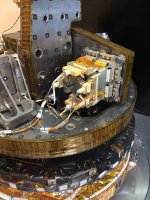
I took this photo at one of my customer's facilities - I was surprised to see dsub connectors on a spacecraft - even if this one didn't fly.D-subminiature connectors (MIL-DTL-24308) with proper gold-plated crimp pins (MIL-DTL-39029) are indeed used extensively in many avionics products! And if your avionics manufacturer is serious, they will use or specify components that meet the above Milspecs.
Progress update. Yes I know that the sensor gap is too large and the sensor is not square to the wheel.
This is more of a "proof of concept" unit, not airworthy. If the sensor provides a good reliable signal with these flaws then we'll be more confident yet with proper alignment.
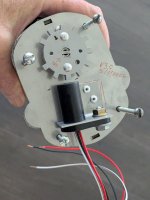
This is more of a "proof of concept" unit, not airworthy. If the sensor provides a good reliable signal with these flaws then we'll be more confident yet with proper alignment.
Looking really good Bryan! - more friends have helped make a cover for the gear and sensor from Bryan's design . Hope to test on the workbench next week with a micro-controller and firmware to verify signal quality and basic UI on a phone. .Progress update. Yes I know that the sensor gap is too large and the sensor is not square to the wheel.
This is more of a "proof of concept" unit, not airworthy. If the sensor provides a good reliable signal with these flaws then we'll be more confident yet with proper alignment.
View attachment 117377
Making progress
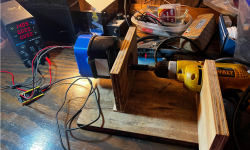
Testing has begun! Bryan sent the test mule last week and I made a crude test bench for it. Been spinning it for a few hours. The hall effect wires plug right into the ESP32 then it sends data wirelessly to the ipad.
Screen grab from the test software
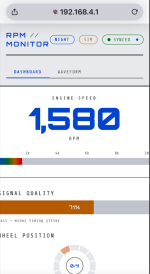
It makes nice square waves on the ipad reading data from the ESP32. Data logs say it reads the missing tooth really well(synced), but we miss a few tooth reads. I think we might have the sensor to tooth gap a bit large. We will change and test. More to come........
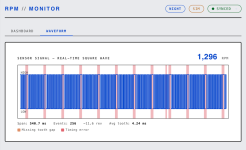
Screen grab from the test software
It makes nice square waves on the ipad reading data from the ESP32. Data logs say it reads the missing tooth really well(synced), but we miss a few tooth reads. I think we might have the sensor to tooth gap a bit large. We will change and test. More to come........
i would zoom in on that graph and check for consistency in the time between each of the 11 teeth. it is not just about the physical spacing of the teeth, but how the sensor and SW deal with either the shape of the rise or fall, depending upon how you coded it, and how it captures/processes it.. suspect you are capturing this in the code somewhere, but worth being sure.Testing has begun! Bryan sent the test mule last week and I made a crude test bench for it. Been spinning it for a few hours. The hall effect wires plug right into the ESP32 then it sends data wirelessly to the ipad.
View attachment 118069
Screen grab from the test software
View attachment 118070
It makes nice square waves on the ipad reading data from the ESP32. Data logs say it reads the missing tooth really well(synced), but we miss a few tooth reads. I think we might have the sensor to tooth gap a bit large. We will change and test. More to come........
View attachment 118068
As this is a Hall sensor, there isn't the same sort of sine waveform as on a VR type.i would zoom in on that graph and check for consistency in the time between each of the 11 teeth. it is not just about the physical spacing of the teeth, but how the sensor and SW deal with either the shape of the rise or fall, depending upon how you coded it, and how it captures/processes it.. suspect you are capturing this in the code somewhere, but worth being sure.
That said, our timing isn't 100% quality currently and we are investigating why.
No, the wave is not the same, but there is still a capture on the rising or faling edge, though it is baked into the sensor hardware. With hall effect, you cannot tweak settings to adjust it, like VR, but it still must be tested. Challenges will have to be dealt with via mechanial issues - sensor gap, tooth shape, magnet strength, etc. I have no experience with the type of hall effect sensor you are using. I have only worked with sensors that use magnets instead of ferrous metal. Suspect the latter are far more sensitive due to the weaker magnetic field.As this is a Hall sensor, there isn't the same sort of sine waveform as on a VR type.
That said, our timing isn't 100% quality currently and we are investigating why.
Last edited:
based upon your previous post, I expect the excessive sensor gap is a large part of your reliability issues. while not VR, the issues are the same, need a strong enough magnetic field for consistency and reliability and steel parts don't have a strong field. This requires tighter gaps.No, the wave is not the same, but there is still a capture on the rising or faling edge, though it is baked into the sensor hardware. With hall effect, you cannot tweak settings to adjust it, like VR, but it still must be tested. Challenges will have to be dealt with via mechanial issues - sensor gap, tooth shape, magnet strength, etc. I have no experience with the type of hall effect sensor you are using. I have only worked with sensors that use magnets instead of ferrous metal. Suspect the latter are far more sensitive due to the weaker magnetic field.
Most likely. Interestingly the gap is just 10% greater than the sensor's datasheet max recommendation. Part of our research will be to find at what gap the reliability starts to decrease.based upon your previous post, I expect the excessive sensor gap is a large part of your reliability issues. while not VR, the issues are the same, need a strong enough magnetic field for consistency and reliability and steel parts don't have a strong field. This requires tighter gaps.
Rather than clutter up the latest pMag / eMag thread...
The pros and cons of a fully integrated solution like the eMag...
If any part of it dies ... you need to swap in a full replacement. Unlike a mag, don't expect some A&P can fix it.
With a solution like Pete is proposing, the pickup, control box, and coil pack are all separate units. So would be the standby battery if you go that way.
If the coil pack fails the local autoparts store can get you a replacement the next day.
The control box as envisioned is a very inexpensive ESP32 --- small & light, easy to carry a spare.
The pickup we are currently trying is also not expensive --- small and light, easy to carry a spare.
The pros and cons of a fully integrated solution like the eMag...
If any part of it dies ... you need to swap in a full replacement. Unlike a mag, don't expect some A&P can fix it.
With a solution like Pete is proposing, the pickup, control box, and coil pack are all separate units. So would be the standby battery if you go that way.
If the coil pack fails the local autoparts store can get you a replacement the next day.
The control box as envisioned is a very inexpensive ESP32 --- small & light, easy to carry a spare.
The pickup we are currently trying is also not expensive --- small and light, easy to carry a spare.
