

Van's Air Force

The definitive Van's Aircraft support community! Buying, building or flying an RV? Join our exclusive family of mentors and enthusiasts!

Oil leak

MarkCFI

Well Known Member
Patron
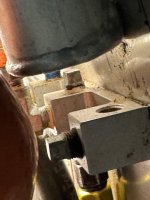
I have an oil leak that I believe is coming from the vicinity of the connections on an aluminum block that appears to allow for dual fuel and oil pressure senders.

One pair feeds an EIS 4000 and the other pair feed individual gauges.

I’m not sure how common this is but it’s what it is. I can’t really tell which connection is actually leaking. Is the fix to just disassemble and reassemble ?

Is there some type of thread sealer I should be using on the blue fittings that connect to the aluminum block?
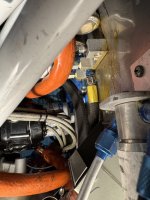
IMG_1173.jpeg
 
It may be leaking from the block but have you cleaned up the engine bay to do a ground run and identify the true source of leak? The fittings that are pipe thread should have thread sealant. There is a Loctite high temp thread sealant recommended by lycoming you may use.
 
It may be leaking from the block but have you cleaned up the engine bay to do a ground run and identify the true source of leak? The fittings that are pipe thread should have thread sealant. There is a Loctite high temp thread sealant recommended by lycoming you may use.

I did clean it up prior and it re-appears. It looks like the leak is from the blue fitting into the aluminum block that is attached to the hose that comes from the engine itself.

It does not look like there is any thread sealant on those blue fittings.

I have not cleaned and then done a test run. Yet.
 
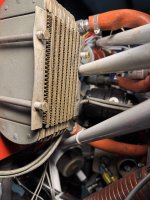
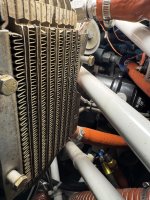
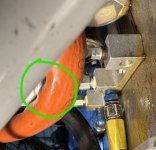
There's a shine on that oil cooler hose as well. How certain are you that the oil isn't coming from a leak at the cooler or its associated fittings/hoses, and getting blown back against the firewall?

Oil.jpg

The blue fittings going into the aluminum manifold are pipe thread (NPT) and appear to have been correctly installed with thread sealant, possibly even Loctite 567 which is arguably one of the better options. There should be no sealant from the hose to the blue fittings - those are flare fittings and unless they're torqued incorrectly, should not be leaking even without sealant.
 
Last edited:
There's a shine on that oil cooler hose as well. How certain are you that the oil isn't coming from a leak at the cooler or its associated fittings/hoses, and getting blown back against the firewall?

View attachment 103594

The blue fittings going into the aluminum manifold are pipe thread (NPT) and appear to have been correctly installed with thread sealant, possibly even Loctite 567 which is arguably one of the better options. There should be no sealant from the hose to the blue fittings - those are flare fittings and unless they're torqued incorrectly, should not be leaking even without sealant.

The oil cooler and fitting at the oil cooler are dry as a bone. I inadvertently spilled some brake fluid on the hose you called out when I topped it off.

I am a little suspicious of what I will call the blocking plug on top of the aluminum fitting. It does have sealant but the threads look a little damp.

I’ve cleaned it so it may not show as well.
 

Attachments

  • IMG_1178.jpeg
    IMG_1178.jpeg
    1.1 MB · Views: 97
  • IMG_1177.jpeg
    IMG_1177.jpeg
    2.4 MB · Views: 95
  • IMG_1176.jpeg
    IMG_1176.jpeg
    1.5 MB · Views: 97
That galvanized plug should be replaced with a brass plug.... That one item would make me stop and examine the entire FWF.
 
That galvanized plug should be replaced with a brass plug.... That one item would make me stop and examine the entire FWF.

I can replace them. Do you by chance known what size it is?

I will order and redo those plugs.
 
To me, the blue AN fittings seem to have a light-brown substance around them where they screw into the manifold (what you call the “block”) - it is reminiscent of “Fuel Lube”, which some people have mistaken for a sealant (its not - its a lube). If you are confident that the leak is coming from where the fittings screw into the block, it is an easy thing to take them out, clean them, and reinstall using your favorite sealant - LocTite or Permatex Aviation Selant (#3). Then clean things up and run it some more to see if you fixed it. Try one thing at a time, so that you know what stopped the leak.
 
I did clean it up prior and it re-appears. It looks like the leak is from the blue fitting into the aluminum block that is attached to the hose that comes from the engine itself.

It does not look like there is any thread sealant on those blue fittings.

I have not cleaned and then done a test run. Yet.
Oil leaks can be very frustrating to locate exactly where it is leaking. I had one on my oil cooler (clocked 45 which is always difficult at best to insure it is clocked correctly and tight) Since almost all oils flores with a UV light that can help. Thoroughly clean everything and then check with a UV light that nothing glows, fly for an hour or two and then recheck with a UV light. Oil leaks tend to fly almost everywhere FWF. The other trick is wrap the suspect fitting(s) with a small strip of paper towels (Combustion temp ~ 454 F) then take guerilla tape and completely wrap the paper towel strip. Fly for 5 hours and then unwrap the fitting. If it's oily you have probably found at least one of the leaks.

Yes, remove the galvanized fitting and replace with brass and Loctite 567, my favorite sealant to use. Flare fittings do not need sealant but torque to the correct spec. It is easy to over or under torque a flare fitting. (Use a crow's foot adapter)

Good luck !
 
When you do remove the NPT pipe fittings from the manifold and clean, put a small blob of loctite or permatex on your finger and run that evenly around the perimeter of just the first 3-4 threads on the end of the fitting and then tighten the fitting back into the manifold. Shouldn't need to cover all the threads.
 
Also, check your oil breather tube/hose connection somewhere above or to the right in the vicinity....could be leaking/blowing by from that?
 
All good advice.

I was able to find the brass cored plug here locally. It appears a 1/8” MIP fits. Could not find the 567 so will need to order.

I think what I will do as suggested is clean the fitting and reassemble with the known correct sealant. Then test.

It’s 30 degrees in the hangar so that’s enough for today.

I’ve got a punch list of other items as well including everyone’s favorite, fixing spinning rivnuts.

Will report back once I get the plug reinstalled.
 
Also, check your oil breather tube/hose connection somewhere above or to the right in the vicinity....could be leaking/blowing by from that?

There is definitely some blow by from the breather. Whenever I go above 6 quarts I seem to get some from the tube.

This however seemed to bean unusual amount on the firewall. It also came into the inside of the firewall from around the heater vent.

I appreciate the help.

Thanks.
 
I had a similar mystery on my RV7A, also a similar oil stain on the firewall, but not on the IO-360. Both of the sending units were mounted on the firewall and looked suspiciously like the source. I even replaced the oil pressure sending unit because it was oily wet where the wires extruded. In addition there was a constant oily stripe on the belly. Like one drop wide and 6 to 8ft long after each flight. Clean it all up and tighten all fittings, fly for couple hours and then clean it up again. Turned out to be the base of the DIPSTICK TUBE (Its Plastic!). When you overtight the dipstick it screws in the plastic threads on the tube as well, then when you unscrew the dipstick, it loosens the plastic tube threads. eventually the threads are worn thinner and tube wobbles. The gasket was paper thin and the Safety wire only prevented turning in one direction. I installed a new style Silicone 1/8th inch Gasket (Part#08-13621from ACS) and safety wired the tube in BOTH directions of rotation. Firewall and Belly have been clean ever since! There were no signs of oil on the block so it may have been leaking under high pressure and during Higher RPMS. Your results may vary. Ed S.
 
I had a similar mystery on my RV7A, also a similar oil stain on the firewall, but not on the IO-360. Both of the sending units were mounted on the firewall and looked suspiciously like the source. I even replaced the oil pressure sending unit because it was oily wet where the wires extruded. In addition there was a constant oily stripe on the belly. Like one drop wide and 6 to 8ft long after each flight. Clean it all up and tighten all fittings, fly for couple hours and then clean it up again. Turned out to be the base of the DIPSTICK TUBE (Its Plastic!). When you overtight the dipstick it screws in the plastic threads on the tube as well, then when you unscrew the dipstick, it loosens the plastic tube threads. eventually the threads are worn thinner and tube wobbles. The gasket was paper thin and the Safety wire only prevented turning in one direction. I installed a new style Silicone 1/8th inch Gasket (Part#08-13621from ACS) and safety wired the tube in BOTH directions of rotation. Firewall and Belly have been clean ever since! There were no signs of oil on the block so it may have been leaking under high pressure and during Higher RPMS. Your results may vary. Ed S.

Full disclosure. I had the same issue and replaced the gasket with the orange silicone one as well. The original gasket was some type of very thin plastic.

I will double check this also.

Would be great if it is. I don’t look forward to pulling the oil senders apart.

Thanks for the info and reminder.
 
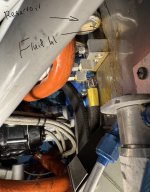
The photo of the “oil leak” in the OP looks suspiciously like brake fluid to me. When fluid 41 leaks it congeals and goes sticky, and from what I can see the leak is originating from the bottom of the brake reservoir.

You can clean off the fluid with avgas
 
You mentioned that you spilled some brake fluid when you topped off the reservoir. If you over filled it all the way to the top, excess will come out when you press on your brakes. I only fill mine to about 3/4 of an inch or so from the top.
 
I discounted that because of the color. However, it does seem to all flow down from the area of the reservoir. I will pull that this afternoon if the weather allows me to get to the hangar.

Thank you
On my reservoir the plastic fitting which goes into the bottom port used to leak a little, and the result looked just like this
 
I checked the filler tube and brake reservoir and they are dry. There was a little weeping at the top of the master cylinders.

I redid the pressure sender and changed the speed plug to brass and used Loctite 567 for both.

I’ll let them cure for a couple of days then test.

IMG_1180.jpeg
 
Well, I’m now back to removing the reservoir. Now I think it’s leaking between the forward side of the firewall and the reservoir. No drips on the cockpit side of the firewall at the reservoir.

It’s going to take a few days to get at it again with the cold weather coming in.

I appreciate all the guidance.
 
So I resealed the pressure senders and the cored plug in the manifold. Test run, checked for leaks, then flew it for .6

No oil residue. I will fly it again and see if it stays clean. Pressure is good (80 lbs at takeoff), i’m starting to wonder if it was all coming out the breather. There is some crud on the exhaust where the breather ends. Unclear. Not sure what else would be leaking?

I did look the engine over pretty good. Replaced an intake tube gasket that appeared to be leaking.

Thanks again for the support.
 
Well, I’m not sure whether I fixed it or not.

The manifold fittings are re-sealed. But I’m starting to think it’s coming out the breather. Picture below.

I’m going to monitor for the next several hours of flight time and see what happens. Once I get to about little above 6 quarts in the stick it typically stays at that level. Usually about 25 hours per quart. Starting to think I added a quart before a cross country and blew it out the breather.

IMG_1167.jpeg
 
Back
Top