


Van's Air Force

The definitive Van's Aircraft support community! Buying, building or flying an RV? Join our exclusive family of mentors and enthusiasts!

O-360 Carb Fuel Pressure Spikes 25PSI Real?

paulsmeds

Well Known Member
Friend
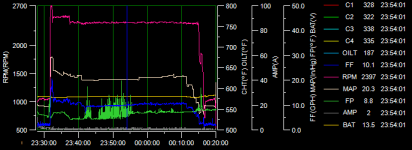
I'm pretty sure this is a sensor problem but thought I'd check with the group that I should consider something else is wrong. I'm seeing some spiking of the fuel pressure from a steady 6.5 PSI to 25 PSI instantly then back down, then mid-teens then back down. After a bit it steadies out back to 6.5 to 7 and then goes through it again and seems random. Almost always does this when pulling back the power into the pattern then settles out again.

Example - level flight no changes, then suddenly the FP goes nuts. Stops then starts again - see the green first big spike then settles out. Then starts again, then settles out but reads higher overall. No change in altitude or power settings.
1738016699520.png

I'm feeling this is sensor error and not real. Looking at all other data I don't see any changes happening at the same time. Also, I don't think the engine driven pump can produce that kind of pressure especially in an instant. Boost pump on and off when this is happening doesn't change a thing. My understanding is that if the wiring was loose to a terminal, the added resistance could cause this spiking. However all the wiring has been checked and double-checked.

This might all be fixed with a another FP sensor I'm going to try and get ordered but in the meantime, has anyone else seen something like this that was actually real? I miss the mechanical gauge because that would show if this was real in an instant.

RV-6A w/EDM-350 and all sensors. All behaving. Had an issue with the MP sensor showing extremely low and changed out the 2 month old sensor which cured the problem. Odd this would now happen with the FP just a short time later.
 
Last edited:
If you really had that much pressure for the five to ten seconds it shows, fuel would be forced past the needle and seat in the carburetor. You would immediately notice a rich condition in the engine at least, and even a possible engine stoppage, without leaning with mixture. Agree with Walt, definitely not true high fuel pressure. Look for ground wire corrosion issues, or a flaky sensor…..
Jim Baker
RV-6
 
The fuel pressure sensor is a 5V ratiometric one.
The wiring is sensitive to strong electric fields.
Shielded wire is recommended.

Good luck
 
You using single wire or two wire to that sensor? If single wire the grounding of that sensor or the invisible ground wire is the connection to the airframe. Clamps, bolting, corrosion under sensor bolts will all do that. Two wire sensors have a ground that should go all way back to EMS plug. However a bad sensor might also be your problem. For some reason fuel pressure sensors tend to be very sensitive to additional resistance in the "ground wire".
 
Check ground, typically off/max scale high has been indicated with ground issues. If a variable resistor sender, they seem to get weird wear on the wiper at the normal cruise position, which catches the eye on a scan.

I bet some folks run a parallel analog indicator for oil if not fuel pressure. The risk of fuel or oil in cockpit may be mitigated by the value added.

I may add an oil pressure long line in the forwardmost tap on the front of the case. The one new Cessnas use with the higher limits at cold start.
 
You using single wire or two wire to that sensor? If single wire the grounding of that sensor or the invisible ground wire is the connection to the airframe. Clamps, bolting, corrosion under sensor bolts will all do that. Two wire sensors have a ground that should go all way back to EMS plug. However a bad sensor might also be your problem. For some reason fuel pressure sensors tend to be very sensitive to additional resistance in the "ground wire".
Two wire sensor. Checked both all the way and re-ended them. Solid and look good. Ground to the overall unit verified. 11 other sensors all working as expected and all less than 8 months old. I have a replacement sensor ordered and that has to be the issue. I'll report back but might be weeks!
 
To close this loop, I went to replace the sensor and when taking the wiring off found a near full break in the wire about a foot back by an Adel clamp. Mad I missed this spot during the first full look over. Looks like the wire got nicked at some point and vibrations finished the job. Replaced the wire and the sensor is working perfectly again. Good to know that if a wire is failing or a terminal is loose the resistance goes up and you get bogus readings. It was unnerving to watch these spikes flying over mountain areas. You guys were spot on with your advice!
 
Hello There... I purchased an RV-7 with an O-360-A1D... I have been getting low fuel pressure warnings... down to 0.5 psi. when I turn on the boost pump, the pressure does go up, to no more than 4 psi... more like 3 to 4 psi.. and it isn't fast. Since I didn't know how old the fuel pump really is, and nothing about it was mentioned in the logbooks.. I have to assume it is at least 20 years old, as the airplane. Anyways. I did buy a New Tempest fuel pump, and installed it, with the help of some dental floss, and a lot of dexterity and patience. My flight testing seems to indicate the problem is still persisting.
I don't feel engine roughness, and my fuel flow readings on the DYNON D180 seem steady. But having the pressure drop that low is a bit concerning.
The hose to the sensor manifold on the firewall, is plumbed in with a T fitting right at the output of the mechanical fuel pump, but before the Fuel flow sensor, that is just upstream of the carbuerator. Has anyone seen this? My DYNON D180 has the latest software updates, but he sensor is probably 20 years old also... Since the boost pump improves the pressure when running, I thought the pump may be worn... but I took the old pump apart and didn't see anything obvious. HOW Can I install a second, or maybe a wireless 0-15 psi sensor or gauge and test this in flight? BTW... the low pressure doesn't just happen at high or max powers.. it happens in cruise also.. .sometimes even on the ground. Could it be a fuel inlet issue of some type? Has anyone experienced something similar? Tempest specs seem to indicate I should see 4-6 psi... I never see 4 psi, I don't think. Please help , Thank You
 
You probably have the old VDO type pressure sensor which were not terribly accurate. Change it out, much cheaper than a fuel pump!
 
I had this same thing after the last condition inspection. I replaced the engine driven pump because pressure seemed to be going up and down constantly. After replacing the pump, pressure was fine on the ground but climbing out and turning off the boost pump I watched the pressure drop off pretty quickly to 0.2. Boost on pressure came back up to 5 psi. Quickly back on the ground checking everything over and nothing - everything dry. Pulled the cowling in the hanger and engine off, hit the boost pump and let run 10 seconds to build up pressure. Boost off watched the pressure drop off. Checked from the boost to the engine driving pump and found the gas collator wet on the outside with fuel. Took it apart and the main o-ring was damaged and not sealing.

It all made sense as the collator is in-between the boost pump and engine driven pump. The boost pump sealed back to the tanks could suck fuel and pump. But the engine driven pump was sucking just enough air at the collator to lose suction out of the tank. New o-rings and pressure is stable and solid again.

Check for any leaks between the electric boost pump and the engine driven pump. Pull the cowling off, pull the mixture and throttle full out, and with the engine off hit the boost pump and let it run a while. Then inspect the entire line from the boost pump and you might find a lose fitting, pin hole in the line, or gas collator that are wet with fuel.
 
Back
Top
