


Van's Air Force

The definitive Van's Aircraft support community! Buying, building or flying an RV? Join our exclusive family of mentors and enthusiasts!

In-flight current reading-should be steady?

F18Sailor

Well Known Member
Patron
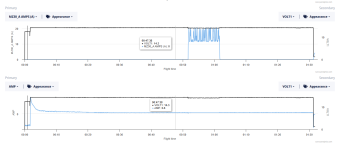
On a recent flight I elected to validate my Monkworkz MZ-30L standby alternator by running it for a few minutes with the primary alternator off for ~10min. During this, I kept an eye on the MZ-30 current output, as reported by the MZ-30 voltage regulator proportional current output (pin 5) wired into my Dynon EMS/EFIS. The results were odd, with the system reporting a peak to trough current measurement delta of ~7.5A. For the first ~5min I didn't change anything electrical with the aircraft (strobes on, beacon on, everything else off). I switched both the strobes and beacon off at ~7min into the test and observed no change.

The MZ-30 is wired into the secondary 60A ANL fuse, plus has an inline fuse itself. The primary fuse has the B&C alternator tied to it, and the current shunt on the Dynon is connected between this and the main contactor. If I understand this correctly, it is really a battery meter, and doesn't show actual load on the avionics bus in flight.
IMG_3283.png20260509 Philly Flight Monkworkz Alternator Variable Current.png


Any and all thoughts are much appreciated!
 
Is your proportional current calibrated? It's a small voltage range, maybe also check the ground reference for that voltage, make sure it isn't loose.
 
On a recent flight I elected to validate my Monkworkz MZ-30L standby alternator by running it for a few minutes with the primary alternator off for ~10min. During this, I kept an eye on the MZ-30 current output, as reported by the MZ-30 voltage regulator proportional current output (pin 5) wired into my Dynon EMS/EFIS. The results were odd, with the system reporting a peak to trough current measurement delta of ~7.5A. For the first ~5min I didn't change anything electrical with the aircraft (strobes on, beacon on, everything else off). I switched both the strobes and beacon off at ~7min into the test and observed no change.

The MZ-30 is wired into the secondary 60A ANL fuse, plus has an inline fuse itself. The primary fuse has the B&C alternator tied to it, and the current shunt on the Dynon is connected between this and the main contactor. If I understand this correctly, it is really a battery meter, and doesn't show actual load on the avionics bus in flight.

View attachment 118716View attachment 118715


Any and all thoughts are much appreciated!
Many elec appliaces are quite variable in their load. Strobes, for example, initially draws 3-5 amps and tapers to almost nothing every second or two. Every time you key the mic, it may spike 3-5 amps; transponder similar. Most ammeters agressively smooth or average out the readings. Very possible the monk doesn't do this kind of smoothing and are seeing more of a raw, unadultered feed.
 
Many elec appliaces are quite variable in their load. Strobes, for example, initially draws 3-5 amps and tapers to almost nothing every second or two. Every time you key the mic, it may spike 3-5 amps; transponder similar. Most ammeters agressively smooth or average out the readings. Very possible the monk doesn't do this kind of smoothing and are seeing more of a raw, unadultered feed.
That is what my initial thought was, but also hoping to learn something from this. The transponder current makes sense to me (I'm pretty familiar with another transponder that spikes to 7A during the ADS-B output cycle), as do strobes etc.
 
Is your proportional current calibrated? It's a small voltage range, maybe also check the ground reference for that voltage, make sure it isn't loose.
Hmm, I'm not sure this can be calibrated by the installer. I do agree that checking the ground is a good place to start!!
 
Hmm, I'm not sure this can be calibrated by the installer. I do agree that checking the ground is a good place to start!!
Someone has to program the high/low and the current corresponding to those values in the efis. At least that’s my understanding.
 
Someone has to program the high/low and the current corresponding to those values in the efis. At least that’s my understanding.
Correct. Posted here before. I'm fairly certain this is aligned with the Monkworkz manual.

sensor={
id=MONKWORKZ CURRENT
function=AMPS
pins=C37_P8 C37_P22 C37_P23 C37_P31
name=MZ30_A
min_val=0
max_val=30
resolution=1
round=.1
is_piecewise=0
low_coeff={
c_x4=0
c_x3=0
c_x2=0
c_x1=11.111
c_x0=0
}
low_resistance=NONE
low2high_cross=0
high_coeff={
c_x4=0
c_x3=0
c_x2=0
c_x1=0
c_x0=0
}
high_resistance=NONE
high2low_cross=0
shift=5
}
 
Connect an electrolytic capacitor to the Dynon EMS/EFIS input.
-
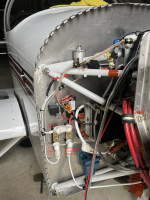
The picture shows wire-ties around the engine mount. That is not recommended because dirt under the wire-ties can abrade the steel over time.
 
Correct. Posted here before. I'm fairly certain this is aligned with the Monkworkz manual.

sensor={
id=MONKWORKZ CURRENT
function=AMPS
pins=C37_P8 C37_P22 C37_P23 C37_P31
name=MZ30_A
min_val=0
max_val=30
resolution=1
round=.1
is_piecewise=0
low_coeff={
c_x4=0
c_x3=0
c_x2=0
c_x1=11.111
c_x0=0
}
low_resistance=NONE
low2high_cross=0
high_coeff={
c_x4=0
c_x3=0
c_x2=0
c_x1=0
c_x0=0
}
high_resistance=NONE
high2low_cross=0
shift=5
}
I'm not familiar with a Dynon setup, so this setup code is foreign to me. You are right 2.7 volts is 30 amps from the manual, so that's your 11.111, but I don't know if it's all in the right spots code wise. (low and high_coeff seem reversed to me, and I don't know what shift of 5 is, but I'm out of my knowledge area, hopefully someone else can verify and maybe explain for those that don't now, like me)
 
Connect an electrolytic capacitor to the Dynon EMS/EFIS input.
-
The picture shows wire-ties around the engine mount. That is not recommended because dirt under the wire-ties can abrade the steel over time.

Interesting thought on the cap. Not part of the install manual but makes sense. I’m curious if others with the Monkworkz have seen similar readings.

Understood on the wire ties-I’m 95% sure I went back and put silicone tape under those zip ties. If not I will now and switch to the griplock ties with the rubber lining. For what it’s worth, I’ve read this comment before and completely understand the risk, but the original install on this system had normal zip ties/no chafe protection on the engine mount and no signs of damage to the paint, ~975 tach hours ago. Likely it’s a bigger issue lower down on the engine mount where dirt likes to collect…
 
I'm not familiar with a Dynon setup, so this setup code is foreign to me. You are right 2.7 volts is 30 amps from the manual, so that's your 11.111, but I don't know if it's all in the right spots code wise. (low and high_coeff seem reversed to me, and I don't know what shift of 5 is, but I'm out of my knowledge area, hopefully someone else can verify and maybe explain for those that don't now, like me)
This is a bit of my knowledge area-at least I get paid to mess with code like this from time to time. Does not mean I am an expert!

When both the low_resistance=none and the high_resistance=none flags are enabled, nothing below those lines matters to the system. At least that is my understanding from the Dynon examples.

I have also reviewed other configuration files and they match mine for the Monkworkz/Dynon input. What i haven’t dug into is a moving average filter in the Dynon software for this EMS channel, if it exists (I think it does). Might be an option in place of a “hardware” solution.
 
Correct. Posted here before. I'm fairly certain this is aligned with the Monkworkz manual.

sensor={
id=MONKWORKZ CURRENT
function=AMPS
pins=C37_P8 C37_P22 C37_P23 C37_P31
name=MZ30_A
min_val=0
max_val=30
resolution=1
round=.1
is_piecewise=0
low_coeff={
c_x4=0
c_x3=0
c_x2=0
c_x1=11.111
c_x0=0
}
low_resistance=NONE
low2high_cross=0
high_coeff={
c_x4=0
c_x3=0
c_x2=0
c_x1=0
c_x0=0
}
high_resistance=NONE
high2low_cross=0
shift=5
}
This code works when you paste it at the end of your sensor definition file. You also need to make sure that the pins you're using are listed in the "pins" list above. You have to download your sensor definition file out of your dynon, open it with a text editor, paste the text above at the very end, upload the edited file to your dynon, then direct the sensor mapping to use that sensor.
 
Thanks Bill! It would be nice to know if folks are using any "window" or "age" value with the monkworkz sensor definition. There may be some moving average filtering going on with "shift=5" set.

It would also be nice to know if others have seen similar readings from their system. My suspicion that I'm seeing the transponder caps charge and discharge is tough to confirm on the ground as the ADS-B out function is disabled by Dynon while on the ground.
 
Back
Top
