
I took the 16 hour course so now I can do my own conditional inspection on my RV – 12. Pretty scary considering how little I know. I do have an AxP looking over my shoulder. I removed my upper and lower cowlings today for the first time. I noticed that the lower cowling has what appears to be some insulation I assume to protect a cowling from melting. In fact, it appears the insulation itself has melted or at least is disintegrating. I’ve included a photo. Can anyone tell me what this material is actually for and where I buy it and any tips on replacing it. Thank you.

Van's Air Force
You are using an out of date browser. It may not display this or other websites correctly.
You should upgrade or use an alternative browser.
You should upgrade or use an alternative browser.
I’m an IA!
- Thread starter glenadavis
- Start date

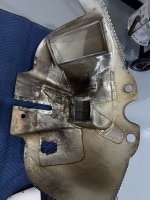
First lesson...... It's "Condition" Inspection.I took the 16 hour course so now I can do my own conditional inspection on my RV – 12. Pretty scary considering how little I know. I do have an AxP looking over my shoulder. I removed my upper and lower cowlings today for the first time. I noticed that the lower cowling has what appears to be some insulation I assume to protect a cowling from melting. In fact, it appears the insulation itself has melted or at least is disintegrating. I’ve included a photo. Can anyone tell me what this material is actually for and where I buy it and any tips on replacing it. Thank you.
I suspect we'll be fielding these and "Biannual" / BFR until the heat death of the universe.First lesson...... It's "Condition" Inspection.
At least I haven't heard "I got my privates" in a while...
rmarshall234
Well Known Member
Second lesson….if you say you are an IA it means you have an Inspection Authorization and are allowed to do annual inspections (and other things) on certificated aircraft. It is a higher level of authority than an A&P.First lesson...... It's "Condition" Inspection.


I wasn't sure what material you were asking about. The foil is sold by Vans in sheets. It really should have a layer of Fiberfrax between to protect the fiberglass.
It appears the fiberglass is bare. I would strip it all down and apply two coats of epoxy neat (no thinner) then a couple coats of epoxy primer. Then reapply the foil with Fiberfrax (1/16-1/8").
It appears the fiberglass is bare. I would strip it all down and apply two coats of epoxy neat (no thinner) then a couple coats of epoxy primer. Then reapply the foil with Fiberfrax (1/16-1/8").

Thank you to everyone who clarified my previous post. So, I’m not an IA, I have my LSRIA certification. I am not due for my (B) FR, but I am still holding my PRIVATES.

And us certified "IA's" are soon going to be "IR's"...but that's a whole different story... It is however, another reduction of FAA touch labor.
flightdoc101
Active Member
I would consider it to be a layer of carbon or soot. Exhaust leak or spilled oil? What does it look like after you have cleaned it off? That is right where the oil cooler sits, no?
