

Van's Air Force

The definitive Van's Aircraft support community! Buying, building or flying an RV? Join our exclusive family of mentors and enthusiasts!

How frequently do crowbar over voltage devices fail?

azrv6

Well Known Member
Sponsor
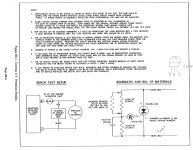
I built my RV6 in the early 90's and used the Bob Nuckolls crowbar over voltage module. I was looking through the documentation today and noticed: "The OV module should be tested every year for proper operation. Suggest removal at every annual inspection time for bench testing as described in notes 1 thru 3 above."
So that got me wondering how frequently do they fail? Is the failure mode binary - either they work or they don't. Or is there a failure mode where they start to cause intermittent gremlins (ex; odd voltage fluctuations). Some of these are getting pretty old.
Nuckolls-OV.jpeg
 
I built my RV6 in the early 90's and used the Bob Nuckolls crowbar over voltage module. I was looking through the documentation today and noticed: "The OV module should be tested every year for proper operation. Suggest removal at every annual inspection time for bench testing as described in notes 1 thru 3 above."
So that got me wondering how frequently do they fail? Is the failure mode binary - either they work or they don't. Or is there a failure mode where they start to cause intermittent gremlins (ex; odd voltage fluctuations). Some of these are getting pretty old.
View attachment 83266
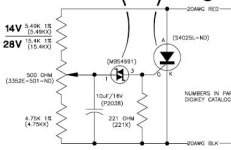
The only part that is likely to go bad over time is the electrolytic (10uF/16V) capacitor. They typically dry out and lose their capacitance over time (faster at higher temps).
In this case it would make it more susceptible to noise spikes leading to false triggering. If you haven't experienced that it's probably still OK.
Yes, the other components can go bad but much less likely.
The yearly testing is for peace of mind.
EDIT: Deleted.
 
Last edited:
I've always been leery of "how would you know" type failures. I tried to get some idea of what percentage CB circuits are actually getting tested annually and related results but the feed back was very limited. An understated advantage of the B&C reg is being able to easily test in situ; proper access assumed.

CB test query
 
Does your OVM-14 have electrolytic or tantalum capacitors? The one I sourced/made from his bill of materials were tantalum. These should last almost forever.

The full OVM-14 document is here: http://www.aeroelectric.com/DIY/DIY_Crowbar_OVP_F.pdf

It documents well how to test the OVM-14 in the plane - it's a go/nogo test but gets the job done. I don't know if every annual is a requirement I guess it depends on how much hassle it is to get at it and how often one fails. But if it hasn't been checked in a long time..... you know.
 
Does your OVM-14 have electrolytic or tantalum capacitors? The one I sourced/made from his bill of materials were tantalum. These should last almost forever.

The full OVM-14 document is here: http://www.aeroelectric.com/DIY/DIY_Crowbar_OVP_F.pdf

It documents well how to test the OVM-14 in the plane - it's a go/nogo test but gets the job done. I don't know if every annual is a requirement I guess it depends on how much hassle it is to get at it and how often one fails. But if it hasn't been checked in a long time..... you know.
Another thought - it could be handy to put in a power lead disconnect with a faston insulated connector close to the OVM-14 if it is a big hassle to get to the back of the CB for it. One could then disconnect, plug in the test fitting, and go from there without a lot of hassle.
 
The only part that is likely to go bad over time is the electrolytic (10uF/16V) capacitor. They typically dry out and lose their capacitance over time (faster at higher temps).
In this case it would make it more susceptible to noise spikes leading to false triggering. If you haven't experienced that it's probably still OK.
Yes, the other components can go bad but much less likely.
The yearly testing is for peace of mind.
EDIT: Deleted.
Interesting. I have been chasing a problem with random trips of my ovp. Know there are spikes noise on my buss but they don’t go high enough to hit the 16v trip point i set. Now wondering about that cap. It is 10 years old. Are you saying that a failing cap could cause the ovp to trip below its set point when noise is present? My trips are usually in cold temps. Don’t think it has ever happened when things are warm.
 
Interesting. I have been chasing a problem with random trips of my ovp. Know there are spikes noise on my buss but they don’t go high enough to hit the 16v trip point i set. Now wondering about that cap. It is 10 years old. Are you saying that a failing cap could cause the ovp to trip below its set point when noise is present? My trips are usually in cold temps. Don’t think it has ever happened when things are warm.
Not sure how it would trip if all spikes really are below the set trip point. But a load dump (flap motor stopping, for example) added to noise from other sources could bring it above the set trip point. I don't remember how electrolytic capacitance changes with temperature. May improve with higher temps.

Wouldn't hurt to replace the cap.

Some multimeters can measure capacitance. But perhaps more importantly ESR (how well the capacitor "dampens" higher frequencies). I've had good luck with this cheap and crude unit that measures both (as well as other components): LCR-T421 128 https://www.ebay.com/itm/156329236841
 
Not sure how it would trip if all spikes really are below the set trip point. But a load dump (flap motor stopping, for example) added to noise from other sources could bring it above the set trip point. I don't remember how electrolytic capacitance changes with temperature. May improve with higher temps.

Wouldn't hurt to replace the cap.

Some multimeters can measure capacitance. But perhaps more importantly ESR (how well the capacitor "dampens" higher frequencies). I've had good luck with this cheap and crude unit that measures both (as well as other components): LCR-T421 128 https://www.ebay.com/itm/156329236841
Thanks. up to now, I assumed this issue lay elsewhere and trying to track it down. You just got me thinking that it is possibly in the OVP. I tested the OVP and it worked properly, but that didn't account for a failing cap that is sensitive to noise or spikes.
 
Thanks. up to now, I assumed this issue lay elsewhere and trying to track it down. You just got me thinking that it is possibly in the OVP. I tested the OVP and it worked properly, but that didn't account for a failing cap that is sensitive to noise or spikes.
I found an updated (relative to what I had) pdf document on aeroelectric.com on his crowbar over voltage device. Much more thorough than what I had. Several mentions of capacitor values and reducing nuisance tripping due to short duration surges. Attached for your reference.
 

Attachments

I found an updated (relative to what I had) pdf document on aeroelectric.com on his crowbar over voltage device. Much more thorough than what I had. Several mentions of capacitor values and reducing nuisance tripping due to short duration surges. Attached for your reference.
Not that I want to dismiss this evolution completely, but I think one reason for the more complex circuitry was that the MBS4991 diac became unavailable from Digikey. However, because I like the simplicity of the original circuit, I was able to purchase several on eBay for future use.
Also the specified SCR became unavailable but there are several possible replacements. They may have slightly different trigger voltages, but that is easily adjusted by changing the resistor values in the voltage divider. Note that I later omitted the variable resistor (pot) by experimenting and picking appropriate values for the two voltage divider resistors -- one less component to fail.
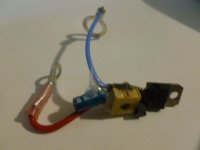
One thing I just noticed was the change from 20AWG to 18AWG wires. That may not be good. At first I didn't pay attention to the specified wire size (nor length) and used real thick and short wires with the OVP module mounted an inch from the breaker. I managed to blow up the SCR on testing. You do need a bit of resistance in the wires to the SCR or the initial inrush current when triggered exceeds what the SCR can handle (the breaker does not pop immediately).

Finn
 

Attachments

  • OVP.jpg
    OVP.jpg
    12.8 KB · Views: 35
  • P1020376.JPG
    P1020376.JPG
    27 KB · Views: 36
Thanks for this guys. I am about to order some parts from digikey (making an LED replacement for the strobes), so may just order some parts and make another OVP to be sure that is not the issue.
 
Back
Top