

Van's Air Force

The definitive Van's Aircraft support community! Buying, building or flying an RV? Join our exclusive family of mentors and enthusiasts!

How did you build your aileron pushrod?

bob865

Well Known Member
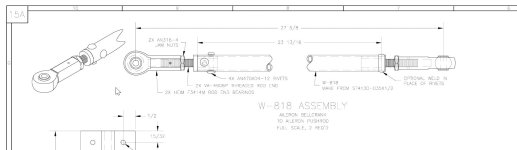
I haven't had a chance to build much lately. I've reached the point in assembling my wing where I need a second guy and my time has been sucked up by finally finishing my instrument rating. I check out on Saturday so I'll finally get back into the shop. Since I've only had a little time, I've been working on small parts that I need to knock out so I started working on the W-818 aileron bellcrank to aileron pushrod assembly. I'm not a welder(no equipment or skill), so naturally I am using the rivet method. The problem is I've driven that rivet like 6 times now and I can't get it to set right. The shop head likes to roll over instead of drive straight. I've tried and tried and I'm at my wits end. At this point, I've even ordered a new pushrod tube to build a new one because I feel like I've wallowed out the holes drilling out the rivets over and over again. Does anyone have any suggestions on how to get these rivets to set correctly or even an alternate method, pulled rivets perhaps?

pushrod.jpg
 
When I built my -4 many years ago, I did not like the rivet option and found a welder to make the part in accordance with option shown on the drawing. I did all the prep and he made the bead. It took less than 15 minutes to do both ends. I had a syringe with a cc or so of "tube oil" and squirted it in the tube after the first stud was welded in place. Welding the second part sealed the oil in the assembly forever (in theory at least). I don't know if this technique is used much today, but 25+ years ago, it was a strategy believed to prevent the inside of the tubing from corroding...

Good luck,
 
If you have a squeezer and sets that will let you get the tube in and will set 1/8” rivets it’s wasn’t a problem IIRC. I imagine that thick steel part is going to absorb energy from the rivet gun.
 

Attachments

  • IMG_1424.jpeg
    IMG_1424.jpeg
    2.3 MB · Views: 38
Last edited:
Does anyone have any suggestions on how to get these rivets to set correctly or even an alternate method, pulled rivets perhaps?
A friend of mine who is building an RV-7A knows Vern G. via an S-51D Vern built. We sent ours to Vern and he welded them for us.

If you have a community college or welding training facility near you, talk to the instructors.

You'd have to strip the powder coat and the cad plating to weld them. Replace it with Cerakote. You can use the ambient temp. cure Type C Cerakote or give your significant other a gift cert. for a pedicure and cure one of the other types in your oven. A sand blasting cabinet would come in very handy for stripping and for Cerakote prep.
 
Last edited:
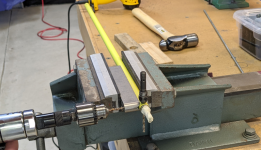
Slide the rod into a short length of rubber hose and securely clamp it in a vice. Do not crush the tube!
Using a HAND squeezer with TWO concave rivet sets, the second concave set also helps avoiding it sliding sideways on the shop head, Slowly squeeze the rivet while forcefully holding the handles to counteract any rivet bending tendencies.
Be sure the factory rivet head is tight to the tube when you start squeezing the rivet.
I leave the second concave set in the squeezer through to completion, minimizes the shop head having sharp edges that might interfere with any clearance issues in the wing.
 
I squeezed mine much like MikeyB. Came out ok.
I have a feeling that Vans says don't worry too much about the shop heads as the rivets are in shear, so as long as thay can't fall out you're ok. Seem to remember reading that somewhere.
Aslo, as Ralph points out, there are clearance issues where the rod goes through the rear spar. If I did mine again I would get them welded.
 
Fill the threaded rod end cavity with JB Weld (and cure) before you drill. That will help keep the rivet straight internally. The two cupped sets trick helps too. (Squeeze the rivets). Many have struggled before you!
 
I had the exact same problem, but with a much simpler solution. The shop head was rolling over and even cracking on me because it's too long. Go down one size in length from what the plans say (AN470AD4-11). There's still plenty length for a good shop head after squeezing and it was much easier to squeeze with no rolling over.
 
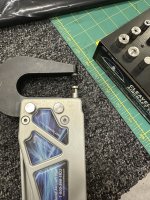
Do you have a C-Frame dimpler/riveter? That's what I used to do these rivets. It's far easier to control the angle and wobble of the part if it's in the C-Frame. I struggled with terrible rivets on these parts until I remembered the C-Frame. It made a huge difference for me.
 
Do you have a C-Frame dimpler/riveter? That's what I used to do these rivets. It's far easier to control the angle and wobble of the part if it's in the C-Frame. I struggled with terrible rivets on these parts until I remembered the C-Frame. It made a huge difference for me.
+1. This was my tool for these rivets from the word go, and worked great from the first rivet on. The advice on using a slightly shorter rivet should also help...if any rivet is too long anywhere on the plane, it will tend to topple.
 
I screwed up my first attempt, but learnt from it.

Start by making sure the holes through the tube and rod end are correctly aligned and precisely along the tube diameter. For this, I used a Gator drill guide and clamped the assembly before drilling and reaming. While drilling the second hole in each end, I kept the first hole properly aligned by putting a drill bit through it. I protected the rod end threads against drill chips and other damage or contamination by wrapping them in masking tape.

wings_2021-06-02_01.png

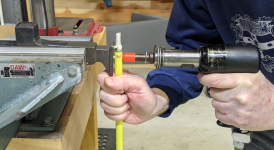
For riveting, I used a cup head set with snap-soc, with the air pressure up high (90 psi at compressor). These long rivets need the high pressure to set in as few strikes as possible. I clamped a bucking bar in a vise and drove the shop head against it. It's important to hold everything square while riveting, and to lean into the gun while riveting at the higher pressure. In particular, need to restrain the tube against any tendency to rotate while riveting.

wings_2021-06-02_02.png

Also, I used my first failed attempt to work out a method and practice it on a couple of holes. It turned out not too difficult at the second attempt. The important things were to make sure the holes are drilled precisely square and to keep gun, tube and rivet precisely square to bucking bar surface.
 
A bit off-topic, but...if you can learn to hold the rivet gun with your palm against the back of it, and use your middle finger to squeeze the trigger, you'll be more able to keep the gun straight on to the rivet. If you're working on the wings or fuse, you've probably got reasonably good technique by now, but I learned this early on on the advice of folks here, and I think it definitely made my riveting technique better.

Just a thought...others no doubt can add theirs.
 
Use universal head set in your gun, set MFG head against bucking bar/steel plate and drive the shop head/bucktail down. The cuplike set will make a beautiful smooth rounded bucktail that stays centered. I do this on all my nutplate rivets also when I'm able to backdrive or squeeze them. Pretty common practice amongst us greybeard industry guys.
 
Back
Top