

Van's Air Force

The definitive Van's Aircraft support community! Buying, building or flying an RV? Join our exclusive family of mentors and enthusiasts!

Hobbs Time Drift

SquawkVFR

Active Member
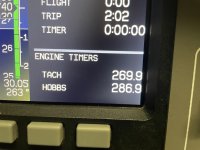
My aircraft has two Hobbs timers - one old school mechanical gauge and one processed by a Dynon D180. The mechanical gauge is activated by an oil pressure switch. The Dynon increments the timer when it sees over 15 psi from the oil pressure sensor. The oil pressure switch and oil pressure sensor are linked with a short segment of 1/4" aluminum tubing. In theory, both timers should be in-sync. In reality, they're off by just enough for them to drift over time.

Is there a fix for this so that both gauges will increment simultaneously, or should I disconnect the wire from one or the other, so I don't have to keep adjusting the Dynon to match the mechanical gauge?
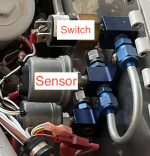
Hobbs Source.png
 
My aircraft has two Hobbs timers - one old school mechanical gauge and one processed by a Dynon D180. The mechanical gauge is activated by an oil pressure switch. The Dynon increments the timer when it sees over 15 psi from the oil pressure sensor. The oil pressure switch and oil pressure sensor are linked with a short segment of 1/4" aluminum tubing. In theory, both timers should be in-sync. In reality, they're off by just enough for them to drift over time.

Is there a fix for this so that both gauges will increment simultaneously, or should I disconnect the wire from one or the other, so I don't have to keep adjusting the Dynon to match the mechanical gauge?

View attachment 89880
Since installing a new G3X panel and flown about 100 hours, I’ve seen 0.6 hours drift between the mechanical Hobbs and the 3X. Decided I wasn’t enough difference to worry about.
 
"A man with a watch knows what time it is. A man with two watches is never sure."

Skylor


My aircraft has two Hobbs timers - one old school mechanical gauge and one processed by a Dynon D180. The mechanical gauge is activated by an oil pressure switch. The Dynon increments the timer when it sees over 15 psi from the oil pressure sensor. The oil pressure switch and oil pressure sensor are linked with a short segment of 1/4" aluminum tubing. In theory, both timers should be in-sync. In reality, they're off by just enough for them to drift over time.

Is there a fix for this so that both gauges will increment simultaneously, or should I disconnect the wire from one or the other, so I don't have to keep adjusting the Dynon to match the mechanical gauge?

View attachment 89880
 
Typically the Hobbs switch is set to trigger at about 4-5 psig....So if the Hobbs triggers at 4 psig, and the Dynon at 15 psig, there's a lot of your difference. Can the Dynon be set to a 4 psig trigger?
 
Typically the Hobbs switch is set to trigger at about 4-5 psig....So if the Hobbs triggers at 4 psig, and the Dynon at 15 psig, there's a lot of your difference. Can the Dynon be set to a 4 psig trigger?
Im thinking the switch activation pressure is higher than 15 psi that the Dynon uses because the mechanical timer is running a little slower than the Dynon. I haven’t yet noticed anything in the manual to change the pressure setpoint but yours is a very good idea. I will have to look at the manual again
 
I'd consider removing them both. No need for hobbs.

In fact I'm far past considering it... no hobbs in my plane.
 
...just thought about this -- is there a voltage spec for the Hobbs? Maybe 14.5Vdc is too much and putting a diode of some stripe inline would lower the voltage and thus make it run slower, or faster -- depends on the oscillator/drive configuration...
 
I’ve got the GRT EIS that starts counting hours when rpm reaches 600 rpm and a Hobbs meter system using oil pressure switch setup similar to the OP. Over the years they have drifted apart to where there is now 2.8 hours difference. My question is: who cares and why?

Oil changes always occur early, the CI is done annually, and I measure each flight based on Hobbs time (at least I’m consistent). All maintenance entries include both EIS and Hobbs time and dates. Hey, my Seiko watch is relative depending on when I last set it. If there’s a big concern, update the Dynon D180 time to match the Hobbs.

Just make sure you account for your time zone and daylight savings! 🤩
 
By chance do you know the activation pressure of the switch?
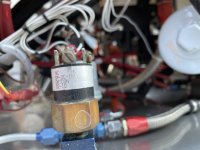
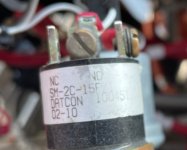
OK, so the pressure switch label says it's a Datcon 100451. Web search results indicate the switch contact closes at 15 psi. The thing that's got me wondering about the delay is the fact that a single wire goes from it to the mechanical Hobbs timer, which means the ground/return path is through the body, then the threads, then the manifold, through the firewall, back to the battery ground strap. The suspect point in that path is the threads. I don't know what was used for thread sealant, but it looks like transulcent green goop. What do you think?

C810EFE1-08B4-4AC6-88DC-D7B361F3A07F_1_105_c.jpeg
 
OK, so the pressure switch label says it's a Datcon 100451. Web search results indicate the switch contact closes at 15 psi. The thing that's got me wondering about the delay is the fact that a single wire goes from it to the mechanical Hobbs timer, which means the ground/return path is through the body, then the threads, then the manifold, through the firewall, back to the battery ground strap. The suspect point in that path is the threads. I don't know what was used for thread sealant, but it looks like transulcent green goop. What do you think?

View attachment 89957
Threads are a completely adequate ground path, even when sealant is used.
 
That manifold is anodized.... and it is non conductive.
I don't think that switch needs to be grounded. It is a switch that operates by oil pressure.
The connections look like they could use a cleaning....;)
 
Last edited:
Typically the Hobbs switch is set to trigger at about 4-5 psig....So if the Hobbs triggers at 4 psig, and the Dynon at 15 psig, there's a lot of your difference. Can the Dynon be set to a 4 psig trigger?
OK, so after digging into the manual, there's not a way to change the setpoint that I could find. I'm guessing it's hard-coded by Dynon at the factory.
 
...just thought about this -- is there a voltage spec for the Hobbs? Maybe 14.5Vdc is too much and putting a diode of some stripe inline would lower the voltage and thus make it run slower, or faster -- depends on the oscillator/drive configuration...
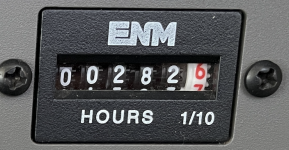
It's definitely running slower than the Dynon. I don't see any diodes in the circuit. It's an old school ENM model. Not sure the part number - I'd have to dig into the panel a bit to pull that info.

Hobbs Meter.png
 
I’ve got the GRT EIS that starts counting hours when rpm reaches 600 rpm and a Hobbs meter system using oil pressure switch setup similar to the OP. Over the years they have drifted apart to where there is now 2.8 hours difference. My question is: who cares and why?

Oil changes always occur early, the CI is done annually, and I measure each flight based on Hobbs time (at least I’m consistent). All maintenance entries include both EIS and Hobbs time and dates. Hey, my Seiko watch is relative depending on when I last set it. If there’s a big concern, update the Dynon D180 time to match the Hobbs.

Just make sure you account for your time zone and daylight savings! 🤩
Seems like an easy thing to trivialize till it's time to sell the plane, and you have to go back and explain the divergence. I've had a couple mechanics work on my plane since I bought it, and some of them have used the mechanical hobbs time and others pulled from the Dynon. Now there's a discrepancy in the hours, which might cause suspicion. Easy to explain? Yes - if you understand and are able to competently convey the information to a prospective buyer.
 
That manifold is anodized.... and it is non conductive.
I don't think that switch needs to be grounded. It is a switch that operates by oil pressure.
The connections look like they could use a cleaning....;)
If it doesn't need to be grounded via the manifold, how do you complete the circuit if there's only one wire going to the switch?
 
Back
Top