

Van's Air Force

The definitive Van's Aircraft support community! Buying, building or flying an RV? Join our exclusive family of mentors and enthusiasts!

Getting tires on rims - how?

inktomi

Well Known Member
Sponsor
Hi -

I've been trying a little every day for about the past week to get my tire tubes onto my rims in order to consolidate some storage. For the life of me, I can't seem to get them on. There must be a trick.

Here's what I've been trying.
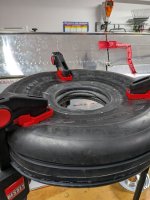
  1. Talc the tube
  2. Stuff tube into tire
  3. Inflate just a bit to smooth it out inside the tire
  4. Remove the valve from the stem, let out all the air
  5. Following Matco's directions, using three clamps to bring the wheel flanges closer together - here's where it goes wrong!
  6. Insert the valve stem in one half
  7. Struggle to try to get the tube back into the tire, because it's now blocking the other half from mating properly.
  8. Give up for the day and feel bad. Repeat.
What can I try differently? Is there a trick to this? I've watched a few YouTube videos and it doesn't seem like it should be this hard.

PXL_20250419_024415993.jpg

PXL_20250419_024431521.jpg
 
Deflate the tube just enough to keep it out of the way. You will have to tuck it in the tire a bit but don’t deflate too much.
 
I'm not sure if I did it right or wrong, but I didn't have any trouble: Tire talc, then inflated the tube just enough to get it into the tire with some shape (so it's not all folded or wrinkled). I didn't use clamps on the tire at all. With the tube in place and inflated just a touch so it wouldn't be pinched in between the rims, I pushed one rim into place. Then flipped the tire over and slid the other rim in. I put the bolts in place and inflated/deflated the tire as necessary to push the rims together just enough to get the nuts to catch. I'm not sure how clamps would really help. Pushing the rims together with some air in the tire didn't really take much effort. All three of my tires worked fine this way.
 
You took way too much air out of the tube - you want just enough pressure (and no more) to have it hold its shape. And I’ve been mounting aircraft tires for over fifty years, and never once have I used a clamp (or three) - just put the two wheel haves in place, line up the bolt holes, make doubly sure the tube isn’t pinched between the halves, and run all three bolts through both halves. Get a nut started on each and draw them together.
 
I have the same Goodyear tires. They have much stiffer sidewalls than the stock Vans. What I did was to put the wheel clampshell together, they will still be far apart, and line the bolt holes up with temporary long lag bolts.

slowly tighten the lag bolt until the wheel clamp shells close up.
Replace one lag bolt with the wheel bolt.
Repeat for the remaining lag bolts.
 
I don’t use any clamps.. and make sure that the wheel half’s both have the notch to clear the valve stem. Then with the wheel hanging off the workbench just a little, you press the top half on and it should make a metal to metal “clink” noise to verify the tube isn’t getting pinched. You can then drop the bolts in, and with the wheel hanging off the bench, you should be able to catch a few threads.
 
I finished mounting new Wilkerson retreads yesterday. Looking at your photos I can tell I use much more talc than you have applied, the inside of the tire and the tube should be thoroughly coated with powder so there is little friction. As mentioned previously, leave more air in the tube after you get it inside the tire, it should hold a "donut" shape.
 
Talc the tube and the inside of the tire coating both well. Put the tube into the tire. Inflate the tube until round. Remove the Schrader valve to let the air escape. The tube will remain in shape. Line up the valve stem with the dot on the tire. Slip the wheel halves together lining up the bolt holes, valve stem notch and brake disc. Put the bolts in from the disc side. Here I use a 1 L empty metal paint can and put the open end inside the brake disc to hold the bolts in place. Flip the assembly over sitting on the can. Press the wheel halves together (you can feel the metal to metal contact) and start the nuts. After the nuts are all started, stand the wheel up and torque the bolts. Inflate the tire without the valve a couple times to set the tube and then install the valve and inflate. Not hard to do and never a pinched tube in many years of tire/tube changes. Will need a different size can or?? if other than a 500-5 tire. YMMV
 
I have the same Goodyear tires. They have much stiffer sidewalls than the stock Vans. What I did was to put the wheel clampshell together, they will still be far apart, and line the bolt holes up with temporary long lag bolts.

slowly tighten the lag bolt until the wheel clamp shells close up.
Replace one lag bolt with the wheel bolt.
Repeat for the remaining lag bolts.
I have the same tires and never use clamps. Just enough air to keep it from pinching like others have said. I’ve even rotated these tires after use and also never had issues.
 
Thank you everyone! I knew I was doing something wrong. I'll try again after a biannual flight review today. I'm not using enough talc, and it seems that removing the valve entirely isn't needed, as we want to keep a bit of air in the tube to keep it inflated. I'll get some long bolts, I like that idea @PhatRV - the tires are quite stiff and it's hard to get the wheel halves into them, so that seems like a great idea.
 
Ugh, I don't understand the talc. It isn't necessary.

You will likely pinch the tube and destroy it when the rim halves come together. If not this time, you will in time if you do enough of these. Matco recommended in their old literature, and possibly still do recommend, using a strip of thick paper to prevent the rim from pinching the tube. 1: Place the tire on the rim half with valve stem. 2: insert the tube in the tire with valve stem in rim. 3: Insert a strip of thick paper or thin cardboard extending from one side of the valve stem, around the ID of the tire to the other side of the valve stem. The paper should be tucked into the tire bridging the gap between tire sidewalls thus preventing the tube from being pinched as the rim halves come together.
 
Paper or cardboard inside the tire? I'll stick with the talc. My experience has always been (lost count of how many times the RV tires have been flipped or replaced) when the tube has enough air to hold it's shape there will be sufficient clearance around the wheel. The only time I have had a tire go down after maintenance was when the valve core failed to seat or was defective.
 
Last edited:
Paper or cardboard inside the tire? I'll stick with the talc. My experience has always been (lost count of how many times the RV tires have been flipped or replaced) when the tube has enough air to hold it's shape there will be sufficient clearance around the wheel. The only time I have had a tire go down after maintenance was when the valve core failed to seat or was defective.
The cardboard makes sense. Or a very thin cheap dollar store cutting board cut to size. It holds back the tube while mating the rim, and then once mated the material is removed before tightening; it isn't left in the tire.
 
With as tight the tire fits around the rim I doubt you’ll be able to remove the paper. I don’t see how leaving the paper would affect anything, however I would still use talc which would keep the outside and sides of the tube slippery
 
Ugh, I don't understand the talc. It isn't necessary.

You will likely pinch the tube and destroy it when the rim halves come together. If not this time, you will in time if you do enough of these. Matco recommended in their old literature, and possibly still do recommend, using a strip of thick paper to prevent the rim from pinching the tube. 1: Place the tire on the rim half with valve stem. 2: insert the tube in the tire with valve stem in rim. 3: Insert a strip of thick paper or thin cardboard extending from one side of the valve stem, around the ID of the tire to the other side of the valve stem. The paper should be tucked into the tire bridging the gap between tire sidewalls thus preventing the tube from being pinched as the rim halves come together.
Very normal to have a flat tire without a puncture, and you find many pinholes in the tube....This is caused from the tube fretting.

Tire talc has been used on tube tires for at least 80 years.

It also helps the sidewalls of the tube slip inside the tire when the tire is under inflated.
 
Very normal to have a flat tire without a puncture, and you find many pinholes in the tube....This is caused from the tube fretting.

Tire talc has been used on tube tires for at least 80 years.

It also helps the sidewalls of the tube slip inside the tire when the tire is under inflated.
The flats I have experienced without a puncture were from tire flexing and pinching the tube between the tire bead and rim. I respect your opinion; I just disagree with it. I see talc as unnecessary and likely carcinogenic.
 
The flats I have experienced without a puncture were from tire flexing and pinching the tube between the tire bead and rim. I respect your opinion; I just disagree with it. I see talc as unnecessary and likely carcinogenic.
The nice thing about EXP aircraft is you can choose how you want to maintain your aircraft and learn as you go.....

I have never had a flat tire. So, I will continue to coat the inside of the tire and rub it in, and also rub talc all over the entire tube.
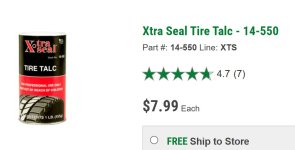
talc.jpg
 
How much talc are you using, anyway? And where, exactly? :)
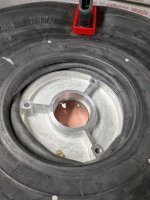
Using dry and clean hands, rub it all over the tube, really coating it, then put a bunch in the tire, rolling it around and up in the sides, and I leave a teaspoons worth (maybe a tablespoons worth) extra inside the tire. You can’t have too much talc, but you can have too little. The OP picture looks like there isn’t any..
 
Using dry and clean hands, rub it all over the tube, really coating it, then put a bunch in the tire, rolling it around and up in the sides, and I leave a teaspoons worth (maybe a tablespoons worth) extra inside the tire. You can’t have too much talc, but you can have too little. The OP picture looks like there isn’t any..
I was being kinda snarky...the concerns about talc as being carcinogenic have centered around miners with lifelong exposure, and use of talcum powder on the, uh, female genitalia. Not once-every-few-years exposure to a few teaspoons when changing tires.
 
I was being kinda snarky...the concerns about talc as being carcinogenic have centered around miners with lifelong exposure, and use of talcum powder on the, uh, female genitalia. Not once-every-few-years exposure to a few teaspoons when changing tires.
Haha I get you now lol
 
Screenshot_20-4-2025_11499_.jpeg
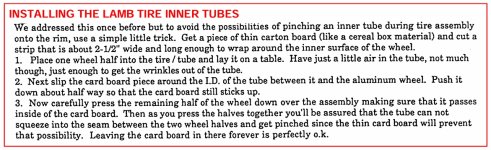
From another Eab build manual, but could apply in an RV also. Posting here for the benefit of any who may be newish at changing the tires on these little wheels.
 
View attachment 85702
From another Eab build manual, but could apply in an RV also. Posting here for the benefit of any who may be newish at changing the tires on these little wheels.
I would not want to leave cardboard between the tube and rim. Moisture will get in and be wicked into the cardboard and stay there allowing corrosion to occur. Just my opinion.
 
Not using a sufficient amount of tire talc is guaranteed to induce early tube failure.
Anyone advocating for not using it doesn’t understand its importance in preventing chafing of the tube on the interior of the tire (the tube moves against the tire as the sidewall flexes.
+1
 
Back
Top