

I have ~50 hours on my -9A since first flight in April, and it's been a dream to fly. No major squawks, but one annoying minor one -- on warmer days (>70 OAT) when heat soaked I get what sounds like an occasional miss at low power. It is not a major hiccup or unnerving -- it sounds like a single combustion event is getting missed. It's noticeable on some idle power final approaches and when taxiing after landing with RPM below ~1100. You can just barely notice RPM drop on the G3X when in the plane, but it's very obvious in logged data as "noisy" RPM -- from this morning, for example:
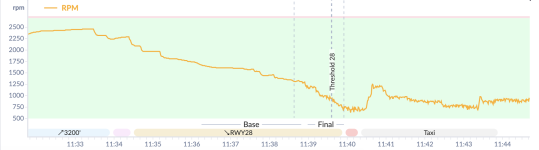
It does not cause the engine to die -- I can pull the throttle back to idle (<700 RPM) and it'll continue to run fine -- it's just a little embarrassing on the ramp. Mixture control has no impact. Never a problem when cold.
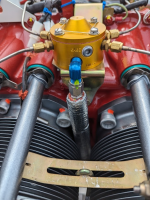
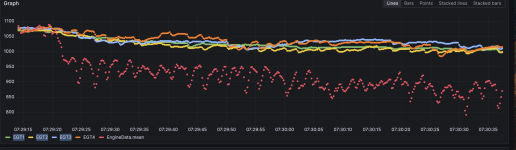
I am pretty sure this is fuel vaporizing in the injector lines above the engine, primarily on the 2/4 side. I set up a data logger using the G3X's 5hz RS-232 feed to log RPM and EGTs at a higher sample rate than the SD card without smoothing. From the same flight as above (red is RPM), you can easily see the varying RPM, and what looks to me to be a similar periodicity in EGT2/4, but not EGT1/3. I might be imagining things though -- EGT is fast to react to combustion events, but perhaps not fast enough.
Setup is an RV-9A with an IO-320-D1A, Silverhawk mechanical fuel injection, dual p-mags. I do have a plenum, and the baffles are I think, well sealed; CHTs are well controlled -- will hit ~390F during climb out, LOP cruise in the 340F range; typically about 15F max spread among cylinders (2/4 slightly hotter). Oil is cooled through a firewall mounted oil cooler taking a 3.5" duct from behind cylinder 4 and regulated with a butterfly valve; at current temps (70-85 OAT on ground), I can easily keep oil in the 180-190F range with the cooler half closed. Break in was normal -- high CHTs first flight, but dropped about an hour in and came down a little from there. Oil consumption has been very low (about a quart in last 35 hours, and most of that was wiped off the belly).
I've read every thread about fuel vaporization that I can find, and that has led me to so far try:
I'll probably bite the bullet and put the louvers in, but before I do -- any ideas I've missed? If it helps, I have or can get lots more data (1 hz data logging from every flight, some 5 hz data, and I'm set up to log up to four additional thermocouple locations FWF).
Noah
It does not cause the engine to die -- I can pull the throttle back to idle (<700 RPM) and it'll continue to run fine -- it's just a little embarrassing on the ramp. Mixture control has no impact. Never a problem when cold.
I am pretty sure this is fuel vaporizing in the injector lines above the engine, primarily on the 2/4 side. I set up a data logger using the G3X's 5hz RS-232 feed to log RPM and EGTs at a higher sample rate than the SD card without smoothing. From the same flight as above (red is RPM), you can easily see the varying RPM, and what looks to me to be a similar periodicity in EGT2/4, but not EGT1/3. I might be imagining things though -- EGT is fast to react to combustion events, but perhaps not fast enough.
Setup is an RV-9A with an IO-320-D1A, Silverhawk mechanical fuel injection, dual p-mags. I do have a plenum, and the baffles are I think, well sealed; CHTs are well controlled -- will hit ~390F during climb out, LOP cruise in the 340F range; typically about 15F max spread among cylinders (2/4 slightly hotter). Oil is cooled through a firewall mounted oil cooler taking a 3.5" duct from behind cylinder 4 and regulated with a butterfly valve; at current temps (70-85 OAT on ground), I can easily keep oil in the 180-190F range with the cooler half closed. Break in was normal -- high CHTs first flight, but dropped about an hour in and came down a little from there. Oil consumption has been very low (about a quart in last 35 hours, and most of that was wiped off the belly).
I've read every thread about fuel vaporization that I can find, and that has led me to so far try:
- Swapped injector restrictors from 0.028" to 0.022" -- this had some impact on the temp/RPM at which the problem would appear, but didn't eliminate it. Did help get me running very far LOP w/ low spread. Cleaned injectors per the SI while I was at it.
- Swapped spider spring to 4PSI spring. No impact.
- Rerouted pump-to-servo and servo-to-spider lines to be well away from exhaust; no real noticeable impact. The only semi-close point between exhaust and a fuel line now is where the fuel line enters the fuel servo; this is about 3.5" from an exhaust pipe at the closest point. There is a stainless/fiberfrax/aluminum sandwich heat shield on the exhaust pipe.
- Blast tube pointed at fuel pump. No impact.
- Checked timing on p-mags. No impact. Problem persists when running with left, right, or both ignitions on, so pretty sure it's not an ignition problem.
- Checked and adjusted idle mixture. 50 RPM rise.
- Checked for induction leaks w/ a smoke machine - none exist.
- Expand exit area, either by cutting back the exit around the exhaust or adding louvers (which were included with the kit for the new nose gear, but I didn't install). I've hesitated to do this because my overall cooling seems plenty adequate, and like everyone, I want to minimize drag.
- Add a flow restricted return line tee'd in at the fuel servo inlet and circulate a few GPH back to the tank. This would help keep fuel temps down going into the servo and perhaps gain additional margin downstream of the servo. This is a non-trivial project to do, and I'm not sure how much it would really help. I do have return fittings capped off in my tanks, but no duplex valve or plumbing back to the returns.
- Switch to EFI and marvel at the magic of high rail pressures. Not really realistic.
I'll probably bite the bullet and put the louvers in, but before I do -- any ideas I've missed? If it helps, I have or can get lots more data (1 hz data logging from every flight, some 5 hz data, and I'm set up to log up to four additional thermocouple locations FWF).
Noah
 and like you have improved it a bit. We also double fire-sleeved all the fuel lines from the firewall up to the servo with heat reflecting firesleeve (aluminumized). That had a pretty helpful effect of staving this off.