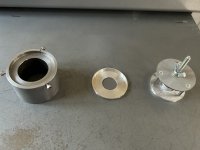



A friend had a small, but persistent, leak coming from the general direction of one of his fuel tank drain flanges and ask for my input.
He wasn't interested, if at all possible, not to remove the tank, drill out all the rivets (and recover them) and reinstall same.
I came up with a very small "cup" type cover plate that is attached (after good cleaning practices of the installed flange) with a fuel resistant epoxy adhesive - such as 3M 2216 or 3M DP-190.
I talked with 3M engineers many years ago, and was assured their product was not effected by the aromatics of AvGas - just to be sure, I have had an ongoing "test" of coupons, submerged in 100LL, made with 2216 & DP-190 since 2011, with no degradation of the immersed parts.
The joint (epoxy) thickness is ~ .032 on the faces & .125 around the perimeter.
I also made a little installation tool to help with glue squeeze out as well as holding the "cup" in place on the underside of the tank during cure.
YMMV - But this might be a way to avoid a major repair ...
HFS
He wasn't interested, if at all possible, not to remove the tank, drill out all the rivets (and recover them) and reinstall same.
I came up with a very small "cup" type cover plate that is attached (after good cleaning practices of the installed flange) with a fuel resistant epoxy adhesive - such as 3M 2216 or 3M DP-190.
I talked with 3M engineers many years ago, and was assured their product was not effected by the aromatics of AvGas - just to be sure, I have had an ongoing "test" of coupons, submerged in 100LL, made with 2216 & DP-190 since 2011, with no degradation of the immersed parts.
The joint (epoxy) thickness is ~ .032 on the faces & .125 around the perimeter.
I also made a little installation tool to help with glue squeeze out as well as holding the "cup" in place on the underside of the tank during cure.
YMMV - But this might be a way to avoid a major repair ...
HFS