

Van's Air Force

The definitive Van's Aircraft support community! Buying, building or flying an RV? Join our exclusive family of mentors and enthusiasts!

Elevated Silicon in Oil Analysis

rvanstory

Well Known Member
Sponsor
I have an RV10 with an IO-540. For 4 years (over 600 hours on engine now) my oil analysis keeps showing elevated silicon levels. According to Blackstone website, elevated silicon represents the following: "Silicon: Airborne dirt escaping air filtration, silicone sealers, gaskets and lubes."

Twice now I have identified small "leaks" around the air filter gasket in the air box and have sealed those leaks. Each time I expect silicon levels to go down to "normal", but each time the results keep coming back the same. (see attached photo of report).

My intake gaskets are good (changed to SDS machined intake o-rings). I don't know where else to look or what to look for. Any suggestions of how to identify the source of elevelate silicon? I'm told it usually means unfiltered air is getting into system.

Any thoughts about what to look for (and how) would be appreciated.
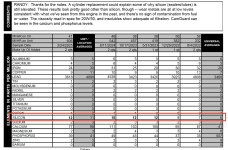
Image 4-19-25 at 8.59 AM.jpeg
 
You're a Texas boy -- notice how dirty the air has been the last month or so? Check the condition of your air filter -- dirty? Holes in it?

Elevated Silicon isn't from rocker cover gaskets, or other seals that are *NOT* exposed to the combustion process...
 
How and with what are you using to seal the gaps around the air filter? Silicon caulk?
 
Has the air filter worn into your airbox at all?

I noticed a bit of a gap between the top of the filter and the throttle body plate. I measured the K&N filter and it was one mm short of spec. I assumed it had shrunk slightly and ordered a new one. To my surprise, it too was slightly undersized. Like many others, I ended up Pro Sealing an aluminum plate to the bottom of the airbox—even though there was minimal wear in the fiberglass.
 
Has the air filter worn into your airbox at all?

I noticed a bit of a gap between the top of the filter and the throttle body plate. I measured the K&N filter and it was one mm short of spec. I assumed it had shrunk slightly and ordered a new one. To my surprise, it too was slightly undersized. Like many others, I ended up Pro Sealing an aluminum plate to the bottom of the airbox—even though there was minimal wear in the fiberglass.
…and do NOT use silicone caulk, RTV or similar in the airbox.
 
I've been told sand=silicone, ie sand from the runway surface.
Your numbers look consistent to me, absent other evidence I'd ignore them.
 
Is it possible you are using an engine dryer with silicon desiccant? If so, you should take care to ensure that none of that silicon dust is getting into the engine.
 
…and do NOT use silicone caulk, RTV or similar in the airbox.
I don't! I have an aluminum plate riveted in bottom of air box, but did find (with help of borescope) a SMALL gap in back upper section. I built back of metal plate up in that are with fiberglass underneath, re-installed plate for good solid seal. (no RTV, ect...). I'm beginning to think my numbers are "normal", but want to make sure I'm not overlooking a problem.
 
I've been told sand=silicone, ie sand from the runway surface.
Your numbers look consistent to me, absent other evidence I'd ignore them.
That's what I'm thinking, but want to make sure I'm not ignoring an issue of some kind. Thank you for your response.
 
Don’t seem that high to me. Do you use the orange rocker cover gasket’s? Those are silicone and will raise your numbers a bit over those that use cork. Those numbers are parts per million, I believe , so 12 ppm is a really small number.
 
A different possibility is that the drain hose used is not absolutely clean, thereby introducing grit (silicon) into the oil sample, as you drain. Ask me how I know.

Merrill
 
Hi Randy, I have had elevated levels in my reports in every sample since I started flying in 2017. I have spoken to Blackstone and have come to the conclusion that it is caused by the filter oil on the K&N air filter.

Terry
 
I use Blackstone and have had the very same issue for years and haven't figured it out. I replace my K&N filter every two years and do not recharge it. I wish there was another filter to try to determine if that is the silicone source.
 
I use Blackstone and have had the very same issue for years and haven't figured it out. I replace my K&N filter every two years and do not recharge it. I wish there was another filter to try to determine if that is the silicone source.

Switch to a paper type filter if you are concerned that it might be the oil in the K&N (it isn't, but do the experiment anyway) -- see https://www.aircraftspruce.com/catalog/eppages/tempest_airfilters_08-17580.php

And for the record - again - elevated silicon is not caused by Silicone. Unless there is some RTV lurking in your engine in some very hot areas (think cylinder base/case -- maybe some inexperienced A&P slathered some Ultra Red in there before putting the jugs on...).

Blackstone, and the rest, are measuring the element silicon (Si, bound up with Oxygen, called silica or silicon dioxide or sand). This makes up most of the dust in the atmosphere.

@DanH had an observation recently, and it's worth repeating here -- What's the surface composition and condition of the airport movement areas in KRCE? Looks like a lot of 1940's concrete slab. Since you have a low mounted intake, it's possible you're sucking in sand from the concrete in the taxi- run-ways.

@rvanstory Randy - same question to you; New Braunfels is an old Army Airbase -- lot's of 1940's concrete to taxi across with that bottom mounted air scoop...
 
Last edited:
Do you use Dow Corning #4 on your oil filter gasket? An overdose might lead to high silicon readings. If not, you're back to dust/sand/yukk.
 
Hi Randy, I have had elevated levels in my reports in every sample since I started flying in 2017. I have spoken to Blackstone and have come to the conclusion that it is caused by the filter oil on the K&N air filter.

Terry
I clean and re-oil my K&N filter for three years and then replace on the fourth. I never in 19 years have had "high" silicon levels, what ever someone has determined that to be.
 
IMG_0108.jpeg

Good discussion.

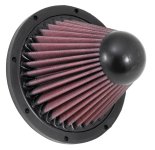
I have the conical shaped K&N filter and I’m confident that it has a good seal around its flanges. It has a fibreglass cone that extends horizontally forward to the inlet just below the spinner. I don’t think there is a paper filter that would work without a lot of changes.

I fly almost exclusively from asphalt runways with the occasional concrete ramp. I do have an alternate air valve that I cycle during my run-up, other than that the air is always filtered.

If it’s not the filter oil, then I can’t explain it. I don’t lose sleep over it, I have accepted it as normal.

Terry
 
View attachment 85735

Good discussion.

I have the conical shaped K&N filter and I’m confident that it has a good seal around its flanges. It has a fibreglass cone that extends horizontally forward to the inlet just below the spinner. I don’t think there is a paper filter that would work without a lot of changes.

I fly almost exclusively from asphalt runways with the occasional concrete ramp. I do have an alternate air valve that I cycle during my run-up, other than that the air is always filtered.

If it’s not the filter oil, then I can’t explain it. I don’t lose sleep over it, I have accepted it as normal.

Terry
I would expect that the sand particles entering during your runup create the silicon traces in the oil smaple. Opening the alt air on the ground at high power will invite dirt into the engine.
 
Switch to a paper type filter if you are concerned that it might be the oil in the K&N (it isn't, but do the experiment anyway) -- see https://www.aircraftspruce.com/catalog/eppages/tempest_airfilters_08-17580.php

And for the record - again - elevated silicon is not caused by Silicone. Unless there is some RTV lurking in your engine in some very hot areas (think cylinder base/case -- maybe some inexperienced A&P slathered some Ultra Red in there before putting the jugs on...).

Blackstone, and the rest, are measuring the element silicon (Si, bound up with Oxygen, called silica or silicon dioxide or sand). This makes up most of the dust in the atmosphere.

@DanH had an observation recently, and it's worth repeating here -- What's the surface composition and condition of the airport movement areas in KRCE? Looks like a lot of 1940's concrete slab. Since you have a low mounted intake, it's possible you're sucking in sand from the concrete in the taxi- run-ways.

@rvanstory Randy - same question to you; New Braunfels is an old Army Airbase -- lot's of 1940's concrete to taxi across with that bottom mounted air scoop...
I have been based at three different airports and the high silicone numbers were consistent at each airport. To me, it's something about the engine.
 
These oiled gauze type filters are not very efficient, so airborne dust could just be going through the filter. Ingested dust is bad as it is a grinding compound on the ring/bore (s) so will also elevate the iron measurement. It only takes 1/2 a thimble of dust to contaminate 55 gallons of oil. I flew through the PNW a few years ago with all the wild fires and it elevated my silicon & iron for 3-4 oil changes.

Your iron is high along with silicon indicating that it is dust, although some failing internal component could exist as well. My iron is 4-9 and as reference, typical diesel off highway is 2-3.

IMO, iron of 30 is worth noting, and combined with silicon indicates either a high airborne dust is likely and/or a failing component. I would replace the air filter as a minimum just as a precaution and inspect filters carefully for fine iron particles. You could stick some strong magnets on the filter for the next change if they don't adversely affect your compass. Bore inspection information might be helpful if it is available.

This is not necessarily serious, but does call for attention and more careful inspection. At these levels it is going to be hard to find a smoking gun, but you never know until you look.
 
Last edited:
Silicon, Silica, and Silicone drive me crazy. As a simple Aero engineer, chemistry was a one-quarter required class, and it mystified most of us wing-and-fuselage guys, so I always have to look this up - but exact words are important (which is why many of us are so pedantic about “Condition” inspections and it grates on our ears to hear someone one “Transitioning” airspace…..)…so here’s a quick reference I keep handy to remind myself that these are three different things - and while they might share some common roots at the atomic level, they can’t be used interchangeably:

In conclusion, while the terms silicon, silica, and silicone are often mistakenly used interchangeably, they refer to distinctly different materials with unique properties and uses. To recap:

  • Silicon is a metalloid chemical element widely used in electronics and as a semiconductor.
  • Silica is a naturally derived compound resulting from the interaction of oxygen and silicon, commonly found in nature and used in various industrial and consumer applications, including glass production and as a filler in paints, plastics, and rubber.
  • Silicone, on the other hand, is a synthetic, oily, rubber-like polymer made from siloxane or silicon oil. It has various applications in multiple industries, from personal care and home products to aerospace and electronics.
Understanding the differences between these materials is essential in order to select the appropriate material for your application and avoid any health hazards associated with its use.
 
View attachment 85735

Good discussion.

I have the conical shaped K&N filter and I’m confident that it has a good seal around its flanges. It has a fibreglass cone that extends horizontally forward to the inlet just below the spinner. I don’t think there is a paper filter that would work without a lot of changes.

I fly almost exclusively from asphalt runways with the occasional concrete ramp. I do have an alternate air valve that I cycle during my run-up, other than that the air is always filtered.

If it’s not the filter oil, then I can’t explain it. I don’t lose sleep over it, I have accepted it as normal.

Terry
It snows a lot up your way -- what do they use to pre-treat or remove the ice/snow? Lot's of sand I'll bet ;)

By the way, the particle size of silica is widely varied, but 1uM and smaller is common - and since oiled filters are not effective below about 5uM your engine is going to breathe in quite a bit of the stuff...even if you don't see it...
 
Silicon, Silica, and Silicone drive me crazy. As a simple Aero engineer, chemistry was a one-quarter required class, and it mystified most of us wing-and-fuselage guys, so I always have to look this up - but exact words are important (which is why many of us are so pedantic about “Condition” inspections and it grates on our ears to hear someone one “Transitioning” airspace…..)…so here’s a quick reference I keep handy to remind myself that these are three different things - and while they might share some common roots at the atomic level, they can’t be used interchangeably:

In conclusion, while the terms silicon, silica, and silicone are often mistakenly used interchangeably, they refer to distinctly different materials with unique properties and uses. To recap:

  • Silicon is a metalloid chemical element widely used in electronics and as a semiconductor.
  • Silica is a naturally derived compound resulting from the interaction of oxygen and silicon, commonly found in nature and used in various industrial and consumer applications, including glass production and as a filler in paints, plastics, and rubber.
  • Silicone, on the other hand, is a synthetic, oily, rubber-like polymer made from siloxane or silicon oil. It has various applications in multiple industries, from personal care and home products to aerospace and electronics.
Understanding the differences between these materials is essential in order to select the appropriate material for your application and avoid any health hazards associated with its use.
This raises the question of what exactly blackstone is measuring. Pretty certain that a mass spectrometer would not lump all three types in the same category, though blackstone may be doing that for us. They are clear that elevated silicone levels can be caused by RTV use, which makes me speculate that they are measuring silicone and not sand, though thay may be doing both. I was under the impression that most sand was comprised of rock, calcium and other organic biological compounds and only quartz sand contained silica or silicone dioxide. Maybe my lack of chemistry led me astray though.

We should probably confirm exactly what element(s) make up what blackstone calls "silicone" and can actually get there from airborne particles before we conclude what is causing it to rise.
 
Last edited:
This raises the question of what exactly blackstone is measuring. Pretty certain that a mass spectrometer would not lump all three types in the same category, though blackstone may be doing that for us. They are clear that elevated silicone levels can be caused by RTV use, which makes me speculate that they are measuring silicone and not sand, though thay may be doing both. I was under the impression that most sand was comprised of rock, calcium and other organic biological compounds and only quartz sand contained silica or silicone dioxide. Maybe my lack of chemistry led me astray though.

We should probably confirm exactly what element(s) make up what blackstone calls "silicone" and can actually get there from airborne particles before we conclude what is causing it to rise.
I doubt that they would use mass spec. I assume that they use ICP which would measure all forms of silicon.
 
This raises the question of what exactly blackstone is measuring. Pretty certain that a mass spectrometer would not lump all three types in the same category, though blackstone may be doing that for us. They are clear that elevated silicone levels can be caused by RTV use, which makes me speculate that they are measuring silicone and not sand, though thay may be doing both. I was under the impression that most sand was comprised of rock, calcium and other organic biological compounds and only quartz sand contained silica or silicone dioxide. Maybe my lack of chemistry led me astray though.

We should probably confirm exactly what element(s) make up what blackstone calls "silicone" and can actually get there from airborne particles before we conclude what is causing it to rise

Considering that they list by ELEMENT (tin, zinc, copper, iron, carbon) and not COMPOUND (bronze, brass, steel), I suspect that it's an error on the part of the person communicating the findings.

Much like how half of the posts on this thread keep calling it Silicone.

Or the quote from Barry Corbin / General Beringer - Wargames ('83) "And I don't know if you wanna entrust the safety of our country to some silicone diode."
 
Last edited:
Here's some facts to consider. I got a high reading in silicon from blackstone for the first time a couple of years ago. They suggested it might be due to unfiltered air. It was exactly correct. I inspected my FAB and found the alternate air door was open and couldn't be detected from just looking up the exhaust pipe outlet in back of the lower cowl. I can only assume it was broken for a number of flights before the oil analysis report.

Anyway, to summarize.... I redesigne the alternate air inllet on the underside of the FAB. (note the design in the plans needs attention for the IO320 verticle induction air. the swinging door bracket was a copy of the upright sliding cover bracket from the an original alternate air design This copy doesn't account for vibration and gravity stess on the rivets holding it to the underside of the FAB). In the original design gravity helped to keep the door in place in the bent retainer slot of the attachment.

Once I got the FAB redesigned and repaired the silicon got back to low reading in my oil samples.

This is why I posted the comment that the issued described in the OP may be directly related to doing a runup on the ground with the alternate air door open. Even for a minute or so. Not a good idea.
I doubt that they would use mass spec. I assume that they use ICP which would measure all forms of silicon.
I got a high reading in silicon from blackstone for the first time a couple of years ago. They suggested it might be due to unfiltered air. It was exactly correct.

inspected my FAB and found the alternate air door was broken open and couldn't be detected by just looking up the exhaust pipe outlet in back of the lower cowl. So I never saw the problem until I removed the cowl and inspected the FAB. I can only assume it was broken for a number of flights before the oil analysis report. Testing the alternate air as described by the OP would not have found the problem.

Anyway, to summarize.... I redesigned the alternate air inlet on the underside of the FAB. (note the design in the plans needs attention for the IO320 vertical induction air. The swinging door bracket was a copy of the upright sliding cover bracket from an original alternate air design. This copy didn't account for vibration and gravity stress on the rivets holding it to the underside of the FAB).

In the original design gravity helped to keep the door in place in the bent retainer slot of the attachment.

Once I got the FAB redesigned and repaired the silicon returned to normal low readings in my oil samples.

This is why I posted the comment that the issue described in the OP may be directly related to doing a runup on the ground with the alternate air door open. Even for a minute or so, sand particles can ingest and get pulverized in the engine. Not a good idea.
 
I've been chasing the same question for the last year as my silicon (not silicone or silica) levels have always been a bit higher than I'd like, So I finally called Blackstone and spoke to one of their analysts who said sealants and lube *could* cause elevated silicon levels - even the small amount of DC-4 that I use on the oil filter gasket. Some other folks in this thread - https://www.vansairforce.net/threads/high-silicon-reading-in-oil-sample.138876/#post-1130313 - claim to have seen a spike in silicon when swapping rocker head gaskets from cork to silicone.

Blackstone's article on silicon in oil samples - https://www.blackstone-labs.com/the-silicon-question/

HTH

Dave
 
your probably right. i don't even know what an icp is. i just assumed it was a mass spec.
Inductively Coupled Plasma. I have not used one but the technician aspirates the sample into the plasma and the instrument outputs all the elements in the sample. Very quick and one shot provides all the results almost immediately. It has been a long time since I worked in a lab but that is how I understand it.
 
Hey Steve, do you recall what were the high and low values you saw?
Note I got from Blackstone... "Any chance the previous sample actually was run less than 40 hours use? We only ask because wear metals and silicon went up in this report, and that's not what we expected after a shorter interval as the engine gets farther from initial break-in. It's also possible the silicon is from dirt that's adding to piston and ring wear (aluminum and chrome). Check the air filter and intake fittings for leaks. Watch oil consumption too, as that appears to be a couple quarts higher than the previous interval. If all is well, check back in a similar interval to look for improvements."

Silicon readings prior to the report were all below 6, report reading was 27. Readings since that period have been 3, 6, and 3. All my other noted readings returned to normal levels.
 
This site is amazing, just received my Blackstone oil analysis report and everything was normal except the silicon(e) reading was way higher than the last 5 years (33 versus the average of 7) only two things that were different at the last condition inspection was a zealous (maybe overzealous) reconditioning of the K&N air filter, and the replacement of the cork rocker cover gaskets with the orange silicon(e) variety. A google search resulted in a number of comments from car enthusiasts about the K&N red oil causing silicone reading spikes, others about silicone gaskets doing the same thing, and this VAF thread. Wear indicators are all good and Blackstone says check again next oil change to see if the reading return to normal which is my current plan.
Figs
 
Back
Top