

Van's Air Force

The definitive Van's Aircraft support community! Buying, building or flying an RV? Join our exclusive family of mentors and enthusiasts!

Could use some guidance in troubleshooting a possible Lightspeed ignition issue

vas4vans

Well Known Member
Friend
I bought an RV-10 a bit over 2 years ago with dual LSE ignitions. While trying to chase down a different issue about an oil-fouled spark plug (which I posted on a different thread), I ran a GAMI lean sweep followed by an inflight LOP ignition test and then I repeated it - this was on Aug 3rd.

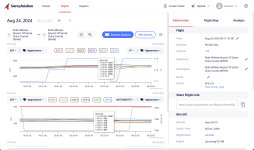
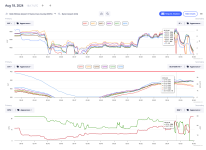
In the attached chart (which starts at the end of the first GAMI sweep), you can see the ignition test starting at about 00:37:20. After that ignition test, you can see (starting at about 38:30), the EGTs on #2, #4 and #6 climbed above 1400 and stayed there until I started to enrich the mixture. When I leaned the mixture again, they went back up and when I did the ignition test again, when running on just the left ignition, the engine essentially died ((at about 46:30). It looks for the 2 seconds that we were on just the left ignition, the EGTs on #1 and #2 plummeted. The behavior did not change even after enriching the mixture. Also, after landing, I was able to reproduce it (engine running very badly on just the left ignition) even at idle RPM.

The evidence seemed to point to the coil on the left ignition that supplied #1 and #2 cylinders. I worked with my A&P to figure out the coil to plug to ignition mapping and figured out what appeared to be the problem coil. I happened to have a spare coil which came when I bought the plane so I went ahead and replaced the problem coil (let's call it L1 since it was the first coil on the left ignition).

I did a test flight on 8/10 and I wasn't able to reproduce the problem so I thought I had fixed it.

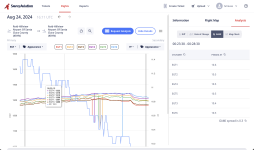
Then, on a flight with 2 passengers last Sunday (8/18), as I was leaning the mixture for cruise (with both ignitions on), I noticed that the some of the EGTs had increased above 1400 and were not coming down (they started going up even when I was quite a bit ROP). I decided to do a precautionary landing enroute at Byron (C83) and when I did an ignition test on the ground (at about 54:40 in the 2nd image), I had the same issue where the engine ran very badly on just the left ignition and looking at the chart, it again shows the EGTs on #1 and #2 plummeted when the right ignition was turned off. I repeated it at 55:24.

I went ahead and replaced the L1 ignition coil with the one that was in the plane originally and when I started the engine and did an ignition test, the same issue kept happening. It was a hot day and I had some suspicion that it may be heat related so at that point, I parked the plane in a maintenance hangar and went out for lunch with a helpful local pilot. When I started the engine around 1-1.5 hours later, the problem did not show up on the ground during a high RPM run-up so I headed back to home base (KRHV - about a 20 min flight) and had an uneventful flight.

I have been exchanging emails with Klaus and also spoke with him. Given my (low level of) knowledge and his expectations, it has been a bit challenging!

A few questions:
- Could this sequence of events (the EGT behavior and the badly running engine on one ignition) point to any other possible issue (other than the ignition)? I have separately been chasing a different issue where it looks like my A&P's uninformed lackey took the Airflow Performance restrictors out to be cleaned at the time of the CI in March and then put them back in randomly. So, I have been going through the GAMI sweeps and changing the restrictor locations to get a better spread.

-Any suggestions on what may cause this kind of intermittent ignition issue (which may possibly be related to heat)?

-Am I possibly chasing more than one ignition related issue?

Here are my next planned steps:
-I worked with my A&P to figure out the ignition coil to spark plug mapping but I am now not 100% sure we got it right so we are going to repeat that tomorrow using a induction timing gun (to know exactly which plugs/coils are on which ignition circuit).
-If it turns out that I previously got that wrong, then perhaps I have replaced the wrong coil in the past so I will replace the appropriate coil (which fires #1 & #2 on the left ignition)
-if it turns out that the previous mapping I had was correct (and I was dealing with the correct coil), my plan is to swap that coil with the next coil over (which is a known good coil/channel on #3 & #4) to see if the problem moves to #3/#4 or if it stays with #1 and #2 in which case it may point to the channel on the LSE Plasma controller being the issue.

One other suggestion I had was to ensure that the spider is distributing fuel ok so I guess I am planning to do the "cup test".

Any other insights or suggestions are welcome!

Thanks,

Vas
 

Attachments

  • Screenshot 2024-08-22 at 8.47.31 AM.png
    Screenshot 2024-08-22 at 8.47.31 AM.png
    316.5 KB · Views: 29
Here is a good video on Lightspeed stuff. It shows you how to check for a bad coil.

Note the spark plug wire replacement requirement. I found Lightspeed ignitions to be very sensitive to plug wires.

On your A&P screwing up the nozzles, I would have been pissed. At any rate I would be surprised if the builder did not log what size nozzle was in each cylinder. Check the logs and see. The nozzels (other than the stock 0.028”) should all be stamped on the size. I had a GAMI spread of 1.5GPH on the stock nozzles. I replaced four (all going smaller) and the gami spread when to essentially 0GPH.

Verify the coils, plug leads and plugs good. Fix your GAMI spread problem and let us know.

Side note. Whatever you are using for the backup power for the ignitions, verify it works. I’ve found more than one “per Klaus’ install manual” setup with an absolutely flat backup battery.

Carl
New RV-10 with dual pMags
 
According to the Installation Manual, Coil reliability.
The following installation issues and operating conditions can cause these coils to fail prematurely.
- Excessive output resistance:If one of your spark plug wires is not installed all the way and it vibrates off of the coil or the spark plug, the resistance goes to infinity and the
coil will eventually breakdown internally.
- Maximum continuous operating temperature is 160 F.
- Increased spark plug resistance: The Denso plugs supplied with your system have a high quality 5k resistor built in. Lower quality plugs can burn out their resistor causing the coil to fail. Use only Denso spark plugs for best performance and reliability.
- Worn spark plug gaps: The longer spark required to jump a bigger gap requires a higher voltage. For this reason it is important to maintain the plug gap. Precious metal spark plug electrodes do not wear as fast as nickel electrodes. The spark plugs should be replaced or re-gapped at 100-hour inspection intervals.

Ignition, fuel and air is essential for engine operation.
If it were my aircraft and flying with friends, I would seriously look for a different electronic ignition system.

Good luck
 
Here is a good video on Lightspeed stuff. It shows you how to check for a bad coil.

Note the spark plug wire replacement requirement. I found Lightspeed ignitions to be very sensitive to plug wires.

On your A&P screwing up the nozzles, I would have been pissed. At any rate I would be surprised if the builder did not log what size nozzle was in each cylinder. Check the logs and see. The nozzels (other than the stock 0.028”) should all be stamped on the size. I had a GAMI spread of 1.5GPH on the stock nozzles. I replaced four (all going smaller) and the gami spread when to essentially 0GPH.

Verify the coils, plug leads and plugs good. Fix your GAMI spread problem and let us know.

Side note. Whatever you are using for the backup power for the ignitions, verify it works. I’ve found more than one “per Klaus’ install manual” setup with an absolutely flat backup battery.

Carl
New RV-10 with dual pMags

Thanks, Carl!

I did see the videos on Lightspeed from Vic. I do have the old style ignition coils and it looks like putting in a new style coil (given the different form factor) is a non-trivial exercise. The local RV expert A&P in the area is Lee Apaka out of Rio Vista. I spoke with him - he definitely seems to know Lightspeed (unlike my local A&P) and his suggestion was that in addition to the wires, I should look at replacing all the coils with the new style coils.

I checked the resistance on the ignition wires and they are all less than 160 ohms. That having been said, they are coming up on 500 hours so part of what I plan to do tomorrow is to measure all the wires and order new ones from Klaus. I have ordered new spark plugs (I do use the recommended Denso IK27) so even though it has been less than 100 tach hours since they were replaced, I will just go ahead and replace all the plugs. Also, I checked the resistance of all the coils and they are all between 8000 and 8500 ohms.

Yeah, the nozzle screw-up was really unfortunate. Part of it was I didn't really know myself how the "tuning" was done. There was no information on the cylinder to nozzle size mapping in the engine logs. I reached out to the previous owner and Don at Airflow Performance and unfortunately, neither of them had any records (any more) either (this was from ~2016-2017). As you pointed out, the nozzles are all stamped and their locations/sizes matched what I was seeing on the timing of the EGT peaks so I did one round of swaps and found that the GAMI spread had improved quite a bit (from 1.7 to 0.7 gph). I did one more swap and was trying to do another GAMI sweep on Sunday (to confirm nozzle placement) when the ignition related issue happened and became a higher priority!

According to the Installation Manual, Coil reliability.
The following installation issues and operating conditions can cause these coils to fail prematurely.
- Excessive output resistance:If one of your spark plug wires is not installed all the way and it vibrates off of the coil or the spark plug, the resistance goes to infinity and the
coil will eventually breakdown internally.
- Maximum continuous operating temperature is 160 F.
- Increased spark plug resistance: The Denso plugs supplied with your system have a high quality 5k resistor built in. Lower quality plugs can burn out their resistor causing the coil to fail. Use only Denso spark plugs for best performance and reliability.
- Worn spark plug gaps: The longer spark required to jump a bigger gap requires a higher voltage. For this reason it is important to maintain the plug gap. Precious metal spark plug electrodes do not wear as fast as nickel electrodes. The spark plugs should be replaced or re-gapped at 100-hour inspection intervals.

Ignition, fuel and air is essential for engine operation.
If it were my aircraft and flying with friends, I would seriously look for a different electronic ignition system.

Good luck

Thanks! On your last point, I can't say I haven't been thinking about it! I am planning to finish up current troubleshooting. If it turns out to be the plugs, ignition wires or a coil, then I'll likely just stick with Lightspeed for now. If it turns out that I need to replace all the coils or one or both Plasma CDI units, then I may seriously start thinking about alternatives.

Thanks,

Vas
 
Thanks, Carl!

I did see the videos on Lightspeed from Vic. I do have the old style ignition coils and it looks like putting in a new style coil (given the different form factor) is a non-trivial exercise. The local RV expert A&P in the area is Lee Apaka out of Rio Vista. I spoke with him - he definitely seems to know Lightspeed (unlike my local A&P) and his suggestion was that in addition to the wires, I should look at replacing all the coils with the new style coils.

I checked the resistance on the ignition wires and they are all less than 160 ohms. That having been said, they are coming up on 500 hours so part of what I plan to do tomorrow is to measure all the wires and order new ones from Klaus. I have ordered new spark plugs (I do use the recommended Denso IK27) so even though it has been less than 100 tach hours since they were replaced, I will just go ahead and replace all the plugs. Also, I checked the resistance of all the coils and they are all between 8000 and 8500 ohms.

Yeah, the nozzle screw-up was really unfortunate. Part of it was I didn't really know myself how the "tuning" was done. There was no information on the cylinder to nozzle size mapping in the engine logs. I reached out to the previous owner and Don at Airflow Performance and unfortunately, neither of them had any records (any more) either (this was from ~2016-2017). As you pointed out, the nozzles are all stamped and their locations/sizes matched what I was seeing on the timing of the EGT peaks so I did one round of swaps and found that the GAMI spread had improved quite a bit (from 1.7 to 0.7 gph). I did one more swap and was trying to do another GAMI sweep on Sunday (to confirm nozzle placement) when the ignition related issue happened and became a higher priority!


Thanks! On your last point, I can't say I haven't been thinking about it! I am planning to finish up current troubleshooting. If it turns out to be the plugs, ignition wires or a coil, then I'll likely just stick with Lightspeed for now. If it turns out that I need to replace all the coils or one or both Plasma CDI units, then I may seriously start thinking about alternatives.

Thanks,

Vas
Vas.
If your ever down in the Los Angeles area, let me know and I'll show you how the Aerosparks Ignition works. I think you'll like it.
 
Make sure the fast-on terminals have a tight fit on the coil spades. I mean really tight. Any discoloration is a telltale.

This one from the way-back file; be sure your installation uses RG400 between the box and the coils, not RG-58 as was once common. The RG-58 center conductor can migrate through the insulation given enough heat. Totally unsuited for engine compartment use.

Absolutely make sure your mechanic does the MAP sensor conformation test as the last item before it goes back in service. Disconnect the vacuum line between the source cylinder and the MAP sensor terminal on the box. Plug the end leading to the cylinder. Mark the back of the flywheel at 25 BTDC using WhiteOut, paint, or another high visibility material. Run the engine and use a timing light to confirm the timing is at 25 BTDC (marked line on the flywheel aligned with the case split). If it's advanced to some higher value, the MAP sensor is bad, which means the ignition is firing at that excessive advance all the time.
 
Last edited:
Run the engine and use a timing light to confirm the timing is at 25 BTDC (marked line on the flywheel aligned with the case split). If it's advanced to some higher value, the MAP sensor is bad, which means the ignition is firing at that excessive advance all the time.
Dan is exactly right (as always). On any Lightspeed problem I work I first reach for the timing light. On one relatively new RV both Lightspeed boxes had a failed MAP sensor. Timing was north of 40 degrees from idle on up and CHTs went north of 450 degrees even with full rich mixture. This problem existed from day one on this plane.

Carl
 
Thanks, @DanH & Carl. Yes, my A&P did use the timing light and confirmed that the timing was fine. Klaus did mention the spade connections should need a 5 lb pull force which I did confirm. There is no discoloration on any of them. I'll have to check on the RG400 - what would be a good way for me to be able to tell if it is RG400 and not RG-58?

Vas
 
One basic question - where did they mount the Lightspeed control boxes? These MUST be located outside of the engine bay. Also I see this is a 10... they didn't mount them in the 'tunnel' which I have heard gets really hot?

Sounds like a heat sensitivity issue. Either two coils have gone heat sensitive (possible I suppose), or the control box has gone heat sensitive. Although odd it would only take out a single coil.

Been running a single lightspeed II (plus a mag) for 8 years. Happy with mine.
No micky mouse backup battery complexity for me. And my degree is Electrical Engineering!
 
One basic question - where did they mount the Lightspeed control boxes? These MUST be located outside of the engine bay. Also I see this is a 10... they didn't mount them in the 'tunnel' which I have heard gets really hot?

Sounds like a heat sensitivity issue. Either two coils have gone heat sensitive (possible I suppose), or the control box has gone heat sensitive. Although odd it would only take out a single coil.

Been running a single lightspeed II (plus a mag) for 8 years. Happy with mine.
No micky mouse backup battery complexity for me. And my degree is Electrical Engineering!
The Lightspeed control boxes are in the back of the avionics panel. In fact, I tried to spot them today and it was hard. I am not sure what you mean by the "tunnel" but they are definitely not in the engine compartment. I was hoping to see the fan and confirm that it's working but I wasn't able to do so. I'll get the boroscope out and go hunting for it this weekend!

I swapped the "problem" coil with a known good coil today. I am planning to fly it tomorrow to see if the problem follows the coil (to a different set of cylinders) or stays with the same set of cylinders (in which case it may be a controller issue).

If it turns out to be the controller, would adding additional cooling there be a good start?

DanH & Carl, I confirmed that it is RG-400 wire. It was gold and very clearly labeled.

Thanks,

Vas
 
You didn't mention this earlier, so I'll throw it out for consideration. Check the primary and secondary windings & internals of each coil using an Ohm meter.

Consider the construction of the coil as essentially a transformer with two windings about a chunk of ferromagnetic material (iron, steel). The leg of each winding should be a few ohms when measured to the opposite end of the same winding -- e.g. Primary "+" to Primary "-" terminal should measure about .6 Ohms (IIRC). The secondary to primary terminals should be "open" -- no continuity.

Good luck...
 
Hi Vas
I did have a similar issue on my Rocket after 700+ hours on dual lightspeed. After talking to Klaus who was very helpful decided it was the spark plug lead to the non firing plug which was becoming intermittent. I changed out the lead and all was fine. I then changed out the complete harness which was pretty simple insurance. I liked the Dual lightspeed and GAMI set up. One easy thing to check is that the plug wire caps gets snugged down tight, it sorta takes an extra half turn while pushing on the top of the cap, easy not to get fully on if not familiar with the set up.
Good luck
Chris
 
Which model Lightspeeds? I think there is 2 "II" and 3 "III".
It's a Plasma III unit.

If you have a bad box there are two options:
- Send it to Klaus for repair
- Do what I did ~20 years ago, take both Lightspeeds out and install pMags

Carl

I did another test flight today after swapping the possible problem coil (on cylinders 1 & 2) with a known good coil (on cylinders 3 & 4). The ground run-up before takeoff was fine but the problem promptly happened again in cruise as soon as I turned off the right ignition (even when running ROP). Analysis on the ground indicated that it was still on cylinders 1 and 2 (see the first image at 31:54 where the EGTs on 1 & 2 plummet) so it looks like the problem is either with the Plasma controller (likely one channel) or the plugs or the ignition leads. I replaced those two plugs in the last few weeks and I measured the resistance on the ignition wires (<160 ohms) so I don't think it's either of them.

I previously checked the resistance on all the coils and they were fine (8000-9000 ohms).

I thought it might be a cooling problem (perhaps the fan had stopped working) but with a boroscope, I was able to confirm that there is a tube connected to the vents on both the controllers and the fan (which is in the avionics compartment) is definitely working.

Unless anyone else has any other ideas on tests that I can do to narrow it down further, it would appear that the next step would be to send the controller to LSE to see what they can find after which I will need to make some decisions. I will send Klaus an email with my findings to see if he concurs.

On the plus side, I was able to run a GAMI lean sweep after the last set of nozzle swaps and the GAMI spread seems to be much improved - 0.3 gph. I will probably do one more swap (#1 and #6) and that should make it even tighter.

Thanks,

Vas
 

Attachments

  • Screenshot 2024-08-24 at 1.32.27 PM.png
    Screenshot 2024-08-24 at 1.32.27 PM.png
    526.6 KB · Views: 12
  • Screenshot 2024-08-24 at 10.24.45 AM.png
    Screenshot 2024-08-24 at 10.24.45 AM.png
    453.1 KB · Views: 12
I was taught that a failed/failing ignition would cause the EGT on the affected cylinder(s) to RISE due to delayed/uneven flame front propagation...

Also, when connected to each other, a dual PLASMA III system will shift the spark up to 5° when one of the units is disabled. Are you able to see the spark advance data from each controller? (Simmons unit, or Flight Data systems level shifter to EFIS/EIS).
 
J
I feel like I once read that the Plasma iii had more reliability issues. Can't find that. Maybe I imagined it.
No you didn’t image it, true statement. I will no longer work on LSE systems, too many problems with the system and lack of support.
My 2c, just replace it and move on.
 
I remember a problem with some P/N of Denso spark plug that have a screw on cap. It was decided by most everyone that we need to use the Denso plug that does not have a screw on cap but rather a fixed cap. Have you looked at that cylinder to see if maybe there was a plug with a loose or missing cap??? Just a thought for what it s worth.
 
I was taught that a failed/failing ignition would cause the EGT on the affected cylinder(s) to RISE due to delayed/uneven flame front propagation...

Also, when connected to each other, a dual PLASMA III system will shift the spark up to 5° when one of the units is disabled. Are you able to see the spark advance data from each controller? (Simmons unit, or Flight Data systems level shifter to EFIS/EIS).

The plane came with the dual LSE ignition setup so I am not sure if they are connected to each other. I guess I don't know how I would be able to see the spark advance - the plane has an AFS EIS. In any case, it's hard to reproduce on the ground though one of the times the issue occurred in the air, it continued happening on the ground for a couple of hours and then went away.

Thanks,

Vas
 
The plane came with the dual LSE ignition setup so I am not sure if they are connected to each other. I guess I don't know how I would be able to see the spark advance - the plane has an AFS EIS. In any case, it's hard to reproduce on the ground though one of the times the issue occurred in the air, it continued happening on the ground for a couple of hours and then went away.

Thanks,

Vas
The manual describes how one of the pins on the control box connector outputs a voltage proportional to the degrees of advance.
page 10

So if the box, without the vacuum line connected, is timed to 25 BTDC, and you are seeing say 5 mV 'advance', then the engine's spark is at 30 BTDC.
To confirm basic timing you need a timing light and the vacuum disconnected, as mentioned above.

But, I think this is all drift... Either you have:
  • multiple heat sensitive coils (really?)
  • heat sensitive control box
  • bad spark plug or wire that is blowing out coils
 
I received the following email from Klaus after packaging up all the information and sending it to him:
"The systems you have are C1 versions, it is extremely unlikely that there is a problem with the box.
As far I can tell you might have an input signal problem. I would revisit the installation instructions for the sensor system you have.
The sensor gap AND the concentricity is important."

I asked him if this kind of a problem could cause the intermittent issue that I am seeing and I am waiting for his response. Another A&P friend was of the opinion that these sensors (my setup uses the mini-sensors) either works or it doesn't.

Is there any scenario that anyone can think of with a sensor where the ignition would be fine on a ground run-up, fail in cruise, either work or fail on the ground post-flight and if it fails on the ground, work fine on the ground a few hours later??

The heat sensitivity explanation seemed to make sense but once I confirmed that the fan supplying the vent on the controller box was working fine, it's harder to pin it on that.....

Thanks,

Vas
 
I am currently fighting a LSE III ignition issue. IF I don't figure it out Im just going to get a new P mag. I think they are more reliable from what I am reading here
 
Back
Top