

Van's Air Force

The definitive Van's Aircraft support community! Buying, building or flying an RV? Join our exclusive family of mentors and enthusiasts!

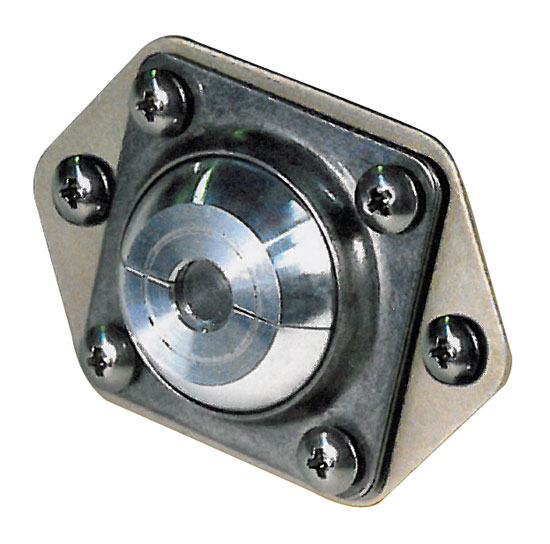
Cable Safe Brand Firewall Cable Pass-through

N804RV

Well Known Member
Friend
What kind of firewall pass through are you using for the Van's supplied throttle/mixture/prop cables?

I tried the Cable Safe II 3/8", but its too large. The outer diameter of the Van's cables is about .33", just small enough that the 3/8" Cable Safe won't capture it. Wouldn't the 1/4" be to small?

Thoughts? Alternatives?
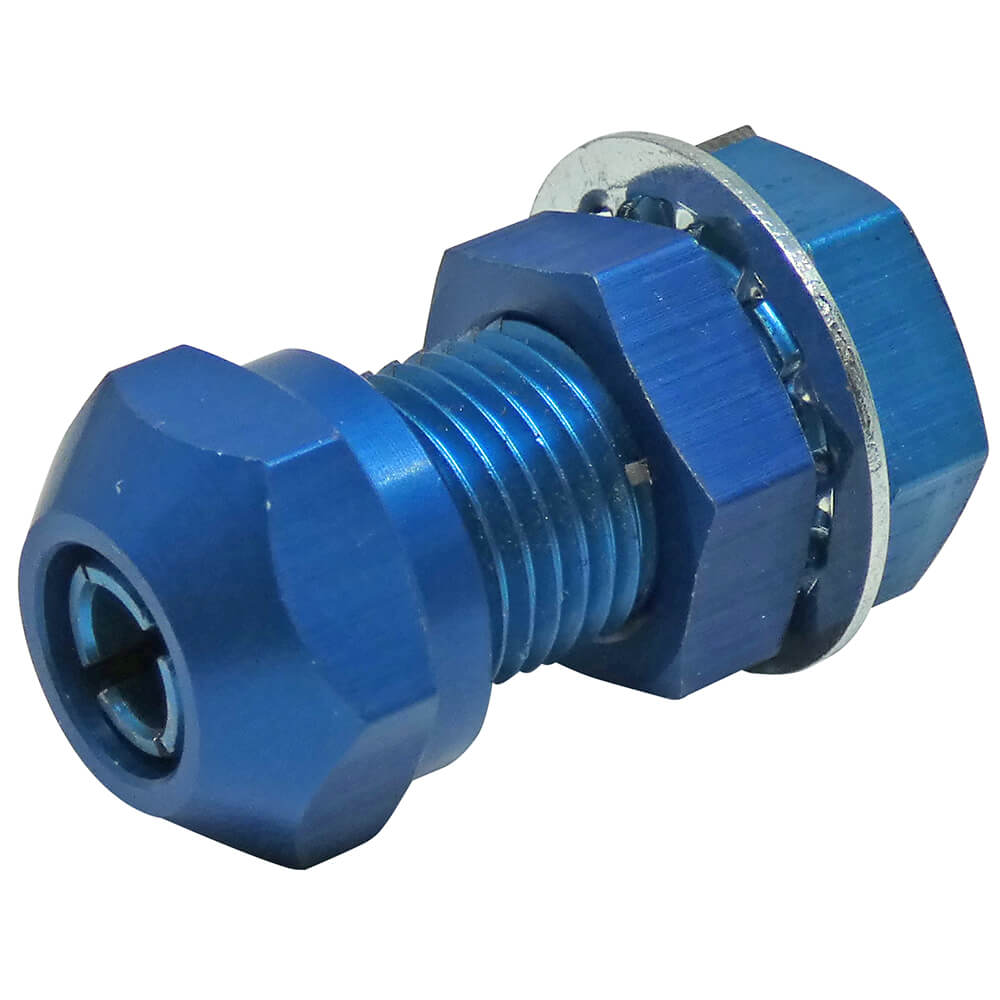
05-16252a.jpg
 
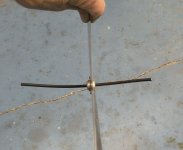
For the throttle, mixture and prop, I used the eyeball type pass-throughs, because it allows you to start bending them in the direction you need to as they go through the firewall. This means more gradual bends for those heavy cables.


I used the ones with aluminum eyeball, and you can drill it to a good size to grip the cables if you need to. I don't remember needing to - they are offered in an 0.33 diameter which I think worked just right.

The Cable Safe pass-thrus are very handy for bundles of electrical wires.
 
TTP-A or TTP-B?

-A and -B are aluminum, so any of the other four models (steel ball TTTP-S for example), assuming you actually want a firewall.

Or just use a simple tube fitting. RV-10 (triple below) and RV-8 multiples are compact, same spacing as the factory firewall holes, and mount on one baseplate.

Multi-Tube Penetrations.jpg

Fireproof too.

P6010025.jpg
 
Last edited:
Double Tee eyeballs for the big three.
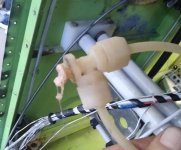
For the smaller Bowden cables I did this...
AN819-3 STEEL AN SLEEVE COUPLING
AN832-3 STEEL UNION FLARED TUBE BULKHEAD
AN818-3 STEEL NUT COUPLING
AN924-3 STEEL NUT
3/16" Brass Ferrule
Stainless washers

Pretty simple. Split the ferrule lengthwise with a dremel cut off wheel. Assemble so the ferrule is clamped by the nut and flared fitting. Holds very tight. I used steel, but aluminum would work.
Check out post #4
 
Last edited:
-A and -B are aluminum, so any of the other four models (steel ball TTTP-S for example), assuming you actually want a firewall.
It would be a fun test to see how long it would take to melt enough of that 1" aluminum eyeball for it to fall out of its keeper plates and result in an open passage thru
.

Important to do the test with a cable clamped in place, since axial conduction will play a role in the time required.
 
It would be a fun test to see how long it would take to melt enough of that 1" aluminum eyeball for it to fall out of its keeper plates and result in an open passage...

Send one and I'll set it up. Coordinate on details?
 
Send one and I'll set it up. Coordinate on details?
I have an extra I could devote to the cause. The ball has a little hole. Might be challenging to upsize.
 

Attachments

  • IMG_1681.jpeg
    IMG_1681.jpeg
    1.6 MB · Views: 48
What kind of firewall pass through are you using for the Van's supplied throttle/mixture/prop cables?

I tried the Cable Safe II 3/8", but its too large. The outer diameter of the Van's cables is about .33", just small enough that the 3/8" Cable Safe won't capture it. Wouldn't the 1/4" be to small?

Thoughts? Alternatives?
If you have a passthrough that doesn't fit quite right you can sometimes take up the extra space with a wrap of silicone tape, then once everything is installed to your liking, smear a layer of high temp RTV over the fitting.

People really should be going the RTV route on those pass through fittings anyway. No matter how good the initial fit, they aren't exactly airtight.
 
Results...

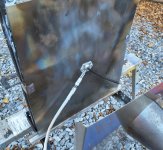
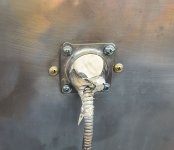
Installation was typical, including a foot of control cable, 6" extending from each side, with casing and the inner wire. Stainless steel panel is same thickness as a Vans firewall.

Installed.jpg

Cable.jpg

Ready on the burn rig. Industrial thermocouple allows live temperature monitoring.

Ready.jpg

Bottom line? Two minutes from cold start to liquid aluminum. The entire video is here. Download, then play. I didn't get fancy. It's just handheld cell phone stuff.

Melted Rear.jpg
 
Results...

Installation was typical, including a foot of control cable, 6" extending from each side, with casing and the inner wire. Stainless steel panel is same thickness as a Vans firewall.

Bottom line? Two minutes from cold start to liquid aluminum. The entire video is here. Download, then play. I didn't get fancy. It's just handheld cell phone stuff.

Great test, thanks.

I assume the stick monkey, in command of the fuel valve behind the firewall, would have starved the thing before then (and/or put the thing down). I guess that assumes the fire is obvious...
 
I don’t care how robust your firewall is, I figure I’ve got two minutes tops (if I know when the fire start time is), to get the airplane on the ground. On the ground anywhere including a field or highway. If you have non-robust firewall protection, you’re probably not going to survive with a gasoline or oil fed FWF fire.
 
Drill hole in firewall, run cable thru. Done. What Cessna has done for decades. Certainly not elegant but works.
 
There are many possible rationalizations. Physical fact remains. Aluminum melts at 1100 to 1200F. The firewall standard is 2000F.

You want eyeball fittings? Buy steel. Same for bulkhead fittings.

While you're at it, ditch the plastic fitting on the brake reservoir. And don't allow any plastic lines to contact the firewall, because when they melt and empty the reservoir on the red hot steel, you're done.

Melted Reservor Fitting.jpg
 
With that thought why not go back to 1980 and put proseal around your passthru with a plastic bushing. It blocks the CO doesn’t it? Dan’’s steel passthru with the fire sleeve or those similar ones from ACS or VANs are the cheap and dead simple way to go. Thanks Dan mine are great!
 
With that thought why not go back to 1980 and put proseal around your passthru with a plastic bushing. It blocks the CO doesn’t it? Dan’’s steel passthru with the fire sleeve or those similar ones from ACS or VANs are the cheap and dead simple way to go. Thanks Dan mine are great!
I think Dan has already shown that Stainless passthroughs sealed with 3M fire barrier 2000 is the gold standard. Seconds count. Another good argument for stainless brake lines too.- JJR
 
There are many possible rationalizations. Physical fact remains. Aluminum melts at 1100 to 1200F. The firewall standard is 2000F.

You want eyeball fittings? Buy steel. Same for bulkhead fittings.

While you're at it, ditch the plastic fitting on the brake reservoir. And don't allow any plastic lines to contact the firewall, because when they melt and empty the reservoir on the red hot steel, you're done.

View attachment 101172
Is this a good reason to move the brake reservoir FWA? I never quite understood having the only part of the brake system FWF be the reservoir. You could then use a plastic reservoir that allows you to easily see the level.
 
Last edited:
I think Dan has already shown that Stainless passthroughs sealed with 3M fire barrier 2000 is the gold standard. Seconds count. Another good argument for stainless brake lines too.- JJR
I assume you mean SS lines from the reservoir back. However, the reservoir is all aluminum including the part that penetrates the firewall, so how will SS lines attached to the reservoir (FWA) help?
 
I assume you mean SS lines from the reservoir back. However, the reservoir is all aluminum including the part that penetrates the firewall, so how will SS lines attached to the reservoir (FWA) help?
I think my fitting is actually not aluminum, may be pot metal of some sort, might be stainless. I agree the reservoir tee needs to match the lines but thats not a big issue if the decision to go stainless is made. My point is we know this is a risk that can be mitigated.
 
I think Dan has already shown that Stainless passthroughs sealed with 3M fire barrier 2000 is the gold standard... Another good argument for stainless brake lines too.- JJR

Minor notes...

No need for stainless steel. Mild steel is fine, with paint.

A braided stainless steel brake line still has a nylon core. Get it hot enough and the core may fail, but it will take a long time, as the stainless wire is a thermal conductor...a heat sink moving energy away from the hot spot.

Is this a good reason to move the brake reservoir FWA? I never quite understood having the only part of the brake system FWF be the reservoir. The reservoir is all aluminum including the part that penetrates the firewall, so how will SS lines attached to the reservoir (FWA) help?

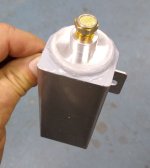
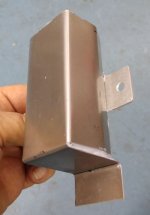
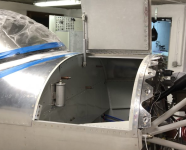
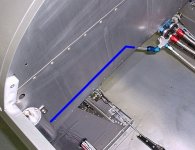
I imagine the primary reason Vans put it on the firewall is convenient access. It can be protected with a simple bent stainless steel cover and some Firebarrier sealant. In the cabin, vent spillage isn't an issue if you substitute a reservoir with a diaphragm, as found on every car and motorcycle.

Res 1.jpgRes2.jpg
 
Last edited:
I put my brake reservoir in the baggage compartment on my RV-8 - can't get easier than that, and one less FW hole.

1762286655290.png
 
Probably good that this started some thread drift to think about other items on your firewall that could be a early pass-thru for fire.

I use individual reservoirs on each brake master cylinder. Main advantage is less plumbing and hoses adding resistance to free rudder pedal movement.

Other things: How many folks have aluminum cabin heat control valves? The stainless cabin heat control valve is very light gauge - it won't melt but it may warp enough to allow significant smoke or heat into the cabin. I don't know that there is anything better we can do there.
 
How many folks have aluminum cabin heat control valves?

They evaporate in well under a minute.

The stainless cabin heat control valve is very light gauge - it won't melt but it may warp enough to allow significant smoke or heat into the cabin. I don't know that there is anything better we can do there.

The problem I'm seeing is attachment of the valve and the actuating hardware. A stainless valve body and door isn't going to do any good if it's all held with aluminum rivets. That includes the cable fixation (consider F-14103), and the arm on the back of the door. It's easy enough to switch to SS pop rivets or monel driven rivets.

The RV-14 plans detail a door hinge assembly which will not close fully. It needs a spacer under the hinge half equal to the thickness of the door.

Not that it matters. Let's just call it like it is...the multi-piece RV-14 firewall is a disaster.

ScreenHunter_2996 Nov. 06 09.01.jpg
 
They evaporate in well under a minute.


The problem I'm seeing is attachment of the valve and the actuating hardware. A stainless valve body and door isn't going to do any good if it's all held with aluminum rivets.
I was going to ask about that. Lots of things held to the firewall with aluminum rivets. I suppose those items mostly just fall off and leave the protective membrane intact except for anything that creates an opening when it falls off. So, cabin heat valve, any toe-kick boxes or recess boxes. (Timely thought for me - I'm about to put a recess box on the firewall of another project). I guess I'll use stainless pop rivets.

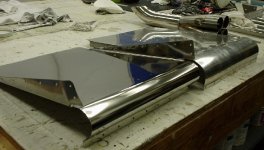
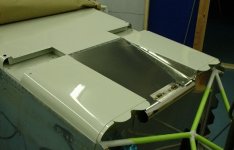
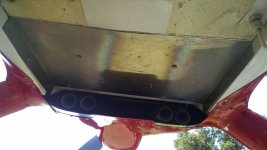
I think a big weak link on the RV-8 is the aluminum radius lip that transitions to the belly tunnel. That is going to go away really fast in a fire. I had intended to replace that with a stainless steel one, but never got around to it. All the other RVs have a similar vulnerability along the lower cowl exit where aluminum skin joins to the firewall.
 
I guess I'll use stainless pop rivets.

Won't do much good.

I think a big weak link on the RV-8 is the aluminum radius lip that transitions to the belly tunnel. That is going to go away really fast in a fire. I had intended to replace that with a stainless steel one, but never got around to it.

Do it on the new one. It's easy enough.

Stainless Exhaust Ramp1.JPG
All the other RVs have a similar vulnerability along the lower cowl exit where aluminum skin joins to the firewall.

To be precise, not all....but I know what you meant :)

Exhaust Ramp Finished.JPG

IMG_20160924_114203403 800w.jpg

Brian Schmidtbauer.jpg

RV10 SS Foil 800w.jpg
 
Last edited:
I tried to find a shop that would make the exit ramp for the RV-8 for me. I was unable to find anyone willing to do it, and I don't own a brake large enough to do it myself. If anyone wants to make them out of steel or titanium/etc and sell them, you'd have at least one sale!
 
Back
Top