
If you want to understand how hopeless FAA medical is read Dr. Brent Blue's article in recent AOPA magazine. FAA is so far behind on examining Class I EKG's that some are not being examined before the next EKG takes place.Most likely it is the lack of knowing what their liability is. For 100 years the FAA said pilots needed to have a special medical so doctors never paid attention to the liability. FAA education to doctors would be helpful. I sent my doctor all info I could on Basic Med 8 years ago and that made him OK with it. Basically they are only signing that you are healthy, to the best of their exam, for the day of the exam. But then there are lawyers.

Van's Air Force
You are using an out of date browser. It may not display this or other websites correctly.
You should upgrade or use an alternative browser.
You should upgrade or use an alternative browser.
Basic Med... a crock?
- Thread starter blaplante
- Start date


pjc
Well Known Member
I wonder how the FAA and AMA feel about Chiropractors (and Dentists) doing Basic Med (at least in some states). They (chiropractors in particular) seem to have a healthy entrepreneurial take on it. (I express no opinion on their individual or collective qualifications).Liability is a common topic of presentation and break-out sessions at the many conferences the FAA and various aerospace medicine societies put on for AME's. I'm utterly confident that the FAA would not embrace the concept of working to educate doctors about the low liability risk of doing Basic Med exams. The FAA and the general run of AME's are not fans of Basic Med. They tend to believe that the liability risk is high and aren't shy about sharing it.

I doubt that the FAA cares at all, but the parameters surrounding Basic Med were specified by Congress...the FAA didn't get a say. The AMA..who knows? It's a pretty irrelevant society, membership representing about12% of physicians, and a substantial percentage of those are medical students and residents who don't know any better. I would assume that they aren't big fans of chiropractors acting as physicians, but don't know for sure. As to dentists doing physical exams...that thought makes me laugh, but the fact that those two groups are doing Basic Med exams in some places and it's still not medical mayhem in the skies probably speaks volumes about the value of FAA medical exams when it comes to General Aviation.I wonder how the FAA and AMA feel about Chiropractors (and Dentists) doing Basic Med (at least in some states). They (chiropractors in particular) seem to have a healthy entrepreneurial take on it. (I express no opinion on their individual or collective qualifications).

Another source for Basic Med for those in Southern California
 flightphysical.com
Dr. Robert French
I just had a chat with the doctor and he is an AME and he also signs off FAA Basic Med
Side Topic: Maybe VAF can create a sticky for a list of doctors who will sign off FAA Basic Med
FlightPhysical.com | Dr. French | LAGUNA BEACH
flightphysical.com
Dr. Robert French
I just had a chat with the doctor and he is an AME and he also signs off FAA Basic Med
Side Topic: Maybe VAF can create a sticky for a list of doctors who will sign off FAA Basic Med

I found that if you use the AOPA guide to explain to the doc that their role is to educate you on your medical conditions, and that they are not certifying that you are fit to fly, then, I have no problem. If the physician thinks that they are signing for your medical fitness to fly, like an AME does, then they aren’t interested.

I've found that there are quite a few Doctors that would sign off on BasicMed but their "Group" (Most all Doctors belong to a group now) won't allow it.
It's not that the "groups" are against it, it's just that they don't know enough about it and are not willing to learn.
It's not that the "groups" are against it, it's just that they don't know enough about it and are not willing to learn.
Oh, the FAA cares. You will recall that, for whatever reason, they were dead set against basic med. It took them years to fix blatant mistakes in the congressional bill (e.g., basic med pilot could fly as PIC, but not as a ‘required crew’, e,g., safety pilot for a PIC under the hood. Except, cfi’s who were giving instruction under basic med could be safety pilots, as congress explicitly included them. We’ve all heard the old saying, ‘a camel is a horse, designed by a committee’. Now, more than a decade later, the data clearly shows no statistically significant change in the accident rate due to faa medical, or basic med. About the only good thing these exams do is to weed out individuals who are clearly senile.I doubt that the FAA cares at all, but the parameters surrounding Basic Med were specified by Congress...the FAA didn't get a say. The AMA..who knows? It's a pretty irrelevant society, membership representing about12% of physicians, and a substantial percentage of those are medical students and residents who don't know any better. I would assume that they aren't big fans of chiropractors acting as physicians, but don't know for sure. As to dentists doing physical exams...that thought makes me laugh, but the fact that those two groups are doing Basic Med exams in some places and it's still not medical mayhem in the skies probably speaks volumes about the value of FAA medical exams when it comes to General Aviation.

This is what I did, ironically, to my flight surgeon. Retiring in June, so can't use my AF physical anymore, have a preexcitation pattern on the EKG that the FAA wants extra stuff for, instead of dealing with that and possibly being denied, I just did basic med and used the AOPA guide to explain to her her role. The only problem was, she was very thorough, so a bit awkward because she is a she and I am a he.I found that if you use the AOPA guide to explain to the doc that their role is to educate you on your medical conditions, and that they are not certifying that you are fit to fly, then, I have no problem. If the physician thinks that they are signing for your medical fitness to fly, like an AME does, then they aren’t interested.

rmartingt
Well Known Member
I just want the FAA to show its work.
If they insist that a medical is just flat-out necessary for, say, night flying, spell it out. Explain exactly what conditions are being checked in an official medical vs. other screenings, what the red flags are, and (most importantly) why. Explain what is so special about the "once you start you're committed" process of getting a medical, and why it has to be so adversarial and set up to trap people. Tell me what exactly is so important about one's anus that it can affect their medical certification. Give us the why for every single disqualifier, even the obvious ones.
But I'd bet they can't (not just won't, but can't)--either nobody knows, or the reason is lost to time, or maybe even that they know they don't have a reason but can't be seen to back down.
In my profession I can't just fall back on "because I said so" or "we've always done it that way". I have to show my work and I'm responsible for it to anyone (with cause) who asks. "Just trust me bro, I'm an expert" doesn't fly (heh) with the FAA, customers, or company leadership when it comes to my work. Why should it be acceptable from a policy standpoint?
If they insist that a medical is just flat-out necessary for, say, night flying, spell it out. Explain exactly what conditions are being checked in an official medical vs. other screenings, what the red flags are, and (most importantly) why. Explain what is so special about the "once you start you're committed" process of getting a medical, and why it has to be so adversarial and set up to trap people. Tell me what exactly is so important about one's anus that it can affect their medical certification. Give us the why for every single disqualifier, even the obvious ones.
But I'd bet they can't (not just won't, but can't)--either nobody knows, or the reason is lost to time, or maybe even that they know they don't have a reason but can't be seen to back down.
In my profession I can't just fall back on "because I said so" or "we've always done it that way". I have to show my work and I'm responsible for it to anyone (with cause) who asks. "Just trust me bro, I'm an expert" doesn't fly (heh) with the FAA, customers, or company leadership when it comes to my work. Why should it be acceptable from a policy standpoint?

I went basic med several years ago because I was worried that my new "diagnosis" of pre-diabetes would cause some worry-wort AME to defer my medical despite the AME Guide being pretty clearly written. (That's exactly what happened previously with my torn meniscus even though my recovery was complete and I could demonstrate full range of motion.) I had to drive 70 miles and pay the same price as an FAA medical, but a got Basic Med.
Once I had a track record of controlling my A1C with diet and exercise I started looking into getting a 3rd class medical again. It turns out that no one I could find within reasonable driving distance (including my PC and several AMEs) would do a Basic Med, so getting the 3rd class this time around turned out to be easier. As long as I can go down to the local jet center and get my medical from their in-house AME, I'll just keep doing that.
Once I had a track record of controlling my A1C with diet and exercise I started looking into getting a 3rd class medical again. It turns out that no one I could find within reasonable driving distance (including my PC and several AMEs) would do a Basic Med, so getting the 3rd class this time around turned out to be easier. As long as I can go down to the local jet center and get my medical from their in-house AME, I'll just keep doing that.
It has to be done in the state that you live in.Maybe you could travel to a neighboring state.
I don't think so.It has to be done in the state that you live in.
It does not.It has to be done in the state that you live in.

You do have data to support this claim ? Pretty sure federal guidelines are good across all 50 states ?It has to be done in the state that you live in.
I had mine done sometimes Ohio and sometimes Florida.
Last edited:

I do the basic med for free to my eaa chapter members. You don’t certify fitness- the pilot does. The doctor merely reviews the self attestation of health and past medical history provided by the pilot. If you haven’t had a MI, stroke or passing out for no reason, and don’t have a history of psychosis or prior medical certification denials, then you usually are good to go. The thinking is if you can safely drive a car, then you can also likely fly a small plane using good judgment, and the “IAMSAFE” philosophy/ checklist. Primary care has gotten quite depleted, but there are reasonable docs out there.
Generally people don’t like to die, or accidentally kill their loved ones as passengers. You do have to have at least one class 3 or higher medical done since 2006.
Cheers. It is true that mosaic 2.0 changes it a lot, but flying at night still requires basic med.
Generally people don’t like to die, or accidentally kill their loved ones as passengers. You do have to have at least one class 3 or higher medical done since 2006.
Cheers. It is true that mosaic 2.0 changes it a lot, but flying at night still requires basic med.

Sam Buchanan
been here awhile
I believe the rule states an FAA medical must have been possessed in the past ten years when converting to BasicMed. The 2006 date can be confusing because it was widely published when BasicMed went into effect in 2016.You do have to have at least one class 3 or higher medical done since 2006.
I would love for this to be true, but the FAA website states these are the requirements with no asterisk to indicate a different method to the date required. You are correct a running 10 year would make sense but that's not what the FAA wants it seems.I believe the rule states an FAA medical must have been possessed in the past ten years when converting to BasicMed. The 2006 date can be confusing because it was widely published when BasicMed went into effect in 2016.
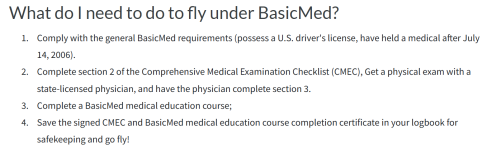
It does not. The date (July 14, 2006, to be specific) is written plainly in 14 CFR 61.23(c)(3)(i)(B).I believe the rule states an FAA medical must have been possessed in the past ten years when converting to BasicMed. The 2006 date can be confusing because it was widely published when BasicMed went into effect in 2016.
Sam Buchanan
been here awhile
Thank you for the clarification.It does not. The date (July 14, 2006, to be specific) is written plainly in 14 CFR 61.23(c)(3)(i)(B).
