



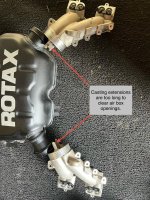
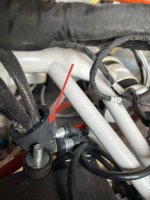
I wanted to share my experience in complying with Rotax’ “Time Limit” parts, and their “This time limit must be followed…” statement for the 912iS air-box connecting hoses… Removing the air box appeared to be necessary to replace these hoses. I learned that you CANNOT believe the Rotax Heavy Maintenance manual that simply removing the aft hold-down bolt will allow it to be removed. In addition to removing the temperature (3/4” deep-well socket) and pressure (21 mm deep-well socket) sensors, throttle body, wire-harness attach brackets and cutting the old hoses, BOTH intake manifolds must also be removed. The attached photo shown that the intake-manifold castings extend too far into the air box to allow simply pulling it off. And just removing the right manifold would not allow air box removal due to interference with the engine mount.
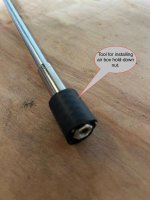
Installing the air box hold-down nut required making a tool from 7/16” fuel-line hose and a socket-wrench socket, as you cannot get your fingers behind the air box to install it.
What’s sad, is that the old hoses looked factory new, so, unless you’ve got an S-LSA, for which I believe following the manufacturer’s maintenance recommendations is required, I would not bother with this replacement. If you do decide to replace them, just remove the intake manifolds – the air box can remain in place. Removing the intake manifolds required the use of a long (4”) T30 wrench. A long 4 mm ball-end hex wrench was also helpful. Heed the maintenance manual’s instructions to pull up on the intake manifolds as the screws are slowly removed in sequence, as the shoulders on the T30 flanged bolts are too tight against the intake castings to clear by trying to completely remove them individually.
If removing the intake manifolds, Rotax recommends the use of Klueber Isoflex Topas Nb5051 lubricant on the fuel-injector O-rings. I did use this, but Lockwood indicated white lithium grease could be substituted. Rotax also recommends replacing the fuel-injector O-rings when reinstalling them, but I reused the old ones, with no leaks.
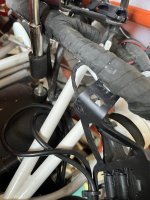
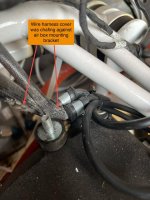
Removing the air box did expose two maintenance items… The engine wire harness was rubbing against the air box mounting bracket and not visible without removing the air box. I installed a piece of coolant hose for padding. Removing the left intake manifold also gave me access to the upper engine mounting bolt, which I found to be loose.
I hope this helps anyone else going down this path.
Installing the air box hold-down nut required making a tool from 7/16” fuel-line hose and a socket-wrench socket, as you cannot get your fingers behind the air box to install it.
What’s sad, is that the old hoses looked factory new, so, unless you’ve got an S-LSA, for which I believe following the manufacturer’s maintenance recommendations is required, I would not bother with this replacement. If you do decide to replace them, just remove the intake manifolds – the air box can remain in place. Removing the intake manifolds required the use of a long (4”) T30 wrench. A long 4 mm ball-end hex wrench was also helpful. Heed the maintenance manual’s instructions to pull up on the intake manifolds as the screws are slowly removed in sequence, as the shoulders on the T30 flanged bolts are too tight against the intake castings to clear by trying to completely remove them individually.
If removing the intake manifolds, Rotax recommends the use of Klueber Isoflex Topas Nb5051 lubricant on the fuel-injector O-rings. I did use this, but Lockwood indicated white lithium grease could be substituted. Rotax also recommends replacing the fuel-injector O-rings when reinstalling them, but I reused the old ones, with no leaks.
Removing the air box did expose two maintenance items… The engine wire harness was rubbing against the air box mounting bracket and not visible without removing the air box. I installed a piece of coolant hose for padding. Removing the left intake manifold also gave me access to the upper engine mounting bolt, which I found to be loose.
I hope this helps anyone else going down this path.
