

Van's Air Force

The definitive Van's Aircraft support community! Buying, building or flying an RV? Join our exclusive family of mentors and enthusiasts!

Do you use electric fuel pump as a backup on takeoff?

The first step I would suggest is to verify that the pressure reading your fuel pressure sensor is providing is actually an accurate value. Fuel pressure sensors probably have a higher failure rate than fuel pumps.
Chasing after a perceived issue without knowing if it is real, can be a very frustrating process.

By the way, a Lycoming carburetor will perform just fine with fuel pressure as low as .5 psi, but I understand your concern, which is why the first thing I would do is verify that the indication value I am relying on is actually correct.
 
Lights, camera, action. My pre-takeoff jingle. Landing lights ON, Transponder to ON (ALT), and fuel pump ON. I do this every flight as I take the runway, as a last ditch catch to make sure I got the important stuff.
 
Since the pressure increases to approx 2.5 to 4 psi, while in cruise, etc... I am wondering if there is a restriction between the fuel selector and mechanical pump inlet?...

Do you generally notice the lower pressure in climb? How about turns? Climbing turns? Effects of low wing in climbing turn vs high wing? How about steep turns?
 
BTW... the low pressure doesn't just happen at high or max powers.. it happens in cruise also.. .sometimes even on the ground. Could it be a fuel inlet issue of some type? Has anyone experienced something similar? Tempest specs seem to indicate I should see 4-6 psi... I never see 5 psi or higher...
At how low of a fuel flow rate will you see the drops? You say it happens on the ground and assume that means taxi and idle. Do you see it at idle ocassionally? As mentioned, .5 is adequate, but if seeing that a low FF rates, it indicates a problem somewhere. If you consistently (I mean 100% of the time) get a rise in FP when turning on the boost pump, then your problem is likely not indication/elec/wiring. But this assumes you have observed this behavior many times. Failing instrumentation can be highly intermittent, but if you can show highly consistent improvement with Boost EVERY time, it kind of rules it out. Probabilities here, not certainties. My first guess would be the pump, but you have replaced that. I have to wonder about excessive vapor forming upstream of the mechanical pump. The pump struggles to produce pressure when bubbles enter its chamber. .5 psi indicates that the pump is meeting demand, but is getting close to max flow. So, if getting .5 during low power taxi and have confirmed it is not an indication problem, you need to find it. Several posts here on how to find leaks that introduce air, but don't leak out a lot of fuel.

One option is to put a mech gauge on it via a tee. Another is to be sure you hit the BP every time this happens. If it doesn't consistently come back to 4, then instrumentation is likely.
 
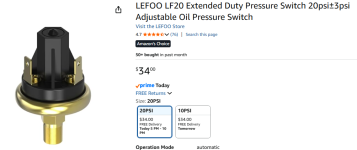
I've been having a problem with a carbureted Rotax engine with a drop in fuel pressure on takeoff. I've spoken to everybody I could think of but no answer. Instead, I have wired in a pressure switch to the electric fuel pump so it automatically goes on when the pressure drops (carbs =1.8 psi, FI= 22psi). the switch is plumbed into the fuel line to the pressure sensor and electrically after the fuel pump switch. The fuel pressure switch is easily calibrated to the pressure I want. I liked it so much, I installed it on my IO-360 on my RV-8.

Like others, I turn on the pump to prime and then off for starting. Back on before takeoff and off when I leave the runway and lean for taxi. I used to also turn the pump on when I changed tanks but now I just keep my hand on the valve until I'm comfortable the fuel is flowing. It is very cheap, eliminates me needing to recognize there is a problem in a critical phase of flight at low altitudes and high angle of attack and I have a warning light that comes on when the boost pump is on.


Screenshot 2026-05-17 092150.png
 
  • Like
Reactions: pjc
If you consistently (I mean 100% of the time) get a rise in FP when turning on the boost pump, then your problem is likely not indication/elec/wiring.
My experience is that activating the boost pump in pretty much any flight condition will cause at least a small increase in fuel pressure.

A common sensor failure causes an indication error that is offset a given amount, so if that error offset is 1.5 psi low, an indicated range of .5 to 3.5 psi, the actual could be 2 - 5, psi which would be acceptable depending on condition.

I agree with the suggestion to compare the induction with another gauge before making any pump change.
 
Last edited:
My experience is that activating the boost pump in pretty much any flight condition will cause at least a small increase in fuel pressure.

A common sensor failure causes an indication error that is offset a given amount, so if that error offset is 1.5 psi low, an indicated range of .5 to 3.5 psi, the actual could be 2 - 5, psi which would be acceptable depending on condition.

I agree with the suggestion to compare the induction with another gauge before making any pump change.
good points and the OP should put these in his diagnostic tool bag.
 
I have recently acquired an RV6 (o-360 carbureted), with a 6psi facet fuel pump (ES-40135). The builder we bought the plane from said to never use the fuel pump on takeoff since it ever so slightly enriches the fuel mixture. However, ever low wing plane I have flown (DA40, Archer) all have you use the electric fuel pump as a backup on takeoff.

Is it common practice for people to use the electric fuel pump on takeoff and landing? Or is the original builder right?
In my experience with multiple float failures (brass, composite and plastic), I would check and replace the carburetor float with the greatly improved solid, blue, epoxy float, which has been proven to be "bullet proof" since it's release in 2005. If the carburetor has one installed, it would have an "F" stamped on the name plate.

 
I use for takeoff/climb, landing, and switching fuel tanks.
Same here! I use it to prime for start on a IO-360 then off for taxi and run-up. It goes ON as soon as I'm cleared for T/O. Back off as soon as I'm above 1000AGL and then back ON when passing 1000 AGL on the way back.

Other times I use it is for switching tanks in flight (momentarily) and if I'm flying around out in the desert /mountains < 1000 ft. Or when doing acro.

Its not an issue with my fuel setup - but I know some guys are reluctant to run it anymore than necessary depending on where their Fuel Flow pickup is - because running it too much can cause errors in their calculated Fuel Remaining display from their Red Cube or whatever - depending where in the fuel line its located.
 
Last edited:
...and for formation flight (in my case).
I've often thought about that and I'm not sure what the benefits are. I do a LOT of formation flying and I don't see a good case for it as the maneuvering is often fairly gentle compared to full on Acro. About the only time I could think that a boost pump might help in formation flying is if one or both of your wing tanks are getting low, maybe having it on during the 60 AOB (lazy 8, etc) maneuvers might help a bit.

Funny story.... I was leading a 2-ship XC just about a week ago. I was deliberately trying to run one of my wings dry and was primed to swap tanks as soon as I felt the sputter. I even told my wingman about it earlier. We were getting close to our split up point where he was going to continue on to his destination and I was going to drop in for cheap gas at a remote airfield right under us. So I thought, lets do some Lazy 8s before we split up because he needed to work on getting better at the top of the 60 deg, slow speed apex on the outside of the turn. So on the 2nd leaf of the steep part of the lazy 8, just as we apexed at about 90 kts with my almost empty tank on the low side - my engine sputtered and #2 shot ahead. I called KIO, switched tanks and got the fuel boost pump on all while still in a 60 deg steep bank falling away. Engine caught right away. I was laughing.... ooops. But it shows that if you follow the proper procedures, no matter the phase of flight - usually good things will happen.
 
Last edited:
Back
Top