

Van's Air Force

The definitive Van's Aircraft support community! Buying, building or flying an RV? Join our exclusive family of mentors and enthusiasts!

Oil cooler sanity check

riseric

Well Known Member
Patron
This is in “Temporary” as it concerns a friend’s airplane (not RV).
I’m reaching out to the collective mind in hope of opinion, especially if one here has or had a 1975 or similar Piper Warrior.
Mods, remove this thread if inappropriate.

For a while now, the pilot (not new to this plane) complains of high oil temps. 235F in climb, 220F in cruise.
STD O-320

Talked to me about it, first thing I asked, “Is the winter kit removed?”
He says that it is.
He mentioned this high temp to his mechanic and he changed the Vernatherm “for diagnostic purposes”.
No improvement in temps.
I suggested to check the temp sensor in hot water. Not done yet.
The owner is also suspecting the cooler.
I went for a short flight with him and I confirm the high temps. In cruise, reducing the RPM by 100 produced a 10F drop.
8C at 4500 ft
(boy this is slow compared to the 8 !!)

POH says oil temps are “green” all the way to the red line at 245F. Typical Lycoming data.
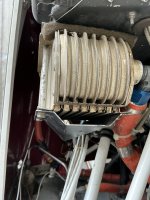
After landing, I popped the cowl open and saw this !!
Owner is convinced that this is not part of the winter kit.
The mechanic might not have seen this, or maybe he has, I don’t know.

I never owned a Warrior, although I flew one decades ago and never worried about high oil temps.
If this were mine and I was concerned about high oil temps, I’d remove or have remove this plate for “diagnostic purposes”.

Ready to receive opinions, especially if you know about Warriors.
Thanks
(edited to add info)
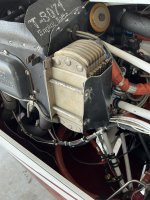
IMG_0668.jpegIMG_0669.jpeg
 
Last edited:
regardless of what you call that cover, it is going to seriously reduce airflow through the cooler (massive turbulence at exit) and thus seriously reduce its cooling capacity. know nothing about warriors, but do believe i understand restrictions to airflow, albeit not an expert. can definately see why one would put that on for winter ops.
 
High oil temps??….he should take that stupid plate off the back of the cooler and go fly and see what changes. Larry is right about it reducing cooling capacity.
 
We had a 1975 Warrior for over a quarter of a century.

I’ve attached the page of the Service Manual that shows the baffle on the back of the oil cooler as part of the airplane’s design equipment.

We never had issues with high oil temperatures, but did have issues with low oil temperatures in the winter. There is a blanking plate that fits over the front of the cooler which we installed for winter ops.

There’s likely another reason for the high oil temperature.

The Lycoming SSP-475 Troubleshooting Guide provides a list of possibilities on page 19.
 

Attachments

I flew a rental Warrior for 120 hours while building my RV8. I think it's difficult to compare the Warrior to the RV8 because the Warrior's cowl is so leaky. Of all the RVs in the very warm SoCal that I had a chance to look at, none of them has the blocker and none of them has any hot oil issue.
 
We had a 1975 Warrior for over a quarter of a century.

I’ve attached the page of the Service Manual that shows the baffle on the back of the oil cooler as part of the airplane’s design equipment.

We never had issues with high oil temperatures, but did have issues with low oil temperatures in the winter. There is a blanking plate that fits over the front of the cooler which we installed for winter ops.

There’s likely another reason for the high oil temperature.

The Lycoming SSP-475 Troubleshooting Guide provides a list of possibilities on page 19.

Isn’t that aluminum sheet between the cooler and the forward inlet. That should be removed. It’s more likely that causing the over tempt than the rear baffle.
 
Great feedback guys, I love it !!
I note from Hotstart’s document that the rear plate seems, in fact, to be part of the oil cooler.
Strange, as that clearly restricts free air flow. I concur with Larry on that.
That’s the thing, the factory winter kit is a plate that goes in front and it’s not there.

I too noticed that AL plate that 1bigdog mentions. It seems to be just behind the rear baffle, in front of the cooler.
I did flash some light through in front and some light shined through on the rear plate. I can’t say if the plate is only a frame around the cooler or if it’s partially blocking the cooler.
Will have to inquire about that plate.

The wrench marks might be from installing and removing the front plate ??
 
Great feedback guys, I love it !!
I note from Hotstart’s document that the rear plate seems, in fact, to be part of the oil cooler.
Strange, as that clearly restricts free air flow. I concur with Larry on that.
That’s the thing, the factory winter kit is a plate that goes in front and it’s not there.

I too noticed that AL plate that 1bigdog mentions. It seems to be just behind the rear baffle, in front of the cooler.
I did flash some light through in front and some light shined through on the rear plate. I can’t say if the plate is only a frame around the cooler or if it’s partially blocking the cooler.
Will have to inquire about that plate.

The wrench marks might be from installing and removing the front plate ??
That cover provides no real benefit beyond reducing airflow, assuming that was the designers intent, so no reason not to remove for testing.
 
The winterization plate fit on the forward side of the left rear baffle in front of the oil cooler.

There are two plate nuts on the forward side of the winterization plate that two -3 bolts fit into hold the plate against the left rear baffle.

The only time that the baffle on the back of the oil cooler was removed was to change the oil hoses as per the AD and to flush the cooler.

That baffle in the attached picture looks as though a gorilla had been working on it… ; )
 
My PA28-151 had that support-diffuser plate on the cooler. During the 27 years of operation I never had oil temp issues.
Leave the plate there.

When was the last time the cooler was serviced.
 
My PA28-151 had that support-diffuser plate on the cooler. During the 27 years of operation I never had oil temp issues.
Leave the plate there.

When was the last time the cooler was serviced.
Thank you Warren for your post, I appreciate.
I don’t know if or when the cooler was serviced.
What service should it receive ?

I will summarize and transmit all the info received here to the owner.
It’s always a pleasure learning from this forum and its members, whatever the subject.
 
i would remove the plate. That thing just seems silly. You should be able to look that up in the parts manual and see if that is an actual Piper part number. Also replacing the vernatherm is not always going to solve problems. You have a valve (the vernatherm) and a seat (the well inside the oil filter adapter). You need to inspect the seat to make sure it's not damaged. There is a special tool that can machine/clean up the seating surface that the vernatherm properly seats against and bypasses ALL the oil through the oil cooler. If there is improper fitment in this area, you can have inadequate oil flow through the cooler to get temps down, especially in hot climates. Rebuild shops usually have this tool to clean up the seating area in the filter housing. You can also check your vernatherm by putting it in boiling water and watch it operate. The valve end doesn't have any wear marks in it and the valve operates with the right temps, you don't need to replace good parts. Oil lines are not forever items. Elastomer lines can break down over time and come apart. That can end up in your cooler and block off the vanes, reducing capacity. Take the oil lines feeding the cooler off and look inside them with a flashlight. Any checking, cracking or missing pieces, junk them and get new ones made up. I've seen some units set up with #6 lines (3/8") and those may be too small in hot areas to get proper cooling. If it ran that way before having issues and the line sizes were #6 then it's not a flow issue. However, even with a O-320, I like #8 lines in and out of the cooler and the engine. It's just reassurance that there is no restrictions in flow.
 
Opinions are like certain body parts -- everyone has / is one ;)

Firstly, do yourself and your friend a favor -- prove up the data and instrumentation. Boil a pot of water and drop the oil temperature probe into it. Assuming that you're near sea level, the probe should report ~212°F (100°C) or thereabouts (if you're not at sea level, figure out the boiling point temperature to altitude gradient and see if the probe is reporting correctly.)
 
Back
Top