

Van's Air Force

The definitive Van's Aircraft support community! Buying, building or flying an RV? Join our exclusive family of mentors and enthusiasts!

Fast, On-Speed, Slow: A Common Language for Aircraft Control

Vac

Well Known Member
Ambassador
For over a century, general aviation has taught pilots to control the airplane primarily by reference to airspeed. It works well, and it has become so ingrained in our thinking that we rarely stop to ask why we do it that way. The answer is surprisingly simple: early pilots could measure airspeed in the cockpit long before they could measure angle of attack. Airspeed became the standard not because it was the ideal aerodynamic reference, but because it was the one we had.

The problem, of course, is that the wing doesn't respond to airspeed. It responds to angle of attack. Airspeed is only a proxy, and it's a good one only under fairly specific conditions. As soon as we start changing load factor, weight, configuration, or maneuvering aggressively, the relationship between indicated airspeed and the wing's actual margin from stall begins to change.

Operational communities that routinely operate near aerodynamic limits—carrier aviation, military tactical aviation, and flight test in particular—gradually converged on angle of attack as the primary maneuvering reference. Rather than thinking in terms of being a few knots fast or slow, pilots learned to think in terms of Fast, On-Speed, and Slow—an aerodynamic description of the wing's state relative to a reference angle of attack. Angle of attack defines the lift demand on the wing; power determines whether that demand can be sustained. It's a remarkably simple framework once you stop thinking in terms of airspeed.

That raises an interesting question. If the underlying physics are identical for an F/A-18 and an RV-7, why are we still teaching two different ways of thinking about aircraft control? The airplanes are obviously different, but the wing still obeys the same aerodynamic laws.

Over the past several years our FlyONSPEED team has been exploring that question. The attached paper isn't about a particular AOA system or avionics package. Instead, it asks whether general aviation would benefit from adopting a standardized operational interpretation of angle of attack similar to the Fast-On-Speed-Slow framework that has existed in operational aviation for decades. We believe the real opportunity isn't better sensors—we already have those. The opportunity is giving pilots a common aerodynamic language for managing both lift demand and energy.

We'd appreciate thoughtful feedback from and discussion with the VAF community. There are a lot of experienced engineers, instructors, civilian and military pilots; and builders here who have spent their lives thinking about these problems.

Standardizing Angle of Attack in General Aviation: The Fast–On-Speed–Slow Framework for Aircraft Control

Fly safe,

Vac
 
Seems complicated.

Takes an absolute measured and displayed item into something that seems less precise.

IFR charts predicated on speed.
 
Vac, I have been following On-Speed for some time. I agree that AOA is a better solution but planes often don't have a true AOA (Dynon is an example) so we are left with IAS. For your idea to come to fruition, airplanes need to come with an audible AOA or have an inexpensive, easily installed option. Ten years ago, or so, I had a simple vane AOA with an LED light bar and a audible tone in a Mooney that drastically decreased landing distance (5 kts fast in a Mooney means a whole lot more runway than 5 kts in an RV). I think the total cost was a few hundred dollars and the installation was simple. I would love to see your On-Speed system available at a low cost and easy installation for those of us not inclined to fabricating the electronics. but that hasn't happened yet (but I'm still waiting).

As to RNB's comments, aerodynamics requires more advanced math but that doesn't make it complicated in use. From a pilots perspective, it is pretty simple. Being absolutely specific about a number that isn't relevant (IAS at a 45 degree bank) isn't as important as being a little imprecise but useful. I'm not certain it is less precise but it is certainly more relevant. Finally, Approach plates are based on ground speed not IAS to predict times.
 
For over a century, general aviation has taught pilots to control the airplane primarily by reference to airspeed. It works well, and it has become so ingrained in our thinking that we rarely stop to ask why we do it that way.

While I totally agree with the rest of your post, I must take issue with this paragraph.

[rant=on]
I actually think it’s been a total disaster that’s led to deaths to hundreds if not thousands of pilots all over the world.

Mention of it and its concept should be consigned to the bin of history. Every aircraft should be fitted with AoA, and every pilot should be taught how to fly AoA from day one.

If you can’t grasp the concept of AoA over above stall speed then you should be informed that aviation isn’t a hobby you should be perusing, no matter how “simple” you might find the concept.

Stall speed was only a “thing” when a bloke in an Avro 500 looked down and thought “ok, this aircraft falls out the sky when the pointy thing says 50”

My airline provided some classroom tuition to all its Airbus pilots on stalling and aircraft protections last year. It was titled “Airbus low speed protections” . I just wanted to cry.

[rant=off]

I wish you luck in your endeavours.
 
Seems complicated.

Takes an absolute measured and displayed item into something that seems less precise.

IFR charts predicated on speed.
Actually, AOA is much simpler than airspeed approximations. Airspeed is great if your at one specific weight under 1 G as in non maneuvering flight at a specific configuration. If you decide to do a fly by with a banked pullup you are relying on a changing stall speed for each variable. If you have the flaps set the AOA at which the wing stalls remains unchanged for bank, weight, and G force. It is simpler and far superior to airspeed as a useful reference.
 
Last edited:
I have to ask what have IFR charts got to do with discussion on stalling?
My read is it is about not using speed, rather AOA to determine safety of flight parameters.
So much of my training is about known speeds

IFR mininums based upon category ABCD ?
Flap speeds?
V speeds?
Known settings to give known 500FPM descents at a given airspeed?
 

Attachments

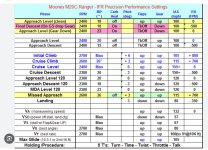
  • Image 7-11-26 at 08.01.jpeg
    Image 7-11-26 at 08.01.jpeg
    412 KB · Views: 14
Last edited:
I am a simple pilot. I will never do a fly by with a banked pull up.

I fly from point A to point B and do a bit of sight seeing.

What is your speed over the fence? Fast? Slow? On target? Or 75?

I think in GAN there was a recent ol timer venting about calling tail draggers as such, wanted the name changed. I have the same reaction to this.

I have not spent a lifetime thinking of these things. Want me to think more about them? Do analysis of accidents with pertinent AOA vs airspeed data and how it would have changed things. Do some demo flights showing specific points pertinent to GA, not performance flying like acro of carrier landings. Get respected YouTubers to explain these things, maybe someone like Jason Mill aka Finer Points.
 
@RNB
While I take on board your point, just about every stall spin (I would say every, but hate absolutes) accident is an AoA issue not a speed issue.

You ask what your speed over the fence is, 75?

Is that your speed every time over the fence? What about at Max Weight? What about at min weight? What about in a significant crosswind? Zero flap?

All these issues and more change that speed, or should.

I wonder just how close you have come to an issue if you just use 75 all the time.

And I feel your pain when it comes to training. I’m not a military guy and all my training was related to speed, and know speeds to stay safe. It’s only when you come to the realisation that all this training was wrong, and could easily get you killed that you start to become angry.

The training is wrong, the concept is rubbish and the sooner people realise and kick up a fuss the sooner it will change. Hopefully to everyone’s benefit and safety.

Sorry @Vac I’ve stolen your thread. I’ll get off my soapbox and go get a beer instead.
 
Last edited:
Seems complicated.

Takes an absolute measured and displayed item into something that seems less precise.

IFR charts predicated on speed.
Vac,

I think this helps with the question you raised of why do we as a community, cling to air speed as the reference. Suggest your efforts begin grass roots. Get an affordable product out there that can work for those who get it. Over time, the word will spread. low equippage rates are the big problem. Then comes training. Once rooted, it will spread.

Just look at our community here. Alarge percentage of us have glass with AOA and most use it regularly, at least in place of stall warning. Maybe not full uage, but a base from which to build on. IMO that only happened because AOA was built in and our small community discussed AOA and so folks spent the few extra bucks for the pitot with AOA built in. We then experimented with it and the bulb lit up.
 
Last edited:
For your idea to come to fruition, airplanes need to come with an audible AOA or have an inexpensive, easily installed option.
I agree with DanH and H1271. Audible lets us keep the eye outside on the horizon. A visual mandates we look inside and devide that task while our audio sense is unused.

Glider have been using audible indicators for decades with great success. The VSI in a glider is sensative. Some are electric with an audible tone. When I'm trying to core a thermal, am doing 12 second turns at 60+ degrees of bank and am on the edge of a stall an audible tone from the Variometer (VSI) gives an indcation if I'm in lift or sink. The eyes are focused outside, and on coring that thermal and maximizing its lift. Applying it to flying on short final: keep the eyes outside and remove the need to shift eyes from inside to outside - back and forth.

I dont have AOA in my aircraft. If it could be easily installed with audible fed into the intercom then I would pursue it.
 
We'd appreciate thoughtful feedback from and discussion with the VAF community. There are a lot of experienced engineers, instructors, civilian and military pilots; and builders here who have spent their lives thinking about these problems.

Standardizing Angle of Attack in General Aviation: The Fast–On-Speed–Slow Framework for Aircraft Control

While some of the information here isn’t new, it is presented in an easy to understand format and is fuel for thought. I found it to be an excellent read that covers many topics not previously discussed anywhere that I’m aware of.

I was particularly interested in the discussion about maneuvering lift factors and the inaccuracy of using airspeed as a stall indicator. Over the years I have done considerable accelerated stall testing in my RV6 and quickly came to the realization that the airspeed indicator is almost useless under those circumstances. (But it does provide a basic idea where the lift factors is, but isn’t precise.) Always very exciting to see exactly where it’s going to break (stall)!

Something else that has bothered me over the years is the generic maneuvering speed that is applied to most RV’s. Obviously Van’s has gone to great lengths to determine safe airspeeds so we don’t pull the wings off our airplanes, but what kind of safety factor has been built in if any? I have to assume that the single maneuvering speed is based on just aerobatic weight? But many RV’s aren’t aerobatic and weight is a factor. Perhaps the later model RV’s have a better limitations section discussing VA based on weight. I look forward to being educated!

Thanks, Ray.
 
+1. Skip the hearts-and-minds campaign. Make the the hardware available!
I don't know why it's hard to get the progressive tone on my Dynon EFIS. It took a few flight test sessions to tune the AOA tone but it's not perfect. It seems the electronic is sophisticated enough for all EFIS manufacturers to provide an easy method to achieve this progressive AOA warning.
 
What a timely post Vac! (Not an accident, I know….😉)

For those folks headed to Wisconsin in a week, there are going to be numerous opportunities to learn about AoA - Vac’s system, the Redbirds at the Pilot Proficiency Center (hey folks, it is AIR CONDITIONED!!!), and the EAA Safety Committee/AoA Working Group is going to have some fast, simplified training set up in Homebuilders Hangar so that those of you who don’t want to drag your butts all the way to the museum have no excuse for not giving it a try. If you’re in HBC, walk on over - Five minutes and you’ll know the basics of flying AoA. It is simple and frankly it is insanely easy. If you want to learn more find Vac, go to the PPC, drop in a forum… (I think mine on AoA is on Tuesday at 1130) …. And then go take a look at systems 0 bth integrated and standalone. All you guys buying Garmin? Its in there! Dynon and AFS? They’ve got it! GRT, MGL…..yup, and yup! And there are standalone systems for the steam gauge hold-outs as well - wander through the exhibit buildings and you’ll find them.

For those who say “we’ve been flying airspeed for generations, I am not going to change now!” Well….the needle has been moving now for a number of years - we’ve been taking surveys for a couple of years, and not only is the awareness of AoA flying increasing significantly every year, the installed base has been going up by leaps and bounds. Audible (tone) AoA is becoming a standard way of flying - and it is probably saving lives - although it is hard to gather data on “wow, I didnt; crash today…..”

AoA will keep you out of the stall weeds, and it will also help you land more precisely (ie, shorter), saving on brakes, potential runway excursions, and all those other bad things that happen when we approach way too fast. If you haven’t flow with it, you need to try it - and Airventure gives you a chance!

Paul
 
AoA will keep you out of the stall weeds, and it will also help you land more precisely (ie, shorter), saving on brakes, potential runway excursions, and all those other bad things that happen when we approach way too fast.
I'm sure my GRT AoA has saved my bacon at least twice when I got distracted in the pattern and was about to do something stupid. For landings, it has to be a very short strip for me to fly my approach with the green ball active - I usually carry a bit more energy over the fence, and just let my speed bleed as I'm flying about 1 foot over the runway.

I can't recommend AoA highly enough, and also recommend taking the time to make sure it's calibrated, and do some low speed flight testing in straight and level and turning attitudes at a few thousand feet AGL to ensure it's working right.

Looking forward to all the cool HW announcements coming up at KOSH! ;)
 
"... Audible (tone) AoA is becoming a standard way of flying - and it is probably saving lives..."

That may be true, however, it is NOT without its own risks. Don't get me wrong, I am a fan and use AOA in my -10, at work, and it will be in my -15 but...

What happens when you are accustomed to and expecting a tone that isn't there? I can relate many stories where an aural alert was not present for one reason or another and the end result was...not pretty.

The point is, if you learn to rely solely on that tone, the first time it doesn't sound you may find yourself in a really bad position. You might even consider the aural tone a single point failure!;)
 
"... Audible (tone) AoA is becoming a standard way of flying - and it is probably saving lives..."

That may be true, however, it is NOT without its own risks. Don't get me wrong, I am a fan and use AOA in my -10, at work, and it will be in my -15 but...

What happens when you are accustomed to and expecting a tone that isn't there? I can relate many stories where an aural alert was not present for one reason or another and the end result was...not pretty.

The point is, if you learn to rely solely on that tone, the first time it doesn't sound you may find yourself in a really bad position. You might even consider the aural tone a single point failure!;)
That's a really good point about relying on the tone only for AOA indication at least as a safety affecting limit indicator. A failure of the audio circuit could very easily lead to a dangerously false sense of safety. I was a steam gauge hold out so I bought an alpha AOA system. I haven't flown with it yet, but it is installed with a heads up display on the glareshield and a flap position calibration system. I have since ordered a Garmin Axis so my entire panel will be reconfigured in the coming weeks, but the Alpha AOA will remain as it is already installed. A BuddY taught me to water land in his icon A5, and the only instrument I relied on and paid attention to during those maneuvers was the AOA, which was positioned at the top of the panel. I think the AOA method of maneuvering in the pattern will be very useful for me. I have less than 100 hours in my Rv7 A, and I think I tend to come in a bit faster than I need to, as I take a pretty conservative approach to safety. i'm spoiled with my home field being 4500 feet long but I think flying with my new AOA will give me more confidence and skill when coming into shorter and unfamiliar fields, dealing with various obstructions, etc...
 
Make hardware available
I agree, and make it inexpensive. And robust. While I agree with the concept of an AOA display in the cockpit of our small airplanes, and flying to an "...on speed..." (there's that reference to speed again! what about "...safe angle..."?) indication, I am more concerned with the sensor itself. I have seen AOA vanes on airliners, and I have seen differential pressure sensors (top of wing and bottom of wing static sensors) on our small airplanes. Big difference in robustness in my opinion.

Let's have a discussion about all of the ways to SENSE AOA on our small airplanes, the location of those sensors, and the robustness of those sensors (susceptible to rain, bugs, and unintended ice). If the sensor(s) are disabled it doesn't matter how well trained the pilot is, or how nice the cockpit display is.
 
“Its a single point failure if you have only one AoA”….. well of course it is. But you also only have a single engine, a single elevator pushrod, a single Airspeed Indicator, single Pitot tube….. so you can argue just to argue, or recognize that flying is all about keeping your head up and cross-checking. {Or do like I do - I have at least two AoA systems in each of our airplanes (and in some places, three….), but that’s just because I test them - not because I feel the need for multiple systems.} AoA is a tool - like any other - not a crutch.

“Oh, but big airplanes have vane sensors.” Yes, they absolutely do. They also have jet engines, so the prop slipstream is not a factor. Yes, you can put a vane sensor out near the wingtip of your RV - but they are delicate and I bet it won’t last. I’ve used several GA systems with the vane transducer, and have found that inexpensive ones tend to stick or bind. The pressure sensor AoA (either in teh pitot or “top/bottom? Holes) has been proven to keep you out of the weeds pretty reliably (there are always exceptions of course), and unless you are trying to do a test program where AoA needs to be measured to sub-degree accuracy, they are good for pilot use.

Tom paul - I really liek the quality and pasion behind the Alpha Systems unit! The one I have is probably eight years old, and it doesn’t have “progressive” tones - just a tone when you are getting flap sped, and a tone near the stall. I have talked with them about a progressive (and they were receptive) , but don’t know if they implemented it (yet) - will be interested in how it works for you. But you’ll have progressive tones in the Garmin, so I bet you’ll use that more than the Alpha systems display.
 
Is the OP arguing for more airplanes operating at or near the aerodynamic limits?
Does this make things safer?


If I test and or understand my airplanes V speed numbers at or near gross weight, then honor those figures with a margin for safety, how does this make me unsafe?

I think the thesis should get rid of the "long used in military aviation".

I think adding in Fast on speed and slow complicates or adds in too much. Isn't this inherently understood without a new (albeit simple) vocabulary?

"GA should standardize use of AOA indicators to improve safety" would be thesis enough.

Isn't there already some process the FAA utilizes for things like SB to determine needed compliance and costs? Couldn't this be applied to the process for such devices? What is the cost to add all of this to "the fleet", what are the ongoing proficiency standards, how much money/value is saved? Have you looked for data where the GA fleet accidents are examined for AOA vs V speed accidents?

Aren't stall speeds part of the certification process? If this is so important a thing to add, shouldn't this be part of some ASTM group? What is being done for serious industry acceptance? Should V speeds be dropped?
 
During routine GA operations in the airport environment, say for flying a standard pattern or an instrument approach, under what conditions does one have a stall or loss of aircraft control when flying per the POH or standard patterns of flight that an AOA adds anything to?

I say it is just a tool, a useful one if one wants to fly at the aerodynamic edge, but of limited additional benefit above the normal tools one escapes with from PPL training (maybe even student solo level) .
 
Dynon and AFS? They’ve got it!
In discussions with Vac, it appears the Dynon AOA really isn't a true AOA. This is why he recommends using the On-Speed generation with its own processor. I can't speak to the Garmin or AFS AOA. Maybe Vac can weigh in on those.
Yes, you can put a vane sensor out near the wingtip of your RV - but they are delicate and I bet it won’t last.
My experience was that it was reliable and maintenance free. I would like to hear from others with vane-style AOA experience if I was lucky or typical.
 
How will I get AOA info into the Garmin? Will
It accept an input from the Alpha pitot? Or would I need to install an additional dual port pitot?
You just need an AoA Pitot tube - it just replaces the standard pitot and has an AoA sense port in addition to pitot. Garmin and Dynon sell them, as do a few others. You MIGHT be able to use the Alpha pitot and split it off (I would be surprised if it doesn’t work), but it’ll take some experimenting….
 
During routine GA operations in the airport environment, say for flying a standard pattern or an instrument approach, under what conditions does one have a stall or loss of aircraft control when flying per the POH or standard patterns of flight that an AOA adds anything to?
Hmmm…well very few of the folks that have stall/spun in the pattern (and died) went out on the flight plannign to commit suicide. Loss of Control accidents are the primary causes of fatalities, a majority of those happen in the pattern, and almost every one of them is a stall/spin. We can cut fatal accidents by something like 30% if we eliminate those.

“Normal Ops” quickly become “abnormal ops” when the engine sputters or quits, or you get distracted looking for traffic, or the Oshkosh tower says “tighten up that turn and hit the orange dot!!” All of these cases are “norma abnormalities”, and are when the AoA becomes incredibly valuable. If all that you know (or learn) is within the confines of the POH normal procedures, you will someday find yourself in serious trouble when things go wrong. And….they do.

Meanwhile, for truly normal ops, using an AoA that is properly calibrated will help you fly at proper approach speed rather than too fast (almost everyone flies their approaches too fast) and that will make better landings and help your brakes last a lot longer.

You’ve been on VAF asking questions and learning for a couple years - stop by the Homebuilders hangar or attend an AoA event and learn more!
 
In discussions with Vac, it appears the Dynon AOA really isn't a true AOA. This is why he recommends using the On-Speed generation with its own processor. I can't speak to the Garmin or AFS AOA. Maybe Vac can weigh in on those.
I’ll let Vac answer the specifics of that (he does AoA every day, all day, and knows more about the fine details than most anyone involved). But I can tell you that the Garmin and Dynon approximate AoA close enough to prevent the majority of fatal stall/spin accidents.
 
Hmmm…well very few of the folks that have stall/spun in the pattern (and died) went out on the flight plannign to commit suicide. Loss of Control accidents are the primary causes of fatalities, a majority of those happen in the pattern, and almost every one of them is a stall/spin. We can cut fatal accidents by something like 30% if we eliminate those.

“Normal Ops” quickly become “abnormal ops” when the engine sputters or quits, or you get distracted looking for traffic, or the Oshkosh tower says “tighten up that turn and hit the orange dot!!” All of these cases are “norma abnormalities”, and are when the AoA becomes incredibly valuable. If all that you know (or learn) is within the confines of the POH normal procedures, you will someday find yourself in serious trouble when things go wrong. And….they do.

Meanwhile, for truly normal ops, using an AoA that is properly calibrated will help you fly at proper approach speed rather than too fast (almost everyone flies their approaches too fast) and that will make better landings and help your brakes last a lot longer.

You’ve been on VAF asking questions and learning for a couple years - stop by the Homebuilders hangar or attend an AoA event and learn more!
Find me one loss of control accident, where they paid attention to the normal things (or diagnostics indicated the same) where an AOA would make the difference?

What part of tightening up a turn at OSH is normal? 27 is too tight, too close and not normal. It might be normal next week, but those are not normal GA.

I have AOA on my plane but don't fly close to the edge.

AOA is just a function of things that are already known. Give me a digital number, not 7 lights.
 
Absent data I think the thesis fails the scientific method. Clearly it has support, but it lacks data.
 
Back
Top