

Van's Air Force
You are using an out of date browser. It may not display this or other websites correctly.
You should upgrade or use an alternative browser.
You should upgrade or use an alternative browser.
AntiSplat mains bearing preload
- Thread starter climberrn
- Start date


I had that question for the nose wheel bearing mod. Contacted Allen, and had the answer in a few minutes. He is very responsive.
mailto:[email protected]
mailto:[email protected]
Let us all know when you find out, Joel.
Thanks!
Dave
Thanks!
Dave
I'm anxious to hear the reply as I just had this done. I was under the impression that we just followed Van's instructions when putting the wheel back on. On the RV-14 mains Van's states to,
"Rotate each Main Wheel and Tire Assembly while hand-tightening the corresponding axle nut until there is no side play in the wheel and the wheel rotates with little or no friction."
"Rotate each Main Wheel and Tire Assembly while hand-tightening the corresponding axle nut until there is no side play in the wheel and the wheel rotates with little or no friction."
I'm anxious to hear the reply as I just had this done. I was under the impression that we just followed Van's instructions when putting the wheel back on. On the RV-14 mains Van's states to,
"Rotate each Main Wheel and Tire Assembly while hand-tightening the corresponding axle nut until there is no side play in the wheel and the wheel rotates with little or no friction."
thought he used sealed bearings. These are usually fully tightened, unlike the tapered roller bearings in the kit that are not
Suggest getting alans input, as I believe following the kit instructions is likely incorrect for his bearings.

Preliad
They are not tapered bearings so vans instructions for preload will not work. Post what Allan says but it will likely be “snug”…
They are not tapered bearings so vans instructions for preload will not work. Post what Allan says but it will likely be “snug”…
Thanks very much!
Dave
Dave

yes
Yes, there is a machined spacer in the middle.
Yes, there is a machined spacer in the middle.
I didn't see a spacer in between the two bearings on the main gear for my -7. They were done about 3-4 months ago. Looked up the bearing number (Spinco CSA 206-20) and see it has some sort of a locking collar but actually looks like a flange is resting on the surface of the original wheel halves that they machine to fit the bearing. A very good idea but I certainly don't see a spacer inside. There are certainly two spacers that ride on the axle on the outside of the wheel, but not the inside so I can only assume it is the strength of the wheels themselves that hold the bearings in position. I'm trying to figure out how much pre-load I can put on the big axle nut so that the brake flange bolt can be snugged up to prevent the brakes/wheel fairing from wiggling back and forth. Recommendations?yes
Yes, there is a machined spacer in the middle.
To clarify, the nose wheel mod has the spacer. The mains do not have a spacer and instead, the bearings are stopped by a .030" step in the bore according to anti splat.I didn't see a spacer in between the two bearings on the main gear for my -7. They were done about 3-4 months ago. Looked up the bearing number (Spinco CSA 206-20) and see it has some sort of a locking collar but actually looks like a flange is resting on the surface of the original wheel halves that they machine to fit the bearing. A very good idea but I certainly don't see a spacer inside. There are certainly two spacers that ride on the axle on the outside of the wheel, but not the inside so I can only assume it is the strength of the wheels themselves that hold the bearings in position. I'm trying to figure out how much pre-load I can put on the big axle nut so that the brake flange bolt can be snugged up to prevent the brakes/wheel fairing from wiggling back and forth. Recommendations?
There should be zero preload on the ball bearings per anti-splat. I actually ordered some 1.5" shims from McMaster to take up any slop. They worked great.
Yes, on the mains, one cotter pin went in perfectly and the other would have allowed a bit of slop therefore I added the McMaster shim.ASA told me 25 ft lbs on the nose wheel bolt.
For the mains, snug them up, then back off to fit cotter pin. (As mentioned above).
Cheers
Stephen
That's what i did. I was surprised with 25 ft/lbs - that was quite a bit of torque for the front wheel bolt. The main wheels are not as tight due to alignment of the cotter pin hole, and I did not want to drill a new one. It's "sort of snug". My understanding that sealed bearings need to be fully tightened for the best service life.ASA told me 25 ft lbs on the nose wheel bolt.
For the mains, snug them up, then back off to fit cotter pin. (As mentioned above).

I’m not sure what “sort of snug” is or what you mean by “full tightened” but you want zero axial load on the in the Anti-Splat main gear ball bearings, snug the nut then back it off until the cotter pin fits, just like the Van’s standard tapered bearings. The Anti-Splat main wheel mod does not include a spacer between the bearings’ inner races.That's what i did. I was surprised with 25 ft/lbs - that was quite a bit of torque for the front wheel bolt. The main wheels are not as tight due to alignment of the cotter pin hole, and I did not want to drill a new one. It's "sort of snug". My understanding that sealed bearings need to be fully tightened for the best service life.
The Anti-Splat nose wheel bearing mod is different, it has a spacer between the two bearings’ inner races so the axle bolt can be tightened without applying axial load to the bearings.
Spacer between bearings’ inner races…Sealed and non-tapered, so they have a precision length spacer trapped between the inner races?
- Yes for the Anti-Splat nose wheel mod.
- No for the Anti-Splat main wheel mod. Snug the nut then back it off until the cotter pin fits
Last edited:
This doesn't sound right for a singular, not stacked, sealed, non-tapered roller bearing in a wheel; application. Yes, the inner race should be a slip fit because it is the non rotating side, but from all of my experience with these types of bearings in automotive wheel applications is that the nut on the inner race is tight not loose. doesn't have to be crazy tigh but allowing the inner race to rotate on the axle seems wrong in a wheel application supporting 1000's of pounds. obviously very different from a tapered roller bearing.I’m not sure what “sort of snug” is or what you mean by “full tightened” but you want zero axial load on the in the Anti-Splat main gear ball bearings, snug the nut then back it off until the cotter pin fits, just like the Van’s standard tapered bearings. The Anti-Splat main wheel mod does not include a spacer between the bearings’ inner races.
The Anti-Splat nose wheel bearing mod is different, it has a spacer between the two bearings’ inner races so the axle bolt can be tightened without applying axial load to the bearings.
no dog in this fight, but suggest further research.
Last edited:

Larry, the key thing in this instance is whether or not there is an inner spacer sleeve. When there is an inner spacer sleeve, you want to clamp down on the assembly, clamping the bearing inner races tight. This is the normal arrangement.This doesn't sound right for a sealed, non-tapered roller bearing in a wheel; application. Yes, the inner race should be a slip fit because it is the non rotating side, but from all of my experience with these types of bearings in automotive wheel applications is that the nut on the inner race is tight not loose. doesn't have to be crazy tigh but allowing the inner race to rotate seems wrong in a wheel application supporting 1000's of pounds.
no dog in this fight, but suggest further research.
In the case of the ASA mains, the bearings are pressed into a pocket in the hub with no inner spacer sleeve. If you clamp down on the inner races, you are basically crushing the hub halves together. Don't want to do that. So a very light clamping load is all you can get. It is a bit of an unusual arrangement because if there were a lot of drag in the bearing itself, the inner race could turn on the axle, as you mentioned. But that is how it is.
The difference between 25 ft/lbs ASA spec for the nose wheel clamping and the unspecified "snug" clamp on the mains seems pretty dramatic. 25 ft/lbs is in the upper limit range for the AN6 axle bolt.
Van's recommends lower 16 ft/lbs for the Matco sealed nose bearing. https://www.vansaircraft.com/wp-content/uploads/2019/01/Nose_W_T.pdf
Van's recommends lower 16 ft/lbs for the Matco sealed nose bearing. https://www.vansaircraft.com/wp-content/uploads/2019/01/Nose_W_T.pdf
Anti Splat:
I received a reply to my query to Anti Splat re do they have written instructions how to tighten the castellated spindle nut on their Main Wheel Bearing Mod for RVs.
I seems the answer is no unless you submit a query.
============================================================
AntiSplat Support
[email protected]
06/22/2026
The castellated spindle nut should be run up hand-tight only. There is no torque specification, and the bearings must not have any preload applied to them, as preload can quickly damage the bearings.
Tighten the nut by hand until the wheel has no noticeable side-to-side play while still rotating freely. Then align the nearest castellated slot with the cotter pin hole by slightly loosening the nut. Do not tighten it further to reach the next slot.
Once aligned, install the cotter pin and verify that the wheel still turns freely.
Best regards,
Niles Nimmo
=============================================================
Beringer:
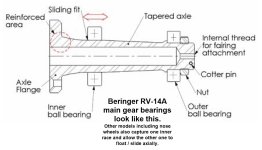
Beringer wheel bearing axial retention is also not what many might expect. Ref attached image.
Note in the main gear instance the nut is not castellated. The cotter pin doesn't prevent the nut from turning but prevents it from moving very far or falling off.
Also note he axle is cylindrical at the inboard bearing inner race ID. Some have confused the callout “tapered axle” to mean the inboard bearing inner race is also tapered to jam it from moving too far inboard.
I received a reply to my query to Anti Splat re do they have written instructions how to tighten the castellated spindle nut on their Main Wheel Bearing Mod for RVs.
I seems the answer is no unless you submit a query.
============================================================
AntiSplat Support
[email protected]
06/22/2026
The castellated spindle nut should be run up hand-tight only. There is no torque specification, and the bearings must not have any preload applied to them, as preload can quickly damage the bearings.
Tighten the nut by hand until the wheel has no noticeable side-to-side play while still rotating freely. Then align the nearest castellated slot with the cotter pin hole by slightly loosening the nut. Do not tighten it further to reach the next slot.
Once aligned, install the cotter pin and verify that the wheel still turns freely.
Best regards,
Niles Nimmo
=============================================================
Beringer:
Beringer wheel bearing axial retention is also not what many might expect. Ref attached image.
Note in the main gear instance the nut is not castellated. The cotter pin doesn't prevent the nut from turning but prevents it from moving very far or falling off.
Also note he axle is cylindrical at the inboard bearing inner race ID. Some have confused the callout “tapered axle” to mean the inboard bearing inner race is also tapered to jam it from moving too far inboard.
Attachments
Last edited:
Ok. Makes sense now that you say that and agree without a sleeve anything beyond less than snug will trash the bearings. Still don’t think i like the idea of the inner race loose on the axle in a straight bearing application. Have people noticed wear on the axle, indicating that the inner race is spinning? That would be my concern with a setup like that. Ok for an armature spinning around, but not in a wheel application supporting 2000 lbs. yes, totally normal in a tapered bearing setup, but that is totally different load dynamics; downward force pushes the races inward to take up the play.Larry, the key thing in this instance is whether or not there is an inner spacer sleeve. When there is an inner spacer sleeve, you want to clamp down on the assembly, clamping the bearing inner races tight. This is the normal arrangement.
In the case of the ASA mains, the bearings are pressed into a pocket in the hub with no inner spacer sleeve. If you clamp down on the inner races, you are basically crushing the hub halves together. Don't want to do that. So a very light clamping load is all you can get. It is a bit of an unusual arrangement because if there were a lot of drag in the bearing itself, the inner race could turn on the axle, as you mentioned. But that is how it is.
But in that berringer example, the inner race of the outer bearing is butted against a flange and assume that nut is to be fully torqued. The notes even state that one bearing is held captive.Anti Splat:
I received a reply to my query to Anti Splat re do they have written instructions how to tighten the castellated spindle nut on their Main Wheel Bearing Mod for RVs.
I seems the answer is no unless you submit a query.
============================================================
AntiSplat Support
S[email protected]
06/22/2026
The castellated spindle nut should be run up hand-tight only. There is no torque specification, and the bearings must not have any preload applied to them, as preload can quickly damage the bearings.
Tighten the nut by hand until the wheel has no noticeable side-to-side play while still rotating freely. Then align the nearest castellated slot with the cotter pin hole by slightly loosening the nut. Do not tighten it further to reach the next slot.
Once aligned, install the cotter pin and verify that the wheel still turns freely.
Best regards,
Niles Nimmo
=============================================================
Beringer:
Beringer wheel bearing axial retention is also not what many might expect. Ref attached image.
Note in the main gear instance the nut is not castellated. The cotter pin doesn't prevent the nut from turning but prevents it from moving very far or falling off.
Also note he axle is cylindrical at the inboard bearing inner race ID. Some have confused the callout “tapered axle” to mean the inboard bearing inner race is also tapered to jam it from moving too far inboard.
I haven't noticed any marks from slippage. The inner race does not move on the unloaded wheel with the original aluminum flat spacers (they need to be left in place per ASA) The instructions in the email response above sound like they are for the standard bearing though.Have people noticed wear on the axle, indicating that the inner race is spinning?
Zero indication of bearing slippage in almost 500 hours…I haven't noticed any marks from slippage. The inner race does not move on the unloaded wheel with the original aluminum flat spacers (they need to be left in place per ASA) The instructions in the email response above sound like they are for the standard bearing though.
