


Well, we’ve been flying a LOT and its nice to take a little break, especially since we’re now in the high 90’s and its pretty bumpy in the desert after mid-morning…. “Myst” is now out of Phase 1 - but we’re still learning, and will continue to do so for quite awhile! Thought I’d share a few notes with the community on what we have learned so far.
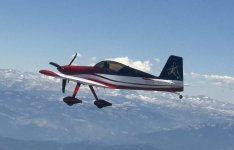
(Picture by “Catmandu”)
First flight of the F1 Rocket (N835PD) was on June 1st, and with excellent flying weather we made it through the EAA Flight Test Manual in fourteen days, flying at least two (sometimes three) sorties a day, mostly before 10:00 in the morning since it is summer and we live in the desert! Most days added two or three hours to the logbook. Because I have tested airplanes before with the FTM, and helped write it, I am pretty familiar with ways to be as efficient as possible. For instance, I always launch with at least two cards – one planned, one backup – and sometimes I’ll do parts of multiple cards on the same flight – for instance, stability-and-control related tests I’ll run through at one loading, then do the same tests on another flight with another loading, and so on. I might hit six cards on one flight loaded light/forward, the same six on an other flight heavy/aft, etc. Its not how I recommend folks doing it for the first time do the program – but if you are familiar with flight testing, particularly in the same general type of plane it is possible to get through it in fewer hours.
The first couple of times I did the program, it took about 35-38 hours to get through. I have reduced that with an RV-type airplane to a little under 30. My profession requires me to be able to quickly evaluate an airplane I have never flown before and come up with valid test points to illustrate my observations in an hour – so I have a head start on most amateur builders. It will take you what it takes you – and I am still sorting out how to use my avionics to best advantage. Also still filling in performance numbers at different altitudes - but I already know I want to cruise high, so that’s where I spend my time. Testing never ends, although test programs do!
Bottom line – the F1 is an RV with shorter wings and a big engine. Clean stall is about 56 KIAS, dirty about 52 KIAS – pretty amazing with a wing shorter than an RV-4. Climb rate is better than 3,000 fpm, but it heats up pretty quick if you climb at Vy. The speeds are pretty much like our other short-wing RV’s – Vy is very flat between 95KIAS and 110 KIAS – so I have been climbing about 110 after an initial climb at 100 KIAS. Best glide is right around 92 KIAS - but the glide ratio is down around 5.5-6.0….not quite shuttle-like, but its familiar territory!
Cruise performance? My “go To” numbers right now at 12.5K are 10.0 gph LOP doing 187 KTAS. More fuel – more speed. Higher gives me better economy – sweet spot seems to be around 15.5K and around 191 KTAS and 9.8 gph. I have built in O2, so the airplane usable up to the bottom of the flight levels. I expect it can easily fly in the low twenties, but those short Hershey-bar wings weren’t optimized for that. Frankly, it is like my jet – with better climb and speed! I spend more time managing temperatures in climb, but it is a more capable and sophisticated aircraft, so requires a little more attention. Best RPM for speed with the WW-330 prop is about 2550 rpm, best climb seems to be about 2620. It is seriously draggy at 2700 rpm, so best to fly the pattern about 2500 unless you need to come down NOW!
Handling qualities are right square in the RV box, although it is a heavier airplane on the controls. Stalls are RV-like, with no real surprises – a definite break, but little loss of altitude. The airplane will never replace my RV-3 for shear delight in handling, and it is heavier feeling than an -8 – but all the gentleman aerobatics are fine – they just feel a bit more “solid. Takeoff and landing are pretty simple so long as you remember that long nose will want to seek dirt if you don’t pay attention. I have been mostly wheel landing, tail-low -like the RV-8. Three pointers aren’t hard – but you want to know how to keep it straight without any forward view – because there isn’t one. Cross-wind capability is excellent, and steering/ground control is solid. Just kep that stick back in your gut because there is a LOT of nose out there! I’m very happy with the solid-bar shimmy dampers - I have a very slight shimmy (just barely noticeable on the taxi cam and in your butt) at about 15 knots ground speed and nothing above or below that.
Phase 1 data gathering with the G3X has been awesome, and I have gotten hooked on FLySto to quickly find specific data points and reduce the numbers. Huge improvement over classic flight testing data gathering.
Squawks Addressed during Phase 1
The aircraft has had few problems during the first couple of weeks, much like a typical RV:
If nothing breaks as we continue to stretch her legs, and if the weather cooperates, we hope to have her at Airventure!
(Picture by “Catmandu”)
First flight of the F1 Rocket (N835PD) was on June 1st, and with excellent flying weather we made it through the EAA Flight Test Manual in fourteen days, flying at least two (sometimes three) sorties a day, mostly before 10:00 in the morning since it is summer and we live in the desert! Most days added two or three hours to the logbook. Because I have tested airplanes before with the FTM, and helped write it, I am pretty familiar with ways to be as efficient as possible. For instance, I always launch with at least two cards – one planned, one backup – and sometimes I’ll do parts of multiple cards on the same flight – for instance, stability-and-control related tests I’ll run through at one loading, then do the same tests on another flight with another loading, and so on. I might hit six cards on one flight loaded light/forward, the same six on an other flight heavy/aft, etc. Its not how I recommend folks doing it for the first time do the program – but if you are familiar with flight testing, particularly in the same general type of plane it is possible to get through it in fewer hours.
The first couple of times I did the program, it took about 35-38 hours to get through. I have reduced that with an RV-type airplane to a little under 30. My profession requires me to be able to quickly evaluate an airplane I have never flown before and come up with valid test points to illustrate my observations in an hour – so I have a head start on most amateur builders. It will take you what it takes you – and I am still sorting out how to use my avionics to best advantage. Also still filling in performance numbers at different altitudes - but I already know I want to cruise high, so that’s where I spend my time. Testing never ends, although test programs do!
Bottom line – the F1 is an RV with shorter wings and a big engine. Clean stall is about 56 KIAS, dirty about 52 KIAS – pretty amazing with a wing shorter than an RV-4. Climb rate is better than 3,000 fpm, but it heats up pretty quick if you climb at Vy. The speeds are pretty much like our other short-wing RV’s – Vy is very flat between 95KIAS and 110 KIAS – so I have been climbing about 110 after an initial climb at 100 KIAS. Best glide is right around 92 KIAS - but the glide ratio is down around 5.5-6.0….not quite shuttle-like, but its familiar territory!
Cruise performance? My “go To” numbers right now at 12.5K are 10.0 gph LOP doing 187 KTAS. More fuel – more speed. Higher gives me better economy – sweet spot seems to be around 15.5K and around 191 KTAS and 9.8 gph. I have built in O2, so the airplane usable up to the bottom of the flight levels. I expect it can easily fly in the low twenties, but those short Hershey-bar wings weren’t optimized for that. Frankly, it is like my jet – with better climb and speed! I spend more time managing temperatures in climb, but it is a more capable and sophisticated aircraft, so requires a little more attention. Best RPM for speed with the WW-330 prop is about 2550 rpm, best climb seems to be about 2620. It is seriously draggy at 2700 rpm, so best to fly the pattern about 2500 unless you need to come down NOW!
Handling qualities are right square in the RV box, although it is a heavier airplane on the controls. Stalls are RV-like, with no real surprises – a definite break, but little loss of altitude. The airplane will never replace my RV-3 for shear delight in handling, and it is heavier feeling than an -8 – but all the gentleman aerobatics are fine – they just feel a bit more “solid. Takeoff and landing are pretty simple so long as you remember that long nose will want to seek dirt if you don’t pay attention. I have been mostly wheel landing, tail-low -like the RV-8. Three pointers aren’t hard – but you want to know how to keep it straight without any forward view – because there isn’t one. Cross-wind capability is excellent, and steering/ground control is solid. Just kep that stick back in your gut because there is a LOT of nose out there! I’m very happy with the solid-bar shimmy dampers - I have a very slight shimmy (just barely noticeable on the taxi cam and in your butt) at about 15 knots ground speed and nothing above or below that.
Phase 1 data gathering with the G3X has been awesome, and I have gotten hooked on FLySto to quickly find specific data points and reduce the numbers. Huge improvement over classic flight testing data gathering.
Squawks Addressed during Phase 1
The aircraft has had few problems during the first couple of weeks, much like a typical RV:
- Prop RPM was too low – could only get 2450 rpm initially. Fixed by adjusting stops, rotating governor core, and then re-clocking lever on splined shaft by three notches to achieve 2700 rpm. This was not done before first flight because the aircraft is sufficiently overpowered that running it up to full power on the ground is terrifyingly difficult – even with the tail spring tied to the concrete it feels like it is going to break free. We accepted the need for iterative tuning versus the risk of full-power static runs.
- Oil temperature and CHT’s higher than desired – initially CHT #1 was too hot, so we cut down the inlet dam. This brought CHT #5 into play, so we continued adjusting the air damn, leaving just a little to balance CHT’s on the right side. Oil temp is still in the 200-210 range during maneuvering flights, but drops into the 190’s in cruise, which is adequate performance.
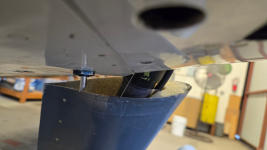
- Gear leg fairings were sliding down the gear legs – this was fixed (for now) with large-headed Tie warps around the gear leg at the lower end to act as “stops”. This fix is still being evaluated, so far, in ten hours, they haven’t moved - but they might be replaced with hose clamps to do the same thing.
- Avionics CAN bus communication errors – initial flights were plagued with flaky communications on the CAN bus, and this precluded reliable data taking with the EFIS. Eventually, the magnetometer behaved long enough on the ground to do a good calibration, and this allowed better data recording. The CAN bus problems appeared intermittent (vibration related), but the biggest culprit seemed to be the G5 – eventually, we removed the LPM from the circuit, and in doing so found a highly suspect connection on the CAN Lo leg – rewiring this has resulted in no further CAN errors, and all avionics have been performing well.
- The tailwheel had difficulty breaking out in one direction – the locking pin was removed and sanded lightly to bevel the edges. It is still somewhat sharp breaking out to the left but is much better, and breaking in a little on each use.
- The Left brake developed a tendency to “lock” while taxiing on day seven of the test program. We discovered some binding in the shaft of the master cylinder and re-shimmed the mounting bolts with washers to take the misalignment out. This work included re-shimming several rudder/brake pedal mounting bolts for smoother operation. The left brake, after mechanical adjustment, refused to bleed properly, so the master cylinder was removed seals replaced, the entire side was drained and re-charged, bleeding was normal, and brake function was restored.
If nothing breaks as we continue to stretch her legs, and if the weather cooperates, we hope to have her at Airventure!