

Van's Air Force

The definitive Van's Aircraft support community! Buying, building or flying an RV? Join our exclusive family of mentors and enthusiasts!

Hi! Can someone point me to ‘how do I get there from here’? -7 Project going back into phase 1 after 2 years of work.

rockyfatcat

Well Known Member
Patron
I have been an A&P for 25+ years. I flew off and on since 1989 and finally got my ppl 2 years ago. Right now my bi-annual is expired. I had a special issuance 3rd class medical that I let expire as I have basic med and Mosaic to rely on.

Aircraft #1 is a Aircoupe coming out of annual after a top overhaul. I haven’t flown anything since last July.

Aircraft #2 is a project RV7 coming back together after major upgrades including full IFR glass panel, full strip, and paint. The aircraft had a wood prop with a split at one tip and I have a 3 bladed carbon fiber ground adjustable prop on it now.

I need to get a biannual flight review before I fly anything. I still need a tailwheel endorsement to fly the -7 and my insurance is saying 10 hours dual before I can fly 10 hours solo.

Replacing the prop will require revisiting phase 1, which the builder flew off in Florida.

Faced with juggling all these balls, I need to figure out the who, what, why, and where to get my -7 flying. Do I need to notify the FAA that I’m redoing phase 1? How should I do that?

How would you approach flying this? Do I fly the phase 1 with a CFI or what?
 
I have been an A&P for 25+ years. I flew off and on since 1989 and finally got my ppl 2 years ago. Right now my bi-annual is expired. I had a special issuance 3rd class medical that I let expire as I have basic med and Mosaic to rely on.

Aircraft #1 is a Aircoupe coming out of annual after a top overhaul. I haven’t flown anything since last July.

Aircraft #2 is a project RV7 coming back together after major upgrades including full IFR glass panel, full strip, and paint. The aircraft had a wood prop with a split at one tip and I have a 3 bladed carbon fiber ground adjustable prop on it now.

I need to get a biannual flight review before I fly anything. I still need a tailwheel endorsement to fly the -7 and my insurance is saying 10 hours dual before I can fly 10 hours solo.

Replacing the prop will require revisiting phase 1, which the builder flew off in Florida.

Faced with juggling all these balls, I need to figure out the who, what, why, and where to get my -7 flying. Do I need to notify the FAA that I’m redoing phase 1? How should I do that?

How would you approach flying this? Do I fly the phase 1 with a CFI or what?
First, the word you’re looking for is ‘biennial’. Biannual means every 6 months.
I think the usual phase 1 for a prop change is 5 hours. You can, I think, use the relatively new 2 pilot rule, but really, the intent is to test the prop/aircraft, not give you dual. My suggestion:
1. Go to an FBO, rent a Cub or Taylorcraft and a tailwheel cfi. Get a Flight Review and a TW endorsement.
2. Find a willing CFI, fill out the paperwork for the 2 pilot phase 1, then fly supervised, for the phase 1 sign off plus more, at least 10 hours. Then another 10 hrs solo.
Given your low overall time and lack of recent experience, these times should be thought of as minimums. A good cfi will tell you if you need more.
 
Last edited:
Forgot to add: Contact your closest FSDO to get a new Phase 1 area (and check that it is 5 hours). Ask them for the paperwork for the "additional pilot phase 1" thing.
 
I spent some time on the phone with the Atlanta FSDO. I explained my situation (which they repeatedly got wrong). They kept referring to the test area in my airworthy certificate. I reminded them SEVERAL times that the aircraft was built and certified in FLORIDA, and my aircraft is at KHMP in GEORGIA.

I explained that the aircraft was certified with a wood prop and that I replaced with a 3 bladed ground adjustable, and that I understand that change requires revisiting phase one. I explained that my insurance requires 10 hours of dual instruction before I can fly solo. I asked for the additional pilot for the phase one thing and that request was met with pure silence.

After explaining it a 3rd time. One of the two guys on the call suggested I pay to rent a RV7 with an instructor before trying to fly my aircraft. As the conversation progressed one of the guys said that he knows a CFI who has a RV7. They were going to call him and get back with me. (Which they never did)

They suggested I visit AWC.FAA.GOV. I did and it is not clear what I should be doing.

Still looking for answers.
 
The Operating Limitations that govern what has to be done for a major change - and what constitutes a major change - have changed dramatically over the years, so without knowing exactly what YOUR Operating limitations say, it is impossible for anyone to advise you. If the FSDO guys suggested that you rent an RV-7, they clearly have no idea how E-AB rules work…so take what they told you with a grain of salt. If they weren’t reading YOUR Ops Lims….take what they say wth a grain of salt. With many older Ops Lims, going from a fixed pitch to a fixed pitch prop (of another brand/type) is not a major change, and Phase 1 is not required. With later Ops Lims wording….it is hazier.

Tell us what your ops Lims say regarding Major changes (the exact wording, not a paraphrase) and you’ll get more meaningful responses.

Paul
 
The Operating Limitations that govern what has to be done for a major change - and what constitutes a major change - have changed dramatically over the years, so without knowing exactly what YOUR Operating limitations say, it is impossible for anyone to advise you. If the FSDO guys suggested that you rent an RV-7, they clearly have no idea how E-AB rules work…so take what they told you with a grain of salt. If they weren’t reading YOUR Ops Lims….take what they say wth a grain of salt. With many older Ops Lims, going from a fixed pitch to a fixed pitch prop (of another brand/type) is not a major change, and Phase 1 is not required. With later Ops Lims wording….it is hazier.

Tell us what your ops Lims say regarding Major changes (the exact wording, not a paraphrase) and you’ll get more meaningful responses.

Paul
Thank you for this insight. I had previously read on VAF about revisiting phase one after switching props. My verbiage reads change of a fixed pitch from or to a controllable propeller. I read that as not needing to revisit phase one to switch from a 2 blade wood prop to my new 3 bladed ground adjustable.

A couple other interesting bits I found in my limitations had to do with documenting aerobatic maneuvers in the maintenance records, and as my aircraft as built was DAY VFR ONLY, as long as it is 91.205(c) compliant it is legal for night VFR. AS it is now IFR capable, it only requires properly documented, installed, maintained, and signed off per 91.205(d).

Of all these things, only switching to or from a fixed or controllable prop requires notification via-a FAA form 8130-6
 
Thank you for this insight. I had previously read on VAF about revisiting phase one after switching props. My verbiage reads change of a fixed pitch from or to a controllable propeller. I read that as not needing to revisit phase one to switch from a 2 blade wood prop to my new 3 bladed ground adjustable.

A couple other interesting bits I found in my limitations had to do with documenting aerobatic maneuvers in the maintenance records, and as my aircraft as built was DAY VFR ONLY, as long as it is 91.205(c) compliant it is legal for night VFR. AS it is now IFR capable, it only requires properly documented, installed, maintained, and signed off per 91.205(d).

Of all these things, only switching to or from a fixed or controllable prop requires notification via-a FAA form 8130-6
Wellllll…. The interpretation of “minor” vs “major” change apparently all depends on which FSDO you ask. Searching the Internet, I’ve seen advice given or FSDO acceptance of a fixed to GA or 2B to 3B props characterized BOTH ways (major or minor). I know of planes out there that have changed props with no FAA contact. I read it like you and since my prop change didn’t change the flight operating characteristics (it’s STILL a fixed pitch whilst flying!) hopefully assumed it would be considered a minor change.

My current Op Limitations required me to contact my FSDO for any MAJOR changes with the same example like yours, of a fixed to a “controllable “ propeller. But, as a rule follower and in my risk adverse ways, not wanting to risk the judgement of said FAA nor insurance adjuster if a bad day occurred, I asked my local FSDO their interpretation. So far, after 9 weeks, I have learned that - emphatically YES changing any prop, unless identical, is major; a form 8130-6 is required (done electronically now), and my plane still sits collecting dust.

And seriously - other than the headache of governmental involvement, nothing is changed by going into “Phase 1”. Either way I still would be going and flying and perform appropriate checks over a safe area.

So, assuming the probability that you do need to contact your FSDO and get your Operating Limitations updated in order to designate a new test area - I respectfully recommend you do so with haste and vigor. I regret not making contact weeks in advance. Lesson learned.
 
Last edited:
If changing the prop changes W&B or flight characteristics significantly then it is a major change. The change to or from a controllable prop only references a new 8130-6. Of course changing to or from a controllable prop is obviously going to change flight characteristics and probably W&B.
 
If changing the prop changes W&B or flight characteristics significantly then it is a major change. The change to or from a controllable prop only references a new 8130-6. Of course changing to or from a controllable prop is obviously going to change flight characteristics and probably W&B.
Agreed. But again, then what is “significantly”? Back into a subjective interpretation. My CG moved forward minimally since original empty weight, (less than 2”) was still well within recommended, and in my opinion, actually was an improvement. Bottom line, my point is to go early if you’re going to ask.

And to also clarify, my point is not to bag on the FAA too much at this point. The gentleman assigned (finally) to my case has been very polite and is doing his best to do his job. I spent my career having to make life and death decisions. And in divisions below me, were a whole flock of staff whose job was to make determinations and interpretations of laws, codes, and ordinances. I get that there are gray areas. And I also understand the variables in staff, and their individual willingness to walk in the gray, or insistence on black or white.
 
If changing the prop changes W&B or flight characteristics significantly then it is a major change. The change to or from a controllable prop only references a new 8130-6. Of course changing to or from a controllable prop is obviously going to change flight characteristics and probably W&B.
I would think that I have made significant changes to the weight and balance of this aircraft. As built the empty CG was 80.25 (range of 78-86).

#1 when replacing the prop I had Sabre make a 2 1/4” prop spacer made out of brass. It weighs about 20 pounds.

#2 all the original VFR gauges are gone. It’s now glass IFR. All the remote units are mounted between the firewall and the sub panel. All to keep the weight fwd.

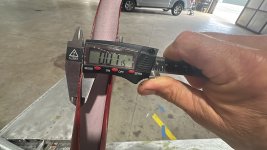
#3 I did a full paint strip. There were 7 coats of paint on the fuselage and tail feathers one of the coats was 0.071 thich

#4 after all this work I know I need to do another weight and balance. I’d be tickled if the new weight and balance was 78. It’s easy to add ballast to achieve a aerobatic CG.

The way I read my AWC, all of that is documented in my maintenance records and not reported to the FAA.

IMG_8007.jpeg
 
I would think that I have made significant changes to the weight and balance of this aircraft. As built the empty CG was 80.25 (range of 78-86).
#1 when replacing the prop I had Sabre make a 2 1/4” prop spacer made out of brass. It weighs about 20 pounds.
#2 all the original VFR gauges are gone. It’s now glass IFR. All the remote units are mounted between the firewall and the sub panel. All to keep the weight fwd.
#3 I did a full paint strip. There were 7 coats of paint on the fuselage and tail feathers one of the coats was 0.071 thick
#4 after all this work I know I need to do another weight and balance. I’d be tickled if the new weight and balance was 78. It’s easy to add ballast to achieve a aerobatic CG.
The way I read my AWC, all of that is documented in my maintenance records and not reported to the FAA.

View attachment 119442
Remember, your CG range is "flying" weight. Empty weight CG is only for reference.
 
Back
Top