

Van's Air Force

The definitive Van's Aircraft support community! Buying, building or flying an RV? Join our exclusive family of mentors and enthusiasts!

Installation of Sky Design ER tanks in flying aircraft

Bill.Peyton

Well Known Member
Patron
So I have completed, tested, and painted my ER tanks and I am ready to modify my flying RV10 that I built over 14 years ago. Before I start cutting, I thought I would solicit any advice from those that have installed these tanks in either flying or completed wings. Installing the doubler rivets look like the most difficult steps in that you must reach through the access plates in the blind to buck the rivets. Anyone have any fitment issues with the rear spar brackets?
 
So I have completed, tested, and painted my ER tanks and I am ready to modify my flying RV10 that I built over 14 years ago. Before I start cutting, I thought I would solicit any advice from those that have installed these tanks in either flying or completed wings. Installing the doubler rivets look like the most difficult steps in that you must reach through the access plates in the blind to buck the rivets. Anyone have any fitment issues with the rear spar brackets

Fit generally was perfect, and specifically the rear spar brackets fit perfectly.

Tools - I did use a magnetic driver in a 90 degree palm ratchet wrench for the bolts, which made life a LOT easier. With the new access panel the reach wasn't too bad for the riveting, although I had just added an Aero Creeper to the inventory before I started and it was very useful for getting my shoulders closer to the wing and minimizing the reach while riveting.
 
So I have completed, tested, and painted my ER tanks and I am ready to modify my flying RV10 that I built over 14 years ago. Before I start cutting, I thought I would solicit any advice from those that have installed these tanks in either flying or completed wings. Installing the doubler rivets look like the most difficult steps in that you must reach through the access plates in the blind to buck the rivets. Anyone have any fitment issues with the rear spar brackets?
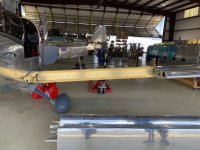
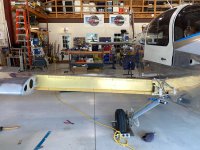
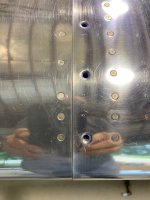
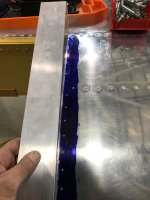
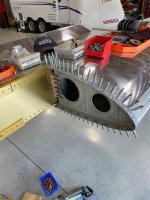
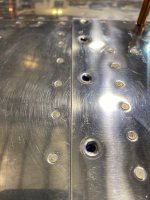
I've done one start to finish and assisted on one other. My brain is a little fuzzy but I don't remember having to blind buck any rivets. With the tanks off, all the modifications are done on the open wing. I did have capable assistance bucking all the doubler rivets. The most time consuming part for me was easing up to the scribe line and trial fitting the tanks to get the skin gap as close to perfect as possible. I probably had the tanks on and off 3 or 4 times.

EDIT: - Yes you do have to blind buck the AN470 rivets that attach the wing nose ribs to the spar web. Forgot about that until I looked at the pictures. Get a helper if you can. The “doublers” that attach to the spar caps are easily riveted.
 

Attachments

  • Results for- airplane - 1 of 1.jpeg
    Results for- airplane - 1 of 1.jpeg
    1.8 MB · Views: 112
  • Results for- airplane - 1 of 1 (1).jpeg
    Results for- airplane - 1 of 1 (1).jpeg
    1.9 MB · Views: 115
  • Results for- April 2023 - 2 of 2.jpeg
    Results for- April 2023 - 2 of 2.jpeg
    2.3 MB · Views: 98
  • Results for- April 2023 - 1 of 1.jpeg
    Results for- April 2023 - 1 of 1.jpeg
    1.6 MB · Views: 104
  • Results for- April 2023 - 1 of 1 (1).jpeg
    Results for- April 2023 - 1 of 1 (1).jpeg
    1.9 MB · Views: 93
  • Results for- April 2023 - 1 of 2.jpeg
    Results for- April 2023 - 1 of 2.jpeg
    1.9 MB · Views: 116
Last edited:
This will probably launch a never ending debate, but after discussing the "big" rudder events and these tank modifications with Rian, I think it's worth mentioning -- at least bringing to your attention the issue and suggested remediation.

Extended Tank Caution

After discussing these tank modifications with the engineer that designed the wing for the RV-10, performed ground vibration testing on the wing, designed the extended range tanks being discussed here AND published a thorough engineering report on this entire subject - I suggest if you haven’t seen said report, you should ask Ken for it. Then compare this report to the Van’s publication shown above and compare the “data”. I also suggest you read the posts in this thread and also here.

Many of us suspect what this Service Notice and the prior “not selling wing ribs unless you sign a waiver form” was really all about.
 
After discussing these tank modifications with the engineer that designed the wing for the RV-10, performed ground vibration testing on the wing, designed the extended range tanks being discussed here AND published a thorough engineering report on this entire subject - I suggest if you haven’t seen said report, you should ask Ken for it. Then compare this report to the Van’s publication shown above and compare the “data”. I also suggest you read the posts in this thread and also here.

Many of us suspect what this Service Notice and the prior “not selling wing ribs unless you sign a waiver form” was really all about.

Not debating right or wrong here or the causes behind the service letter or how many lawyers can dance on the head of a pin, but I couldn't help but notice this sentence from Ken's report (and the data) .

3. The torsional frequency with "standard" (30-gallon capacity) fuel tanks full is 36.3 Hz whereas with zero fuel, the torsional frequency is 39 Hz, a reduction of 2.7 Hz.

(ed - should read "difference" not reduction.)

Makes me wonder what the frequency is with ER tanks, full and empty -- that bit seems to be missing from Ken's report...
 
Apologies to the OP for the thread hijack.

It’s probably painfully obvious by now that the subject of the waiver form and Service Notice has touched a nerve with me (and others that are fans of Ken Krueger).

It has been mentioned multiple times in other threads, but consider this. Hotel Whiskey ER tanks have been produced and installed for decades (since 2002) for RV’s starting with the RV-4. Jesse Saint and Aero Centro (Brazil) have been installing full span tanks (120 gallon) on the RV-10 for years. Nary a peep from Van’s regarding any of these tanks.

Fast forward a few years and Ken Krueger designs an elegant solution for the RV-10 and 14 and now the wings are going to flutter off or the plane will spin into the ground. Absolutely no engineering justification for Van’s position. A single number of Vne reduction for all ER tanks on two different airframes with different structures and absolutely nothing for all the other airframes with HW tanks located at the very tip of the wing.

Let’s call this for what it really is.

Rant over.
 
Crikey I can’t believe that SB keeps coming up….it’s motivation is painfully obvious and tbh I feel a blight on the otherwise excellent reputation of a 50yo company that has unfortunately undergone significant change. Anyway…

Answering the OPs question I also got a helper to buck those rib to spar rivets. The rest of the install I managed solo with no notable difficulties.

I had no significant issues with the rear spar brackets. A trick I found useful was to get two awls or filed down screwdrivers to align two of the 3 bolt holes. Then the 3rd should thread easily. Remove one awl. Thread second bolt. Remove second awl, install third bolt. Then tighten them all.
I found a 90degree electric wrench useful on most of them where access allowed.

There’s another thread here somewhere on tank bolts with other suggestions too.

Good luck!
 
Not debating right or wrong here or the causes behind the service letter or how many lawyers can dance on the head of a pin, but I couldn't help but notice this sentence from Ken's report (and the data) .

3. The torsional frequency with "standard" (30-gallon capacity) fuel tanks full is 36.3 Hz whereas with zero fuel, the torsional frequency is 39 Hz, a reduction of 2.7 Hz.

(ed - should read "difference" not reduction.)

Makes me wonder what the frequency is with ER tanks, full and empty -- that bit seems to be missing from Ken's report...
I reached out to Ken and he responded as shown in the bottom paragraph.

Ken also mentioned that Revision 1 of his document "RV-10 and RV-14ER Fuel Tank Flutter Avoidance Study" references NACA TN-1594 - "Experimental Investigation of the Effects of Concentrated Weights on Flutter Characteristics of a Straight Cantilever Wing" . Ken's analysis referenced this study.

Hi Krea,
Torsional frequency is, in and of itself, not horribly meaningful as a predictor of flutter speed. The relevance of torsional frequency is how close it is to the bending frequency or the frequency of control surface rotation (ref: Intro to Airplane Flutter (IAF), slide 39). For a wing, torsional frequency is typically higher than bending or aileron rotation so when we have a reduction in torsional frequency or an increase in bending frequency, there can be a concern (ref: IAF, slides 40 thru 43).
 
This will probably launch a never ending debate, but after discussing the "big" rudder events and these tank modifications with Rian, I think it's worth mentioning -- at least bringing to your attention the issue and suggested remediation.
I would be 100% willing to throw caution to the wind for 5+ gallons a side integrated into the main tanks on my 8A (~1 rib, I think).
 
Thanks for all the feedback. I have the HW tanks currently installed. While they have been working for 10 plus years just fine, they are just not as elegant a solution due to the transfer pump etc. plus I really wanted the 10 extra gallons for those long xcountry trips I. Also spoke with Ken at length and have no qualms in installing them
 
I reached out to Ken and he responded as shown in the bottom paragraph.

Hi Krea,
Torsional frequency is, in and of itself, not horribly meaningful as a predictor of flutter speed. The relevance of torsional frequency is how close it is to the bending frequency or the frequency of control surface rotation (ref: Intro to Airplane Flutter (IAF), slide 39). For a wing, torsional frequency is typically higher than bending or aileron rotation so when we have a reduction in torsional frequency or an increase in bending frequency, there can be a concern (ref: IAF, slides 40 thru 43).
Interesting. Ken appears to be referencing my flutter primer, “An Introduction to Airplane Flutter.”

 
Last edited:
90h to build the tanks, 50h to modify the wings and install for me.

 
Back
Top