


Van's Air Force

The definitive Van's Aircraft support community! Buying, building or flying an RV? Join our exclusive family of mentors and enthusiasts!

Question for the Vertical Power PPS Experts

Dad's RV-10

Well Known Member
Sponsor
My RV-10 has a PPS, a VP-X and dual P-Mags. The P-Mags are not powered through the VP-X. They have dedicated circuit breakers. The feed for those CB's is piggy-backed to the Battery + lug on the PPS (lower left lug of PPS).

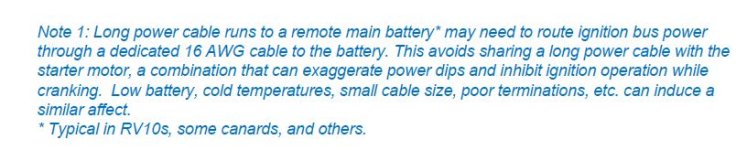
Wired as it is, unless the P-Mag breakers are pulled, the P-Mags remain powered when the master is Off. There is a note in the P-Mag manual which suggests wiring a dedicated 16 AWG lead to the battery (in the RV-10) to prevent power dips which could inhibit ignition operation while cranking. The way I have mine wired isn't exactly the same as what's suggested in the P-Mag manual but what is the same is that the P-Mags remain powered at all times, unless the breakers are pulled.

I'm contemplating simply moving the P-Mag CB power lead from the PPS' Battery + lug to the Main Bus Out lug (top right). Doing so would remove power from the P-Mags when the master switch is Off.

Does anyone see a problem with this? I just wonder if the voltage on the PPS Main Bus Out lug is the same as the voltage on the Battery + lug while the starter is engaged? If the voltage is lower on the Main Bus Out lug than the Battery + lug, then I suppose this could introduce the scenario described in the P-Mag note.

I haven't as of yet attempted to record voltage readings from the two lugs while the starter is engaged. I figured I'd ask here first. I would have emailed Chad at Astronics, but that ship has sailed.
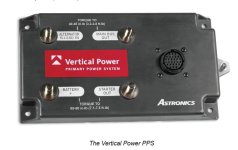
PPS.jpg

P-Mag Battery Power.jpg
 
I have mine in the buss side out of the pps, but I’m still building. So can’t comment on starting voltage.
 
On my -7 with the same setup as you, I have mine powered from two circuits on the VPX. No issues starting so far
 
I think a potential issue with wiring ignition of any sort through the switched side of VPX power is IF you ever had to shutoff the VPX in flight due to an emergency you might lose your engine. A friend was flying IFR and he suddenly saw smoke billowing from under his instrument panel. He immediately shutoff the master switch. He lost his radio and nav instruments but the smoke cleared, he had a vacuum pump driven instrument panel, magnetos, and a handheld radio. That occurred about 20 plus years ago. Think about the same scenario. If you shut off the VPX due to billowing smoke if your ignition was wired directly to the battery you would still have engine power. If your ignition was wired through the VPX switched power your engine might quit. I don't know how a P Mag would react with power removed in flight in this scenario. I know it is self powered above 700-800 rpm. There is a reason the manual suggests wiring the power to the battery.
 
Last edited:
I think a potential issue with wiring ignition of any sort through the switched side of VPX power is IF you ever had to shutoff the VPX in flight due to an emergency you would lose your engine. A friend was flying IFR and he suddenly saw smoke billowing from under his instrument panel. He immediately shutoff the master switch. He lost hosxradio and nav instruments but he had a vacuum pump driven instrument panel and a handheld radio. That occured about 20 plus years ago. Think about the same scenario. If you shut off the VPX due to billowing smoke if your ignition was wired directly to the battery you wouod still have engine power. If your ifnition was wired through the VPX switched power your engine would quit.

My ignition is not powered through the VP-X.

They are P-Mags. They are self exciting when operating above the minimum RPM threshold. They will function with the master switch Off in flight.
 
Last edited:
Correct me if I'm wrong but if you connect P-Mags to the power stud on the VPX and that power stud is also connected to the battery positive, it doesn't matter what the status of the VPX is. The P-Mags will still have power. Right???

EDIT - this is wrong unless you wired the VPX straight from the battery which I don't think anybody would do. Power would either go through a Master relay or PPS with both presumably controlled by a master switch.
 
Last edited:
Correct me if I'm wrong but if you connect P-Mags to the power stud on the VPX and that power stud is also connected to the battery positive, it doesn't matter what the status of the VPX is. The P-Mags will still have power. Right???

If you're asking about my specific setup, the Power lug on the VP-X is not connected hot to the battery. It's connected to the Main Bus Out lug on the PPS.

The Main Bus Out lug is not hot unless the master in On.
 
The power side of the PPS is a protected circuit from my understanding, so no straight connection to the battery unless on and working.

FYI I did put my MZ-30 on the buss side out, after talking with Bill, so that I have a backup power source in the scenario of the PPS having an issue, but that's not an issue with the pmags being self powered above critical rpm.
 
Correct me if I'm wrong but if you connect P-Mags to the power stud on the VPX and that power stud is also connected to the battery positive, it doesn't matter what the status of the VPX is. The P-Mags will still have power. Right???
No, the power stud on the VPX is connected to the output of the Master relay. If the Master gets switched off, power to the VPX (and the P-mags if wired to the stud) would be disrupted.
 
No, the power stud on the VPX is connected to the output of the Master relay. If the Master gets switched off, power to the VPX (and the P-mags if wired to the stud) would be disrupted.
Yeah, I'm using a PPS so I hadn't thought about the Master relay that non-PPS folks use. Thanks for clarifying that!
 
To answer OPs concerns: moving the ignitions from CBs directly attached to the batter behind the PPS sounds perfectly reasonable to me, all the concerns about power loss during flight are not really applicable to PMAGs
 
To answer OPs concerns: moving the ignitions from CBs directly attached to the batter behind the PPS sounds perfectly reasonable to me, all the concerns about power loss during flight are not really applicable to PMAGs

I'm not quite following what you've written? I'm not concerned about in-flight power loss issues with the P-Mags.

I'm questioning starting voltage. If you put much credence in the voltage-drop note in the P-Mag manual, I'm already at somewhat of a disadvantage by powering the P-Mag CB's at the firewall end of the cable that's routed to the rear mounted battery.

In contemplating moving the P-Mag power source to the Main Bus Out lug, I'm wondering if the voltage on the Main Bus Out lug could possibly be lower than the voltage on the Battery + lug during engine cranking, thereby potentially introducing the engine start voltage drop issue described in the P-Mag manual note.
 
Yeah, I'm using a PPS so I hadn't thought about the Master relay that non-PPS folks use. Thanks for clarifying that!
But the PPS is essentially a solid state master relay. I don't think the VPX would be connected to the battery + side. Wouldn't it be connected to the Main Bus Out side?
 
I'm not quite following what you've written? I'm not concerned about in-flight power loss issues with the P-Mags.

I'm questioning starting voltage. If you put much credence in the voltage-drop note in the P-Mag manual, I'm already at somewhat of a disadvantage by powering the P-Mag CB's at the firewall end of the cable that's routed to the rear mounted battery.

In contemplating moving the P-Mag power source to the Main Bus Out lug, I'm wondering if the voltage on the Main Bus Out lug could possibly be lower than the voltage on the Battery + lug during engine cranking, thereby potentially introducing the engine start voltage drop issue described in the P-Mag manual note.

The voltage drop at the PPS battery lug is only going to be subjected to an additional voltage drop across the wire to that, but any additional losses due to the PPS if you switch to the main out lug is probably minimal. In other words, if the battery+ is 12v, maybe the PPS battery lug is 11V (1V loss due to long wire run) but any additional losses at the main out lug might be 10.9V? But not a whole lot more than on the PPS bat lug.

The voltage drop due to the wire distance can be calculated based on the length.

The PMAGs can operate off of a 9v battery in an emergency, so they don’t need much voltage.
 
Last edited:
Back
Top
