Van's Air Force

The definitive Van's Aircraft support community! Buying, building or flying an RV? Join our exclusive family of mentors and enthusiasts!

Backfiring at low power setting

Bsquared

Well Known Member
Patron
RV-14A standard 390 with 300 hrs. For my stabilized approach below 80kts I typically set my rpm at 1800 (controlled by throttle because prop is in fine pitch). If I am a high on the approach and I reduce the throttle even just a little bit I get some significant popping out of the exhaust. It seems to be doing it more often as the engine ages. Is this a concern?
 
RV-14A standard 390 with 300 hrs. For my stabilized approach below 80kts I typically set my rpm at 1800 (controlled by throttle because prop is in fine pitch). If I am a high on the approach and I reduce the throttle even just a little bit I get some significant popping out of the exhaust. It seems to be doing it more often as the engine ages. Is this a concern?
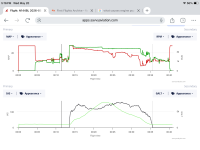
Any engine monitor data to share? Plot would be nice.
 
Engine data with CHT and EGT? With a focus on the couple of minutes on final approach where the popping is happening, and a minute or so prior to that.
 
Check idle mixture, prob too lean.
+1

If it happens when pulling back to idle, it is most likely the idle mixture set too rich or too lean. Looks like you are getting down to around 10” of map and that implies low likelihood of an intake leak.
 
To clarify, I presume by your statement:
If I am a high on the approach and I reduce the throttle even just a little bit I get some significant popping out of the exhaust.
you mean the popping isn't just immediately after the throttle reduction then discontinues, but in fact the popping continues so long as you leave the throttle closed in descent? If it continues, that is the same as I have experienced.

I had a carb'd x-340 with an electric MT prop. Now I have an injected io-360 with hydraulic Hartzell prop. Both do it. With the electric prop I could make it come or go by the blade pitch. If I left the blades pitched out like in cruise I would not get the popping. As soon as I pitched the blades close to takeoff pitch I would get the popping very reliably repeated.

I believe that popping is not "backfiring" but in fact is afterfiring from the prop driving the motor causing unburned fuel to enter the exhaust. The only way I have found to mitigate it with the hydraulic Hartzell prop is to plan descents further out with a little power in on descent.
 
Engine data with CHT and EGT? With a focus on the couple of minutes on final approach where the popping is happening, and a minute or so prior to that.
You can post the entire .CSV in a zip file so all parameters (fuel flow, mp., etc.) would be seen.
 
RV-14A standard 390 with 300 hrs. For my stabilized approach below 80kts I typically set my rpm at 1800 (controlled by throttle because prop is in fine pitch). If I am a high on the approach and I reduce the throttle even just a little bit I get some significant popping out of the exhaust. It seems to be doing it more often as the engine ages. Is this a concern?

Not a concern, but it can be concerning ;)

I only get popping when, like Steve, I pull power so the prop is acting as a brake. The fix brings to mind the old joke...

Patient: "Doctor, it hurts when I do this."

Doctor: "Ok, don't do that."

Try lower and slower, sooner. Vso is 51 KIAS, yes? 1.3 is 66. Fly a few at 70 knots max.
 
Pl pl
To clarify, I presume by your statement:

you mean the popping isn't just immediately after the throttle reduction then discontinues, but in fact the popping continues so long as you leave the throttle closed in descent? If it continues, that is the same as I have experienced.

I had a carb'd x-340 with an electric MT prop. Now I have an injected io-360 with hydraulic Hartzell prop. Both do it. With the electric prop I could make it come or go by the blade pitch. If I left the blades pitched out like in cruise I would not get the popping. As soon as I pitched the blades close to takeoff pitch I would get the popping very reliably repeated.

I believe that popping is not "backfiring" but in fact is afterfiring from the prop driving the motor causing unburned fuel to enter the exhaust. The only way I have found to mitigate it with the hydraulic Hartzell prop is to plan descents further out with a little power in on descent.

RV-14A standard 390 with 300 hrs. For my stabilized approach below 80kts I typically set my rpm at 1800 (controlled by throttle because prop is in fine pitch). If I am a high on the approach and I reduce the throttle even just a little bit I get some significant popping out of the exhaust. It seems to be doing it more often as the engine ages. Is this a concern?

RV-14A standard 390 with 300 hrs. For my stabilized approach below 80kts I typically set my rpm at 1800 (controlled by throttle because prop is in fine pitch). If I am a high on the approach and I reduce the throttle even just a little bit I get some significant popping out of the exhaust. It seems to be doing it more often as the engine ages. Is this a concern?
I am the OP. Thanks for all the input. I will try to manage my descents to avoid having to change power settings. My problem is that I am based an airport with lots of student traffic. When I am alone in the pattern and I fly my normal stabilized approach I almost never have an issue. Most of the time there are 6 or more in the pattern and tower is calling base and asking for speed changes.
 
I am the OP. Thanks for all the input. I will try to manage my descents to avoid having to change power settings. My problem is that I am based an airport with lots of student traffic. When I am alone in the pattern and I fly my normal stabilized approach I almost never have an issue. Most of the time there are 6 or more in the pattern and tower is calling base and asking for speed changes.
As mentioned, this is not really hurting anything, so don't get yourself in a bad situation by avoiding it.
 
I only get popping when, like Steve, I pull power so the prop is acting as a brake. The fix brings to mind the old joke...
This is interesting, as it is not universal. Has never happened on my 10 with the 540 and hartzel and always go full fine once in the pattern. I am experiencing it on a 360 where we are still tweaking the SDS fuel map, so expected. Wondering how much variability there is in the servos metering.
 
I know of one accident / fatality from that after fire. Guy had a fuel leak and was RTB (returning to base) and when he pulled the power back the after fire ignited the raw fuel. Best to try to find and correct the problem and besides, makes you sound like a dweeb. 😉😅
 
Clean your sniffle valve and make sure it is not leaking when seated. Fuel can gum it up so you get a vacuum leak.
 
This is interesting, as it is not universal. Has never happened on my 10 with the 540 and hartzel and always go full fine once in the pattern. I am experiencing it on a 360 where we are still tweaking the SDS fuel map, so expected. Wondering how much variability there is in the servos metering.

It is interesting. The 540 has an RSA-5 sized servo?

Remember, I'm an early 390 adopter with an FM 200, much like the current 390-119 owners, as there was no FM-150 back then. I adjust idle mixture and RPM with a low idle RPM foremost, for the practical benefit in short field ops, and don't pay much attention to its effect on popping. I doubt FM-200's on a 4-cyl can be made to idle quite as nice as a smaller servo, the classic "big carb" problem of our youth. It will never match PWM port injection, a matter of temperature compensation and nozzle pressure. Ever seen the old Lycoming film of constant flow nozzle delivery inside an intake port? It's a series of blobs.

As you know, a lot of current street vehicles cut injector flow to zero on the overrun, and resume delivery at normal idle. Might be interesting to try it as a setting for the SDS.

 
As you know, a lot of current street vehicles cut injector flow to zero on the overrun, and resume delivery at normal idle. Might be interesting to try it as a setting for the SDS.

I used to drive a 1968 VW Karmann Ghia and it originally had a vacuum servo attached to the carburetor throttle arm designed to effectively limit the throttle closure at high RPM's based on manifold pressure in an effort to reduce un-burned hydrocarbon and CO emissions...

Skylor
 
Last edited:
Apparently some of the tuner kiddies are adding fuel to the otherwise zero delivery period so their cars will pop and crackle on the over run, just like the turbo racecars.

Hey, in our day it was glasspacks, right? There was this one cop in Herndon VA who didn't much like my raspy Datsun pickup...
 
It is interesting. The 540 has an RSA-5 sized servo?

Remember, I'm an early 390 adopter with an FM 200, much like the current 390-119 owners, as there was no FM-150 back then. I adjust idle mixture and RPM with a low idle RPM foremost, for the practical benefit in short field ops, and don't pay much attention to its effect on popping. I doubt FM-200's on a 4-cyl can be made to idle quite as nice as a smaller servo, the classic "big carb" problem of our youth. It will never match PWM port injection, a matter of temperature compensation and nozzle pressure. Ever seen the old Lycoming film of constant flow nozzle delivery inside an intake port? It's a series of blobs.

As you know, a lot of current street vehicles cut injector flow to zero on the overrun, and resume delivery at normal idle. Might be interesting to try it as a setting for the SDS.

Yes, the 540 had a 5 sized servo, so maybe these are a bit fat on the 360’s and the afterfires are from excessive richness on the throttle down. Decel fuel cut is an interesting idea for the sds. I have been steadily decreasing map fuel in the lower areas and seen improvements. Just haven’t gotten to zero popping yet.
 
Apparently some of the tuner kiddies are adding fuel to the otherwise zero delivery period so their cars will pop and crackle on the over run, just like the turbo racecars.

Hey, in our day it was glasspacks, right? There was this one cop in Herndon VA who didn't much like my raspy Datsun pickup...
My 1987 Suzuki Samurai does that. When I deaccelerate it makes a popping rumble.
 
... Decel fuel cut is an interesting idea for the sds. I have been steadily decreasing map fuel in the lower areas and seen improvements. Just haven’t gotten to zero popping yet.
Every airplane I've owned will pop on downwind. Including the Rocket with a factory new Lycoming. Once I went to SDS I turned on the fuel cut feature and now no more popping. Yes, the engine is in essence "quit" (just like millions of EFI cars), but it responds to throttle without a stumble.
 
Every airplane I've owned will pop on downwind. Including the Rocket with a factory new Lycoming. Once I went to SDS I turned on the fuel cut feature and now no more popping. Yes, the engine is in essence "quit" (just like millions of EFI cars), but it responds to throttle without a stumble.
That’s interesting. Never happened on my 540, but only 400 hours so far. Never happened on my 6 either with a 320 FI at 1600 hours, but that is FP. Wonder what is different on mine. I do run a leaner idle mixture than most.

Didn’t realize there was a decell fuel cut option on the sds. Will definitely implement that on the 7.
 
I've found, that many times, a blown exhaust gasket, a cracked exhaust or a leaking joint will cause popping when the throttle is closed. Some exhaust systems, by design, are more prone to popping when the throttle is pulled back on down wind. The Pitts S2B comes to mind, they always start popping base to final...
 
Back
Top